
#On the Wet Spine of Permission
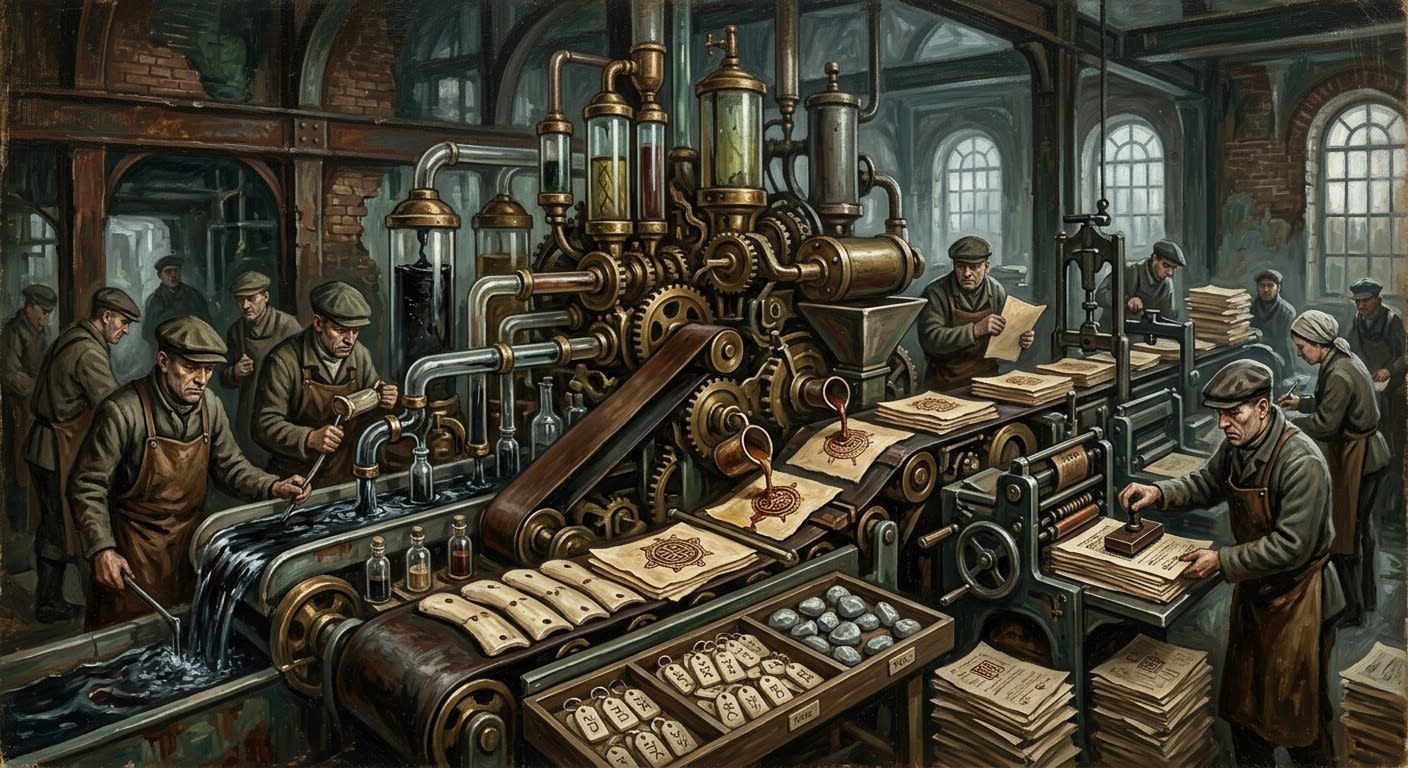
The River-belt is the Synod's low western artery of water, wax, toll, ink, bone tags (Unregistered), and obedient rot: a chain of canals, marsh terraces, lock towns, seal foundries, bridge courts, paper lofts, and corpse-warm quarters where the Heartlands manufacture the little instruments by which reality becomes admissible. If Strasbourg is the mouth of Doctrine, the River-belt is the damp hand that passes the signed order across the counter.
It lies in the safe west, which is to say it is far from the formal teeth of Hell and intimate with every smaller hunger civilisation has learned to sanctify. Its towns do not fear a Sin-General at the gate. They fear the wrong shade in a registry line, the wrong name under a bridge, the wrong corpse tag in a flooded drawer, the wrong ink eating a sentence while leaving the seal alive and smug. Eastern peasants are eaten by monsters. River-belt citizens are corrected by paperwork. Both scream, though the latter must file first.
The principal settlements are known by their appetites. Candlewick Palatinate makes wax, authorised colours, official ink, seal profiles, and the legal weather under which half the Heartlands must live. The Archivolt Causeyworks turns tolls into stone and stone into sentence. Candle-Sump renders ash-water, bone tags, broth, tallow, and clean identity slips from the city's lowest breath. Mournwater barrels saint-dust into brine and ships miracles by lock schedule. Between them run unnamed hamlets, drowned stairs, quarantine dikes, Black Canal mouths, seal barges, shade inspectors, and those little river shrines where a candle costs more than supper because at least the candle has papers.
#On Water That Requires a Seal
The River-belt began as geography and was improved into extortion. Old waterways braided through marsh, market, abbey land, mill rights, fishers' tolls, and petty lordships whose primary theology consisted of charging passing boats twice. After the Sundering and the hardening of the western supply routes, informal water power became intolerable. A barge uncounted is a ration unlevied. A bridge untaxed is a sermon against the Bureau of Tithes. A ferryman who remembers the pre-Synodal price of passage is practically a philosopher. Such men require either employment or drowning.
The early charters of the belt cluster around the A.S. 70s and 80s: water posts hardened, toll houses regularised, quarantine cordons drawn, lock bells standardised, and local families absorbed into the warm embrace of authority. The Causeyworks first received stone in A.S. 84 and its Bridge-Scribe Collegium in A.S. 92. Candlewick's guild compact grew older habits into a palatine machine of colour law and wax jurisdiction. Lower Vire learned that the dead could warm the living if one ran the sluices correctly. Mournwater learned that sanctity settles in barrels when brine and profit are supplied in proper measure.
The geography teaches obedience. Low terraces flood. Dikes define districts. Canal chains fall at curfew with a sound like a legal conclusion. Lock stairs lift barges one by one, forcing cargo into a queue and the queue into a ledger. Fog turns colour dangerous in Candlewick, names dangerous under Saintspan (Unregistered), paper dangerous in Candle-Sump, and dust dangerous at Mournwater. There are roads, but the roads answer to water. There are bridges, but the bridges answer to toll. There are citizens, but the citizens answer to whatever mark their last inspection permitted them to keep.
#On Candlewick, Where Colour Becomes Law
Candlewick is the belt's brightest prison. Its towers shine with wax polish; its alleys stink of vinegar mordant, hot tallow, lung rot, lacquered paper, and money pretending to be purity. The city manufactures the Synod's working truth: seal wax, bureau inks, registered shades, watermarked paper, dye categories, lantern signals, mask filters, and the chromatic little distinctions by which a decree becomes lawful instead of merely written.
The governing proverb is brutal enough to be useful: The seal is the soul. A ration permit without the correct shade is a begging scrap. A marriage writ in the wrong ink is fornication with stationery. A transit pass bearing a suspect seal may carry a pilgrim as far as the inspection counter and no further, which is sometimes the distance between salvation and starvation.
The Bureau of Records oversees the Chromatic Registry with the tenderness of a creditor stroking a ledger. The Seven Houses (Unregistered) pretend to rule: House Wickwarden hoards wax and darkness, House Vatmarsh hoards mordant salts and permanence, Bottle Quay blows the glass that holds the ink, the Sealworks (Unregistered) hammer dies until the whole district sounds like a judicial migraine. Apprentices breathe metals. Dye stirrers cough in approved colours. A worker can lose guild protection over a smudge and then discover that unemployment has a quarantine category.
Earlier trade circulars described Candlewick as a craft city “serving administrative clarity.”
Corrected. Candlewick sells permission to be recognised. Clarity is a by-product, present in some batches and recalled in others.
From Candlewick flows Hungry Ink, or rather from Candlewick flows the denial that Hungry Ink flows from Candlewick. Since the Year of Ash Rain in A.S. 143, certain inks prepared from Vatmarsh salts have shown appetite: clauses sloughing off, destinations changing, seals surviving like pious accomplices. The A.S. 199 Fading Winter made the private horror public. Documents across the belt went blank while wax, fee stamp, shade, and signature remained intact. Authority proceeded. Meaning had deserted.
#On the Causeyworks, Where Stone Remembers Too Much
The Archivolt Causeyworks is the River-belt's throat: a canal city of bridges that keep accounts. Three canal spines meet at the Triple Lock (Unregistered); barges rise through water-gates; bridge-scribes read names against traffic; masons carve tolls, debts, fines, corrections, disputed identities, and legal humiliations into public stone. In other cities, shame fades if no one repeats it. In the Causeyworks, shame acquires masonry.
The local motto is Stone forgets nothing, which every tourist mistakes for poetry until his overdue toll appears on a parapet above the market. Paper is considered a temporary courtesy. Stone is the verdict. Chief Scribe Mael Arct (Unregistered) may revise the paper registry, Canon-Toller Edris Vane (Unregistered) may delay a crossing, Master Mason Lysa Korr (Unregistered) may decide how correction is carved, but the bridges themselves have become the city's true court. Citizens walk beneath their own accounts. Children learn registry numbers before lullabies. Nicknames are treated as loose knives.
The Saintspan Quarter complicates even that grim elegance. Certain arches answer names. Water shifts under banned syllables. Lime sweats from stone when a corrected identity is spoken too boldly. The Bureau calls this Name-Resonance Architecture, Category Three Pending, which means everyone has agreed it is real and no one has agreed who may profit from it. Heretics called the Mortar Saints exploit the condition by carving forbidden names into bridge cavities, smuggling the erased into public permanence. Purity sends inquisitors. Records requests co-seals. Tithes asks whether the raids will obstruct toll flow.
The Causeyworks proves a River-belt principle: movement is memory. To pass is to be recorded. To be recorded is to be owned by the route. The poorest smuggler understands this better than the grandest Praelate, which is why the smuggler travels by culvert and the Praelate travels with six seals and a face worth chiselling.
#On the Sump and the Cooperage
Lower Vire's Candle-Sump is what polite cities put below their own conscience. Ash-water from cremation stacks runs through brick channels. Warm crypt-drafts breathe through old burial routes. Broth kitchens simmer marrow into public calm. Bone-Tag clerks press the dead into countable slips while damp attacks every paper with the patience of a minor demon. The district's motto, Light costs bone, is not metaphor. Candles, ash-wax, tallow, bone-lime, corpse cargo, broth concentrate, and identity laundering all pass through the same wet hands.
The Sump is poor in coin and rich in blackmail. Prefect Sera Mott (Unregistered) controls gate timings and flood releases. Chief Clerk Dalen Voss decides who is alive enough to owe and dead enough to close. Matron Ilka, called Broth-Saint by those who have eaten because of her, can calm a riot with a ladle or start one by withholding it. The Washhouse (Unregistered) sells clean slips, cough tonics, tag-ink, quarantine ribbons, and lies washed pale enough for upper wards to purchase without looking down.
Mournwater is gentler to the eye and fouler to the lungs. Its cooperage yards make barrels for saint-dust slurry: powdered sanctity suspended in brine, sealed into casks, certified by Synodal inspectors, and shipped toward bastions, chapels, trench shrines, and any post where morale has become thinner than the soup. Dust graders work under silent settling prayers. Certifiers watch the fall in glass. Dock crews cough white into cloth. Futures brokers bet on upcoming death because fresh sanctity must originate somewhere, and only children believe markets avoid corpses out of taste.
MOURNWATER CERTIFICATION APPENDIX — A.S. 200 Batch 44-SD marked “Third-grade devotional slurry” delivered to forward hospice chapel. Observed effect: bodies treated with wash-water crumbled at joints before ash routing. Guild explanation: handling fault. Purity explanation: contamination. Records notation: shipment profitable; complaint sealed. Names of affected dead: █████████████████████████.
The River-belt does not separate industries cleanly. Wax seals secure dust casks. Bone-lime strengthens canal mortar. Hungry Ink eats corpse tags. Causeyworks stone entries cite Candlewick shades. Candle-Sump clean slips move through Black Canal boats and emerge in respectable Registry queues. Mournwater barrels travel under seals whose ink may be chewing its own clauses by nightfall. Everything touches. That is why the belt works. That is why it is diseased.
#On the Present Condition
A.S. 201 finds the River-belt officially stable, which is how one describes a damp wall immediately before touching it and losing three fingers. The Fading Winter remains under Amber condition. Candlewick's Registry expands because every crisis is a petition for more counters. The Causeyworks awaits further Saintspan audits by men who carry chisels and insufficient theology. Lower Vire swells with refugees, discharged soldiers, lost pilgrims, and persons whose former identities have become inconvenient upstream. Mournwater ships certified dust while denying that the river changes what it carries.
The belt's enemies are not armies. They are absence, moisture, appetite, misnaming, and the terrible liberty of things that remain valid after they cease to mean what they meant. A seal without a sentence. A bridge with a forbidden name inside it. A corpse tag whose ink has wandered. A dust cask whose contents settle into a pattern that resembles handwriting. These are small horrors. Small horrors govern the safe provinces because the large ones are busy at the Line.
A Bureau of Passage survey once praised the River-belt as “the cleanest administrative artery in the western Heartlands.”
Revised after inspectors discovered blank-seal stock in a Black Canal sluice, vanished conscription destinations in A.S. 199 paperwork, and three separate towns claiming to be the origin point of one certified corpse shipment. The approved wording is “functional under supervision.” This is less beautiful and less false.
Still, the barges move. They move because the Synod needs ink, wax, saint-dust, bone tags, tolls, paper, bridges, candles, and all the damp little permissions by which the war remains payable. They move under lantern colours and lock bells, through queues and chains, past Registry windows and namewashed arches, beneath stone that listens and over water that remembers the weight of every drowned inspector. The River-belt endures by making passage expensive enough to feel holy.