
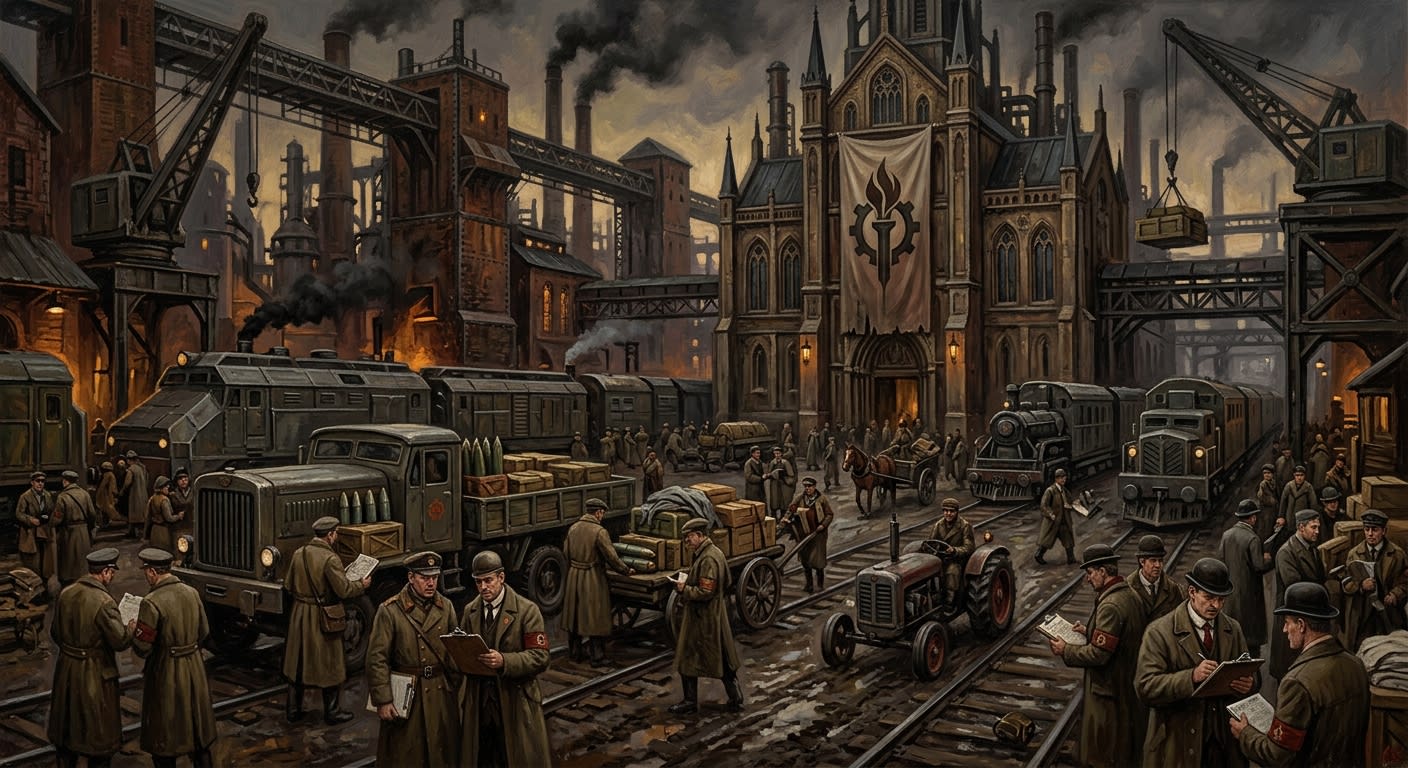
#On the Safe Province That Mistook Distance for Innocence
Zone 1 is the Western Heartlands: Atlantic seaboard, French river-belt, Low Country warehouses, deep safe cities, pilgrimage roads, candle quarters, salt courts, ash quays, and all the polished civil machinery by which the Synod pretends the war is elsewhere. It is called safe because the Sagittal Line stands far to the east, because no Sin-General presently camps outside its gates, because its children do not wake to artillery, and because citizens with full stomachs love any word that excuses appetite.
Safe is a military term, never a moral one.
Zone 1 includes Lyon on the Rhône, Candle-Sump in Lower Vire, the Vire River-Belt Interchange, Marseille, Paris, Rouen, Metz, Bruges, Ghent, Antwerp, Brittany, Saint-Malo, and a thousand smaller places whose names appear in ledgers as sources of wax, grain, paper, boys, daughters, rope, ferry fees, confession slips, and taxably pious grief. It is the rear of the war, which means it is where the war learns to eat cleanly.
The Bureau of War calls Zone 1 the deep reserve. The Bureau of Tithes calls it the reliable base. The Bureau of Pilgrimage calls it the road garden. The Bureau of Records calls it legible. I call it a velvet glove soaked through at the seams.
#On the Western Edge and the Fiction of Clean Hands
The westward map flatters Zone 1. Spain (Unregistered), France, the coastal Low Countries, river roads, Channel ports, Atlantic storehouses: all shaded in the calm colour cartographers reserve for territory that pays on time. The line of hellfire lies east. The dead cities lie east. The Charnel Lands lie east. Even fear, properly routed, is supposed to travel east by rail.
In practice, Zone 1 is the Synod’s left hand: counting, feeding, laundering, knotting, carrying, sealing, burying, and blessing whatever the right hand has broken. Marseille loads ships for the southern corridors. Calais reads names into fog. Candlewick supplies sanctioned inks and watermarked paper. Lower Vire renders fat into light for wards that speak of purity while burning candles made from the accounting of death. Lyon sells scar and repentance in equal packets, both wrapped prettily.
The zone’s founding as a category hardened after the Sundering and the A.S. 65 fixation of the Sagittal Line, when retreat became refusal and the west had to be sorted by use. Zone 4 would hold. Zone 3 would stage. Zone 2 would manufacture and administer. Zone 1 would sustain, remember, perform, and pay. It was deep enough to avoid direct demonic occupation and close enough to be consumed by military appetite. A perfect distance. Bureaucracy loves a perfect distance. It lets responsibility arrive folded.
The great lie of Zone 1 is that distance purifies. The mills of Lyon, the quays of Marseille, the salt courts of Calais, the Vire lockhouses, the Candle-Sump vats, the pilgrim road stations, and the passage tribunals all know better. A shell fired at Bastion-Przemyśl begins as tax in Zone 1. A dead conscript begins as a parish signature in Zone 1. A candle burning before a trench relic begins as grease in a Zone 1 vat. Every holy object has a supply chain. Every supply chain has a ditch.
Elementary geography primers describe Zone 1 as “the peaceful western heart of Synodal life.”
Corrected. It is peaceful in the limited sense that the screams have been scheduled, muffled, redirected through committees, or converted into festival sound. The heart continues to beat. One should ask what it is pumping.
#On Cities That Wear Their Wounds Profitably
Zone 1 contains cities old enough to remember wickedness before the Synod gave wickedness uniforms. The Red Slaughter of Lyon occurred in –39 A.S., before the sacred calendar began its count from the Rationalist wound. Forty-three friars burned, four lay brothers shot, ashes cast into the Rhône, psalms rising from water for three nights. Lyon was not a frontier town then. It was civilized, local, municipal, self-satisfied. Native evil had keys to the stairs.
Lyon remains the zone’s perfect exhibit: rich, devout, supervised, musical, profitable, and theatrically dangerous. It has learned to process guilt into route fees. It sells ash bowls, whistle hymns, saint oil, festival tickets, and moral instruction to pilgrims whose purses are more open than their consciences. The Bureau of Festivals watches it the way a keeper watches a performing animal that has learned to count fingers.
Farther north and west, Saint-Malo bears the later wound that ignited the Atheist Wars in public memory. Brittany keeps blue-thread customs and stubborn local saints. Rouen keeps ash-blackened lessons. Paris keeps black-market absolution under Purity eyes. Calais, deep in safe territory and yet gnawed by undertide pressure, proves that no map can keep the strange at the shore. The sea does not respect zone colour.
Zone 1’s wounds are not hidden. They are curated. Plaques are polished. Routes are timed. Silence is metered. Ash is carried in clean bowls by citizens whose grandfathers would have hidden the bones under floorboards if Records had permitted more domestic architecture. This is the zone’s genius: it turns confession into civic infrastructure. The pilgrim sees remorse. The clerk sees traffic. The Treasury (Unregistered) sees both and smiles in columns.
#On Rivers, Quays, and the Wet Machinery of Obedience
A province may be judged by how it treats water. Zone 1 taxes it, blesses it, dams it, falsifies it, and orders it to carry paperwork.
At the Vire River-Belt Interchange, barges become manifests and trains acquire the smell of bilge. Cargo enters wet and leaves disputed. The Hook Cranes (Unregistered) lift coal, soap, food, paper, candle wax, salvage iron, bone-tagged dead, and bodies quiet enough to pass as freight. Lock Courts (Unregistered) convert water into fees with such sacramental precision that a barge may be charged for a passage before it reaches the lock. The river objects by flooding, rotting, misdirecting, and occasionally producing evidence with the wrong hand attached.
Candle-Sump lies lower still, the gut of Lower Vire, a drainage ditch that metastasised into a district of tallow, bone tags, marrow broth, rot-lung, crypt drafts, and clean slips. The wards above burn its candles and avert their eyes from the vats. Forty-two thousand registered souls live there by official count. Official counts in Candle-Sump are comedy performed by drowning men.
RIVER-BELT SANITATION ABSTRACT — LOWER VIRE, A.S. 199 Blue-burn candle reports increased near crypt mouths. Bone-tag duplications rose by seventeen percent. Three clean slips bore names predating the Concordat. One slip bore a name not yet born. Recommendation: ███████████████████████ Disposition: deferred under budget seal.
The river-belt sustains the rear by making filth useful. Ash-water becomes sanitation. Bone-fat becomes candle. Dead names become documents. Floodgates become political instruments. A Sluice Prefect (Unregistered) can drown a ward by clock. A Bone-Tag clerk (Unregistered) can kill a living man by paper. A broth matron can humble a prefect by withholding soup. This is Zone 1 governance in miniature: no demon horn, no flaming breach, no glorious charge, only a damp office in which someone decides whether your name remains attached to you.
#On Pilgrimage, Chains, and the Theatre of Motion
Pilgrimage in Zone 1 is piety, commerce, sentence, crowd control, and road maintenance performed in a single line. The Bureau of Pilgrimage calls routes sacred arteries. The Bureau of Passage calls them toll opportunities with incense. Families walk to wound-sites; merchants sell tokens; confessors harvest road-speech; magistrates clear prisons by declaring convicts suitable for visible correction.
The Pilgrim-Chain Handler belongs to this western machine. Jubilee years produce columns of chained “pilgrims” escorted along relic-sites, bell-towers, wound-markers, bridge chokepoints, and cathedral forecourts. The public sees sanctity in motion. The handler sees ankles swelling under iron, mercy units counted, water sold, ditch bodies filed, keys tied to wrists during demon hours. No step, no absolution. No ledger, no mercy. No audience, no point.
Zone 1 provides the roads on which punishment becomes scenery. Its villages host columns, feed guards, spit quietly, pray loudly, buy trinkets, hide runaways, betray neighbours, and return at Vespers to call the system holy because the alternative would require courage after supper. The chained body passing through a safe town instructs the citizen without endangering him. It says: the Synod can move suffering anywhere.
Pilgrimage circulars once described chain-columns as “voluntary penitential intensifications.”
Corrected. The voluntary portion belongs chiefly to spectators, vendors, and officials approving budgets from chairs. The chained have contributed movement, blood, and a touching lack of alternatives.
Here the western heartlands show their finest hypocrisy. They denounce frontier brutality, then applaud when brutality arrives with route tokens and hymn sheets. They shudder at trench punishments, then request better viewing barriers. They send sons east and buy souvenirs from men dragged west. Moral distance is Zone 1’s most abundant crop.
#On Administration Without Thunder
Zone 1 does not need fortress walls to display power. It has counters.
The zone is thick with offices: salt tribunals, passage windows, route desks, festival prefectures, toll courts, registries, mercy wards, candle compacts, shrine assessors, quarantine booths, archive porches, lock courts, municipal Purity annexes, and minor chapels whose true sacrament is queue discipline. The Atlantic cities provide ships and customs. The river cities provide transfer and paper. The old martyr towns provide memory. The industrial quarters provide candles, seals, ink, rope, soap, and the permanent smell of useful poverty.
The Bureaus love Zone 1 because it speaks their language. Its citizens know permits, fees, catechism schedules, ration windows, route clearances, ash receipts, relic tokens, toll appeals, and the thousand small humiliations by which Order (Unregistered) becomes habit before anyone notices the collar. The Synod does not always need fear. Sometimes it needs a form with three copies and a clerk who will close at Sext.
Yet Zone 1 is dangerous precisely because it works. A starving frontier town has little time for philosophy. A prosperous rear city has leisure to remember, embroider, complain, misfile, counterfeit, perform, rebel beautifully, and call the ticket price tradition. Rationalism began in comfortable rooms. Heresy (Unregistered) often wears clean cuffs. The Bureau of Purity watches the West because the West has chairs, paper, money, and mirrors.
#On the Present Condition
As of A.S. 201, Zone 1 remains loyal, wealthy, saturated with offices, and less peaceful than its own postcards. Lyon is watched. Candle-Sump is Amber and coughing. Vire fights Lorn by toll, manifest, and wet fraud. Calais lives under sea-pass anxiety. Marseille counts ships and pilgrims with the same hand. Paris buys absolution in alleys. Brittany remains locally stubborn in the pious manner that irritates central authority by being technically obedient.
The Line holds because Zone 1 pays. The western shrines glow because Zone 1 renders. The records endure because Zone 1 dries paper. The pilgrims move because Zone 1 builds roads and chains. The front eats because Zone 1 harvests, taxes, loads, blesses, and pretends the blessing was the hard part.
This is the first zone of safety. It is also the first zone of excuse.