

#On the Saint Whose Miracle Was a Knot
Saint Liora Knot-Hand is the patron of the Bureau of Oaths, which tells the reader nearly everything necessary and nothing sufficient. The Bureau prefers saints who do not interrupt procedure. A martyr bleeds too loudly. A prophet rearranges furniture. A wonder-worker attracts peasants, relic dealers, fraudulent limpers, hymn-vendors, and the entire sticky carnival of devotion. Liora tied cloth and made thirty hungry households keep their word.
An efficient woman. A dangerous woman. A saint after the Bureau's own ledgered heart.
The approved hagiography places Liora in the first years after the Sundering, during the chaos before the Concordat, in the long wound of the Great Retreat, when the old world had lost its seals, the new world had not yet printed replacements, and every village between the Rhine and the forward roads had discovered that charity without enforcement lasts exactly as long as the first empty stomach. Food was scarce. Trust was scarcer. Men hid grain from neighbours whose children had played with their own the week before. Widows locked cellars against brothers-in-law. Priests preached mutual aid in churches where the alms boxes had been stripped for firewood.
Liora entered that condition with a strip of cloth.
#On the District of Hunger
The district is not named in the earliest copies. This is inconvenient for pilgrims and excellent for doctrine. A named district becomes a route, a market, a relic-stall, a quarrel among local prelates over whose mud deserves incense. An unnamed district becomes universal. Every starving place may imagine Liora at its threshold; every starving place may be instructed to behave.
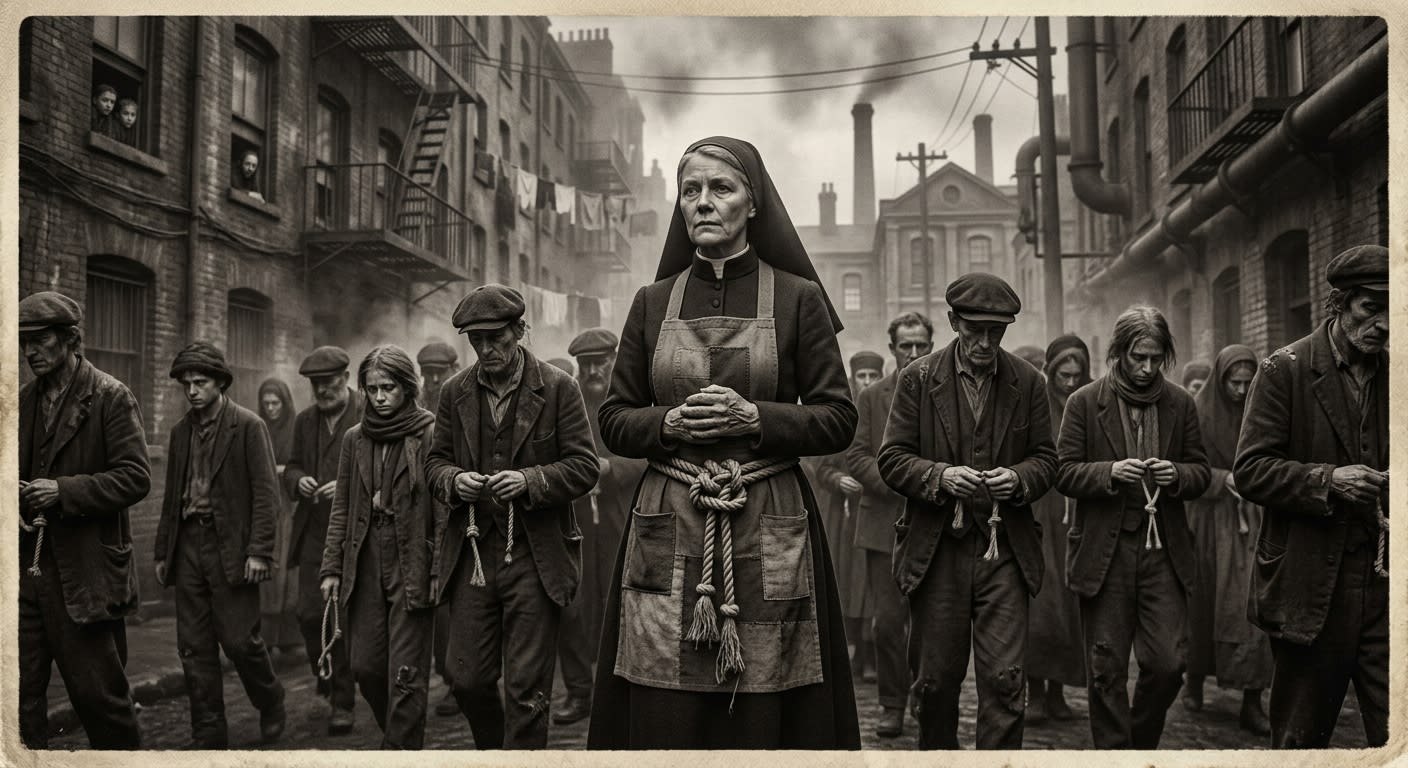
Later traditions place the event near Mainz, near Worms, near a burned Rhine hamlet, near a road chapel whose foundations no one can find, and in one Iberian version, inexplicably, outside Seville. The Bureau of Records rejects all four with equal dryness. The Bureau of Oaths records only “a district under post-Sundering scarcity, thirty households surviving by mutual pledge.” Thirty is the sacred number in the file. Thirty knots. Thirty doors. Thirty families. Thirty chances for human selfishness to dress itself as prudence. The Bureau of Records has verified the number with the confidence of men verifying smoke.
Liora moved house by house. She stood at each threshold and required the inhabitants to speak aloud what hunger makes indecent: how much flour they had, how many dried beans, how many strips of meat in smoke, how many children, how many sick, how many mouths they had hidden in lofts and root-cellars. She did not ask for kindness. Kindness is a summer virtue. She demanded inventory.
At each door she heard the pledge. “I will share what I have; you will share what you have; we will endure together.” The formula is later, polished by clerks whose hands never cracked from winter water. The original words were likely uglier, shorter, and more useful. Bread here. Beans there. Your child with mine. Your roof if ours burns. My last sack if your fever breaks. No household spoke alone. Two neighbours stood witness. Liora tied a knot in the strip for every obligation, pulling the cloth through fingers already stiff from cold until her hands bled and the knots darkened.
By the time the rations arrived — from whom, by what road, under which proto-Bureau seal, no record agrees — thirty families were alive. The cloth held more faithfully than the granary.
#On the Knot-Hand
Her title has produced more idiotic embroidery than any hand deserves. The popular woodcuts show Liora with fingers twisted into permanent loops, hands shaped like cords, palms flowering into little red bows of sanctity. One Ghent printer, now deservedly dead, drew her right hand as a literal sailor's knot. The Bureau of Oaths purchased the edition in bulk and burned it privately, which is the most merciful thing ever done by a procurement office.
The earliest depiction is better: a woman seated on a low stool, left hand wrapped in cloth, right hand swollen across the knuckles, face turned away from the viewer as if listening to someone just outside the frame. No halo. No theatrical wound. Merely a working hand punished by its own instrument.
Earlier devotional broadsheets stated that Liora was born with a knotted hand as a sign of predestination.
Withdrawn. The title derives from injury sustained during the vow-bindings, or from the knotted cloth preserved by later Witnessers, or from an error introduced by a scribe who mistook “knot in hand” for “Knot-Hand.” The Bureau permits all three explanations. Ambiguity, when properly licensed, is cheaper than adjudication.
The hand matters because the Bureau requires the body to certify the word. A seal may be forged. A signature may be copied. A spoken vow may be denied. A hand that has tied thirty knots while thirty households spoke their hunger into public record becomes evidence no clever man can comfortably dismiss. The hand is the first Witnesser. The hand is the first lead tablet. The hand is where breath became archive.
Private devotional fragment, allegedly copied from the First Knot-Cloth before its transfer to Strasbourg: Knot 17 — household of █████: “We have hidden meal beneath the dead girl's bed.” Knot 18 — household of █████: “We knew.” Knot 19 — Liora's mark, not words, pressure distortion in the thread. The Bureau of Oaths classifies the fragment as unsuitable for feast recitation.
#On Her Use by the Bureau
The Oaths Witnesser profession claims Liora as mother, instrument, and warning. On the 14th of Ember each Witnesser re-ties a knot in the cord-sash while reciting the axiom: a vow unwitnessed is vapor. New Vow Runners (Unregistered) receive their first tokens. Breach-Rite Witnessers fast, partly from piety and partly because men who bury broken promises develop delicate stomachs.
The ceremony is simple by Synod standards, which means only three offices disagree about it. Oaths provides the cords. Records verifies the feast register. Doctrine supplies the approved lesson. Bells refuses to alter the peal schedule and has done so with admirable consistency since A.S. 115. The cord is drawn across the palm. The knot is tied. The Witnesser speaks Liora's threshold formula. Then the sash is worn into ordinary misery: marriages, debt covenants, adoption oaths, military last-vows, guild bonds, and those small private bargains by which desperate people consent to futures they would spit on in better weather.
The Bureau's use of Liora is not innocent. No patronal cult ever is. Her story teaches mutual aid, but under witness. It praises sharing, but through inventory. It exalts trust, but only after trust has been converted into obligation, knotted, remembered, and made punishable. The starving district survived because each household knew the others had heard its promise. A man may betray kindness in secret and sleep. A man who betrays a spoken vow sleeps under the Ledger's pillow.
This is why the Bureau loves her. This is why I trust the cult as far as one trusts a velvet glove around a manacle.
#On the Cloth and the Relics
The First Knot-Cloth is kept in the Registry of Bonds (Unregistered) beneath the Basilica of the Ledgered Saints, unless it is kept in the Third Vault (Unregistered), unless the Bureau of Relics is correct and the true cloth was divided into five strips during the early Concordat inventories, two of which are now sewn into the cord-sashes of the Synod Registrar of Bonds (Unregistered) and the Senior Breach-Rite Witnesser (Unregistered). The public guide says “the cloth is preserved.” It does not say where. This is the correct amount of truth for pilgrims.
A pilgrim expecting splendour would be disappointed, which is why pilgrims are not invited. The cloth, in the one viewing I was permitted after signing a form whose penalty clause had elbows, is brown linen, finger-width, frayed along one edge, stiff in places where blood or grease or kitchen smoke entered the fibre and refused to leave. The knots are uneven. Some are tight as sin. Some are loose enough to shame the household they represent. One has been reinforced with later thread. The Bureau of Oaths insists no knot has ever failed.
There are secondary relics: the stool, three vow tokens said to have been cut from Liora's own hem, a threshold stone bearing two depressions attributed to her knees, and a wooden spoon presented by a district that claimed descent from the thirty households and then submitted three contradictory genealogies. The Bureau of Records rejected the genealogies. The Bureau of Oaths accepted the spoon as “devotionally consonant.” A beautiful phrase. It means false, but useful.
A Ghent catalogue once listed “the complete and authenticated hand of Saint Liora.”
Corrected. The object was a wax teaching model used for Vow Runner instruction, later stolen, kissed smooth by fools, and resold as relic-grade anatomy. The Bureau of Relics downgraded it to Category D. The Bureau of Oaths requested custody anyway, citing “pedagogical embarrassment.”
#On the Saint as Accusation
Saint Liora is usually invoked to comfort. This is vulgar. Her proper function is accusation.
She accuses the hoarder who calls fear prudence. She accuses the neighbour who demands charity without revealing his own cellar. She accuses the Bureau, though the Bureau has taken care not to notice, because her miracle occurred before the Bureaus existed and worked without a charter, a seal, a fee schedule, or a seven-storey granite annex in Strasbourg. One woman, one strip of cloth, thirty thresholds, thirty vows. The Bureau has spent a century and more proving that such simplicity now requires four hundred officers across seventeen districts.
The faithful pray to her when contracts sour, when spouses vanish, when soldiers swear before deployment, when a household must decide whether to share the last sack of grain or bar the door and wait for the screaming to move elsewhere. Witnessers pray to her before breach rites. Grain Keepers pray to her privately, which the Bureau of Oaths denies because the implication is intolerable: that a proscribed heretic feeding a ward may stand nearer to Liora than a licensed officer recording the ward's debt.
The saint's answer, if saints answer, is a knot. Tighten it and live. Cut it and learn what fraying costs.