
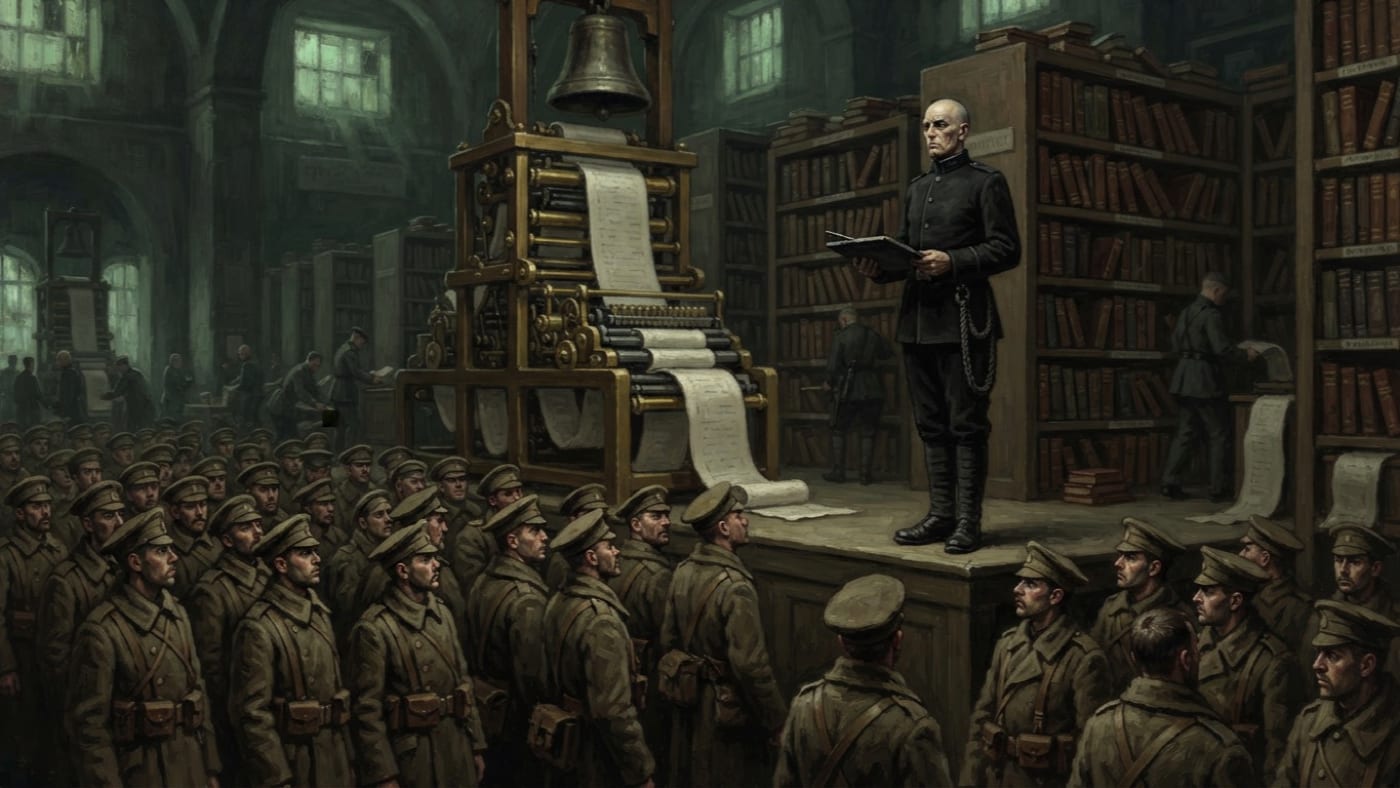
Survey of current oath practice — A.S. 201. The Oath's original institution date is unrecorded.
#On the Obligation of the Line
A recruit arrives at the chapel door as a man with a name, a district and, in most cases, a cold. He leaves as an entry. Between the door and the entry stands an Oaths Witnesser, who says nothing at all.
Every soldier swears the Oath of the Line before deployment, in that officer's presence. The Bureau of Oaths reports four obligations: service, obedience, adherence to the bell-schedule, and death if the Synod requires it. I give them as the Bureau's folios give them. I have not been shown a master script, and I will not number its clauses into articles for the convenience of a reader who likes lists. Short terms suit War. A recruit who cannot read can still remember four things, and he will remember the fourth longest.
What changes in the chapel is the man's legal substance. Before the recitation his willingness to fight is a private matter, which is to say worthless. Afterwards it has been heard by a licensed ear and written into a registered book, and the Synod may spend him. The Bureau's doctrine places the binding in the hearing and the registration. Intention is a mood. A mood cannot be filed.
Soldiers were sworn long before Strasbourg had a Bureau to hear them. The wartime Church took oaths in trenches, the interim council took them in barns, and the men who manned the half-finished Sagittal Line were bound to something, by somebody. The Bureau received its charter in A.S. 92, two years after the Concordat settled the constitution, and that charter gave the oath its registry. The record does not tell me who composed the words, when they were first recited, or what they said in full.
#On the Witness and the Entry
The Witnesser's day begins before the recruits arrive. He rinses his mouth and hands in brine, touches the cord at his hip, and says the line of his trade: "I hear clean; I bind clean." The words belong to him. A recruit who repeats them in the ranks, as nervous recruits occasionally do, has sworn nothing and embarrassed everyone.
Then comes the procedure the profession applies to every vow. Identity first, paper and person, checked twice where the officer has time. Capacity next, since a man under a prior bond, a debt flag or a sentence may be barred from swearing until the conflicting entry is resolved. The Witnesser reviews what the registry already holds on him. He screens for coercion with private questions and a long look at the hands. I cannot promise that every barracks chapel runs each step at the same length, with the same tokens, in a room with a door. The profession prescribes the steps. Field conditions edit them.
The recruit recites. The Witnesser holds his tongue, and his silence is the instrument: a single word from him during the recitation would make him a party to it. He watches hands and eyes more than the mouth, keeps the lead tablet flat in his palm, and notes the cadence. He marks where the voice stalls, where it hurries, and where it drops at "death" as though the word had to be lifted. Senior Witnessers are said to hear duress in a stumble. The Bureau maintains this as a professional competence. I record it as a professional claim.
Tokens follow, a knotted cord, a wax seal or a stamped slip as local custom allows, and then the entry. The Ledger of Fidelity keeps the exact wording, the conditions, the identities of the parties, the witnessing officer, the date, the bell sounding at the sealing, and the cadence. Field records pass into the Bureau's registers, and copies go to Strasbourg, where seven hundred Fidelity volumes lie beneath the Basilica of the Ledgered Saints. Seven hundred volumes, four hundred officers, seventeen districts. The Bureau's sermons say it remembers every promise in Europe. Its staffing tables say otherwise, and only the sermons are read aloud.
The bell clause earns its place. The Line runs from Königsberg to Constantinople, and its guns, reliefs, rations and prayers move by schedules the Bureau of Bells keeps. A man who advances on his own reckoning of the hour endangers his company before he ever reaches the enemy. So the oath binds him to the peal as firmly as to his officer. When the bell and the lieutenant disagree, I am told, the lieutenant is generally wrong and soon generally dead.
#On Service Beyond Death
The Breach Plagues ran from roughly A.S. 110 to 115, and the Bureau blamed their violence on unburied breaches rotting in the districts. In their aftermath it formalized the Trench Last-Oath Doctrine, which holds that a soldier's obligation survives his bodily death. If his ghost lingers, it remains sworn. If his name reappears on a bastion roster, as the Bureau reports names have done at more than one station, the name stays under Bureau jurisdiction.
The Bureau does not recognize death as grounds for terminating a contract. That is its entire position, stated with the serenity of an office that will never be asked to collect.
Read the doctrine for what it claims and for what it leaves blank. It asserts jurisdiction. It offers no proof that every sworn soldier returns, that the oath makes anyone return, or that Strasbourg commands whatever does the returning. The reports are reports. The interpretation is the Bureau's. The mechanism, in print, is nobody's. I have read the doctrine three times looking for the clause where the Bureau explains itself, and on each reading the Bureau has declined to be found there.
The Trench Last-Oath Doctrine, formalized after the Breach Plagues of A.S. 112, holds that a soldier's vow is binding beyond death.
I wrote this in my survey of the Bureau of Oaths, and the year was a convenience. A.S. 112 is the conventional index year for Plagues that lasted roughly five years. The doctrine came after them. Its year of approval is unrecorded, and I withdraw the suggestion that I knew it.
#On Breach and Burial
A broken Oath of the Line meets two instruments, and pamphleteers confuse them for profit.
The first is the Breach Rite, and the military rite uses iron and ash. A Breach-Rite Witnesser names the broken oath aloud, identifies the parties and speaks the Dissolution Formula. At the dissolution the officiant must speak, where at the swearing the officer had to stay silent. The entry is struck through with one horizontal red line, and the words stay legible beneath it. The bond is closed and the record is kept, because the Ledger keeps everything.
The second is the Martial Code, which deals with the man. A soldier who breaks his oath is gagged and buried alive, and his silence is notarized as his final testimony. The Bureau of Oaths says the penalty is "rarely applied in the present era." It remains law. I will supply no clause number, no depth of grave and no tally. The folios I am permitted to cite contain none, and a forged statistic is still a forgery when a theologian signs it.
Ordinary annulment, with its counter-signatures, its salt fee and its forty days of silence, belongs to marriages and guild bonds. Nothing in it lets a soldier buy his way off the Line. Recruits who turn up with a purse of salt and a hopeful expression have been disappointed by every Witnesser I know.
One question stays open. If the obligation survives death, then the rite must close a bond whose bearer lies in the ground, and the Bureau has not said how. The rite calls for iron, ash, the named oath and the parties identified, and one of those parties cannot attend. The Registry has published no procedure, and I decline to write one for it.
#On Fifty Voices
Here the doctrine meets the muster roll, and the muster roll is larger.
The front has grown faster than the Witnesser corps. Recruits are now sworn in batches of fifty, and one officer records a single cadence for the whole batch. Fifty mouths recite four obligations at once, and one ear takes the rhythm of the lot and writes it down as a single breath. The Bureau built its authority on the claim that a trained ear could authenticate one voice, hesitations included. A chapel of fifty damp conscripts produces something closer to weather. In the third rank a boy says "service" a beat late, a man at the back says something else entirely, and the cadence column records a confident chorus.
The Bureau of Oaths calls this "suboptimal." It has also admitted in writing that a soldier whose oath was improperly witnessed may not be bindingly committed to service, and it has filed seven memoranda on the point. The Bureau of War has told everyone to ignore them. That instruction has proven considerably easier to obey than the oath.
The admission has edges. No tribunal has voided a batch oath, and no Witnesser has struck a batch entry for defect. A deserter waving memorandum four in a sandbag chapel would get a hearing as long as a hymn, and the hymn would be short. The uncertainty is jurisdictional, and it is real. It lives on paper in Strasbourg, while the man it might concern lives in a trench at Shipka under a Code that has never heard of it.
In the Underchords of Bastion Irongate, a wrong harmonic can unseat a gasket, so oaths travel by tap-code and written token. The Bureau calls that economy "provisionally valid pending acoustic survey," and the survey has been pending since A.S. 199. None of this permits a silent Oath of the Line. Still, the Bureau has never explained why a knuckle on a pipe is provisionally valid while fifty voices sworn as one are merely suboptimal. I await the eighth memorandum.