
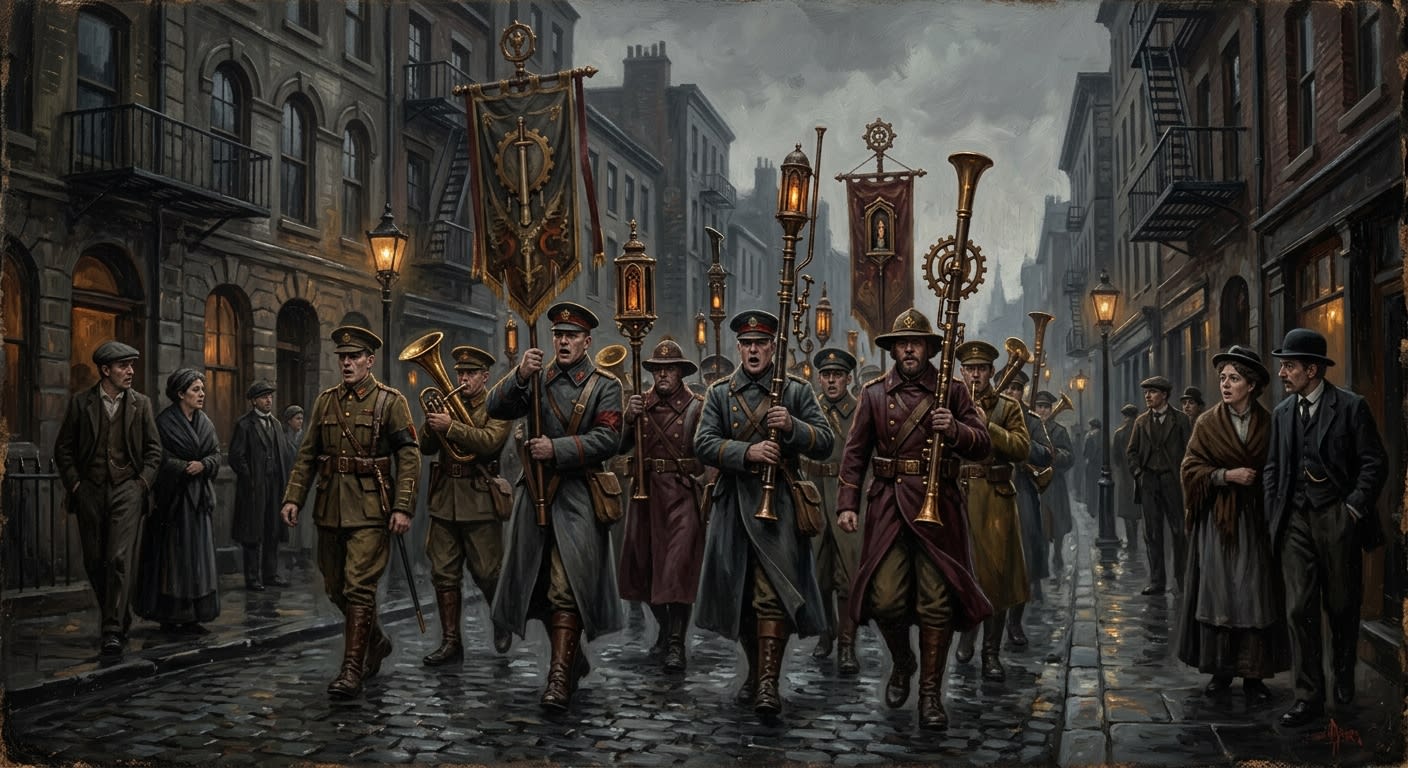
#On the Sacramental Faction
The Doctrine Marchers are the faction within the Cadence Corps that still believes, with the dangerous serenity of men who have never been crushed against a grain gate, that a procession is first a sacrament. Bodies may be counted afterward. The chant comes first.
They inherit the most polished lie of the Concordat of Civic Cadence: “a city that prays in one rhythm cannot be harmonized by the enemy.” Other Marshals treat that sentence as useful language drafted to make crowd control palatable to bishops. Doctrine Marchers treat it as theology. They hear footfall as antiphon, lane rope as nave rail, baton strike as minor bell, and the public street as a temporary church whose roof has been omitted for budgetary reasons.
Their cadences are slow. Their call-and-response is beautiful. Their sash knots are immaculate. Their Marshals can move a funeral column through Strasbourg with such grave splendour that even the paid mourners forget to exaggerate. A Doctrine Marcher at his best turns public obedience into visible liturgy: one beat, one breath, one road, every citizen made briefly tolerable by being arranged.
#On Their Method
A Doctrine Marcher begins with the bellway. The route is subordinate to the bellway; the gate is subordinate to the bellway; the crowd, with all its sweat, fear, hunger, weak knees, bad shoes, and inconvenient mortality, is subordinate to the bellway. If the Route-Timing Concordat gives him a cleared corridor of sound, he treats that corridor as consecrated ground. If the corridor narrows, he slows the chant rather than cutting the line. If the line thickens behind him, he adds response. If the response grows strong enough, he calls it stability.
This produces splendid motion and poor arithmetic. A slow cadence through a narrow gate means fewer bodies per minute. Fewer bodies per minute means the queue lengthens. The queue lengthens into the adjoining lane. The adjoining lane feeds the bridge. The bridge is already carrying a levy column, because the Bureau of War has never seen a bridge it did not wish to overburden in the name of necessity. Now the funeral is exquisite, the chant is pure, the dead are honoured, and three hundred living persons are beginning to hate the Creator in a crush-line.
Their tools reveal their souls. Doctrine Marchers polish the baton-staff until it resembles a processional wand. They tune whistle-flutes to the local bell with fanatical delicacy. They carry chant cards, pocket rubrics, bell-table excerpts, and little waxed slips containing approved emergency antiphons for fog, fire, riot, and inconvenient cavalry. They distrust rope-knives. A rope cut is, to their eye, a broken sentence.
#On Patronage and Hatred
The Bureau of Doctrine loves them. Naturally it does. They confirm the Bureau’s favourite claim: that administration is prayer with better filing. The Bureau of Rites tolerates them as useful ceremonial muscle. The Bureau of Bells finds them flattering, which has ruined wiser institutions. War despises them with the clean hatred of a staff officer watching twelve hundred conscripts delayed by a hymn whose third verse contains no tactical value.
A Corps primer of A.S. 166 states that Doctrine Marchers “achieve the highest safety through spiritual cohesion.”
Corrected: they achieve the highest ceremonial cohesion. Safety varies by gate width, weather, hunger, bridge traffic, chant tempo, and the number of War officers shouting nearby.
Their quarrel with the Flow Marshals is old and usually audible. Flow Marshals accuse them of loving cadence more than bodies. Doctrine Marchers accuse Flow Marshals of reducing the faithful to water in a gutter. Both accusations are true enough to be impolite. Their quarrel with the Iron Wedges is simpler: Doctrine Marchers believe the crowd must be sanctified into obedience; Iron Wedges believe obedience begins when the baton lands.
CADENCE CORPS DISCIPLINARY ABSTRACT — STRASBOURG FEAST ROUTE, A.S. 188 Doctrine Marcher unit maintained full relic chant despite rear compression at Market Mouth. Flow Marshal reserve attempted tempo increase. Iron Wedge detachment entered without bell authority. Casualties: ███. Public finding: “mixed command confusion.” Private notation: “all three factions correct in the manner most fatal to bystanders.”
#On Their Virtue and Defect
One must be fair, a nauseating obligation I perform better than my enemies. Doctrine Marchers do prevent certain horrors. A crowd that sings together panics more slowly. A funeral that moves beautifully riots less often. A pilgrimage kept inside a shared response is harder for rumor, hunger, and off-tempo malice to split. The Corps’ whispered maxim — “off-tempo is a doorway” — gives their theology a practical spine. Some doors are kept shut by chant.
Their defect is the same organ turned inward. They believe beauty proves correctness. They believe reverence can substitute for release rates. They believe a perfect procession is still perfect while the rear ranks choke beyond sight. This is the old clerical disease: mistaking the visible front for the whole body. The altar gleams; the nave burns; the sermon continues.
#On Present Standing
As of A.S. 201, Doctrine Marchers remain strongest in Strasbourg, major cathedral cities, relic routes, and old quarter funeral offices where the paving stones remember processions older than the Cadence Corps and resent being hurried by young men with whistles. Their manuals cite Prefect Malven “Iron Step” as proof that cadence is sacrament. Flow instructors cite the same man as proof that timing saves bodies. Iron Wedges cite him as proof that quarantine improves when nobody is allowed to turn around. A fabricated saint is generous. He has no original opinion to defend.
The Corps will never purge the Doctrine Marchers. It needs them. Without them, the Corps becomes War with lane ropes. With too many of them, the city becomes a chapel queue waiting to die beautifully at a narrow gate. The proper dosage is determined by audit, casualty, and embarrassment.