
#On the Yard at Bastion-Brest
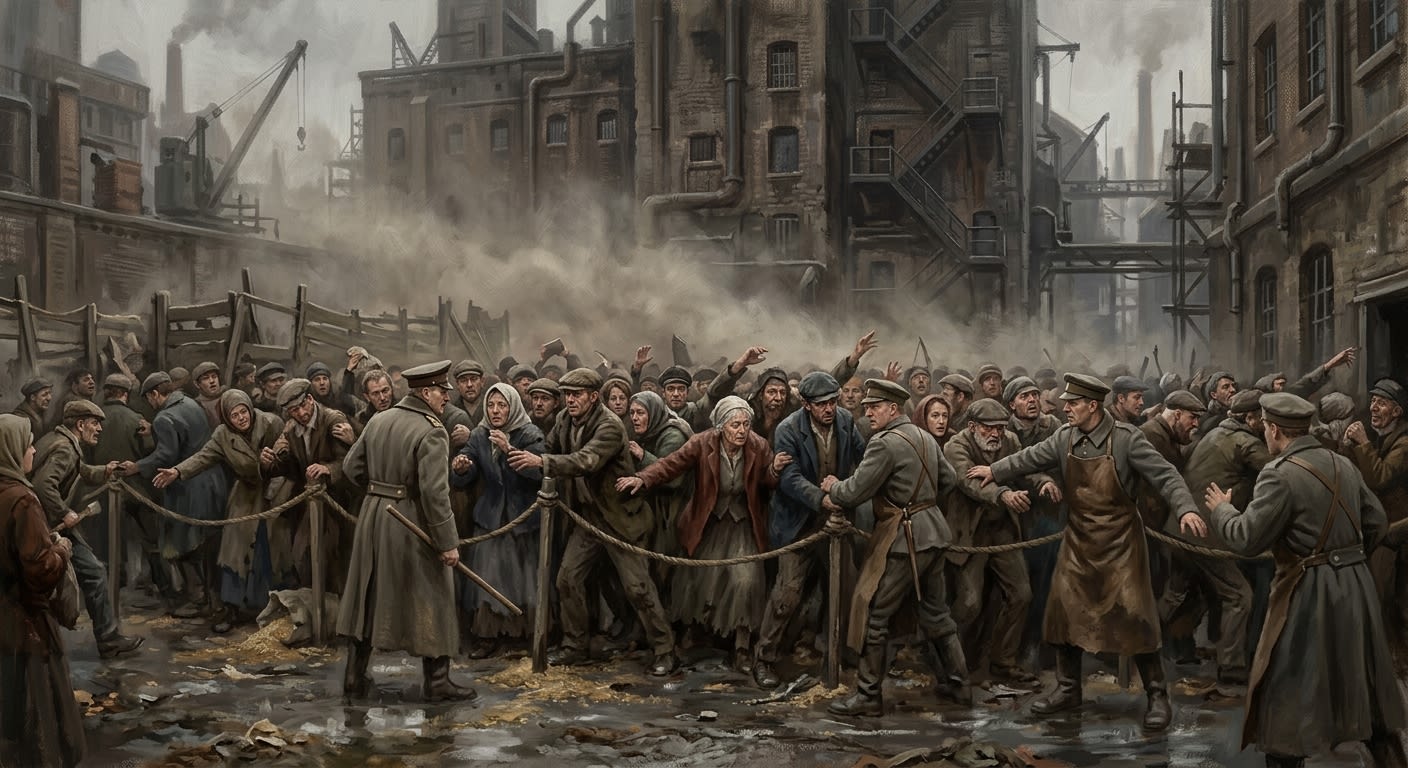
The Ashbread Stampede occurred in A.S. 112 at the northern grain depot of Bastion-Brest, in a yard designed for three thousand petitioners and entered, by the Bureau of Records’ own reluctance, by twelve thousand. I dislike numbers that arrive already guilty. These arrived wearing chains.
The yard stood west of the Bug approaches, behind a distribution gate whose hinges had been praised in a War inspection the previous winter and whose lane ropes were hemp, thin, damp, and fit for laundry. The grain clerks had three thousand loaves of ashbread stacked under tarpaulin. The crowd had four times that many stomachs, plus children, plus the old, plus the sort of hunger that stops being a sensation and becomes government.
The gates opened on schedule. This detail has been repeated so often by Records that one hears the absolution hiding in it. On schedule. At Prime. Per writ. According to distribution protocol. The schedule was innocent, naturally. Schedules always are. Men die around them.
#On the Folding of the Crowd
A crowd does not surge like water. Water has the decency to be mindless. A crowd remembers, hopes, hears rumour, smells bread, mistrusts the guard line, sees one woman lifted near the gate, sees one child squeezed against a post, sees a clerk raise both hands and mistakes this for opening. Then the rear presses forward. The front has nowhere to go. The middle becomes a mill.
The first rope snapped at the third lane, near the west table. The second went at the north stake, where a Rope-Hand had tied a sailor’s knot in hemp too wet to hold. The third did not snap; the stake came out of the cobbles and flew backward, striking a boy in the teeth. The lanes folded inward in sequence. Bodies turned sideways. Feet left ground. Breath became property of whoever had room for it.
The guards did what guards do when a crowd ceases to resemble a queue and begins to resemble an accusation. They struck. The striking made pockets. The pockets collapsed. A wagon team bolted through the south gate with six sacks still aboard and dragged two petitioners under the axle. The bread tables overturned. Ashbread broke underfoot, mixed with blood and mud, and became a grey paste later scraped from the cobbles by penitents from the Bureau of Mercy kitchens.
MERCY INTAKE LOG — NORTHERN DEPOT ANNEX, A.S. 112 Official receiving count: 317. Unfiled bodies placed in lime trench before second bell: ███. Children without family marker: ██. Bodies counted twice to satisfy distribution ledger: █. Instruction from Records liaison: “Do not create a second disaster by naming the first one accurately.”
#On the Arithmetic of Bread
The official count is three hundred and seventeen. The Mercy log, incompletely redacted by a hand either pious, drunk, or merciful beyond career prudence, places the number nearer five hundred. I have seen the log. It is stained at the lower corner, and the stain is not ink. Records calls the larger figure “unreconciled receiving duplication.” Mercy calls it Tuesday, because Mercy has less talent for euphemism and more experience with corpses.
The first printed civic notice described the incident as “a disorderly attempt to obtain duplicate ration allotments.”
Corrected: the duplicate allotments were issued after the dead had already been removed. The dead were, by then, unusually unlikely to cheat the ration table.
The scandal was never that people died. People die every day in Synod custody: in work lines, levy yards, confession queues, pilgrim chains, ossuary carts, and the little administrative silences between them. The scandal was that they died visibly, at a gate, in a countable heap, with bread beneath their boots and witnesses above them on depot roofs.
That visibility made doctrine possible.
#On the Concordat of Civic Cadence
The Concordat of Civic Cadence followed with impressive speed. When the Bureau is guilty, it moves like a saint fleeing biography. Rites and War ratified the new authority jointly: a licensed corps to control mass movement in every city above five thousand souls, every gate, every bridge, every cathedral approach, every funeral, levy column, reliquary procession, ration queue, pilgrim march, and public grief thick enough to obstruct traffic.
The Cadence Corps was born one year before its catechism and centuries after its necessity. Its first law was simple enough for a starving crowd to understand and complicated enough for a Bureau to monetize: one beat, one body, one road.
The Corps tells its recruits that the Stampede proved discipline saves lives. This is true in the same way a locked door saves a prisoner from falling out of a window. Discipline might have saved lives at Brest. Bread would have saved more. Fewer petitioners in the yard would have saved more. A clerk capable of arithmetic before catastrophe would have saved enough to deserve canonisation, which is why no such clerk is recorded.
#On the Saint They Chose Instead
The Corps could have chosen the Ashbread dead as its patrons. It did not. Dead petitioners make poor instructional icons. They accuse without procedure. They do not hold batons, set cadences, or flatter the living into believing that every later improvement was latent in the first failure.
So the Corps chose Prefect Malven “Iron Step”, that convenient boot-beat in human costume, who supposedly marched a plague quarter into quarantine without breaking cadence. Malven predates the Corps when useful, follows the Corps when necessary, and stands above it when auditors ask why a profession born from trampled rationers requires a saint rather than a confession.
The Cadence Corps Foundational Primer, A.S. 140 edition, states that the Ashbread Stampede “revealed the ancient necessity of Malvenite discipline.”
Corrected: the Stampede revealed wet rope, insufficient bread, locked gates, crowd pressure, clerical incompetence, and the Bureau’s exquisite instinct for inventing ancestry after disgrace.
Malven’s beat entered training because the Stampede had no rhythm, only crush-noise. Heel, pause, heel-heel. A shape imposed after the fact. The Corps needed a sound older than screaming. Doctrine provided one.
#On the Yard Afterward
The northern depot yard was resurfaced in A.S. 114. The cobbles were lifted, scrubbed, relaid, and blessed by three offices that argued over whose blessing would bind deepest. The new lane stakes were iron. The ropes were braided twice as thick. Chalk markings were cut into the stone so rain could not wash them out. A plaque was installed beside the west gate.
It reads: ORDER PRESERVED THROUGH SACRIFICE.
Today, every Flow Marshal studies the pressure diagrams. Every Doctrine Marcher chants the catechism over them. Every Iron Wedge points to the snapped lanes and says the batons should have landed sooner. Each faction finds its own relic in the heap. That is how institutions digest shame: one bone per office.