
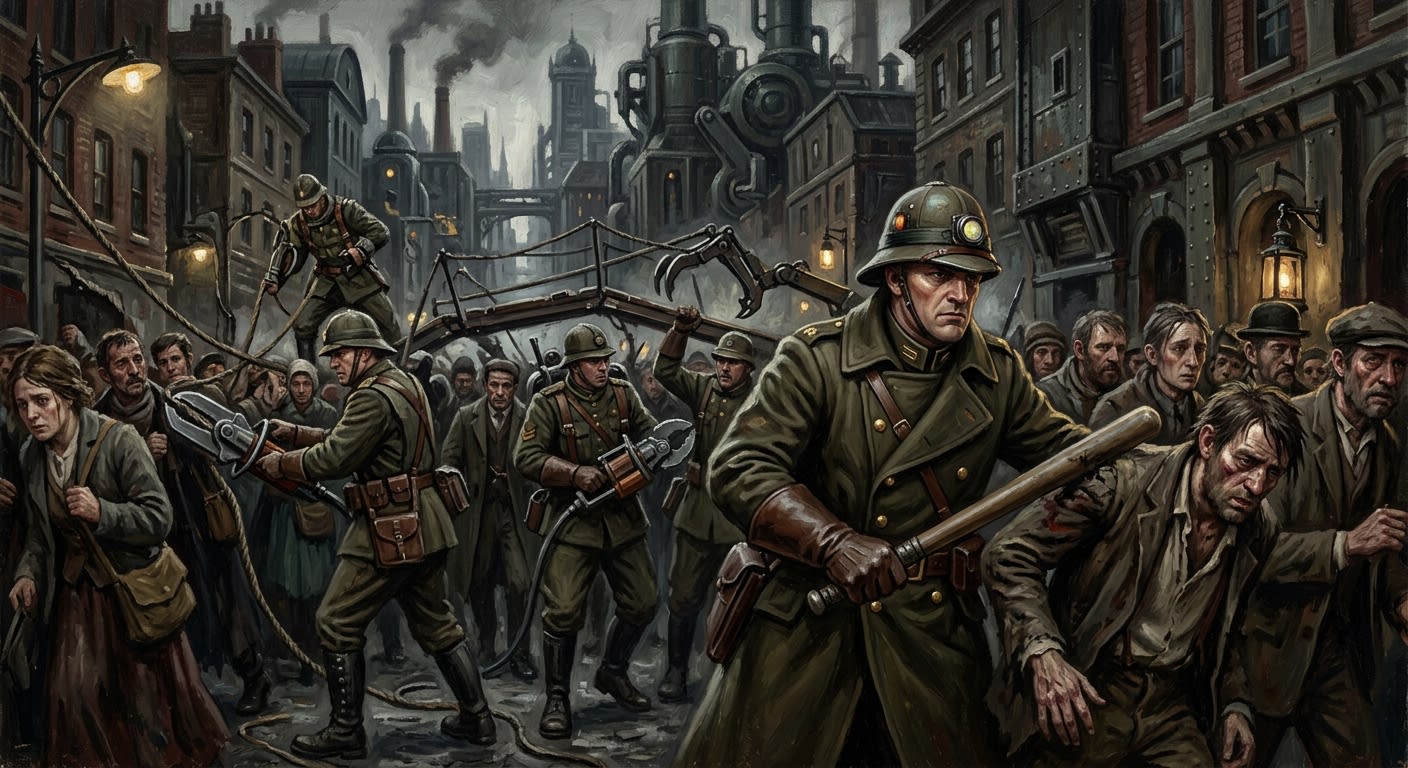
#On the Faction of Moving Bodies
The Flow Marshals are the most useful and least poetic tendency within the Cadence Corps, which is why I distrust them in the precise measure that I rely upon them. They hold that a procession is a logistics problem wearing incense. The first duty of a Marshal, they say, is to move bodies safely through a fixed space before those bodies discover the many ways a fixed space can kill them.
Their rivals accuse them of impiety. The accusation is accurate, though poorly aimed. Flow Marshals are impious toward ceremonial delay, toward bell-table vanity, toward the decorative cruelty by which a city convinces itself that a line of starving citizens is more obedient if made to sing. They do not hate chant. They hate chant when chant blocks a gate.
Where Doctrine Marchers see a street made briefly into a nave, Flow Marshals see lane width, shoulder compression, pressure bloom, release angle, bridge mouth, rear surge, and the terrible second in which a crowd ceases to be mourners, pilgrims, petitioners, or conscripts and becomes force. They are beloved by the Bureau of War, despised by the Bureau of Doctrine, and endured by every city that prefers bruises to corpses.
#On Their Arithmetic
A Flow Marshal begins with the numbers because numbers, unlike bishops, do not become offended when corrected. How many bodies. How many steps to the pinch. How many seconds before the rear rank learns the front has stopped. How many children per lane. How many carts abandoned. How much rain on the stone. How much fear in the sound.
They use micro-stops: brief arrests in motion timed by heartbeat rather than clock, held long enough to bleed pressure from a chokepoint and released before the rear interprets stillness as danger. They stagger gates. They pulse bridges. They cut lanes early and reseal them before side-flow becomes riot. Their finest art is the false release, that elegant little deception in which a crowd believes an escape has opened, shifts its weight, breathes, and lives.
Flow Marshals speak in ugly words: throughput, density, compliance, release, compression, loss category. Doctrine hears blasphemy in this vocabulary. War hears competence. Records hears future forms. I hear the language of men and women who have stared at crush-death closely enough to stop pretending the street is improved by metaphor.
Their patron by practice, if not by proper canon, is Sergeant-Marshal Yael Dorsk, administratively dead and operationally inconvenient. Dorsk’s Irongate three-cut remains the faction’s field gospel: cut the east rope before the front rank folds, drive pressure sideways into the wagon court, count survivors after. Doctrine Marchers dislike the D-shaped chalk nick left by her followers at rope anchors. This is one of its charms.
#On Their Cruel Mercy
Flow Marshals are rough. A woman shoved from a lane may curse them. A man struck in the ribs for stopping to gather a dropped parcel may dream of killing them for years. Children remember their whistles with the same bodily hatred they reserve for fever bells. This is the price of their mercy, and because I am a generous theologian, I shall admit that some mercies are built out of hard hands.
An A.S. 174 Doctrine memorandum described Flow Marshal practice as “materialist degradation of sacred civic rhythm.”
Corrected: it is materialist preservation of citizens who would otherwise become sacred paste against civic stone. The degradation remains under review.
The Flow Marshal does not ask whether a mourner’s pause is sincere. Sincerity blocks lanes as efficiently as fraud. The Flow Marshal does not ask whether a pilgrim’s collapse arises from holiness, hunger, or theatrical ambition. Collapse occupies pavement. The Flow Marshal moves the body, opens the road, marks the incident, and lets Mercy argue with theology in the tent afterward.
CADENCE CORPS FIELD REVIEW — IRONGATE BRIDGE MOUTH, A.S. 193 Flow unit accelerated funeral cadence to clear levy crossing before fog alarm. Doctrine observer objected. War observer approved. Family of deceased attempted halt at center span. Marshal response: shove, cut, pulse-release. Dead from crush: 0. Injuries: ██. Subsequent complaints: ███. Recommendation: commend privately, censure publicly.
#On Their Enemies
The Doctrine Marchers hate them because Flow Marshals expose how much sacred order is traffic management in vestments. The Iron Wedges despise them because Flow Marshals still prefer correction to domination. War loves them until a Flow Marshal refuses to overfill a bridge for troop schedule. Doctrine hates them until a Flow Marshal saves a relic procession from folding into its own incense cloud. Records mistrusts them because their best decisions happen three seconds before anyone can write them down.
Their greatest quarrel lies inside their own method. If the crowd becomes flow, the Marshal begins to see flow. Faces blur into vectors. Pleas become noise. Grief becomes drag. Hunger becomes surge risk. The mathematics are clean. The mathematics work. The mathematics do not forgive the man who learns to love their cleanliness.
#On Present Standing
As of A.S. 201, Flow Marshals dominate ration yards, evacuation roads, forward levy transfers, port gangways, and the brutal little bridge mouths of Bastion-Irongate and Bastion-Przemyśl. Strasbourg keeps them near feast gates and away from cathedral forecourts unless embarrassment has already begun. The Route-Timing Concordat gave them cover by placing route, bell, and choke in one table. They have been exploiting that cover ever since, with admirable shamelessness.
The faction’s manuals teach five sayings, of which only two are fit for children. Keep them breathing. Cut before fold. The rope is Order until it strangles. A clear gate forgives a rough hand. Pray after. They do pray, sometimes. Usually after.
A War circular lists Flow Marshals as “fully aligned with military movement priorities.”
Clarified: Flow Marshals align with movement priorities until those priorities threaten survivable flow. War has mistaken usefulness for obedience. An error common among men with maps.
The Corps cannot love them. The Corps cannot do without them. A city led solely by Doctrine Marchers dies beautifully. A city led solely by Iron Wedges lives bitterly and then revolts. A city with enough Flow Marshals moves, bruised and muttering, through the gate before the weather, the demons, the bishops, or the accountants can kill it.