
#On the Mathematicians of Obedient Grief
The Cadence Architects are the pale specialists of the Cadence Corps who design the routes by which crowds are made to behave before they discover that number has become strength. They are senior Marshals by warrant, street geometers by practice, liturgists by insult, and dinner guests only when the host desires his chairs counted, his servants rerouted, and his soup accused of arriving without two-bell clearance.
Their office was created after the Night of Two Bells in A.S. 129, when two lawful bells in Strasbourg split eight hundred mourners into three obedient streams and sent nineteen citizens into a dark canal with their candles still warm. The ordinary Marshal can set a beat, mark a lane, cut a rope, halt a column, and strike a fool hard enough to improve his theology. The Cadence Architect does the colder work before the crowd assembles: he decides where obedience will break.
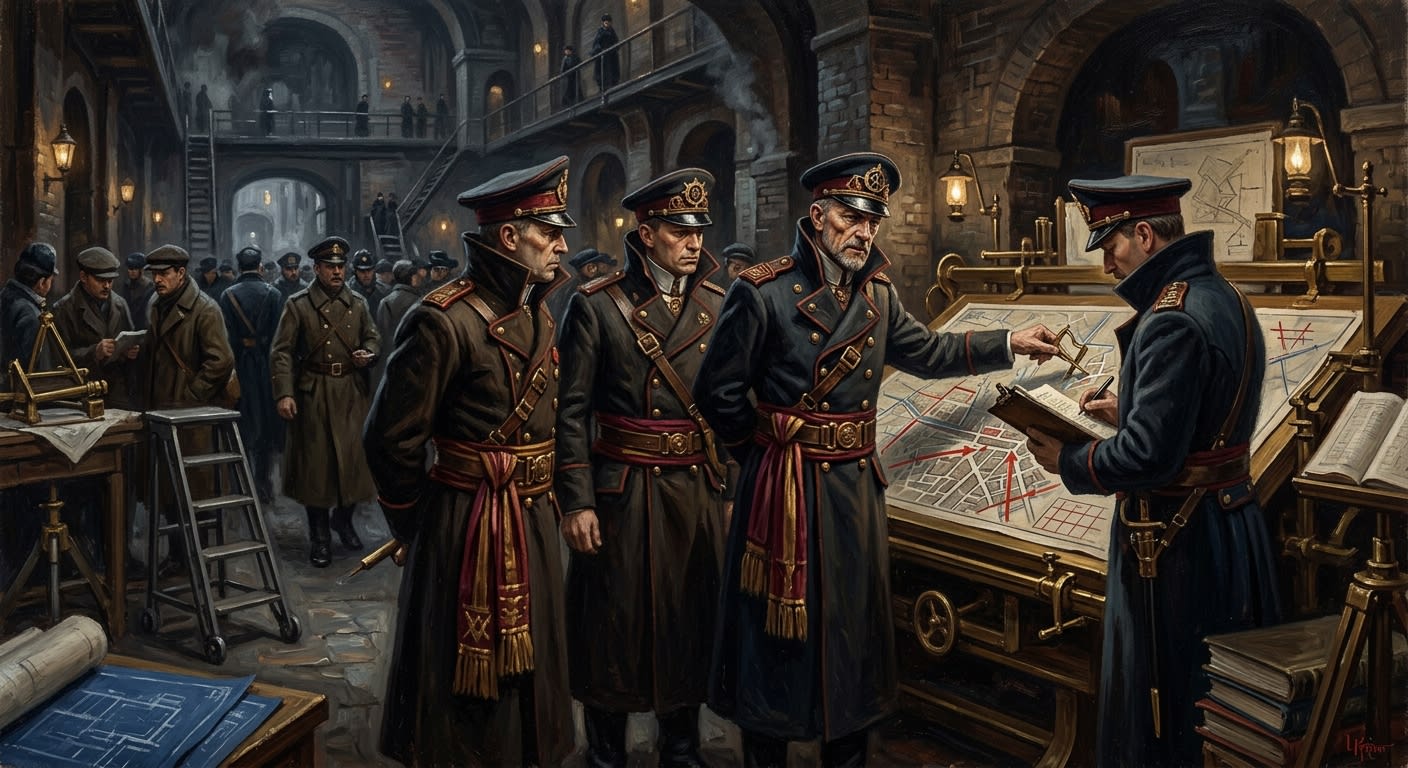
A Cadence Architect measures corners, alleys, bridge mouths, canal lips, shrine steps, market stalls, bell return, rain slick, door drag, coffin delay, child lift, candle stall, old-woman pause, grief sob, military impatience, and the precise moment at which a crowd obeying two authorities ceases to be a congregation and becomes a casualty diagram. Their art is not crowd control. Crowd control is what happens when the art has failed loudly enough for batons.
#On the Birth of the Rank
The Concordat of Civic Cadence in A.S. 113 had given the Synod its first great answer to public mass: one beat, one body, one road. Born from the Ashbread Stampede at Bastion-Brest, it armed Marshals with baton-staffs, whistle-flutes, chalk, rope-lane rigs, and the authority to turn hunger, mourning, levy, pilgrimage, and penitence into movement under command. It was a magnificent instrument, which is to say it killed fewer people than the old disorder and produced better files when it failed.
Sixteen years later, Strasbourg proved that one beat is useless when two lawful sounds claim the same street. Saint Erasmus tolled for a funeral. The Cathedral of the Perpetual Writ tolled for vespers. The lead Marshal's whistle, tuned to one obedience, lost ownership of the other. No demon was required. No saboteur lifted a hand. Two bell-ringers, each loyal to his own table, rang at once, and nineteen mourners drowned in the space between jurisdictions.
The first Corps teaching copy described Cadence Architects as “post-incident route advisers.”
Corrected. Advisers suggest. Architects bind. A route designed under Architect seal is not a recommendation; it is a street forced to confess its future crimes before the bodies arrive.
The Route-Timing Concordat followed those bodies with the brisk tenderness of an office protecting itself from recurrence. It imposed two-bell clearance, forced route sheets and bell-tables into one document, granted Marshal whistle authority to suspend parish bells, and created the Cadence Architect rank to make certain that no procession, ration release, levy transfer, relic passage, or funeral route could plead ignorance of its own geometry.
#On the Tools of the Architect
The Architect's kit looks harmless until one notices how many deaths have been folded into it. Waxed route slates. Bellway overlays. Chalk compasses. Street-width calipers. Candle-drift cards. Rain-density tables. Bridge-pulse counters. Coffin-turn templates. Child-density estimates. Whistle-frequency strips. Panic angle charts. Copies of Form RT-1b with the margins already crowded by prior embarrassments.
He walks the route before the city wakes. He counts the steps between shrine and choke. He marks which alley returns sound and which swallows it. He tests how a whistle rebounds from wet stone. He notes where a mourner will slow to cross himself, where a vendor will refuse to move a stall, where a levy officer will shout over the bell because officers, as a class, confuse volume with authority. He asks whether a corpse borne by six men can turn through the Fishmongers' Elbow (Unregistered) without forcing the rear mourners into the lampworks queue. This question sounds absurd until one has cleaned wax, fish oil, and widows' blood from the same paving stone.
The Architect distrusts open space as much as narrow space. A cramped alley crushes. A wide square disperses. A dispersing crowd begins choosing for itself, and choice in public is the larval form of riot. The finest route is neither broad nor tight, neither ceremonial nor fast, but proportioned to keep obedience in one channel until the Ledger has finished with it.
#On Obedience-Split
Obedience-split is the Architect's central horror. Panic is crude. Hunger is loud. Riot announces itself with bottles, slogans, and that collective intake of breath which makes every decent Marshal reach for the rope-knife. Obedience-split arrives wearing lawful clothing. Two bells. Two chalk marks. Two sashes. Two commands, each proper, each stamped, each fatal beside the other.
The Night of Two Bells gave the office its first anatomy. The front rank heard Saint Erasmus and followed the funeral. The middle heard the Cathedral and corrected toward vespers. The rear heard both and tried to remain virtuous in two directions. They did not disobey. That is why they died so efficiently.
Architect notebooks divide obedience by age, grief-state, bell familiarity, hunger, proximity, parish loyalty, rank fear, and the tiny tyrannies of habit. Old women follow parish bells. Children follow light. Levy men follow the shout that sounds most like punishment. Pilgrims follow banners. Paid mourners follow the person paying them unless a louder saint intervenes. A good Architect knows which authority will own which body at which corner.
CADENCE ARCHITECT SCHOOL COPY — OBEDIENCE-SPLIT RISK TABLE If two lawful auditory commands overlap, divide projected body flow by: parish imprint, grief latency, bell literacy, hunger agitation, visible sash authority, child-drag, coffin proximity, and █████████████████. Do not publish the final factor. Do not test the final factor inside cathedral quarters. If the crowd begins answering the command before it is given, summon Rites and stop drawing.
This is why Architects are feared by ordinary Marshals. A Flow Marshal reads pressure. A Doctrine Marcher reads chant. An Iron Wedge reads threat. The Architect reads loyalty as a vector and shame as a delay. He knows where the citizen will become dangerous because the citizen is trying to be good.
#On Their Relations with the Corps Factions
Every Cadence faction claims the Architects and resents them. Doctrine Marchers praise their bellway purity until an Architect shortens a relic chant to clear a bridge mouth before fog. Flow Marshals praise their arithmetic until an Architect preserves a ceremonial pause because removing it would turn mourners into sideways pressure at the third shrine. Iron Wedges praise their cut-lane diagrams until an Architect forbids hard entry because fear would drive the rear ranks into a child-heavy ration queue.
The Architect is not moderate. Moderation is the vice of men afraid to choose. The Architect is prior. He decides which kind of cruelty the route can survive before the factions arrive to perform it.
Doctrine Marchers accuse Architects of turning sacrament into diagram. The accusation has merit. Architects mark prayer-routes with bleed yards, corpse-turn radii, chant drag, and emergency dispersal slots. Flow Marshals accuse them of overvaluing symbolic stops. The accusation also has merit. Citizens sometimes live because a grandmother was allowed to touch a saint's niche rather than stop forty paces later in a worse place. Iron Wedges accuse them of weakness. This proves the Architects are still human in at least one audited respect.
The Bureau of Bells dislikes them with old professional soreness. Architects can suspend a parish bell inside a cleared route zone, and no bell office enjoys being told that silence is safer than its own competence. The Bureau of Rites uses them, flatters them, and files complaints when they move feast routes through lanes with poor devotional sightlines. War loves them in levy transfers and hates them in funeral districts. Records loves their signatures. Records loves any living name placed where blame may later bloom.
INTER-BUREAU ROUTE OBJECTION SUMMARY — COMMON CAUSES Bells: harmonic dignity impaired. Rites: devotional sightline interrupted. War: troop movement delayed by coffin spacing. Records: signature illegible. Architect response: alter route, hold bell, cut verse, move officer, rewrite name.
#On the Schools and the Tables
Architect training begins after five years in the Corps or after one spectacular disaster survived with enough witnesses to make promotion cheaper than inquiry. Candidates study crowd arithmetic, bellway harmonics, street survey, liturgical sequence, bridge mechanics, emergency dispersal, liability notation, and the restricted psychology of obedience. They learn to draw a map that admits fear without using the word fear. They learn to mark a death before it happens and call the mark prevention.
The Strasbourg School (Unregistered) keeps a practice room built from movable walls, rope anchors, bell boxes, chalk floors, and little weighted figures representing mourners, pilgrims, children, soldiers, vendors, clergy, and the officer class. The officer figures are made heavier than scale. I approve the realism.
Students are given famous routes and ordered to kill as few model citizens as possible. The Ashbread yard. The Saint Erasmus funeral line. The Irongate bridge fog crossing. The Przemyśl levy stair. The Brest winter ration turn. The exercise ends when the instructor strikes two bells at once. Beginners move the wrong wall. Better students silence a bell. The best students remove the procession entirely and send the family an apology before dawn.
An A.S. 171 recruitment broadside called Cadence Architecture “a noble science of sacred civic harmony.”
Corrected. It is the applied suspicion that every street wants witnesses and every crowd wants an excuse. Nobility may attend if it keeps to the marked lane.
Their tables are famous in the Corps: RT-1b for route and bellway, C-3 for coffin drag, L-9 for levy impatience, G-2 for gate compression, P-4 for pilgrim devotional stalls, WET-6 for rain on old stone, and the restricted OS series for obedience-split. The uninitiated mock these forms until a route saves them from drowning behind a chapel.
#On Failures and Present Use
Architects fail in ways ordinary Marshals cannot afford. A bad baton bruises a citizen. A bad route kills citizens who have not yet left home. The worst Architect failures are invisible until the bell strikes: a clearance radius too narrow, a side lane left open, a shrine delay underestimated, a market cart assumed movable, a parish bell trusted to obey a hold writ, a canal rail listed as present because Engineering has always enjoyed comedy in its darkest vestments.
As of A.S. 201, Cadence Architects are assigned to every major Synod city, every bastion gate complex, every high relic route, every official funeral involving more than three hundred mourners, and every levy transfer crossing a bridge, canal, tunnel, stair, or market quarter with prior complaint history. Strasbourg has the largest school and the worst streets, a pairing so elegant that even incompetence appears ordained. Bastion-Brest uses Architects in ration yards with grim devotion. Bastion-Irongate uses them at bridge mouths where fog and grief share a talent for bad timing. Bastion-Przemyśl uses them near trench-levy stairs, where men moving toward the Line and coffins moving away from it keep trying to occupy the same theology.
The office grows more necessary as the cities grow louder. Bellways multiply. Processions overlap. Ration queues lengthen. Pilgrim traffic thickens. Refugees arrive with village rhythms that ignore urban bells. War wants roads clear. Rites wants chant whole. Doctrine wants obedience visible. Mercy wants fewer bodies under carts. The Architect stands among these appetites with a slate and a pencil, committing the daily blasphemy of telling each Bureau where its sacred urgency must wait.
The Cadence Architect's virtue is prevention without applause. His vice is the pleasure of prevention without faces. He learns to love the empty route, the held bell, the cleared bridge, the complaint filed by a family delayed but not drowned. He learns to hear a city before it moves and to mistrust every sound that arrives with authority in both hands.
At dawn the Architect walks the route alone. At Prime the bells obey his silence. At Sext the citizens curse his detour. At Vespers the canal remains empty.