
I've read the continuity, voice and Auditor sources and am now writing the article body.
#On the Feast as Surveyed
Attendance is allegiance. (Auditor motto, carved over more doorways than any prayer)
This survey records the Feast of the Exact Ear as it is kept in A.S. 201 in Orison houses, in sector offices and in the schools where the Sky-Sermon Attendance Auditors are made. The feast belongs to Blessed Edrin of the Count, and it has two movements. First the trainees are made to listen under impossible conditions. Then everyone eats in silence while a Markcounter counts the spoons.
Other feasts of the Church commemorate martyrdom, deliverance, harvest, or the Creator's patience with a city that had exhausted it. This one commemorates the column. Of all the feasts in the calendar, it is the one most honest about its purpose. I have read the calendar, and that is not high praise.
#On the Patron and the Local Calendar
Edrin is Blessed, and his rank was kept narrow on purpose. He is patron of Auditors, Markcounters and sermon-token clerks. Fevers, harvests and artillery are left to other saints. The Bureau of Records dates his earliest stable reference to an attendance ledger of A.S. 117. That is the date of a ledger. The feast has its own silence: no founding decree, no ratification, and no first celebration that any office has been able to produce on request. The Bureau of Orison calls this ancient usage. Records calls it a blank. Both are describing the same drawer.
The day itself wanders. The inherited account says that the parish calendar was copied badly at some early stage, and that afterwards no office would give up its own holiday to correct the mistake. The account is repeated everywhere and documented nowhere. Districts keep the Exact Ear on whatever day their own copy names. In Strasbourg it falls in late autumn, when the windows are shut against the cold and the season's first compliance disputes reach the office counters wrapped in scarves. Strasbourg's date binds only Strasbourg. There is no universal day, and this survey will not invent one. An invented date for a feast of exactitude would be a blasphemy with a sense of humour.
#On the Three Horns
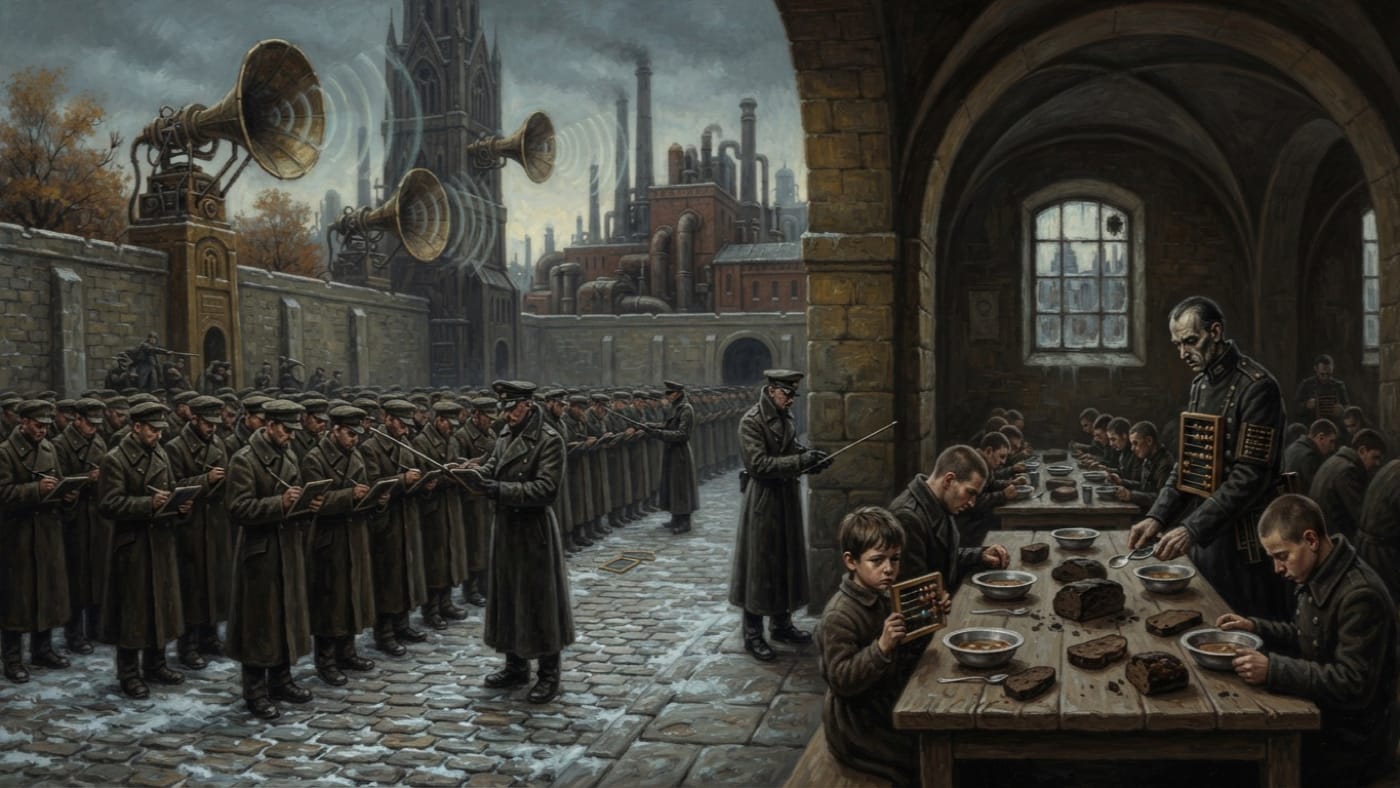
The rite begins in a courtyard. Three sermons play at once, each from its own horn, and the trainees stand inside the collision holding slates. They write down what they can recover: each distinct phrase they separate from the noise, and how many phrases they recovered. That is the whole exercise. A wall of horns and a square of chalk are enough to examine a soul, or at least to examine a slate.
Then the senior Auditors walk the line and check the slates for false confidence.
The phrase deserves more attention than it gets. Feeble hearing is not the failure the seniors are hunting. The dangerous trainee is the ambitious one, whose slate is too full. Three sermons played together are not a fair test, and everyone in the courtyard knows it. The horns overlap, the phrases break apart, and somewhere in the noise a sentence the trainee has heard a hundred times before seems to come forward and present itself whole. A trainee who writes that sentence down has heard nothing. They have remembered something and then signed it as heard. In the field, the same habit marks a household present because it ought to have been present, or rounds a stairwell upward because the stairwell looked devout. The seniors read the slate the way they will later read a forged excuse slip, looking for the line that is too neat.
No office surveyed publishes a number of recovered phrases that counts as a pass. The seniors are judging something harder to count. They want to know whether the slate records the sermon that arrived or the sermon the trainee expected. A short honest slate can satisfy them. A long, fluent, well-punctuated slate makes them pick up the chalk and ask questions.
The horns themselves are not on trial. The Orison Signal Engineers make a signal arrive. The Auditor documents whether it was heard, and nobody in the courtyard is asked to repair anything. The exercise rehearses the street as the street actually sounds: a tower horn, a neighbour's receiver and a square-preacher all at the same moment, and a district that still has to be counted afterwards. Nobody's hearing improves. The Bureau has never claimed otherwise, and in this one matter I commend its restraint. A feast that promised sharper ears would need miracles, and miracles would need auditing.
#On the Counted Table
The meal follows: communal bean broth and black bread. Nobody speaks until the presiding Markcounter has counted the bowls, the spoons, the hands, the mouths and the leftovers.
Consider the order. The count begins with the crockery, which is issued property and can be counted without offending anyone. It moves to the spoon, the instrument, and then to the hand, the body that holds the instrument. Then it reaches the mouth, the organ that the Sky-Sermon is meant to reach and that the Auditor is trained to watch. It ends with the leftovers, which are what the body refused. A bowl left full at an Auditor's table is an absence that sat down and pretended to eat. The Markcounter enters it with the rest.
The count has no fixed length. The silence lasts as long as the count lasts. On a large school feast that can be long enough for the broth to stop steaming, and no ladle moves before the last entry is made. Every person at the table eats under the gaze they are being trained to direct at others. A cynic would call this humiliation. Orison calls it formation. The broth is thin under either name.
Children of Auditor families receive toy counting frames with five beads. The record gives no age, examination or quota, and none is needed. The toy finishes the argument the courtyard began. Counting stops being a professional skill and becomes a household object, small enough to hold in a fist and simple enough to work before the child can read the motto over the door. They learn to move a bead long before they learn whom the bead will count. Joy improves under supervision. That is a nursery rule in these families before it is ever an office rule.
#On the Chapel and the Rulebook
Clerks keep confusing the feast with the devotion at the Sermon Compliance Chapel in Strasbourg, so this survey separates them. The Chapel has its own liturgy. An Auditor takes a blank sermon token and washes their hands, a page from Against the Mercy of Rounding is read, and the officiant moves one bead on the reliquary frame. Each step of that sequence belongs to the Chapel. None of it belongs to the courtyard. No tokens are handed out among the horns, no relic is carried to the broth, and no oath is renewed over black bread. The five-bead toys are toys. They were not made in the relic's image and should not be described as if they were.
Legislation is a separate matter again. Compliance Directive 14-R fixed attendance as allegiance in A.S. 112. The Metric Sanctification Edict of A.S. 158 turned Choir Rate figures into indicators of spiritual health and made adjusting them a sin. Neither instrument created the feast, and the feast enforces neither. It drills the habits both laws take for granted: distrust of the confident total, an eye on the visible mouth, and a full account of what was left in the bowl. Doctrine allows the observance without regulating it. That is the most generous treatment Doctrine gives anything that predates its paperwork.
A late A.S. 160 instructional sheet styled Edrin "Patron of Perfect Belief."
Withdrawn. Edrin is patron of attendance. The Feast of the Exact Ear trains the ear, the slate and the count. It does not examine belief, and a trainee who leaves the courtyard believing more has done so on their own time.
#On Present Observance
As of this survey, the feast is kept in Orison houses, sector offices and Auditor schools, on whatever day each district's copy of the calendar names, and in late autumn in Strasbourg. Its origin is unknown. The record establishes the following: three horns, the trainees' slates, the seniors' search for false confidence, the broth and the bread, a silence that lasts as long as the count, and five beads in a child's hand. It establishes nothing beyond that, and this survey has added nothing beyond that. For a feast of the Exact Ear, adding anything would be the one unforgivable error.
In the Auditor schools the slates are wiped after the inspection and reissued the following morning. The chalk dust is swept out of the courtyard with the leaves. In the sector offices the Markcounter's tally from the meal is filed with the day's other counts, between the excuse slips and the brand orders, where Edrin would have wanted it. The Bureau of Orison reports the observance as healthy.