

#On the Sky-Sermon Attendance Auditor
"Attendance is allegiance." — Bureau of Orison and Song, Compliance Directive 14-R, stamped annually without amendment since A.S. 112
The Synod does not require belief. Belief is a private matter, unsuitable for ledger entry, and the Bureau of Records cannot stamp what it cannot count. The Synod requires attendance. A body in the street when the horns sound. A window open when the prayer descends. A household token, stamped and dated, proving that at the appointed hour the faithful stood — or sat, or lay bleeding, or crouched over a dead child — and listened. That the listening produced faith is a theological question. That the listening occurred is a bureaucratic one. The Sky-Sermon Attendance Auditor answers the second question, because the first has never been asked by anyone with authority to act on the answer.
They are formally styled Orison Compliance Auditors, Sermon Metrics Officers, Sector Attendance Examiners. The street calls them Sky-Listeners, Markcounters, Deadzone Men. The gutter, which has sharper teeth than the street, calls them Choir Rats, Radio Cops, Brand-Mongers. I prefer Markcounter. It describes the act without flattering the actor, and in a profession built on counting the living to determine who deserves rations, flattery is an expense the Bureau has not authorised.
#On the Function
Their task, reduced to its administrative skeleton: prove that the city listened, so that Synod authority does not collapse into private thought. Every district under Synod governance is assigned mandatory listening windows — the Sky-Sermons broadcast from tower-horns, relay wagons, rooftop speaker shrines, and, where the Vigil Arks patrol, from brazen projectors mounted on airships whose volume the operational manual describes as "permitting intelligibility to faithful and unfaithful alike." When the broadcast ends, the Auditor's work begins: household rolls checked against sector rosters, sermon tokens collected and verified, excuse slips adjudicated, and the daily Choir Rate — that marvellous metric, that spiritual blood-pressure reading — calculated and entered into the ward ledger with enough decimal places to hang a neighbourhood.
The day-to-day output is modest in ambition and vast in consequence. Household attendance rolls, filed by block, stairwell, tenement. Sector compliance scores — the Choir Rate — published on district boards where everyone can see which streets the Bureau considers healthy and which streets the Bureau considers diseased. Deadzone maps, showing where the horns don't reach and the radios falter, where the silence pools in basements and ossuaries and thick-walled cellars built before the Concordat. Brand orders: the formal authority to mark a sector as spiritually unreliable, which triggers ration downgrades, curfew extensions, forced-assembly sermons, and the particular attention of the Bureau of Purity, whose attention no sane district wants.
And excuse adjudications. A man missed the sermon because his wife was dying. A woman missed the sermon because her child was ill. A soldier missed the sermon because he was defending the wall. A widow missed the sermon because the radio broke. The Auditor stamps each excuse into one of four categories: Approved (rations preserved), Noted (rations preserved this time), Suspicious (investigation pending), and Heresy-Adjacent (may the Creator and the Bureau have mercy on your compliance score, because the Auditor has run out of both).
#On the Origin of the Counting
The profession did not spring from theology. It sprang from infrastructure failure, which is the same womb that bore half the Synod's apparatus and all of its resentment.
The early broadcast network — tower-horns, relay wagons, rooftop shrines wired to the Bureau of Bells' master chime — failed unevenly. Ports drowned in fog. Basements swallowed sound. Ossuary districts, built from stone thick enough to stop a cannonball, stopped a sermon with the same indifference. The Orison Signal Engineers could extend the reach of the Word. They could not prove that the Word had arrived. And the Synod, which trusts nothing it cannot stamp, needed a feedback loop: proof the message landed, a ledger recording who heard it, and a mechanism for punishing regions where it did not land — whether from fault, defiance, or the slow spiritual rot that silence breeds in neighbourhoods left too long without supervision.
The Quiet Quarter Revolt clarified the matter. A deadzone district in the lower wards of Kanzleiburg — radios broken, horns inaudible, speaker shrines wrecked by a storm the Bureau of Engineering blamed on budget constraints — became a sanctuary for dissenters, Silent Godless pamphleteers, and worse. When the Bureau of Purity finally cleared the quarter, they found unlicensed prayer circles, hand-copied tracts, and a cellar where someone had been conducting services in a language the Bureau of Doctrine could not identify and the Bureau of Records refused to transcribe. The Synod's response was the Hornline Reforms: rooftop speaker shrines installed across every district, coverage standards established, and the creation of a corps of auditors whose sole purpose was to measure whether the coverage standards were being met.
The Metric Sanctification Edict of A.S. 158 completed the metamorphosis. Compliance scores were declared "spiritual health indicators," which meant that a number in a ledger was now a religious artefact, which meant that adjusting the number was now blasphemy, which meant that the Auditor's stamp carried the weight of canon law. The Bureau of Doctrine approved. The Bureau of Records filed the Edict twice — once under Liturgy and once under Revenue — and the contradiction has been policy ever since.
An earlier annotation credited the Metric Sanctification Edict to the Bureau of Bells. The Bureau of Bells has requested that its name be removed from any document associating it with "the quantification of the sacred into a ration coupon."
The Edict was issued jointly by the Bureau of Orison and Song and the Bureau of Tithes. The Bureau of Bells' objection has been noted, filed, and stamped "Acknowledged Without Implication."
#On the Blessed Edrin of the Count
Every profession in the Synod's employ has a patron saint, and every patron saint is a minor fraud gilded by repetition into a plausible holiness. The Sky-Sermon Attendance Auditors venerate Blessed Edrin of the Count, a ledger-saint of uncertain provenance who is depicted in Guild iconography with a quill in one hand and a counting frame in the other, his mouth open in eternal sermon and his eyes fixed on a tally that never ends.
The hagiography claims Edrin attended every sermon delivered in his parish for forty-one consecutive years without absence. The hagiography does not explain how a man who spent every waking hour counting sermons also managed to eat, sleep, or produce the three volumes of attendance methodology the Bureau attributes to him. The hagiography does not need to explain this. Saints are not subject to audit.
#On the Workplace
The Auditor's kingdom is the sector office and the stairwell. The sector office smells of ink, damp wool, cheap soap, and the metallic ghost of branding irons warming on coal grates. Attendance ledgers stack on trestle tables. Sector maps paper the walls, every street gridded into compliance zones, every zone colour-coded — gray for acceptable, yellow for wavering, bruised purple for branded, and a red so dark it approaches black for the deadzones where the horns do not reach and the Auditor does not walk alone.
The stairwell is the Auditor's battlefield. Deviance hides vertically: a compliant ground floor, a wavering second storey, a silent attic where an old woman has not opened her window in three months and the token runner has been marking her "present" because she gives him soup. The Auditor climbs. The Auditor counts. The Auditor notes the closed shutters, the cold receiver, the absence of the faint hiss that means the speaker shrine on the roof is functioning. The Auditor stamps.
The tools of the trade are: attendance ledgers, stamp blocks coded by sector and penalty category, sector maps chalked and re-chalked until the paper wears through, hornline timing keys, branded wax seals for official correspondence, portable receiver testers the size of a man's fist, and chalk — always chalk, because the Auditor marks doorframes and stairwell posts with symbols the residents learn to read faster than scripture. A single white line means inspected. A double line means flagged. A circle means enforcement visit pending. A cross means the Brand Authority Officer has been notified, and the Brand Authority Officer does not carry chalk.
The contraband is better: forged excuse slips, bribery tallies kept in separate ink, informant codes scratched into bootleather, and the "signal-lie" device — a palm-sized box that mimics the hiss of an active sermon broadcast, allowing a household to present the sound of compliance without the burden of attention. The signal-lie is illegal. Its manufacture is punishable by erasure. Its prevalence is, by the Bureau's own internal estimate, "statistically inconvenient."
#On the Choir Rate
The Choir Rate is the Auditor's scripture. It measures the percentage of a sector's registered households that attended the most recent Sky-Sermon broadcast, verified by token collection, open-window inspection, or receiver-tone confirmation. A Choir Rate above ninety-two percent is "Faithful." Between eighty-five and ninety-two is "Wavering." Below eighty-five is "Branded" — the sector receives a public mark on the district compliance board, its ration priority drops by one tier, curfew extends by two hours, and every household receives a printed notice explaining that their neighbourhood's spiritual health has been assessed and found wanting.
Below seventy percent triggers forced-assembly sermons: the district's residents are marched to the nearest speaker shrine or open square and compelled to listen to a three-hour supplementary broadcast delivered at a volume the Bureau of Engineering classifies as "pastorally assertive." The residents do not enjoy this. The Bureau does not require enjoyment. The Bureau requires a Choir Rate above seventy percent, because below seventy percent the Auditor's own career enters the branded category, and the Auditor's superiors have their own ledgers, their own metrics, their own version of the same chalk marks on the same kind of walls.
The Fog Weeks demonstrated what happens when the system fails. Port districts swallowed in maritime murk — horns inaudible, receivers static-drowned, tower shrines reduced to shadows moaning into wet air. Auditors blamed engineers. Engineers blamed Auditors. The Choir Rate collapsed to numbers the Bureau had never printed on a public board. Inquisitors arrived. They culled both professions with the elegant impartiality of men who do not understand radio equipment and do not need to.
#On the Factions
The profession is split between two camps, and the split runs through every sector office, every stairwell, every ledger entry where the difference between "Approved" and "Suspicious" is a single stroke of the stamp.
The Mercy Counters use penalties sparingly. They round compliance numbers upward. They approve excuse slips that a rigorous reading would reject. They falsify, in small daily increments, the spiritual health of their sectors — because a branded sector means hungry children, and hungry children mean riots, and riots mean an Inquisitor asking questions the Mercy Counter cannot answer without a confession of his own. They are tolerated because their sectors are quiet.
The Branders stamp discipline first and count mercy never. They mark every absence, reject every excuse, and publish Choir Rates with the precision of men who believe that accuracy is a form of worship. Their sectors comply. Their sectors also hate them with a specificity that keeps the Roving Judge's Bailiff busy and the Auditor's door locked after dark. They are tolerated because their numbers are clean.
The Bureau has never acknowledged the split. The Bureau has never needed to. The split is the system working as designed: two factions balancing each other's excesses, each faction keeping the other's ledger in check, the whole apparatus grinding forward on the friction between mercy that cannot be admitted and discipline that cannot be questioned.
A previous edition of this entry described a third faction, the "Signal Methodists," who allegedly sought to reform the Choir Rate calculation to account for infrastructure failure.
No such faction exists. The suggestion that attendance metrics should reflect equipment condition rather than spiritual compliance was raised at the Fourth Compliance Congress (A.S. 171) and voted down unanimously. The voting record has been sealed as a courtesy to the delegates who proposed it.
#On the Deadzones
A deadzone is a district where the sermon does not reach. Horns blocked by stone. Receivers broken and unreplaced. Speaker shrines wrecked by storm, riot, or the slow bureaucratic attrition of a maintenance budget that was redirected to the Bureau of Tithes three fiscal quarters ago and has not been returned. The map shows a gap. The gap shows a neighbourhood that has not heard the Synod's voice in weeks, months, years.
The official position is that deadzones are infrastructure failures, addressable by the Orison Signal Engineers through standard maintenance protocol. The operational reality is that deadzones become heresy markets and demon-listening pits within days of the signal's collapse. The silence fills. Private prayers bloom — unsanctioned, unaudited, conducted in rooms where the Auditor's chalk marks have faded from the doorframe and no one has replaced them. Unlicensed preachers emerge. Pamphlets appear. The Silent Godless set up shop with the quiet efficiency of men who have been waiting for exactly this gap.
And worse. The Bureau of Doctrine has classified — and immediately reclassified, and reclassified again — reports of deadzones where the silence is not empty. Where something else broadcasts. Where residents stand in their rooms with their mouths moving and their eyes fixed on a point the Auditor cannot see, and when questioned they insist they were listening to the sermon, and their tokens are stamped, and their compliance is perfect, and the Auditor's portable receiver picks up nothing but static that has a cadence.
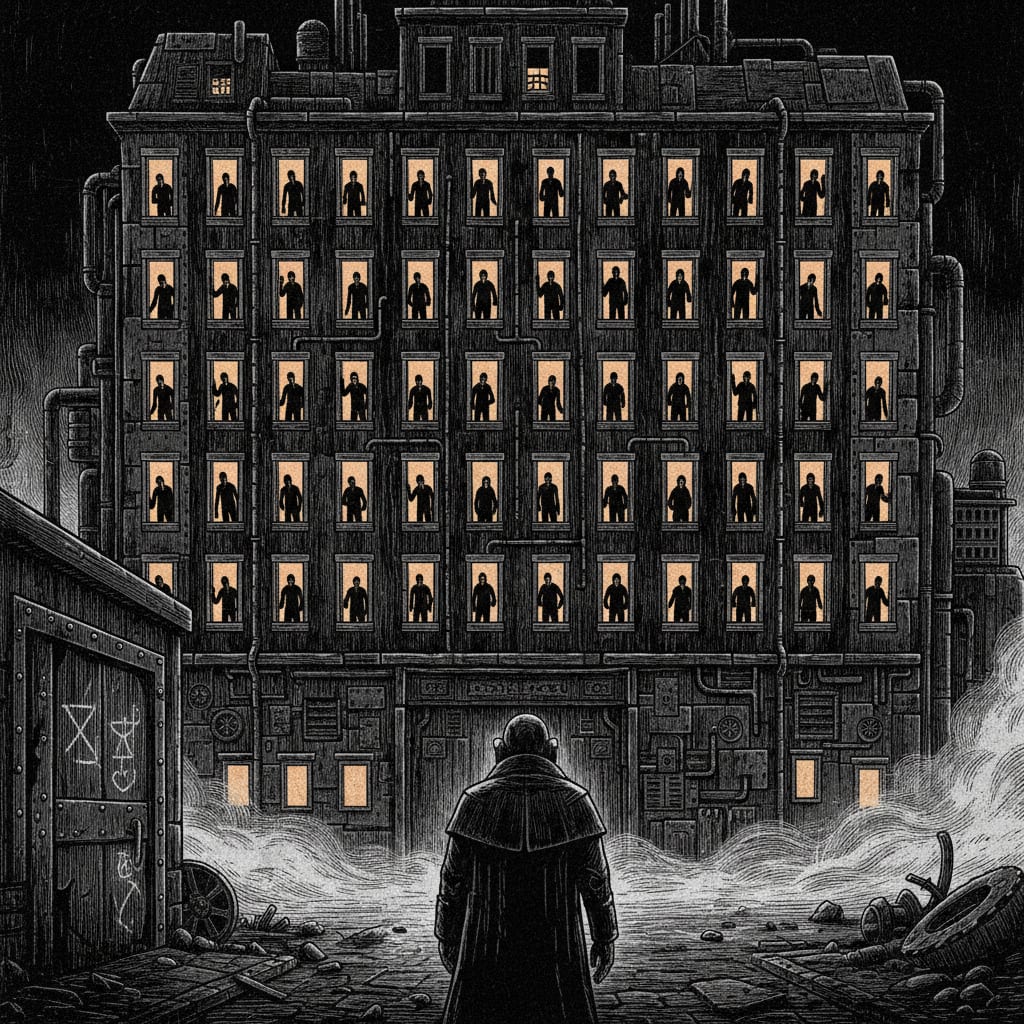
The Auditor's field wisdom, carved into training slates and whispered in sector offices, runs: "Silence eats." A deadzone left too long breeds something. Infrastructure failure or demonic cultivation — the distinction matters to theologians. The Auditor standing in a stairwell at midnight, counting windows that glow with a light that has no source, does not care about the distinction. The Auditor cares about getting out.
#On the Brand
The Brand Authority Officer carries the iron. The Auditor carries the order. The distinction matters to the Auditor; the branded resident does not care who holds which instrument.
Sector branding is public punishment: the district's compliance board receives a mark — bruised purple, visible from the main thoroughfare — declaring that this neighbourhood has failed to meet the minimum Choir Rate for three consecutive broadcast windows. The mark stays until the rate recovers. While it stays, ration priority drops, curfew extends, and the district's name appears on the Bureau of Purity's attention list, which is a list no district has ever wanted to appear on and from which no district has ever been removed as quickly as it would like.
The Auditor who issues the brand order knows what it means. Ration downgrade means children eat less. Curfew extension means workers earn less. The Bureau of Purity's attention means searches, interrogations, and the particular silence that falls over a neighbourhood when the white mantles arrive and begin asking questions in rooms where the answers are recorded and the recording is never shown to the person who gave it.
The Auditor stamps the order. The Brand Authority Officer heats the iron. The board is marked. The neighbourhood learns to open its windows wider.

#On the Costs
The profession consumes its practitioners in small daily cuts. A Markcounter learns to see people as compliance probabilities. A stairwell is a column of numbers. A face is an excuse slip waiting to be adjudicated. The stress tells accumulate: compulsive counting, tapping the receiver in empty rooms, checking windows reflexively on days off, insomnia in quiet places because quiet has become a warning.
Bell-sickness — metric paranoia — sets in after three to five years. The Auditor cannot stop counting. Cannot stop calculating the Choir Rate of every room he enters, every gathering he attends, every funeral where the mourners stand in rows that his hands itch to tally. He begins to suspect the numbers of speaking to him. He begins to suspect that perfect compliance conceals something, and imperfect compliance conceals something else, and the gap between the two is where the Enemy lives.
The burnout endpoint is specific and recognized in Bureau medical files, though the Bureau uses the clinical term "Metric Saturation Syndrome" and the street uses the blunter "gone to numbers." The Auditor can no longer see a person without assigning them a probability. He stamps in his sleep. His ledger becomes a diary. His diary becomes a ledger.
The slogans on the training slates say it clean. "Windows sing." Compliance visible. "Brand before bloom." Punish early before heresy takes root. "Don't chase perfection." Perfect numbers trigger audits — from above, from the men who audit auditors, from the Inquisitors who audit the men who audit auditors. And the oldest, scratched into a stone lintel above the first sector office in Strasbourg and never repainted because repainting would require acknowledging what it says:
"A quiet block is a hungry block."
The Bureau has never contradicted this. The Bureau has also never confirmed it. The slogan sits in the same administrative purgatory as the Auditor himself: useful, unacknowledged, and too deeply embedded in the machinery to remove without breaking something the Bureau would prefer to keep running.