
#On the Men Who Keep the Word Forward
“Static is where the Enemy prays.” — Broadcast Directorate slate, issued with mask and cough
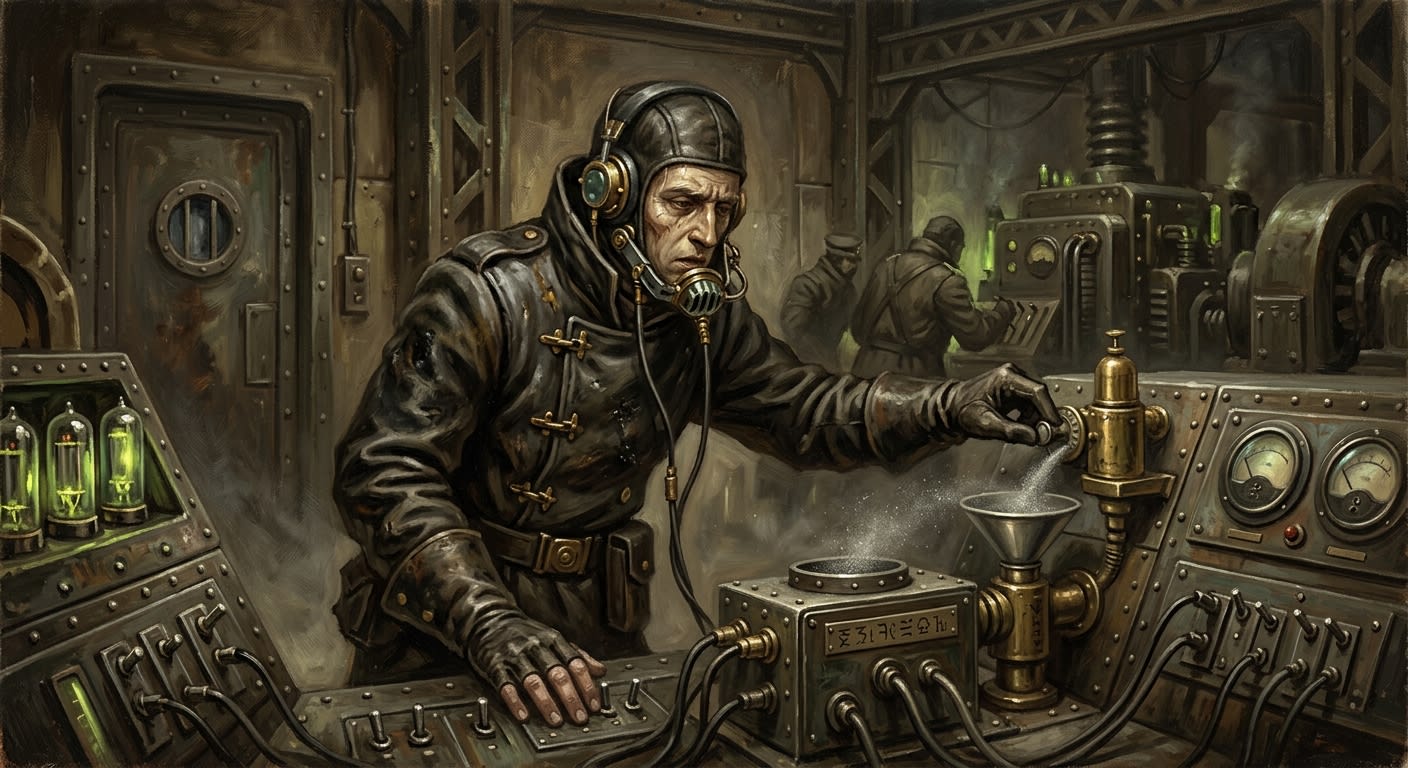
The Orison Signal Engineer keeps the Synod’s voice intact over distance, which is a modest phrase for a profession that daily prevents sermons from becoming riots, ration schedules from becoming hunger-marches, and casualty lists from whispering back the names of the living. Bells rule hours. Engineers rule reach. Between Strasbourg’s decree and the mud-hut receiver at Bastion-Brest lies a corridor of copper, saint-dust, wax seals, hot coils, tired lungs, and men with enough technical pride to confuse poisoning with vocation.
They are formally styled Reliquary Modulation Technicians, Orison Transmission Wardens, Sanctified Carrier Engineers. The street, being wiser and less afraid of syllables, calls them Dustcasters, Choirwires, Static Priests, Bone-Breathers, Saint Snorters, Broadcast Liars. I prefer Dustcaster. It has the mercy of accuracy and the cruelty of sounding faintly ridiculous.
Their charge is simple: transmit approved speech without inversion. Their work is impossible: the air hates purity, the Enemy loves repetition, and every Bureau that writes a message believes its urgency supersedes physics. War bulletins, curfew decrees, convoy routings, sainthood calendars, execution notices, ration adjustments, Sky-Sermon attendance marks, and the daily Orison Hour pass through their hands. If the feed arrives clean, no one thanks them. If the feed arrives corrupted, men die while auditors sharpen pencils.
An Orison Signal Engineer is half priest, half mechanic, and half condemned lung. This arithmetic is approved by the Bureau of Orison and Song.
#On the Origin of Dust and Authority
The Bureau of Orison and Song was chartered in A.S. 92 under the Concordat apparatus, though like every Bureau with ambition it claims ancestry older than its seal. Its public inscription gives the theology: The saints carried the Word through death. Their dust carries it through static. I admire the line. It is concise, hideous, profitable.
Early broadcast systems were too honest for Synod work. They carried sound and nothing more. Rebel towers imitated them. Foreign choristers jammed them. Pale Chanters and other acoustical vermin learned to twist a carrier wave until comfort became panic and command became appetite. A ration notice, inverted at the third syllable, could send a ward into bread-riot. A casualty roll, bent through an unhymn, could make widows hear their husbands asking to be let in. A prayer, half-heard, becomes heresy with excellent posture.
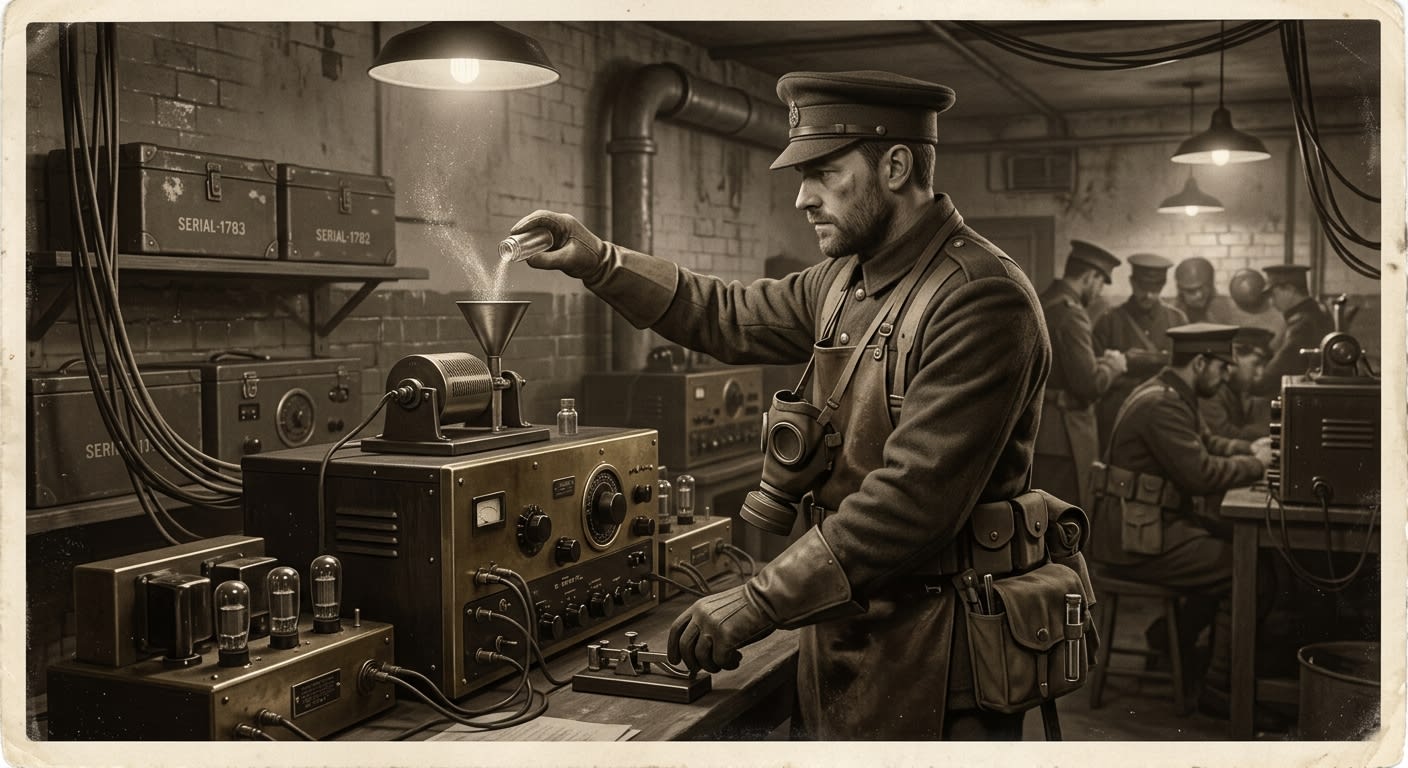
The field solution began as desperation. Engineers at forward repeaters mixed authenticated relic powder into the carrier apparatus: bone ash, grave wax, sanctified salts, powdered martyr-scrap from whatever reliquary had recently exploded within salvage range. The dust altered the resonance. The inversion weakened. The signal held. The Bureau saw, measured, doubted, sanctified, taxed, and monopolized.
The supply now runs through the saint-dust economy: salvage sorties in corpse-mud, grading halls such as the Cooperage of Mournwater, casks of slurry stamped by purity clerks, sealed urns distributed to broadcast houses, line repeaters, port fog towers, and the bellway apparatus of the Vigil Arks. Every grain is counted. Every shortage is explained. Every explanation leaves someone reassigned to a place where the fog has teeth.
Saint Damaris of the Coil (Unregistered), patroness of the profession, is depicted with copper spiral in one hand and urn in the other. She is a fraud with candles, and therefore a saint of the useful kind. The Bureau of Relics has authenticated her urn four times from four contradictory provenances. Engineers pray to her anyway. A man coughing bone from his lungs deserves whatever fictional auntie helps him stand at the console.
#On the Coil Room
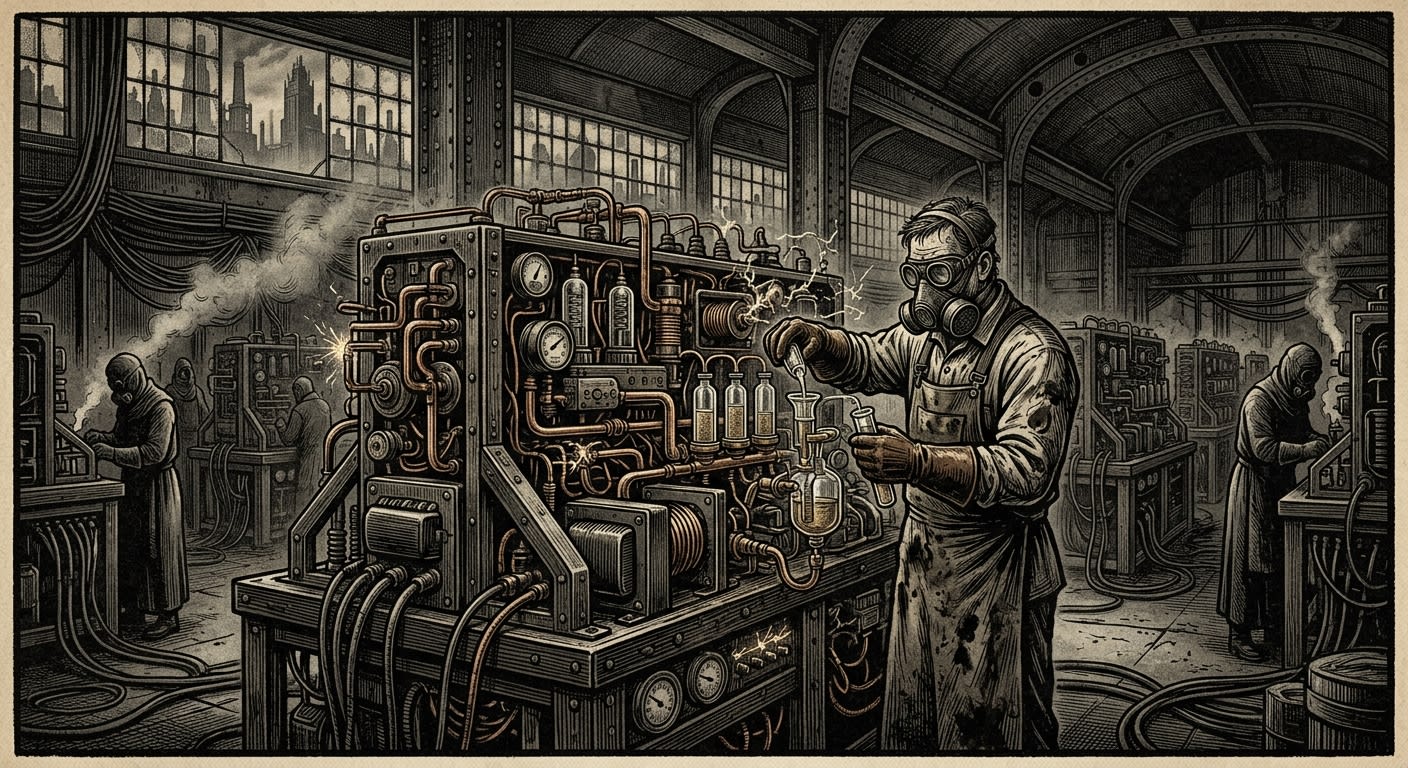
A broadcast house is a crypt that learned mathematics. The coil room smells of ozone, hot varnish, wax, salt, sweat trapped beneath masks, and the sweet dry rot of saint-dust drifting through poor seals. Copper banks hum against stone walls. Arc flashes light the operators in brief little judgments. Prayer loops play low for calibration, not devotion, though the distinction grows thin after midnight.
The shift begins with saltwater. Hands washed. Mask checked. Urn tapped three times. Forward phrase recited. Tuning fork struck and held near the ear until its decay is declared clean. A senior engineer unlocks the saint cage, always with a witness present. No urn is opened alone. The story says an engineer once did so, and the dust formed a word in the air that followed him into every broadcast for seven years. The official manual calls this apocryphal. The manual also requires two witnesses.
The work proceeds in seven acts, because the Synod distrusts any procedure that cannot be made liturgical. Verify message authenticity: wax, cipher, seal, witness mark. Select dust blend: saint-grade for doctrinal broadcasts, front-grade for military orders, port-grade for fog towers, emergency ash if one wishes to die investigated. Calibrate the carrier: frequency, guard band, cadence spine. Inject dust through venturi or coil-film method. Run a test prayer packet. Transmit. Monitor. Log all variance in enough detail to hang the junior if required.
Morning brings dawn briefs and casualty corrections. Midday brings ration schedules, convoy routing, and bribes from district bosses who want a cleaner feed than their rivals. Late day belongs to urn swaps and paper reconciliation with clerks from the Bureau of Records, who count saint-dust with an intimacy that would shame a miser. Night is unhymn hour. Consonants arrive late. Static thickens into almost-choirs. A soft under-voice says a name that may be yours if you are vain enough to listen.
The profession’s first survival rule is simple: if you hear your name, log nothing.
#On the Orison Hour
The Orison Hour is the Broadcast Directorate’s daily act of dominion. Parish posters call it a prayer programme. They are selling obedience in smaller print. It is the empire checking its own pulse and discovering, with relief or fraud, that the pulse still obeys schedule.
At the appointed hour, transmission houses from Strasbourg to Constantinople release the approved packet: prayer, ration advisory, curfew amendments, casualty roll, work quota adjustments, feast calendar, doctrinal correction, and whatever little moral cudgel the Bureau of Doctrine has chosen to hide in the blessing. Repeater stations along the Sagittal Line catch and cast the signal forward. Pilgrim waystations bow their receivers toward it. Trench officers hold men still enough to hear. Kitchens wait on the feed before unlocking flour. In some districts, mothers set infants down at the first tone, because even crying must learn precedence.
A clean Orison Hour steadies the realm. A dirty one fattens Hell.
The Engineer must make the official voice irresistible enough to be obeyed and clean enough not to devour the listener. Propaganda, in lesser states, is simply speech with a uniform. In the Synod it is speech with relic particulate in its teeth. A decree laced properly settles into the ear like doctrine remembered from childhood. A decree laced poorly blooms into headache, weeping, vomiting, sudden piety, or the conviction that one’s dead sister is speaking beneath the third verse.
Earlier training circulars described saint-dusted broadcast as “pure communication.”
Corrected: saint-dusted broadcast is sanctioned communication. Purity remains subject to dust grade, coil condition, listener susceptibility, and political requirement. The prior adjective implied a theological confidence the equipment did not earn.
The Engineer is judged by boredom. If no district riots, if no front order reverses, if no ward reports hearing names-in-static, if no auditor finds the dust ledger too light by even a widow’s pinch, the day is praised as uneventful. Uneventful days are the most expensive product in the Theocracy.
#On Unhymns and Inversion
An unhymn (Unregistered) is a prayer turned inside out and taught to hunt. The Bureau’s polite term is counter-hymn, introduced by stamped correction because even the Enemy’s perversions must apparently be treated as structurally reverent. Field crews still say unhymn. Field crews have heard them.
The Pale Chanter does not merely jam a broadcast. Jamming is crude. A jam says nothing. The unhymn says almost the same thing at the wrong angle. Comfort becomes surrender. Vigilance becomes exhaustion. Obedience becomes hunger for a different master. The carrier remains intelligible, which is the danger. A man rejects noise. He obeys meaning.
The Engineer watches for onset: backward consonants, timing drift, chorus-phase anomalies, warmth along the injector line, listener reports of sweetness in the teeth, dogs facing receivers, operators speaking in meter without noticing. A soft inversion can pass a test prayer and still carry a hook. A hard inversion announces itself by breaking glass, spoiling milk, or causing an entire district to kneel toward the wrong horizon.
Countermeasures are practical theology. Increase dust fraction, adjust guard band, overlay counter-orison, introduce bell reference, cut and reseal the packet, kill the repeater if capture is suspected. The last instruction is the cleanest. If a repeater goes quiet, assume capture. If a repeater comes back too clean, assume worse.
The First Unhymn Winter remains the profession’s classroom ghost. A rival city inverted ration broadcasts, and thousands starved under “authorized” panic before the feed was traced. The Repeater Massacre (Unregistered) taught the second lesson: infiltrators captured a front station and transmitted three hours of orders before anyone noticed the wax seals had been warmed and reset. The engineers assigned to the station were executed as accomplices. Their logs were later found to contain warnings. The warnings were filed. The executions were not reversed. Paper is not resurrection.
#On Dust, Lungs, and the Price of Faith
Saint-dust works. This is the sentence that ruins every argument against it.
It also kills the people who use it. The mask filters clog. The seals crack. A rushed urn swap sends powder into the room like grey incense. A coil bloom vaporizes residue and drives it through cloth, leather, beard, nostril, tooth gap. Engineers develop a chronic ash cough, red-rimmed eyes, burn dots on the fingers, bruises where mask straps bite the face. The old ones spit black in the morning and call it proof of service. The young ones find blood on their sleeves and call it a temporary irritation, because youth is the most common form of heresy.
The internal factions despise one another with the warmth of family. Dust-purists demand heavier blends: more saint, more shield, more holiness in the carrier. Coil-pragmatists answer that over-dusting clogs the banks, triggers choir-bloom, wrecks filters, and turns operators into reliquary furniture. Archive-loyalists demand exact logs. Field engineers demand messages that work while shells are rearranging the roof. Official house crews sneer at deniable night broadcasters. Night broadcasters make twice the money and die with better secrets.
Scarcity breeds commerce. A clean feed is political. Merchants pay for cleaner announcements in market districts. Ward bosses pay for a rival’s signal to arrive with a little more hiss. Underworld brokers pay for ghost packets hidden under the Orison cadence. A ghost packet can carry a true warning, a false order, a love note, a death mark, or a map to a door that opens only when the hymn reaches the fifth stress. The Bureau condemns such insertions while employing black-broadcast architects to do them with better stationery.
The Engineer’s moral wound is not that he lies. Everyone in Strasbourg lies; we call it drafting. His wound is that he can make the lie arrive as prayer.
#On Saint Damaris, the Fork, and Other Necessary Frauds
The rites of the profession are intimate and faintly comic, as all survival rites are when observed by someone not currently dying. Start-shift saltwater. Three taps on the urn. Fork struck against copper. Forward phrase. Mask seal check. End-shift note burning, ledger sealing, black-dust spitting, filter swap, and sleep beside a low hum machine so silence will not invite dreams.
The charms are better than the manuals. A wax saint token inside the mask. A bell sliver in the pocket. Diesel scent on the sleeves to “mask listening.” Ash-mark on the throat. One clean fork locked away where no auditor knows to look. A pocket urn sliver, authorized or stolen, for field repairs and private terror. Engineers are skeptics by training and fetishists by lunchtime.
Saint Damaris receives the coughs. Her image hangs in coil rooms: spiral, urn, calm expression of a woman who has never cleaned an injector during shellfire. The Bureau says she was an early martyr of transmission, burned when a coil failed at Strasbourg. Another file says she died at Mournwater blessing dust casks. A third says her feast was added to the calendar before any person by that name existed. The engineers care only that her small painted eyes look sympathetic through fogged glass.
A prior Broadcast Directorate primer identified Saint Damaris of the Coil as “historically secure.”
Revised: Saint Damaris is devotionally secure. Historical security is neither required for patronage nor desirable in a profession already overburdened by facts.
Certain taboos hold everywhere. Never use unverified dust. Never broadcast without a witness seal. Never speak true names during calibration. Never admit inversion hints aloud until you know who owns the audit. Never open an urn alone. Never chase the chorus.
That last one is not superstition. The chorus wants to be followed. A young operator hears pattern in static, adjusts to catch it, hears another layer, adjusts again, and by dawn he has tuned the whole room toward a voice that has been waiting for someone clever enough to invite it. Technical excellence is often damnation with cleaner handwriting.
#On Failures, Punishments, and the Uses of Blame
When a transmission fails, the Bureau conducts a seal walk. Urn seals first. Coil wear second. Dust ledger third. Listener testimony fourth, unless listener testimony is inconvenient, in which case it becomes crowd emotion and is handed to the Bureau of Purity for burning into coherence. The audit begins with exceptions: emergency dust use, unexplained filter swaps, phase drift, late filings, unauthorized silence, any note beginning “minor anomaly.”
Punishments range from the comic to the terminal. Demotion to port fog duty, where sea-static eats thought and every gull sounds accusatory. Ritual penance in a coil room, mask removed for the prayer. Reassignment to a frontline repeater whose coordinates the Enemy already knows. Immurement for willful inversion. Erasure after public catastrophe. The Bureau rarely kills a whole crew when one runner can be blamed for a broken seal. Efficiency is mercy with a knife under it.
INCIDENT FILE — PORT FOG TOWER 3, A.S. 200: Orison Hour transmitted clean by all machine measures. Listener reports: 417 cases of personal-name undervoice; 62 attempts to answer receiver; 9 drownings; 1 infant repeating curfew decree in adult male register. Dust ledger reconciled. Coil temperature stable. Engineer on duty logged variance as “pleasant.” Engineer reassigned to ████████. Tower remains active.
The worst catastrophes are those that leave perfect paperwork. Inversion visible in the logs can be explained. Inversion absent from the logs implies either miracle, enemy competence, or successful falsification. Of the three, falsification is most comforting because it permits arrests.
The engineers know this. They keep private notebooks, burn scrap notes, hide clean forks, trade filter stock like coin, and cultivate one clerk in Records who will remember them kindly if the feed blooms and the Provosts come. This is not cowardice. This is professional literacy.
#On the Present Static
As of A.S. 201, Orison Signal Engineers serve in every major transmission house, bastion office, pilgrim-route repeater, port fog tower, and aerial broadcast apparatus the Bureau can still afford to call operational. The Cloister of Calibrated Breath in Strasbourg issues procedures. The Line issues contradictions. The coils obey whichever is louder.
The present anxieties are three.
The first is the Mirror Choir, which inserts micro-discords into approved sequences and lets accumulation do what a bomb would do less elegantly. A quarter-tone here. A breath where sustain is prescribed. A dust blend that settles too smoothly. Essen’s Resonance Blooms have been blamed on them often enough that the accusation has become doctrine by repetition.
The second is the Grey at Bastion-Königsberg, singing the Bureau’s hymns back before broadcast schedule. Anticipation is worse than mimicry. A copy flatters the original. A thing that sings your sermon before you transmit it has either intercepted time or read your drafts. Both possibilities offend me personally.
The third is the question every Dustcaster coughs around: saint-dust shield or saint-dust cage? Does it protect the signal from hostile cadence, or does it teach every receiver in the Theocracy to accept only the voice laced with powdered dead? The Bureau has determined this question unproductive. That means it is alive.
At Shipka, Syrionic fog deadens Orison packets unless stimulant hymns are overlaid until the operators bleed from the nose. At Irongate, the Gasket Choir interferes with carrier alignment and makes clean feeds arrive with mountain-throat undertones. At Constantinople, the Saint Barachiel still broadcasts above the Bosphorus, and every engineer assigned to its relay house knows the date of the A.S. 199 Broadcast without needing the ledger opened. At the ports, fog towers report more soft inversions each quarter and fewer engineers willing to call them by name.
The Orison Signal Engineer works anyway. He washes, taps, seals, breathes shallow, feeds dust to the coil, watches the needle tremble, and sends the sanctioned voice into a world that would rather hear anything else.
Keep it forward. Seal first. Breathe later.