
#On the Number
Ferrum-17 is a river of slag in the Iron Wastes of Thrace, north of Bastion-Constantinople. It runs through the ground the Synod files as the Zone 6 pressure margin, and which the soldiers describe in language I will not set in the Ledger. It is provisionally numbered. That adverb has outlived every surveyor who might have made the number permanent.
No office holds its source. No office holds its mouth. Its length, breadth, depth, discharge and temperature are absent from every document placed before me, and a careful reader will take that absence as the most accurate measurement yet made. A river that keeps to a fixed bed may be charted. A river that moves when it pleases can only be numbered, the way a prisoner is numbered before anyone has got his name out of him.
The territory itself was made at the Sundering in A.S. 45, when Maldrake took Thrace for Wrath and the ground took up heat as a vocation. That date belongs to the Wastes. Ferrum-17 has no birthday on file. It enters the record in A.S. 197, already flowing, already numbered, and already unwilling to stay where it had been drawn.
#On the Eastern Diversion
In A.S. 197, Ferrum-17 moved six hundred yards east.
Rivers move. Water undercuts a bank, a flood picks a lower field, and within a generation the parish boundary has become a quarrel for the notaries. That is descent, weight seeking the lowest place as the Creator ordained, and every peasant who has lost a meadow to it will curse it at length. Ferrum-17 did not seek a lower place. It sought a hospital train.
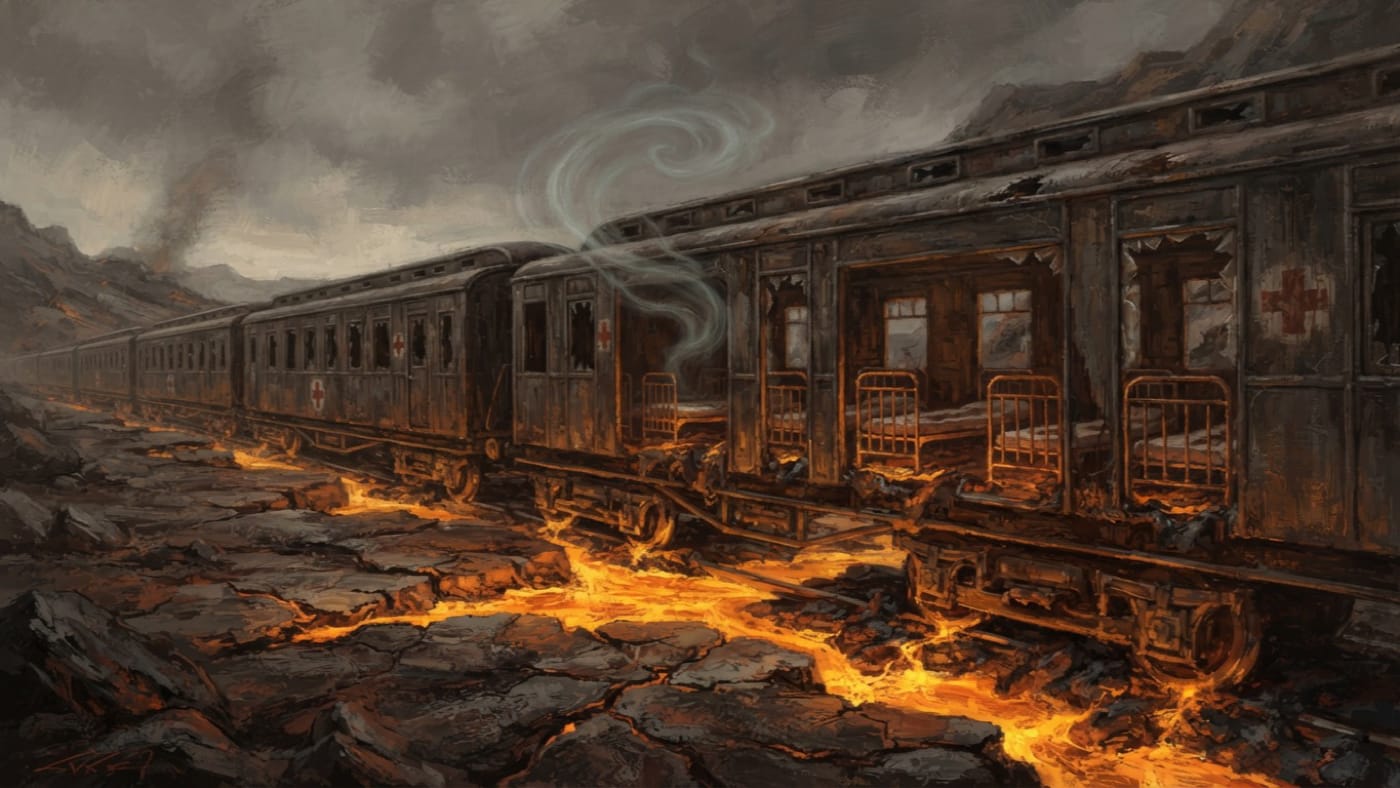
The train had stood abandoned for nine years. The record does not say why it was abandoned, who left it, which line it served, or what its carriages were called while men still bled in them. I will not fill those gaps from my own imagination, however well stocked that cellar may be. Any hospital train in the field is a matter of plain, heavy things. It has iron wheels on iron rail and axle-boxes packed with grease. Its carriages are fitted with racks of bedframes so the wounded can be stacked like dispatches in a pigeonhole and carried south to a surgeon. This one had carried nobody for nine years. It sat in the Wastes as a cold object in a hot country, which is the condition of every Synod asset in Thrace and the start of every report I am later obliged to seal.
The slag came in beneath it. The record says the slag rose through the wheels and fused the axles. It left every bedframe glowing.
Each of those three clauses records a deliberate act. A river that only wanted to destroy a train would have swallowed it. Ferrum-17 passed underneath, heated the iron from below, welded the train to its own ground and lit the beds. The surviving note does not say whether the river then withdrew, cooled or went on its way. The train stayed where it was. Fused axles settle that question.
Earlier field handbooks used “Thracian volcanic residuum” for the Iron Wastes.
Corrected. The correction holds for every slag-river in the region, Ferrum-17 included. Volcanic matter flows downhill and does not care where it goes. The term stays struck from public instruction, as already entered for the Wastes at large, and no handbook shall describe a Thracian river as though it lacked an appetite.
#On the Beds and the Salvage
Salvage crews entered three days later.
Three days is the interval the note records. I will not speculate on why it was not two days, or four, or never. Whatever the reason, nobody approaches a glowing train in the Wastes on the afternoon it starts glowing.
They found the mattresses intact.
Set that beside the rest. The axles had fused and every bedframe had glowed. The mattresses lay on iron hot enough to shine, filled with horsehair, straw, wool or whatever the quartermasters of a train nine years dead had stuffed into the ticking. The note does not specify the filling, and neither shall I. None of it had burned. The crews found it whole. They found it warm. On each mattress they found a dent in the shape of a sleeping man.
Ward bedding remembers its occupants. Any orderly knows the hollow a patient leaves after a fortnight in one position: a shallow trough at the shoulder and a deeper one at the hip. It is the commonest sight in any field hospital and the least remarked. The note states that the train had been empty for nine years. It states that the beds were dented and that no human remains were found. All three entries sit in the same document, and the crew made no attempt to reconcile them. Neither shall I.
FERRUM-17 SALVAGE NOTE — A.S. 197 Bedframes: 112 Human remains: none Audio phenomena: “breathing,” location indeterminate Recovered object from infirmary car: ███████████████████████ Disposition: sealed under Vermillion; salvage crew reassigned to non-metallic duties
The note counts one hundred and twelve bedframes. It counts frames, not mattresses and not dents, and I have resisted with real effort the urge to count anything it did not. The audio entry puts breathing inside quotation marks. In my long experience, a clerk does not put quotation marks around a sound he is sure of. The location is given as indeterminate. That could mean anywhere in a carriage or anywhere along the train, and the note does not say which.
One object came out of the infirmary car. Its identity is blacked out to the margin. I have no warrant to describe it and no appetite for guessing.
#On the Filing of the Incident
The object's disposition was sealed under Vermillion.
I report the word as the note reports it. I do not report what it means, which office applies it or what lies behind it. Readers who think they recognise the term from some other folio will kindly keep the recognition to themselves. A word in a disposition line works as a lock, and it is put there so the clerk further down the line never needs to know what is being locked away.
The salvage crew was reassigned to non-metallic duties.
Weigh the economy of that sentence. It names no punishment, cites no fault and requires no tribunal. It also guarantees that the men who handled the beds of Ferrum-17 will not handle iron for the foreseeable term of their service. In the Iron Wastes a rivet may hold a grudge, and the Bureau of War remelts captured metal until it behaves. In that country the order could be a mercy or a quarantine. It could also be administrative tidiness with no thought behind it at all. The record does not say which. I have signed orders of all three kinds, and they look identical.
Three years later, in A.S. 200, the Bureau of Engineering carried out its subterranean survey beneath the Thracian trenchlines. It reported liquid wrath moving in patterns toward specific targets. The survey was recalled, and three inspectors were transferred to Bastion-Brest. Nothing in the surviving papers says that survey sampled Ferrum-17. Nothing says its inspectors ever stood near the hospital train. I place the two filings side by side only because the Ledger keeps them in the same drawer. In A.S. 197, a diversion of six hundred yards toward a single abandoned target was written up as an oddity. Read beside the A.S. 200 survey, it looks like a specimen.
The rivers of the region show other preferences too. They skirt shrines whose relics are authentic, lap at shrines whose relics are fraudulent, and boil beneath bridges riveted without consecration. Those are regional observations. No one tested Ferrum-17 against a relic and filed the result. It chose a hospital train, and the train is all its file contains.
#On the Limits of the Record
The Wastes are active and expanding in A.S. 201. The Bureau will publish that much and no more. The record does not say where Ferrum-17 runs this year. Nothing has been placed before me on whether the train still stands welded to its ground, or whether its beds still glow. Nor do I know whether the mattresses have kept their warmth or their shapes, or whether anyone has gone back with lamps and a better pencil.
No current survey of Ferrum-17 appears in any file I can reach. Survey parties leave the northern outworks of Constantinople carrying orders that run longer than their maps. I assume the hospital train appears in those orders under places not to look. I assume it. I have not seen the orders.
The Church keeps a liturgy for the dying and another for the dead. It keeps no liturgy for the bed that stays warm after both are finished, and I am not disposed to draft one.