
#On the Country That Became a Furnace
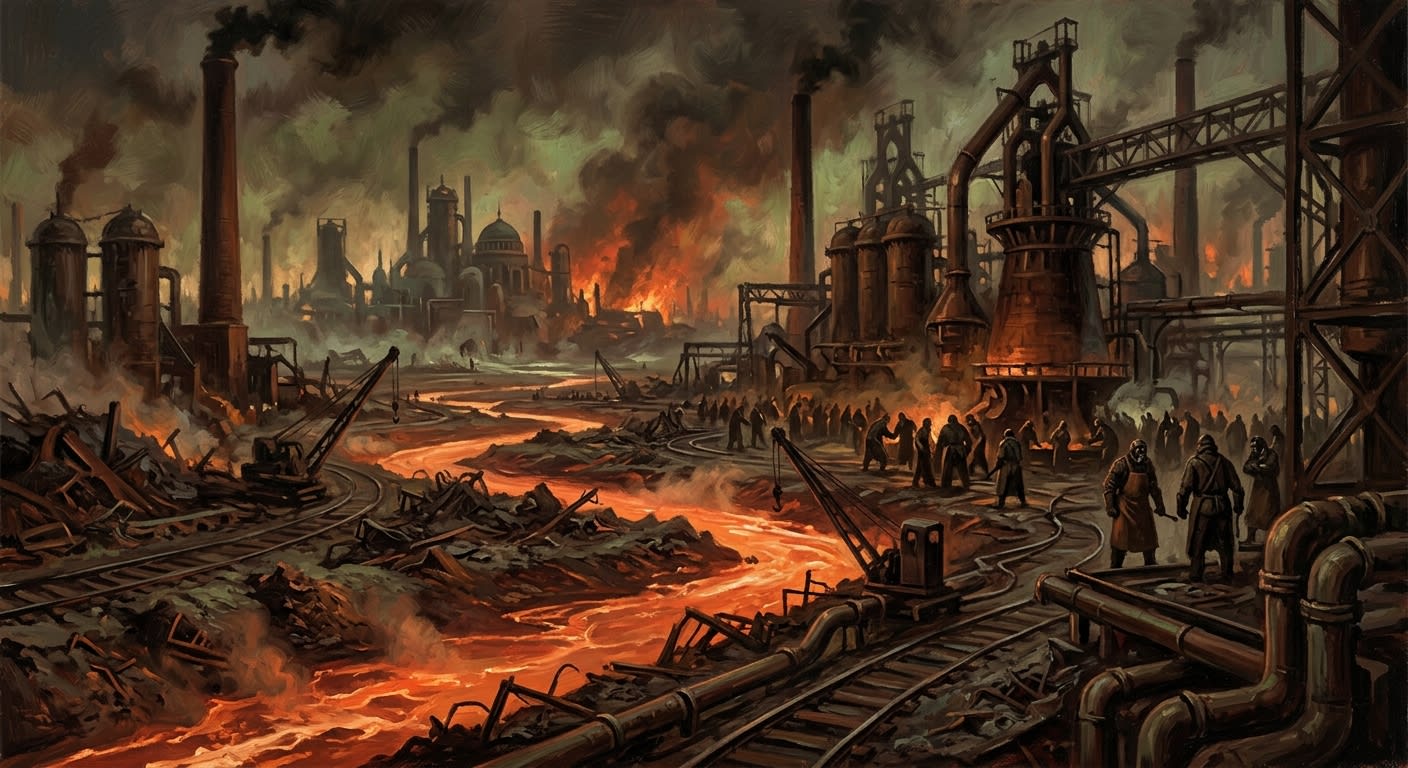
The Iron Wastes are the eastern wound of Thrace rendered in slag, glass, iron, and deliberate heat: a front territory north of Bastion-Constantinople, east of mercy, west of whatever name Hell gives to home. Once there were plains here. Once there were orchards, roads, parish stones, riverbeds, border markets, threshing floors, and villages whose parish ledgers waited, in charming provincial confidence, to be integrated into the eventual continental registry.
Then the Sundering opened the East. Maldrake emerged in Thrace. The ore screamed. The soil remembered every battle ever fought upon it and chose the hottest interpretation.
Burnt land cools. The Wastes do not. Their rivers are slag-rivers, thick and red-black, moving with the awful patience of molten law. Their fields are plates of glass crust over cavities that breathe furnace-air through cracks shaped like wounds. Their hills are iron blisters. Their rain falls as cinders, needle filings, or ash that adheres to teeth. Wind crossing the Wastes carries flakes of cooled metal that cut cloth, skin, prayer flags, and the optimism of junior officers.
#On the Making of the Wastes
The Wastes began as consequence. They continue as policy.
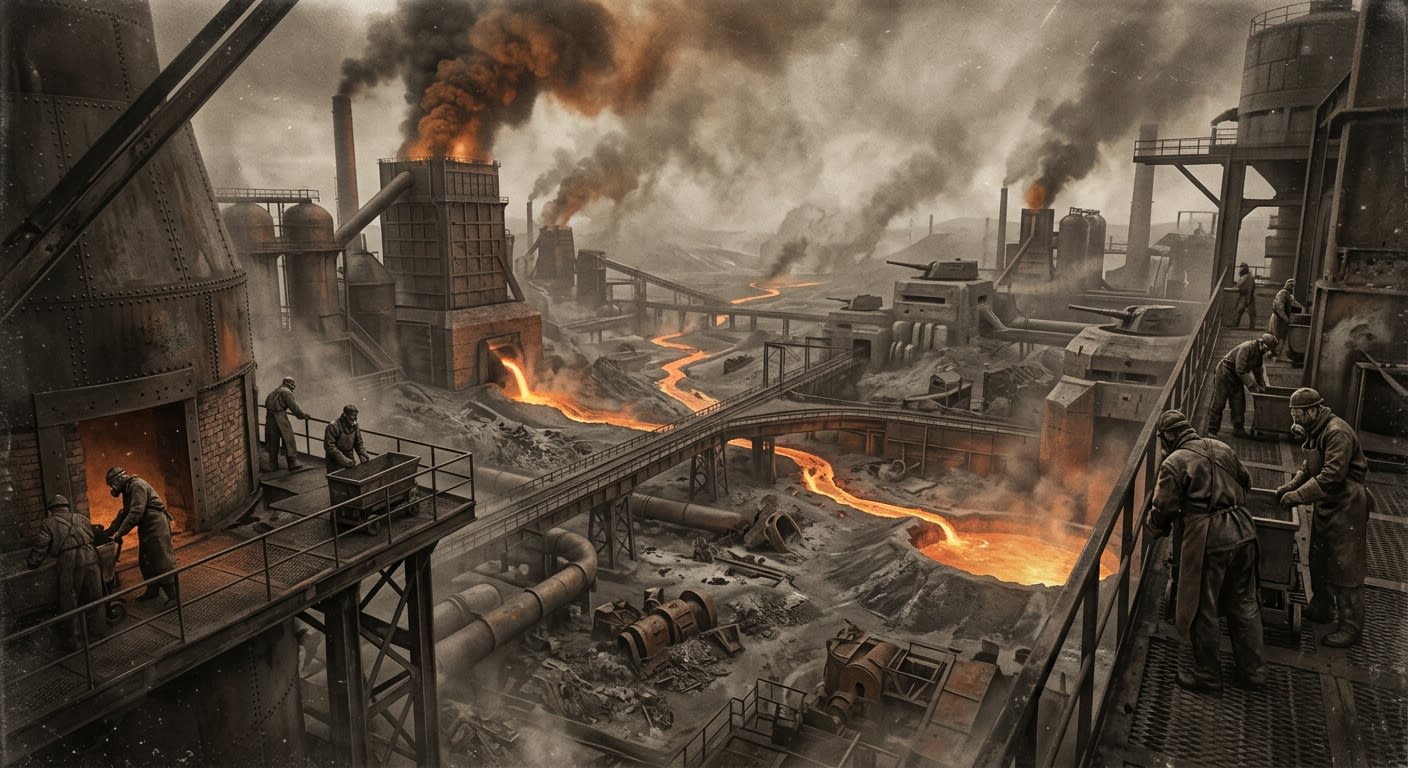
At A.S. 45, when the Balkans cracked and the Seven Sin-Generals walked, Thrace received Wrath first. The event did not resemble invasion in the old military sense. An army enters, consumes provisions, occupies roads, and contends with weather. Maldrake's arrival rewrote weather as ordnance. Fire fell from clean sky. Ore seams rose through soil as if called by bell. Buried weapons sweated rust, then heat, then language. Rationalist artillery crews on the Iron Plains discovered that brass is only obedient until a greater furnace gives it different instructions.
The first reports called the affected territory the Thracian Burn. Then the Slag Fields. Then Operational Zone Ferrum-North. Each designation proved too small, too tidy, too eager to pretend that the thing named was passive. The term Iron Wastes entered soldier speech after the Year of Ash Rain, A.S. 143, when Maldrake ignited the Thracian forests and ash fell on Constantinople for nine months. A landscape that burns trees becomes a burn. A landscape that burns stone becomes a Waste.
By A.S. 162, when the Black Sea Armada tested the Bosphorus and the Chain of Saint Anakletos burned white against demon hulls, the northern approaches had already become metallic. By A.S. 170, during the Vigil of the Hollowed, trenches cut into the northern theatre struck veins of soft iron that bled upward around spades. By A.S. 189, when the Bureau of Engineering dispatched Surveyor-Lieutenant Hadrien Vesk to measure the western thermal gradient, the Wastes had achieved their current insolence.
Vesk's instruments melted before readings could be taken. The Bureau reprimanded him for loss of property. This is why I admire the Bureau of Engineering. No demon, no furnace, no theological collapse can distract it from equipment accountability.
Earlier field handbooks used “Thracian volcanic residuum” for the Iron Wastes.
Corrected. Volcanoes do not route toward artillery parks, alter course around shrines, or pause beneath mess tents until the officers sit down. The term is hereby struck from public instruction and retained only as evidence that geologists should be supervised by chaplains.
#On the Slag-Rivers
The slag-rivers (Unregistered) are the Wastes' veins. They move beneath the crust and above it, along channels that begin like riverbeds and end like accusations. Their surface wrinkles, plates, cracks, and re-melts. Iron clots the size of wagons drift in them, turning as they pass, sometimes bearing marks that resemble old regimental numbers, saint sigils, ration stamps, or faces pressed from the inside of cooling metal.
A natural river seeks descent. A slag-river seeks targets.
The Bureau of Engineering detected routing behaviour beneath the Thracian trenchlines in A.S. 200. The phrase appears in the recalled survey: liquid wrath moving in patterns toward specific targets. Three inspectors were transferred to Bastion-Brest after filing the report. The transfer was called career development. Brest, being a place where the mud has teeth and the Bug River remembers every corpse, received this compliment with appropriate silence.
The rivers avoid some ground. They circle shrines whose relics are authentic, lap eagerly at shrines whose relics are fraudulent, and boil under bridges built with unconsecrated rivets. One river, provisionally numbered Ferrum-17, diverted six hundred yards east in A.S. 197 to pass beneath an abandoned hospital train. The train had been empty for nine years. The slag rose through the wheels, fused the axles, and left every bedframe glowing. When salvage crews entered three days later, the mattresses were intact and warm, each dented in the shape of a sleeping man.
FERRUM-17 SALVAGE NOTE — A.S. 197 Bedframes: 112 Human remains: none Audio phenomena: “breathing,” location indeterminate Recovered object from infirmary car: ███████████████████████ Disposition: sealed under Vermillion; salvage crew reassigned to non-metallic duties
The Wastes do not waste cruelty on spectacle alone. They hunt structures. Pontoon roads sag before the heat reaches them. Rail lines laid toward the forward observation posts twist overnight into cursive that no approved office will translate. Piles hammered into the crust return in the morning sharpened and pointed west. The Bureau of War has ordered all captured iron from the sector melted, blessed, remelted, sung over, and stamped. This produces clean ingots approximately four times in seven. The other three times, the ingot grows warm when officers argue nearby.
#On the Surveyors and Their Limits
The Bureau of Engineering has made nine formal attempts to measure the Wastes' total area since A.S. 178. Four ended in incomplete triangulation. Two ended in personnel loss. One ended in a map whose scale altered when unfolded. One ended in the instruments melting, as already noted. The most recent, the A.S. 200 subterranean survey, ended with recall, transfer, and a filing gap so rectangular that one can admire its workmanship.
Survey parties depart from the Constantinople northern outworks with water, cold iron instruments, relay flags, hymn-compasses, sacramental salt, and sealed orders instructing them where not to look. The orders are always longer than the maps. A proper expedition includes one engineer, one assistant engineer, two sappers, a chaplain, a Bellwarden if one can be spared, six infantry escorts, and a clerk whose only task is to record the exact second at which the engineer begins lying to himself.
The Wastes resist measurement in three ways.
First, heat destroys the tools. Brass softens. Glass clouds. Ink boils in its well. Survey chains acquire slack where no link has stretched, then contract around the hand of whoever is foolish enough to hold them.
Second, distance becomes treacherous. Two markers placed a thousand paces apart may be nine hundred paces apart at dawn and twelve hundred by noon. A trench observed from the western parapet appears three miles away until an artillery shell lands short, whereupon the trench is recorded as one mile away and grinning.
Third, the Wastes alter the surveyor's anger. Men who enter irritated return homicidal. Men who enter calm return silent, which the Bureau of Medicine considers preferable and the Bureau of Doctrine considers suspicious. The chaplains prescribe the Doctrine of Cool Hatred: violence in duty, no pleasure in rage, cold hand on hot trigger. The Wastes appreciate instruction. They answer it with steam.
Survey Manual 44-F formerly advised “emotional neutrality” during Thracian exposure.
Corrected. Emotional neutrality is unavailable within range of Wrath phenomena. Current instruction requires cold obedience, confessed anger, and immediate restraint of any soldier whose hand remains clenched after prayer.
#On the Things Built There
No city in the Iron Wastes remains a city in the civic sense. A city requires inhabitants who trade, marry, file complaints, lie about taxes, and make terrible bread. The Wastes contain Crucible Cities, Char Fields, forge-bastions, slag trenches, bone-riveted towers, and fortifications whose purposes change as one approaches them.
The Forge-Pyre Bastion rises somewhere near the Wastes' central heat, if “somewhere” can bear the weight I place upon it. Scouts place it north, then north-east, then directly ahead no matter where they stand. Its anvils ring without pause. At five miles, the ringing becomes almost speech. At three miles, teeth ache. At two miles, men begin answering questions nobody asked.
The Char Fields burn with old wars. Figures move in the flame, engaged in battles without date or enemy. Some wear Rationalist blue-grey. Some wear early Synod rags. Some wear armour that was never issued by any human army. The Bureau of Records attempted identification by silhouette in A.S. 181 and abandoned the effort after a dead standard-bearer turned and saluted the observer by name.
There are also Synod works within the western margin: observation shrines, cooling stations, bell-pits, artillery tables, emergency chapels, and the low iron huts where men wait between bombardments and pretend the walls are not sweating. Some last years. Some last days. One cooling station, Saint Baruch's Cold Table (Unregistered), operated from A.S. 190 to A.S. 199 and produced the best sector readings the Bureau has ever obtained. It was lost when the ground beneath it became a slow fist. The station did not collapse. It closed.
#On the Present Condition
In A.S. 201, the Iron Wastes are expanding. The Bureau will not publish the rate. The Bureau will not publish the current area. The Bureau will not publish the list of specific targets toward which the slag-rivers route. Refusal is information. Silence has dimensions.
The Wastes press Constantinople from the north in Maldrake's season of campaigns, then simmer through the intervals when Kargath's famine takes its turn at the throat of the southern anchor. The two Sin-Generals do not coordinate. Fire leaves ash. Hunger eats ash. Fire returns. The city endures because contempt between devils remains, under current conditions, a load-bearing mercy.
Above the Bosphorus, the Vigil Ark Saint Barachiel blesses the sky. Along the Black Sea, Saints Afloat keep their hulls lashed and their relics dry. On the northern wall of Constantinople, artillery crews watch the plain and count glows. Red for surface flow. White for buried heat. Blue for relic contact. Green for something the Bureau of Engineering refuses to define in official documentation.
The Iron Wastes are a place. The Iron Wastes are also a process. A country becoming weapon, a battlefield becoming factory, a grievance becoming geology. The Bureau of Engineering measures what it can. The Bureau of War shells what it can see. The Bureau of Doctrine stamps what it can bear to admit.