
#On the Survey
"A child whose hunger could be classified could be governed." — from the Codex entry on the Orphanage Registrar
This is a survey made in A.S. 201. It covers what the Codex can still say about the Foundling Winter, and it is short work. The surviving account names the winter and gives it a famine. It fills the winter with abandoned children and ends it with a new column in the ration ledger. The year, the length of the season and the city are missing from every account available to this office. So are the number of the dead, the number of the abandoned and the name of the first clerk to write a code beside a child. I record these gaps here, once and in full, so that no later reader mistakes them for oversights.
The survey works from what remains. That is enough to convict.
#On the Abandonment
The official ancestry of the Registrar's office runs through war. After the Sundering, after the breaches and the long hardening of the Sagittal Line, every bastion and corridor city acquired children whose parents were dead, missing or struck from the rolls. Those are orphans in the plain sense. Someone killed the mother and father. The child was left over.
The Foundling Winter belongs to another ledger. Its children were set down by the living. Famine did that. The account does not record what caused the famine, and I will not supply a blight, a siege or a Sin-General to give the paragraph a villain. Hunger needs no accomplice. It arrives, empties the bread box, and leaves the mathematics to the mother.
The account states that the abandonment was mass abandonment. It does not tell us whether parents left their children at gates or in kitchen queues, or how many went back for them after the thaw. It says only that the houses beside the Mercy Wards and ration kitchens filled. You may draw the obvious inference yourself, and I will initial it. A parent who cannot feed a child carries it to the place where feeding is done.
The public doctrine of the Orphanarii holds that the Synod adopts all the lost. I have always admired the sentence. It is so warm. It turns a winter of parents surrendering their children into a winter of the Synod receiving them, the way a customs house speaks of "receiving" contraband.
The Synod adopts all the lost.
Clarified: the Synod adopts all the lost who can be entered. The remainder are weather.
#On the Corridors
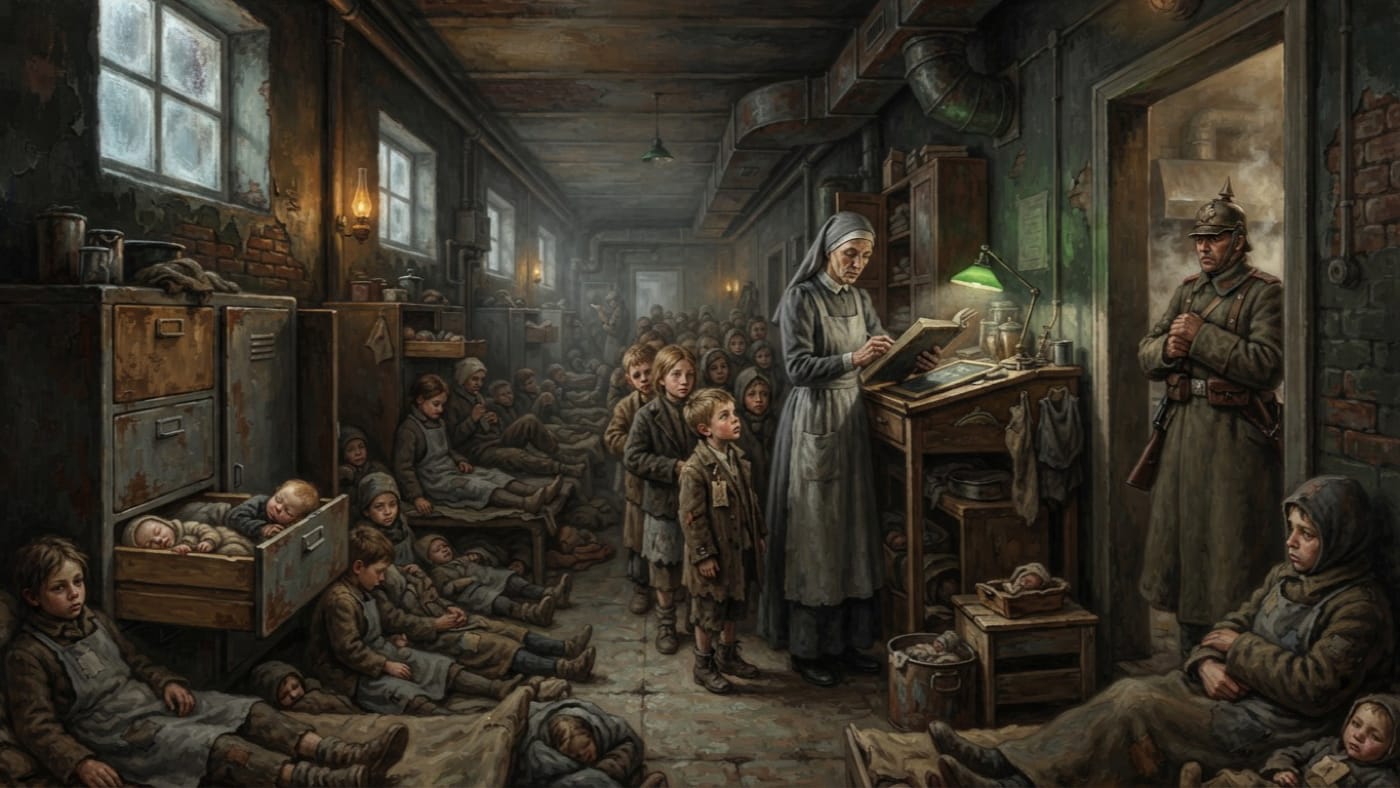
The first Orphanarii did not rise as institutions. They accumulated. The published account puts them beside the Mercy Wards and the ration kitchens. A cot was set down here and a washing bench there. A grey-aproned sister stood with a slate, and a soldier stood at the door because starving kin had been known to come back for a child with a knife. These are the furnishings of improvisation. Nobody planned them. They were pushed into the nearest wall that had a kitchen on the other side.
The Foundling Winter filled those corridors until infants slept in drawers.
I want the drawer kept in the record. It is the most precise object the account gives us. A drawer belongs to a cabinet, and a cabinet holds files. The winter's first and most honest act of child care was to put a sleeping infant where a clerk keeps paper. Nobody intended the symbolism. Bureaucracy never intends its symbolism. It simply runs out of cots.
The profession's houses today smell of stale broth, lye, damp wool, chalk dust and cheap ink. I cannot certify that the winter's corridors smelled the same, and I decline to describe a room I never entered. The ingredients, however, are old ones. Broth comes from the kitchen next door. Lye comes from the washing bench. Chalk comes from the sister's slate, and the slate is where the trouble begins.
A slate can be wiped. That is its charm and its defect. A sister with a slate can count the cots by morning and count them again by evening, and in between the numbers can drift. A child can be fed twice or not at all. A cousin with a knife can claim the same infant two corridors apart. A crowded ward with a slate holds a running argument. It does not keep an account.
#On Ration Eligibility
The response was a code.
The published account credits the Bureau of Mercy with introducing ration-eligibility codes during the Foundling Winter. The profession's own tradition credits the registrars with it. I see no quarrel between these sources. One names the institution that answers for the code, and the other names the hands that wrote it. Mercy owns the policy and the Registrar holds the pen. That arrangement has governed the office ever since. If Mercy's name in the account is a later name fitted to an earlier office, the survey cannot correct it. It notes the possibility and moves on.
Consider what a ration kitchen is without a code. It is a pot and a line. Whoever stands in the line is fed until the pot is empty. The only record is the line itself, and the line has no memory: it forgets the boy who ate at dawn the moment he rejoins it at noon. A kitchen of this kind serves hunger directly. It cannot govern anyone, because it does not know whom it has fed.
The ration-eligibility code ended that innocence. Once the code was written, the right to eat ceased to live in the stomach and began to live in the ledger. Entitlement became a property, and the office could assign it, read it back, reconcile it against the draw, amend it, withhold it and audit it. The child stayed hungry. The child lost the right to be hungry unofficially.
I make no claim that the codes ended the famine, spared a single life or brought one parent back to collect a child. No surviving account says so, and I will not credit an innovation with mercies it has not documented. What the account does establish is the mechanism, which is more interesting than any outcome. A child whose hunger could be classified could be governed. The sentence is the Codex's, and I could not improve it. Once the code exists, every bowl of broth carries a question the office can answer and the child cannot: is this one entitled?
A slate argues. A code decides. The sister at the bench no longer has to choose, child by child, whom to feed first in a corridor of drawers. The choice was made earlier, in ink, by someone she will never meet. This is what my profession calls relief, in both senses of the word.
No source tells us whether the codes were adopted everywhere at once, issued by decree or simply copied from one kitchen wall to the next because they worked. My instinct favours copying. Decrees are slow, and famine does not wait for a seal. That remains instinct, however, and this survey keeps instinct out of the infobox.
#On the Credit and the Later Office
Tidy minds want a saint to have done it. Saint Moriah of the Ledger-Cradle is credited with the Three-Tag System of name tag, ration tag and labour tag. The ration tag sits in the middle of her famous ensemble, and the leap from the tag to the winter's codes looks short. The survey declines to make it. The profession's tradition records the winter and the saint separately. Nothing in the surviving material puts Moriah at a kitchen wall in the Foundling Winter, and the Codex itself records that the oldest surviving memorandum on the tag system bears the signature of a quartermaster whose name has been piously misfiled. Who wrote the tags is disputed. Who wrote the winter's codes is unknown. These are two different ignorances, and I will not merge them to save the reader the trouble.
The later turning points need the same separation. The Bastion-Name Riots, with their forged reclamation papers and seized children, gave the office its witness-ribbon protocols. The Purity Reclassification came later still, made lineage a liability and handed the Registrar the risk score, with the Bureau of Purity leaning over the desk. Each built on the habit the winter began. None of them happened in that winter, and none of them should be painted into it.
#On What the Winter Left
The famine has no recorded end, and the children have no recorded names. The drawers were presumably emptied and returned to their proper use. What survives is the column. Every Orphanarium ledger kept since carries some descendant of it. Children are entered, tagged, reconciled, placed, and checked against the Bureau of Records at the end of the month. The children still line up when the bell rings, and the code is still the thing that tells the sister whether to fill the bowl.
The Synod adopts all the lost. It started by writing down which of them could eat.