
#On the Mercy of Names
“A child without paper is a demon’s invitation.” — Orphanarium intake maxim, stamped above the first washing bench
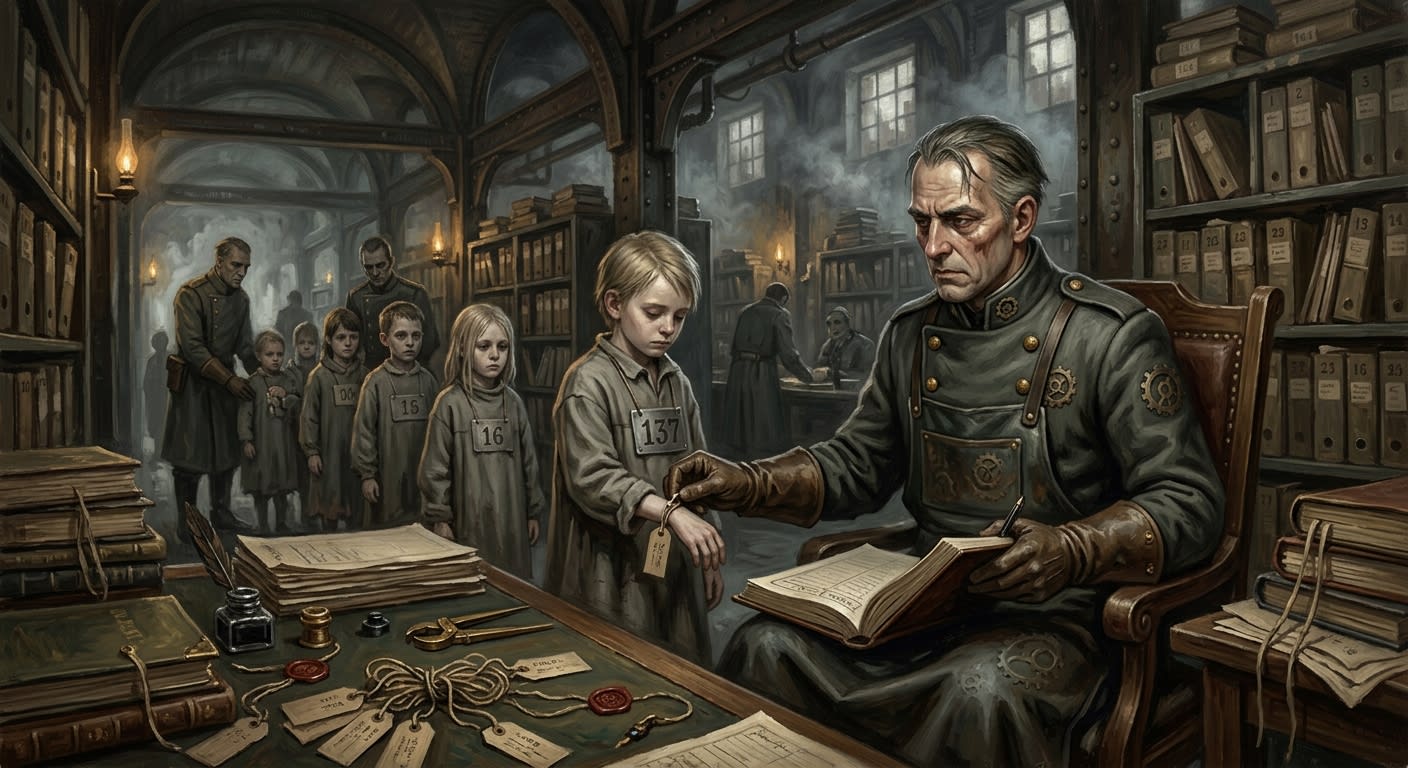
The Orphanage Registrar stands at the narrowest gate in the Synod: between birth and use, between grief and inventory, between a crying mouth and the line of ink that will decide whether that mouth receives broth, doctrine, labour, punishment, adoption, conscription, or the softer mercy of being lost in a cabinet no auditor opens. The profession is praised in devotional prints as maternal. This is an error of iconography. A mother remembers. A Registrar assigns.
The Bureau of Mercy calls the Orphanarii shelters. The Bureau of Records calls them minor intake facilities. The Bureau of Purity calls them containment. Street children call them the grey houses. I call them what they are: manufactories of lawful childhood, where the unwanted are converted from weather into subjects.
The Registrar’s implements are humble: seal stamp, ink kit, tooth chart, measuring rod, ration ledger, witness ribbons, quarantine gloves, tag punch. Humility is the proper disguise of power. With a punch of iron through ceramic, a child becomes eligible for soup. With a marginal code, the same child becomes eligible for a trench apprenticeship, a choir dormitory, a militia levy, a Purity examination, a labour placement, a clean adoption, or a vanishing conducted with the utmost pastoral quiet.
The public doctrine is tender: the Synod adopts all the lost. Names are protection. Paper is shelter. The poster shows Saint Moriah of the Ledger-Cradle tying a ribbon around a sleeping infant’s wrist. The infant is clean. The ribbon is white. No poster shows the quarantine annex, the lice comb, the bite mark chart, the child who will not stop saying a surname already struck from the Great Ledger of Souls. Posters are for citizens. Ledgers are for government.
#On the Foundling Flood
The Orphanage Registrar was born from arithmetic. After the Sundering, after the Great Retreat, after the Line hardened into stone and wire and doctrine, every bastion and corridor city acquired the same problem: children without usable fathers, mothers, homes, writs, parish memory, baptismal proofs, ration lineage, or anyone strong enough to claim them without being charged a fee for the privilege. War makes orphans. Bureaucracy makes categories. Strasbourg, being Strasbourg, congratulated itself on improving upon nature.
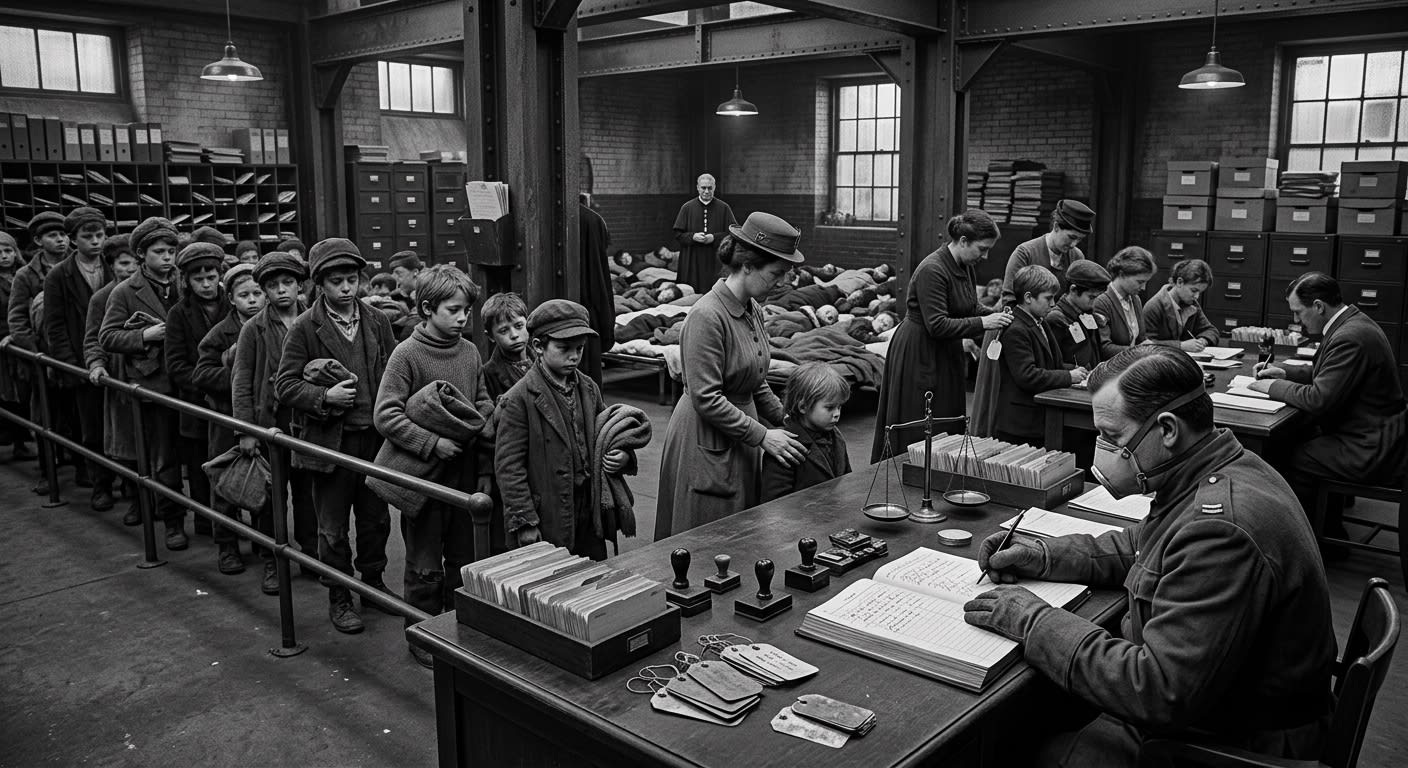
The first Orphanarii grew beside Mercy Wards and ration kitchens. A cot here, a washing bench there, a grey-aproned sister with a slate, a soldier at the door because starving cousins have been known to reclaim children with knives. The Foundling Winter gave the system its spine. Famine abandonment filled corridors until infants slept in drawers. The Bureau of Mercy introduced ration-eligibility codes, and the first Registrars discovered that a child whose hunger could be classified could be governed.
The Bastion-Name Riots completed the office. Forged reclamation papers spread through three garrison cities. Children were seized from dormitories by alleged uncles, sold twice before vespers, returned under different names, reclaimed by women who produced authentic grief and false seals. The riots that followed did less damage than the paperwork. That, in any civilized state, is the measure of catastrophe.
Witness-ribbon protocols were added. Intake tags were standardized. Three disks became the ordinary grammar of Mercy childhood: name tag, ration tag, labour tag. Saint Moriah of the Ledger-Cradle is credited with the system, though the oldest surviving memorandum bears the signature of a quartermaster whose name has been piously misfiled. Saints receive invention more gracefully than quartermasters receive credit.
The Purity Reclassification arrived later and made the matter honest. Lineage became liability. The Order of the Root argued that heresy passes through blood as fever passes through a ward. Mercy objected in public, cooperated in procedure, and developed risk scores by winter. A child became no longer merely hungry or homeless, but genealogically dangerous. The Registrar learned to read ancestry as one reads mould on bread: trim if possible, condemn if spread.
#On Intake, Teeth, and the Three Tags
Morning begins with counts. Cot count. Death count. Ration count. Tag count. A Registrar who counts tears will be ruined by noon; tears have no stable unit. Tags do.
New arrivals are washed, deloused, separated, measured, questioned, and believed only where belief is cheaper than verification. Age is read by teeth and height, not by claim. Dialect is marked. Scars are mapped. Belongings are catalogued: button, ribbon, splintered toy, medal, bread token, blood-stiff handkerchief, saint card, small knife, parish scrap, forbidden lullaby written in a mother’s hand. Everything becomes evidence. A shoe may prove origin. A lullaby may prove lineage. A coin sewn under a cuff may prove a parent loved the child enough to doom them.
The provisional name is the Registrar’s first sacrament. Some names are drawn from approved lists: Sabin, Moriah, Vell, Marrow, Ash, Cord, Ledger, Mercy. Some are assigned by intake date. Some by district. Some by cruel whim disguised as efficiency. The best Registrars avoid names with hooks. A child called Rose will remember being loved. A child called Ward-Seven will learn faster.
Origin codes follow: unknown parent, trenchline found, ossuary found, scorch-extracted, Mercy transfer, Purity release, street feral, suspected noble, suspected gang kin, suspected salt-blood, Index-adjacent, unlisted, reissued. Each code carries rations, suspicion, placement, and future pain. A “Mercy transfer” may become a nurse. A “scorch-extracted” child may become Ash. An “Index-adjacent” child may never reach adolescence with a complete name.
Then the tag punch. Iron closes. Ceramic cracks softly. Identity acquires a hole so it may hang from the neck.
The Registrar records the entry in the minor ledger, cross-references ration eligibility, files any lineage flags, and sends the child onward: cot, quarantine, interview booth, apprenticeship queue, special instruction, or the locked side corridor where the floor is always too clean. The child may scream. The ledger does not.
#On Lineage as Disease
The Synod teaches that blood is history and history is dangerous when left in private hands. This doctrine is most visible in the Orphanarii, because children are where history attempts to continue without permission.
The Index Damnatus feeds the Orphanage Registrar each morning. Runners bring amendment strips: names condemned overnight, families struck, songs forbidden, lineages marked for uprooting, households administratively dissolved. At the gate a Registrar revises the rolls before breakfast. A child’s mother becomes blank between porridge and catechism. A father becomes a code. A surname becomes contraband.
The procedure is merciful in form. The child is not punished for the parent’s heresy; the child is reclassified under Synod parentage. No kin but the Synod. No claim but the tag. No memory except the approved catechism and whatever survives in the body, which is why the older children are hardest. Bodies keep parish kitchens, grandmothers’ hands, a brother’s limp, a market song, the smell of a room before soldiers entered. Registrars learn to fear memory lodged below language.
The Bloodline Hawks take this fear and build policy from it. They study cheekbones, dialect remnants, lullaby fragments, hand dominance, allergy patterns, sleeping posture. They see heresy in inherited gestures. They find salt-blood under clean shirts and black roots in ordinary tears. Their opponents, the Name-Givers, insist identity can be remade by paper, discipline, and enough hunger. Both factions are dreadful. Both are useful. I have chaired committees between them and found the Hawks less sentimental, which is nearly praise.
Earlier Mercy pamphlets stated that all children in the Orphanarii are “equal before the cradle of the Synod.”
Corrected: all children are equally subject to classification. Equality of exposure must not be confused with equality of outcome. The cradle has compartments.
The Order of the Root supplies the hardest intakes. Entire families condemned, adults burned or erased, children delivered with wrists tied in witness ribbon and names already suspect. Officially, reeducation is universal. Unofficially, the Strasbourg Central Orphanarium basement contains a cabinet reporting that a fixed percentage fail reeducation. I have seen the cabinet. The key remains in my possession because certain truths require a properly vain custodian.
#On Placement and the Appetite of the City
The Orphanarii do not merely keep children. They distribute futures.
Guild masters arrive at midday with clean gloves and filthy intentions. They ask for apprentices: three strong backs, two quiet girls, one nimble-fingered boy, no coughers, no noble claims, no gang kin, no troublesome siblings. They bring fuel chits, soap, medicine, paper, winter ink. They call it charity. The Registrar calls it placement. The child calls it whatever word he is permitted to keep.
Militia recruiters prefer older boys with no known kin and enough obedience to stand in a line while being shouted into usefulness. Choir schools request clear throats. Bureau of Records annexes request patient hands. The Order of Ash likes orphans with poor attachment to property and good tolerance for smoke. Mercy Wards request girls who do not faint at blood. Conscription watches all of it with the bland appetite of a wolf in vestments.
Adoption is the gentler market and therefore the more hypocritical one. Respectable families request clean lineage, small age, pleasing face, no remembered dialect, no history of night terrors, no sibling attachments, no tendency to answer to a previous name. The Registrar interviews them beneath a print of Saint Moriah and decides whether the household wants a child, a servant, a replacement for the dead, or a future ransom shield against loneliness. The distinction matters only if the fee is low.
There are Shelterists, the Creator preserve their inconvenient little hearts. They hide siblings together when policy requires separation. They mark a sick child “temporarily unplaceable” until a brutal guild convoy leaves. They misread a dangerous surname by one letter and thereby save a life. They are bad Registrars and admirable criminals. The Pipeline Purists despise them. The Bureau promotes whichever faction produces fewer audits that quarter.
Side corridors flourish. Shadow placement brokers sell clean origin codes. Tag-splitting creates a public child and a hidden child, one for the ledger, one for escape or profit. Lineage laundering breaks a trail through false district codes and borrowed dead names. Every corrupt Registrar tells himself he is protecting one child from a worse fate. Some are lying. Some are correct. The Ledger does not reward the distinction.
#On Missing Children and Other Forms of Arithmetic
A missing child is a professional execution delayed by paperwork. The tag under your seal, the cot under your count, the ration under your reconciliation: if the body is gone and the disks remain, you have a ghost; if the disks are gone and the body remains, you have fraud; if both are gone, you have a career ending in a small room with bright gloves.
Audits begin with tags. Always tags. The Audit Master traces disk to ledger entry, ledger entry to ration draw, ration draw to cot, cot to placement, placement to witness ribbon. Names can be forged. Grief can be performed. Consistency over months is harder. A Registrar with a dirty office survives; a Registrar with inconsistent months does not.
The Bastion-Name Riots taught this. The Carnelian erasures taught this. The clean paper plague at Marrowgate taught this to every Mercy clerk who thought falsification could remain local. Paper lies best in systems; systems avenge themselves when the lie fails to match the adjacent column.
RIBBON WALK REPORT — STRASBOURG CENTRAL ORPHANARIUM, A.S. 199: Tag Cabinet Three reconciled. Cot Row Seven unreconciled. Twelve children present, thirteen ration draws, eleven labour disks, one name repeated in two hands, one child answering to a surname struck A.S. 80. Night Registrar notes: “They all looked at the empty cot when bells rang.” Follow-up classification: ███████████. Cabinet sealed.
Punishments are calibrated to public usefulness. Demotion to cot-runner for negligence. Reassignment to plague annex for pity. Public penance for negligent mercy. License stripping for repeated loss. Erasure for trafficking if the buyers are low-born. Quiet transfer if the buyers are useful. The Synod abhors child trafficking unless the chain of custody is legible.
The Registrar survives by cultivating ration quartermasters, night captains, quarantine chiefs, tag makers, and one Records clerk who can make a bad month appear merely damp. This is corruption in the vulgar tongue. In administrative language it is resilience.
#On the Children Who Remember
The most dangerous child is not the feral one who bites, nor the sick one who carries fever, nor the noble one whose face may purchase scandal. The most dangerous child remembers cleanly.
A little girl from a scorched ward gives a name that appears nowhere in the current rolls and insists, with the patient contempt of the very young, that the Registrar has spelled it wrong. A boy sings a lullaby banned by Orison because his mother sang it during shelling. Three siblings separated before noon begin tapping the same pattern on dormitory walls by evening. A child with no baptismal certificate recites a genealogy back to the Betrayal of Aachen. A baby taken from a Scour site will not cry unless held facing east.
The manuals call these residual attachment behaviours. The ward-hands call them hauntings.
Registrars develop superstitions because policy leaves gaps large enough for ghosts. Never assign a provisional name from a child’s first spoken word. Never let an unregistered heirloom remain under a pillow. Never leave tags uncounted overnight. Never permit siblings to whisper in a dialect you have not recorded. Never ask a child what happened after the third horn unless you are willing to hear the answer in your dreams.
The Orphanarium teaches them better. Bells, drills, catechism, soup, wash, cot, silence. Names fade under repetition. The old surname becomes a dream-error. The parent becomes a sin not yet explained. By seven, most children understand that names are things the Synod giveth and taketh away. By ten, the clever ones stop asking what was taken.
#On the Present Ledger of the Lost
As of A.S. 201, Orphanage Registrars serve in every bastion orphanarium, Mercy ward house, foundling wheel, quarantine intake, street roundup station, and major corridor city from Königsberg to Constantinople. The war continues. The Scour continues. The Sagittal Line consumes adults and returns children. The apparatus receives them.
The current pressures are plain enough for even a committee to understand. Famine surges send new intakes westward. Purity operations deliver scorch-extracted minors by wagon. Bastion labor quotas rise. Guilds demand apprentices younger and quieter. Conscription watches the dormitories like a creditor at a funeral. The Index sends more amendment strips each month, and every amendment strip makes some child’s memory newly illegal.
The official Orphanarium report describes intake as “high but controlled.” This is a splendid phrase. It means the cots are full, the soup is thin, the tags are counted, the deaths are filed, and the children still line up when the bell rings.
At dusk, the Registrar locks the tag cabinet, seals the ledger, burns draft notes, wipes the stamp clean, and chalks the dormitory totals on the wall. The children breathe in rows. Some clutch their disks. Some mouth old names into blankets. Some sleep as if sleep itself were a permitted ration. In the morning, the count begins again.
Named. Fed. Placed.