
#On the Houses That Parent by Ledger
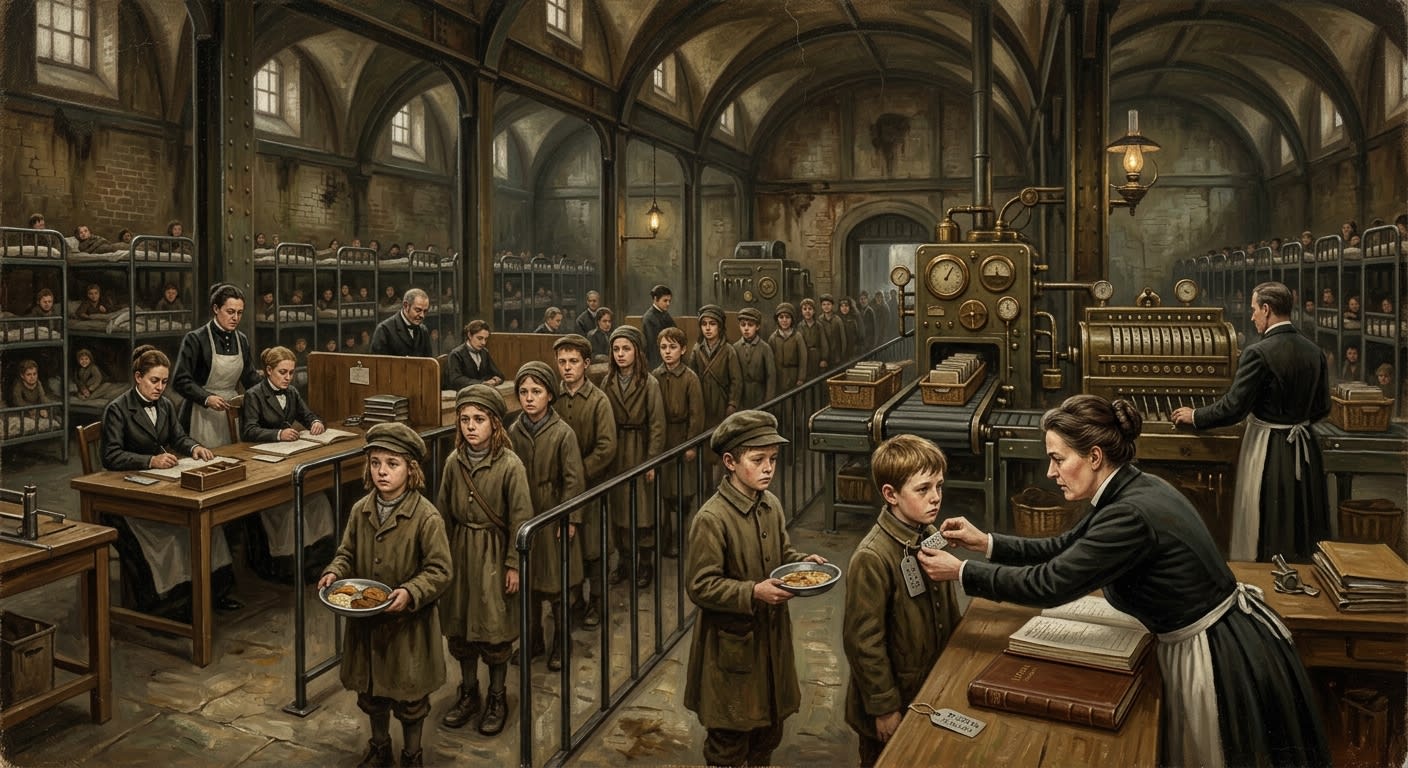
The Orphanarii are the Synod's state orphanage system, though the word orphanage is a little white glove placed over a butcher's hand. They are wards of the Bureau of Mercy, fed by the Bureau of Purity, cross-indexed by Records, amended by Doctrine, harvested by Conscription, inspected by Index wardens, supplied by Tithes, and spiritually justified by anyone in Strasbourg whose conscience has learned to stand still while children are renamed.
A child enters with a mother, a father, a village, a parish, a dirty ribbon, a lullaby, a dialect, a scar, a rumour, a claim. The Orphanarium receives all this material with professional tenderness and converts it into three disks: name, ration, labour. The disks hang at the throat. The throat learns to answer when struck by ceramic.
Do not mistake the Orphanarii for mere warehouses of loss. Warehouses are passive. The Orphanarii manufacture citizens from wreckage. They take the children of apostates, widows, soldiers, dissolved households, famine queues, plague wards, scorched villages, failed adoptions, secret marriages, illegal convents, Root actions, Shroud extractions, Ash corrections, and the unending arithmetic of war. They wash them, number them, feed them, frighten them, teach them, place them, and when the child resists too perfectly, they diagnose the remaining self as a treatable contaminant.
The public motto varies by region. In Strasbourg: No Kin but the Synod. In Mainz: The Lost Are Gathered. In Brest: Named, Fed, Placed. In Ghent, where the canal fog makes pity too theatrical for decent administration, the motto is shorter: Count Them Before Mercy.
The phrase state parent appears in several approved pamphlets. I have objected to it on stylistic grounds. A parent remembers. The Orphanarium records. A parent answers night cries. The Orphanarium rotates night staff by bell. A parent tells a child who she was before hunger, fire, treason, fever, shelling, or Purity arrived. The Orphanarium tells the child who she is authorised to become.
Call this Mercy as Strasbourg understands the word: compassion given a ledger, a ration schedule, a locked side corridor, and the right to call memory a hazard.
#On the Founding Flood
War made children. Bureaucracy made them usable.
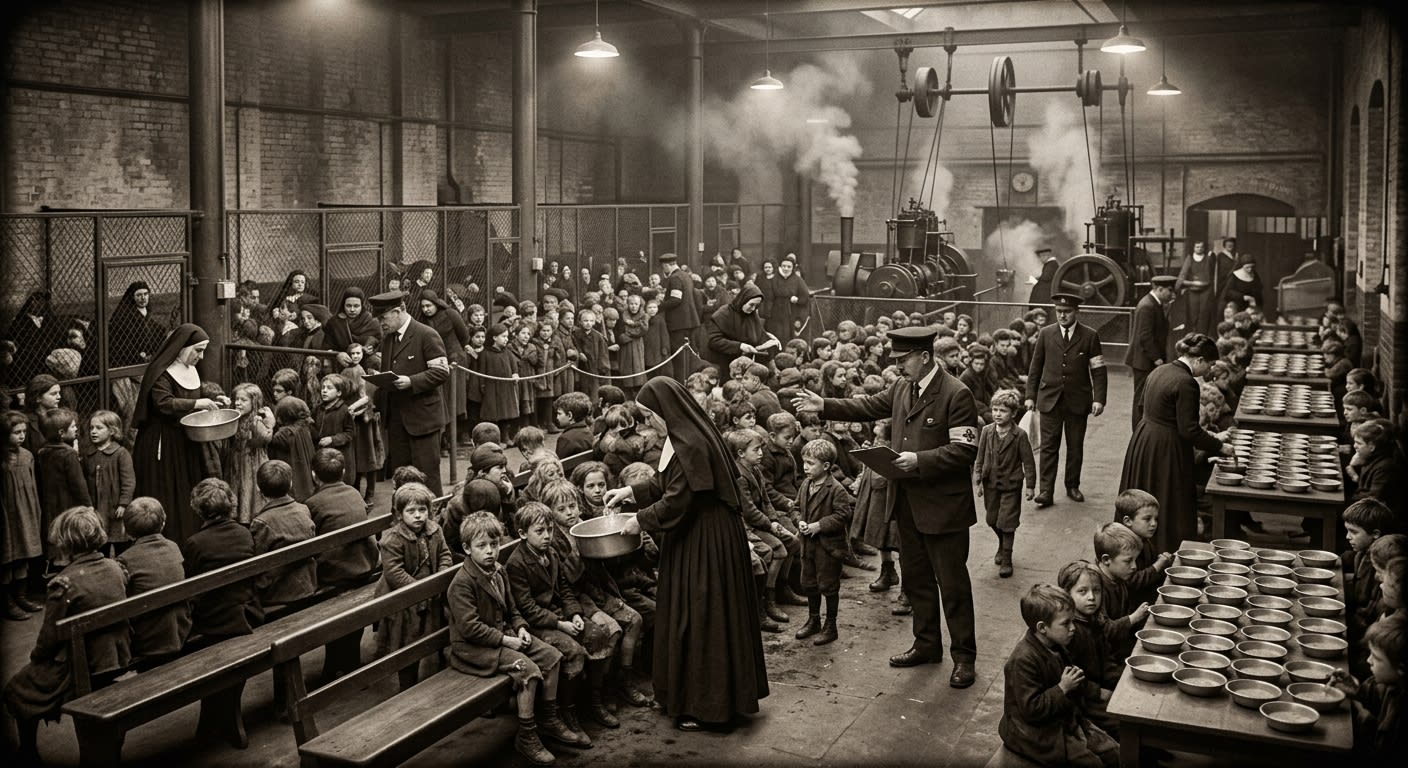
The earliest Orphanarii grew after the Great Retreat and the first hardening of the western corridors, when the new Synod discovered that armies leave more behind than bodies. They leave sons with no fathers in the rolls, daughters with mothers whose names have been gridded by Administrative Dissolution, infants bundled into artillery crates, choir boys whose schools no longer stand, little heirs to houses now classified as doctrinally unsafe, and feral packs of street children whose chief crime is surviving without permission.
The first arrangements were temporary. A Mercy ward had an unused storeroom. A ration kitchen had a dry cellar. A convent had spare cots after fever removed the inconvenient inhabitants. A clerk placed six children in a laundry room and wrote pending kinship review on a slate. The phrase outlived the children. Phrases often do.
By A.S. 90, the Concordat gave the Synod a spine. By A.S. 92, Doctrine and Purity had learned that children of heresy created an argument no sermon could safely leave ungoverned. By A.S. 100, the Penitential Shadows were already reporting households where condemned surnames survived in nursery songs. By A.S. 134, after Severian placed Article 19 into the Catechism and made silence itself culpable, the Orphanarii ceased pretending to be temporary shelters and became one of the Synod's permanent instruments for the correction of blood.
Mercy schoolbooks describe the Orphanarii as a charitable response to war-displacement.
Corrected. Charity supplied the first cots. Fear supplied the walls. Records supplied the tags. Purity supplied the intake lists. Mercy supplied the posters and the damp eyes. All five are necessary to the truth, though only one prints well.
The Order of the Root supplied the decisive theology. Root taught that heresy may pass through blood as fever passes through cloth, that no age is young enough to guarantee innocence, that a cradle can inherit treason before a tongue can form prayer. Mercy objected to the harshness, then asked for a filing category. Strasbourg's genius lies there: moral horror enters through the front gate in chains and leaves by the records window as procedure.
The Orphanarium was born from that transaction.
In the first large houses the children slept by source: battlefield, famine, apostate, unknown, plague, dissolved, noble-disputed, street-feral, Root-transfer, Mercy-voluntary. This arrangement failed within months. Children from the same village found one another. Siblings whispered. Older girls reconstructed family trees in charcoal under bed slats. A boy from Metz taught three dormitories his father's banned oath against Purity. Source-sorting preserved identity too well.
The second arrangement sorted by risk, age, and placement value. It worked.
#On Intake, Tags, and the Orphanage Registrar
The gate opens before first bell. It always opens before first bell, because grief prefers dawn and soldiers prefer dumping cargo before breakfast.
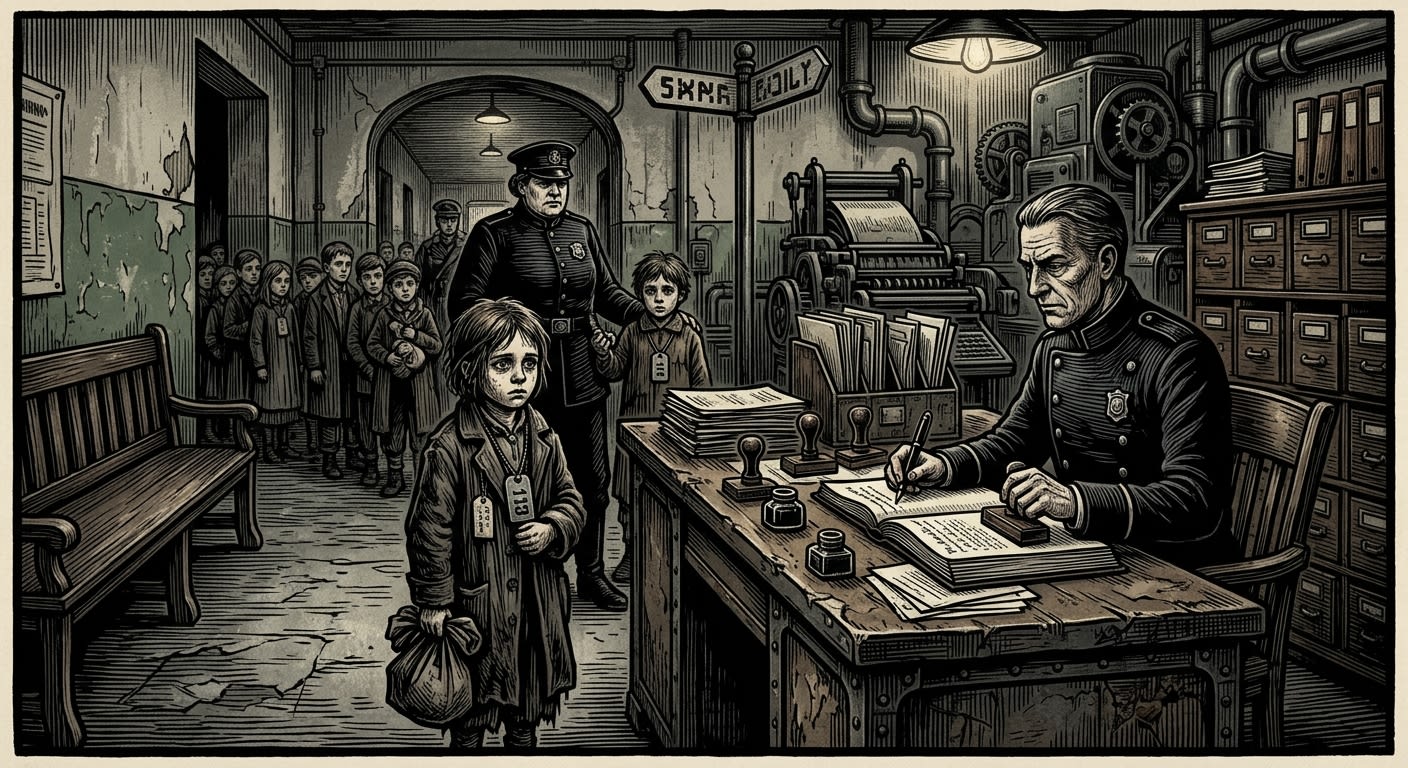
A typical intake line contains three kinds of children: those who have been brought, those who have been seized, and those who have walked in because hunger has outargued pride. The brought children arrive with papers, or with adults pretending to have papers, or with priests who fold pity around fraud until the Registrar must cut both. The seized arrive under Purity escort, sometimes gagged if old enough to speak troublesome kinship. The walkers arrive barefoot, watching the soup hatch with the moral concentration of theologians before a relic.
The Orphanage Registrar sits at the throat of the machine. The office is humble by design: desk, tag punch, ink kit, tooth chart, measure rod, lice comb, ration ledger, witness ribbons, quarantine gloves, minor ledger, lineal suspicion annex. Humility is the old costume of power. A crown frightens a crowd. A punch through ceramic frightens only the child, which is more efficient.
Age is read by teeth and bone, not by claim. Names are provisional unless witnessed by acceptable paper, acceptable clergy, or repeated under pressure without variation. Dialect is marked. Scars are mapped. Belongings are catalogued: ribbon, spoon, saint card, boot button, ration chit, blood-stiff handkerchief, toy horse, shard of bell metal, folded prayer, unlicensed poem, lock of hair, mother's needle, father's pipe, little useless treasures by which childhood attempts to testify.
Everything becomes evidence. The pipe proves a district. The needle proves trade caste. The poem proves an unauthorised vocabulary. The hair proves nothing and is kept anyway because the Bureau of Mercy is not without sentiment. It merely prefers sentiment bagged, tagged, and shelved.
Then the three disks.
The Name Disk bears the child's new or provisional designation. Some houses assign saints. Some assign virtues. Some assign dates. Some assign district codes so dry that even sorrow cannot cling to them. A child called Sabina may remember that a saint once carried bandages at Saint-Malo. A child called Ward-Seven learns faster.
The Ration Disk establishes soup, bread, broth, milk, medicinal allowance, fasting exemptions, and eligibility for festival scraps. It is the disk children guard most fiercely because theology is large and hunger is immediate.
The Labour Disk is the prophecy. It marks likely future placement: guild, choir, ward service, field kitchen, Records copying, Bell rope, Ash auxiliary, Mercy apprenticeship, Conscription review, Purity observation, or the blank mark meaning no office yet wishes to be named in the child's future.
Children learn the disks before they learn the Catechism. A missing disk triggers lockdown. A mismatched disk triggers audit. An untagged minor triggers seizure, classification, and official gratitude for the opportunity to extend Mercy.
The first week is quarantine. Lice, fever, bite marks, ash cough, plague signs, night speech, hidden knives, hidden siblings, hidden names. The second week is catechism. The third week is sorting. After that, the child belongs to a row, a dormitory, a bell, a broth measure, a schedule, and whatever portion of the self survives repetition.
#On Names, Language, and the Index
The Orphanarii teach children to speak correctly because speech is where the old life hides after the body has been washed.
The Index Claritatis governs permitted public words and its influence in the houses is severe. Amendment strips arrive weekly. A lullaby may become suspect between breakfast and evening drill. A family nickname may be reclassified as regional superstition. A dialect word for mother may be replaced by Synod-matron, ward-matron, or simply Matron, depending on local risk tolerance. Children are corrected until their mouths become civic property.
The older children resist through fragments. A girl calls soup by the name used in her burned parish. A boy counts in a fisherman's rhythm from the Baltic. A pair of twins answer questions in a private grammar made before intake. A toddler points at the moon and uses a word no one in the house knows, and three ward-sisters cross themselves because unknown words in children arrive with too much innocence to be safe.
Language drills are conducted after morning broth. Call and answer. Word and correction. Old name and new name. Forbidden word and approved substitute. The children repeat until meaning loosens from memory. When an Index strip removes a word already known to the dormitory, the ward-matron conducts a small funeral without corpse: the word is written, crossed, burned, and replaced. The ashes go into a sealed jar marked lexical residue.
Some jars hum. I have heard this denied by three officials and confirmed by two children who had no reason to know the preferred lie.
The Orphanarii also serve as experimental ground for language discipline because children are easier to correct than adults and less able to hire advocates. Chainmaster Veyl's glasschain reforms among White-Mantled Inquisitors drew from Orphanarium practice: audible correction, visible restraint, portable guilt. The houses had long understood that a child's error should make a sound. A bell, a chain, a tag striking the chest. The body remembers noise even after the word is gone.
#On Lineage as Disease
The Orphanarii are Mercy houses built on Root theology. That is the scandal and the engine.
The Order of the Root sends children with witness ribbons tied around their wrists. Red for direct line. White for household exposure. Black for unidentified kinship. Grey for bloodline under review. The receiving Registrar records the ribbon colour before removing it; the ribbon itself is sealed and stored because some Root examiners believe cloth retains genealogical accusation. I find this absurd, which does not mean it is false.
Children from condemned bloodlines are placed under lineage quarantine. They eat apart. They sleep under low bell. Their letters, if any, are copied rather than sent. They are taught that heredity is a burden the Synod may lift by replacing ancestry with service. A child whose father was dissolved is told the father has returned to administrative silence. A child whose mother was burned is told the mother was corrected beyond private relation. A child whose parents were Shroud-extracted is told less, because Shroud leaves fewer nouns.
The Bloodline Hawks and Name-Givers quarrel in every large house. The Hawks see danger in cheekbone, gesture, inherited tune, night terror, left-handedness, stubborn appetite, freckles arranged like a forbidden sigil, tears shed too late. They prefer strict sorting, early separation, limited adoption, heavy Purity review. The Name-Givers argue that paper can remake a child, that a new name repeated with hunger and bell can cut the old kinship root. They favour adoption, choir placement, guild discipline, and the annihilating kindness of routine.
Both factions are useful. Both are dreadful. The Hawks make cruelty honest. The Name-Givers make cruelty hopeful, which is more dangerous.
The official line remains tender. No child is punished for ancestral sin. The child is protected from ancestral consequence by reclassification under Synod parentage. This is a fine sentence. It walks upright, wears clean shoes, and keeps a knife inside its sleeve.
The hidden cabinet in the Strasbourg Central Orphanarium tells the rest. Reeducation failure rates. Culling euphemisms. Transfer codes to locked Mercy annexes. Purity observation notes. Children whose tags were returned without bodies. The Bureau of Mercy's public position is that culling does not occur. Its basement position is that culling occurs at a rate low enough to be administratively encouraging.
STRASBOURG CENTRAL ORPHANARIUM — BASEMENT CABINET EXTRACT R-4 and R-5 minors, three-year review: placed ███████; adopted ███████; labour assigned ███████; special correction ███████; mercy closure ███████. Annotation in Mercy hand: “Do not use word cull in mixed office.” Annotation in Purity hand: “Use proper words among adults.”
#On Placement, Apprenticeship, and the Appetite of Offices
The Orphanarii shelter children, then distribute futures with the impartial hunger of a ration office.
Guild masters arrive with gloves clean enough to accuse them. They request apprentices: strong backs, small hands, clear eyes, no cough, no gang kin, no sibling attachments, no noble claims, no previous placement failure. They bring soap, lamp oil, extra broth, coal chits, medicine, repair timber, ink, or direct donations to Saint Moriah's (Unregistered) cradle fund. Charity has always improved when given a queue window.
Choir schools request clear throats and obedient posture. Records annexes request patient hands and dull imagination. Bell houses request shoulders. Mercy wards request girls who do not faint at blood and boys who can lift tubs. Ash likes children with poor attachment to property and good tolerance for smoke. Purity likes the ones who watch punishment without looking away. Conscription waits at the edge of every dormitory like winter at the edge of a field.
Adoption is the more fragrant market. Respectable families ask for clean lineage, early age, pleasing face, no recalled dialect, no night screaming, no sibling claim, no history of fire, no tendency to answer to an older name. They sit beneath a print of Saint Moriah of the Ledger-Cradle and speak of love as if ordering linen. The Registrar listens, smiles, notes fee capacity, inspects household standing, checks whether the request resembles grief, vanity, labour need, political repair, or the dangerous desire to possess a child who will be grateful.
Some adoptions are decent. This must be stated because the truth is less tidy than propaganda and because even Mercy occasionally stumbles into mercy. A widow takes a boy who limps. A baker takes three sisters because separating them would make the eldest mute. A retired bell-ringer teaches a girl to read the old peal marks and never asks why she cries at seventh bell. Such cases appear in the ledgers as placements. The Ledger has no field for grace.
The darker commerce moves through brokers. Clean origin codes are sold. Tags are split. A public child remains in the rolls while the hidden child goes to a house, gang, workroom, brothel, black chapel, river boat, or private grief. Lineage is laundered through dead names. A child declared unplaceable in one city reappears as clean in another, the disk re-fired, the old hole glazed over.
The Orphanarii punish trafficking when the trafficker lacks protection. When protection exists, the case becomes custody irregularity, then placement dispute, then closed annex. The Synod abhors child trafficking unless the chain of custody can be made to genuflect.
Mercy annual reports describe labour placement as “vocational discernment under pastoral care.”
Corrected for internal use: labour placement converts ward maintenance cost into civic yield. Pastoral care remains encouraged where it does not delay transport, reduce output, or cause the child to remember kinship at inopportune volume.
#On the Children Who Remember
The biter, the fevered one, the noble bastard, the street knife, the little arsonist, and the feral angel who can climb drainpipes by moonless instinct are lesser hazards. The most dangerous child in an Orphanarium remembers cleanly.
Memory survives where paper fails. A girl names her village after Records has gridded it. A boy recites a father whose entry has been marked Ø. Three siblings separated at intake tap the same kitchen rhythm on three different dormitory walls by nightfall. A toddler sings a forbidden hymn with no words, only tune, and every older child in the room goes still. A baby taken from a Scour road stops crying only when held facing east. The manuals call these residual attachment behaviours. The ward-hands call them visitations. The children call them nothing, because children learn early which names bring gloves.
Dormitory discipline exists to erode clean memory into usable blur. Bells, broth, wash, catechism, line, drill, soup, sleep. New name at every answer. Old name punished first gently, then sharply, then medically. Siblings separated unless separation breaks placement value. Heirlooms removed unless useful as bait, proof, or disciplinary hook. Night speech recorded. Dreams reported by children bribed with sugar and punished if they invent poorly.
There are ward-sisters who sabotage this. Shelterists (Unregistered), they are called when Mercy wishes to sound annoyed rather than grateful. They misfile siblings into the same laundry rotation. They delay placements to brutal guilds. They mark a surname illegible when it is merely dangerous. They hide a mother's needle in a child's blanket seam. They are bad servants of the system and better servants of the Creator, which is exactly why the system keeps disciplining them.
Some children become Orphanarium creatures in the fullest sense. They police each other. They report forbidden words. They mock private grief before ward-sisters can hear it. They learn that memory is a ration stolen from tomorrow. At twelve they can recite intake codes faster than prayers. At fourteen they assist new arrivals with the hard pity of prisoners promoted to turnkey. The Synod calls this formation.
#On Saint Moriah, Saint Marrow, and the House Cults
Every cruelty requires saints, else the public grows suspicious.
Saint Moriah of the Ledger-Cradle presides over official Orphanarium devotion. The icon shows her with a cradle in one arm and a ledger in the other, an arrangement impossible to hold for long unless one has been canonised beyond ordinary tendon law. She is said to have rescued thirty-seven infants during a famine, naming each by lot and feeding them broth measured from her own cup. The historical file is thin. The devotional yield is excellent. Her feast day produces donations, clean blankets, and noble women weeping in supervised rooms while carefully not touching contagious children.
Saint Marrow-of-the-Ladle belongs to the kitchens. His or her nature remains disputed: saint, pot stain, ossuary block, famine miracle, Mercy invention, or the collective name of cooks who kept broth moving when proper food had fled the accounts. Children pray to Marrow for thicker soup. Ward-cooks pray to Marrow that the children stop looking at the pot as if arithmetic can be intimidated.
Saint Sabina of Ghent enters through bandage rooms and sewing benches. Older girls assigned to linen repair learn her story: witness, seamstress, bandage-keeper, survivor. The approved lesson is obedience through service. The hidden lesson, which some girls hear without being told, is that a woman may preserve lives while men argue over whether the blood has been properly classified. Sabina makes the ward-matrons nervous in a way Moriah does not. Moriah counts. Sabina binds wounds.
House cults grow under official devotion. Children keep crumbs under radiator pipes for a dormitory saint called Little Hollow. They whisper old surnames into mattress straw and call the bundle Uncle. They name cracks in the plaster after vanished siblings. They assign patronage to dead rats, broken spoons, a blue button, a bell that misrings, a drainage stain shaped like a woman holding two babies. Doctrine would condemn these practices if it understood them. Mercy usually understands them and looks away until Purity visits.
#On Missing Children and Acceptable Variance
A missing child begins as an accounting event before anyone is permitted the luxury of tragedy. This is procedure, and procedure is cynicism that has acquired pension rights.
The search begins with disks. Body present, disk absent: fraud or theft. Disk present, body absent: escape, seizure, sale, death unreported, mistaken cot, Shadow collection, Shroud error, Purity requisition, drowning, chimney entrapment, broker traffic, or the rare and maddening category child refuses to correspond to tag. Both absent: career hazard. Body duplicated under two disks: audit emergency. Two bodies answering one disk: call Doctrine, then Medicine, then whatever priest is not drunk.
Orphanarium ledgers allow acceptable variance. Every large system does. Winter fever. Transfer delays. Miscounted broth. Illegible tags. Children hiding in laundry carts. Registrars dying at desks. The phrase acceptable variance is where grief goes to be patted down and robbed.
RIBBON WALK REPORT — STRASBOURG CENTRAL ORPHANARIUM, A.S. 199 Tag Cabinet Three reconciled. Cot Row Seven unreconciled. Twelve children present, thirteen ration draws, eleven labour disks, one name repeated in two hands, one child answering to a surname struck A.S. 80. Night Registrar note: “They all looked at the empty cot when bells rang.” Follow-up: ███████████.
Runaways exist. Pale Kin Runners move some beyond the ward gates and into alleys where old names still purchase bread. Brokers take more. Desperate relatives take a few and call it rescue until hunger forces a second betrayal. The Orphanarii recover what they can, deny what they must, and revise the month until the numbers kneel.
Punishments follow the rank of scandal. A junior ward-hand loses soup privileges. A Registrar loses licence. A broker with no patron is hanged as a child-thief. A broker with patrons becomes a placement intermediary under review. A noble household caught with an illicit ward pays a corrective tithe and receives a sermon on paperwork. The child is returned, transferred, or forgotten according to the heat of the room.
#On the Present Houses
As of A.S. 201, the Orphanarii operate in every major Synod city, every bastion support district, every forward corridor with a Mercy ward, and several locations whose existence is denied because the children housed there have classifications too useful to embarrass. Strasbourg Central remains the model: seven dormitory wings, three quarantine courts, two lineage chapels, a refectory, a tag kiln, a Records annex, Purity interview rooms, a placement hall, a locked basement, and a chapel to Saint Moriah whose painted infants look cleaner than any child who has ever passed through the gate.
The pressures are worsening. Famine pushes children west. The Line eats fathers and returns sons with papers folded into blood. Purity sends Root transfers after each purge. Administrative Dissolution creates parents who cannot legally reclaim. The Index removes words faster than ward-matrons can teach substitutes. Guilds want smaller apprentices. Conscription wants older boys earlier. Mercy wants more funds. Tithes wants receipts. Records wants cleaner tags. Doctrine wants fewer lullabies. Purity wants the basement cabinet moved behind a thicker door.
The A.S. 201 Mercy status circular describes Orphanarium intake as “high but controlled.”
Clarified. High means cots in corridors, broth thinned twice, dormitory cough under watch, tag kiln at night shift, placement interviews accelerated, and two closed wings reopened without roof repair. Controlled means the children still line up when the bell rings.
The children breathe in rows. Some clutch their disks. Some have forgotten the hands that gave them up. Some remember and pretend not to, which is the first adult skill the Orphanarium teaches. A ward-sister walks the aisle with a lamp hooded in blue glass. The Registrar locks the tag cabinet, seals the ledger, burns the draft notes, and chalks the morning count before morning exists.
Behind the wall, one child mouths an old name into the blanket. The blanket, being wiser than most officials, keeps the file.