
#On the Recorded Uprising
This entry is a retrospective, commissioned and surveyed in A.S. 201 / 1911 CE. The event it surveys has no year. Anyone who wants to know when the Gray Wax Coup took place may apply to the office that knows who started it, and they will get the same answer.
Mainz is a river city of the central heartlands, a place of bridges and tolls with a long institutional memory for unpleasant things. The Gray Wax Coup belongs to that memory as legend. This Codex's entry on the Night Paper lists it among the "older legends" of the instrument, beside the Metz Oblivion, and declines to say whether the tale is theatre, falsehood or accurate record. I decline with it. A Hieromnemon who certifies a legend has only forged it more slowly.
What the account records is brief. The citizens of Mainz revolted over debt ledgers. It does not say which ledgers, who held them, at what rate, against which households or under which disputed clause. It names the grievance by its paper. In Mainz, the paper is usually what people remember.
Older abstracts enter the Gray Wax Coup under a fixed numbered year of the Synodal count.
Withdrawn. The year so entered falls after the present year of A.S. 201 and cannot date a past event. No substitute is offered. The historical year of the coup is unknown, and this office will not make one up by arithmetic, by rounding or by quietly dropping a digit.
#On the Dozen Papers
According to the account, when the debt revolt rose, a dozen Night Papers appeared at once, each naming a different "instigator."
Twelve Papers, twelve names, one night. The account states this as fact and adds nothing to it. It gives no list of the twelve and no recipients. It describes no route by which twelve sealed slips could reach one city in the same hour, and it names no hand that wrote them. The number belongs to the account. It counts neither the dead, nor the leaders, nor the districts. A reader who turns twelve Papers into twelve corpses has done the Bureau's arithmetic for it, and done it badly.
The instrument itself is better documented than any single use of it. Under the current handling rules, a Night Paper is one slip of grey vellum under one seal of black wax. It is authorised by the Bureau of Doctrine, carried under curfew by grey-coated runners such as the Night Papers Courier, and valid from receipt until dawn. It is read once, aloud, before three witnesses. Then it is burned and its ash is weighed. The Bureau of Shadows carries and denies. The Bureau of Records keeps no issuance ledger.
These are present rules. They show how a Paper could move faster than a riot and leave less behind it than a riot does. They do not establish that each Mainz Paper was sealed in black, read before three or burned in a covered dish. Nor do they tell us whose words the Papers carried. Older lore blames Shadows for the writing. Current doctrine gives the writing to Doctrine and the carrying to Shadows. Neither allocation names an author at Mainz. An institution describes who may hold the pen. It has never confessed who held it.
The word coup is the account's title and nothing more. It records no seizure of a council chamber, no new seal pressed on the city and no successor government. The title does not say whose coup it was, the debtors' against the ledger or the ledger's against the debtors. Titles are cheap. Mainz has paid for dearer things.
#On the Night's Destruction
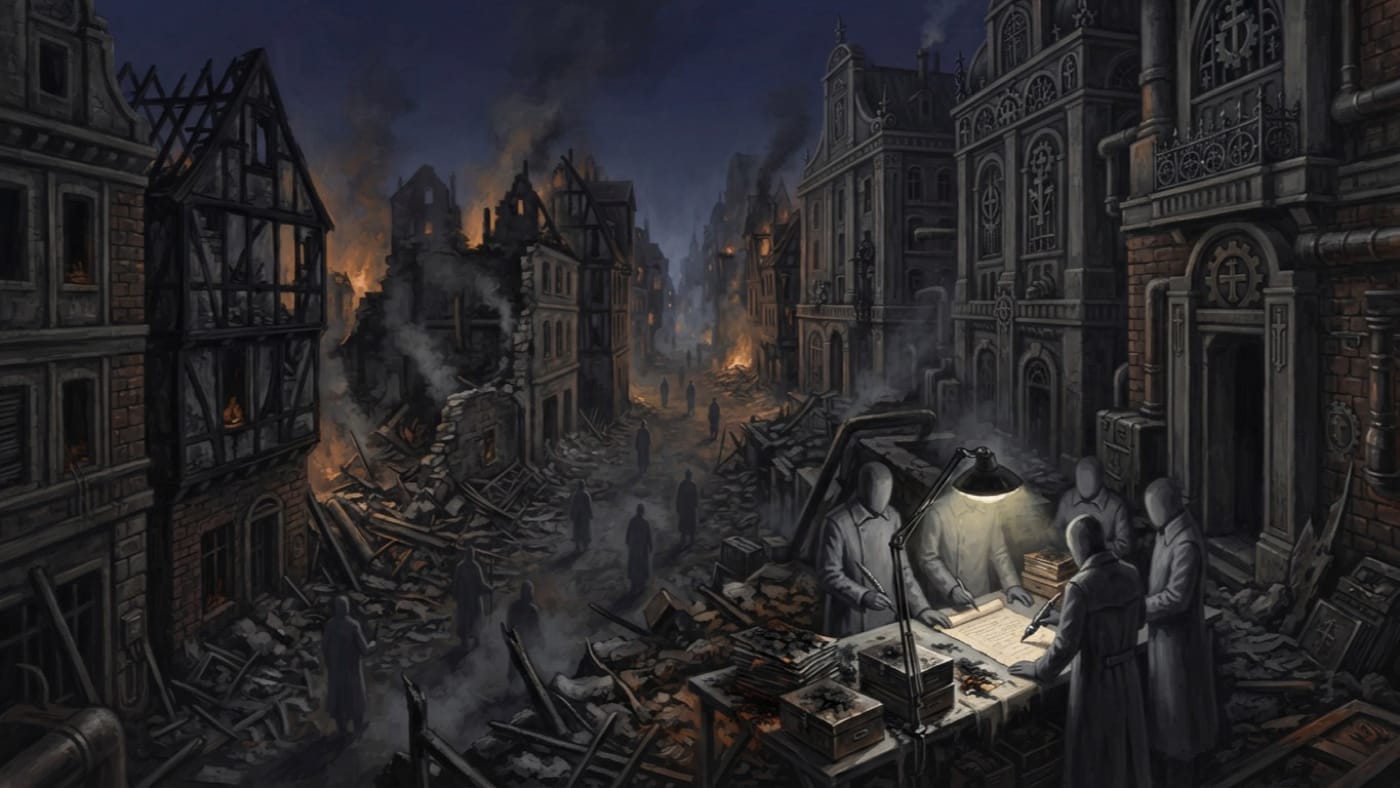
The account states that whole neighbourhoods were wiped out in the dark. The shorter chronicle entries say the Bureau put the revolt down with burning. That is the full extent of it.
I could give you streets. Every hack chronicler on the Bureau's payroll keeps a stock of them: a tanners' lane, a fish stair, a chapel with a cracked bell. I will not. The account names no district, regiment or executioner. It describes no method beyond fire and darkness and gives no total of the dead. It does not say which hands held the torches or under which Paper they held them. It says neighbourhoods, plural and whole, and then it stops talking.
Whole neighbourhoods and no names. That is the proportion the account keeps, and it is the proportion this entry keeps. Anyone who wants a casualty figure will find this office's vellum blank on that line. Blank is the honest entry.
The legend does not say the dark was supernatural. Night is when Papers run, curfew is when doors open for grey coats, and dawn is when their authority ends. Those are the hours of the instrument. They are not evidence of a demon at the city gate. Whatever happened in those neighbourhoods, the account puts it inside a single night and gives no hour before or after it. How long the trouble lasted beyond that night is unknown.
#On Absence and Reclassification
At sunrise, by the account, no Paper remained. No instigators were listed. Where the twelve names should have stood, the record entered "absence."
That is a clerk's word, and a good one. "Absence" is an entry. It fills the line where a name would go. It can be indexed, cross-referenced, copied into a summary and stamped. A blank line invites questions. A line marked absence answers them before they are asked, and answers wrongly with perfect penmanship.
The word proves less than it seems to. It does not show that the twelve "instigators" never lived. It does not show that some power reached into the rolls and lifted their names off the vellum. It shows that someone wrote a word where names had been, or where names were never allowed. Elsewhere in Synodal practice, removing a person from a roll withdraws the claims a name can make. The account does not say whether any such procedure touched Mainz, so neither do I.
The missing Papers are just as uninformative. Present protocol burns them. The account says only that none remained. A Paper burned to the correct ash-weight, a Paper slipped into a coat, and a Paper whose existence was only ever asserted all leave the same empty table at dawn.
Then comes the classification. According to the account, the Bureau logged the uprising as "parade rehearsal misfiled."
I admire it the way a gunsmith admires another man's rifle. Parade turns a crowd into a procession with permission to march. Rehearsal makes the whole affair practice, which means nothing happened that could not be done again more neatly. Misfiled is the masterstroke. It admits an error in the filing and none in the event. The clerk confesses to a drawer.
I give the classification as the account gives it. I have not handled an authenticated Mainz civic ledger with those words on it, and I will not pretend I have for the sake of a better paragraph. The phrase comes down to us through the legend. Its survival is the legend's achievement, not the archive's.
#On the Account's Standing
The Night Paper entry calls the Gray Wax Coup an older legend, one of the stories in which "some records are theatrical, some are lies, some are accurate." It does not say which kind Mainz is. The Courier's trade lore counts the coup among its historic turning points, next to the Metz Oblivion and the betrayal at Constantinople. That is a profession's memory of its own worst nights. It is not an audit, and it gives no date.
What remains unknown fills more space than what is known. The year is unknown. The duration beyond the one attributed night is unknown. The leaders of the revolt are unknown, if it had leaders, and so are the twelve named "instigators," if they were twelve different people. The burned districts are unknown, and so is the number of dead. So are the authors and signatories of the Papers, and the hands that received them. What became of the debts is also unknown. They may have been paid, voided, or simply copied out again in a steadier hand. The account ends at sunrise with the word absence, and nothing after it has been entered.
The Bureau of Doctrine authorises Papers. The Bureau of Shadows carries them. The Bureau of Records files nothing. That arrangement explains why a story like this one could exist. It does not show that this one happened as told. A grey slip, a black seal, a dawn deadline and a classification with a sense of humour do not make a chronology. They make a legend that is easy to believe and impossible to check, and the Bureau has always found that kind useful.