
#On the Instrument
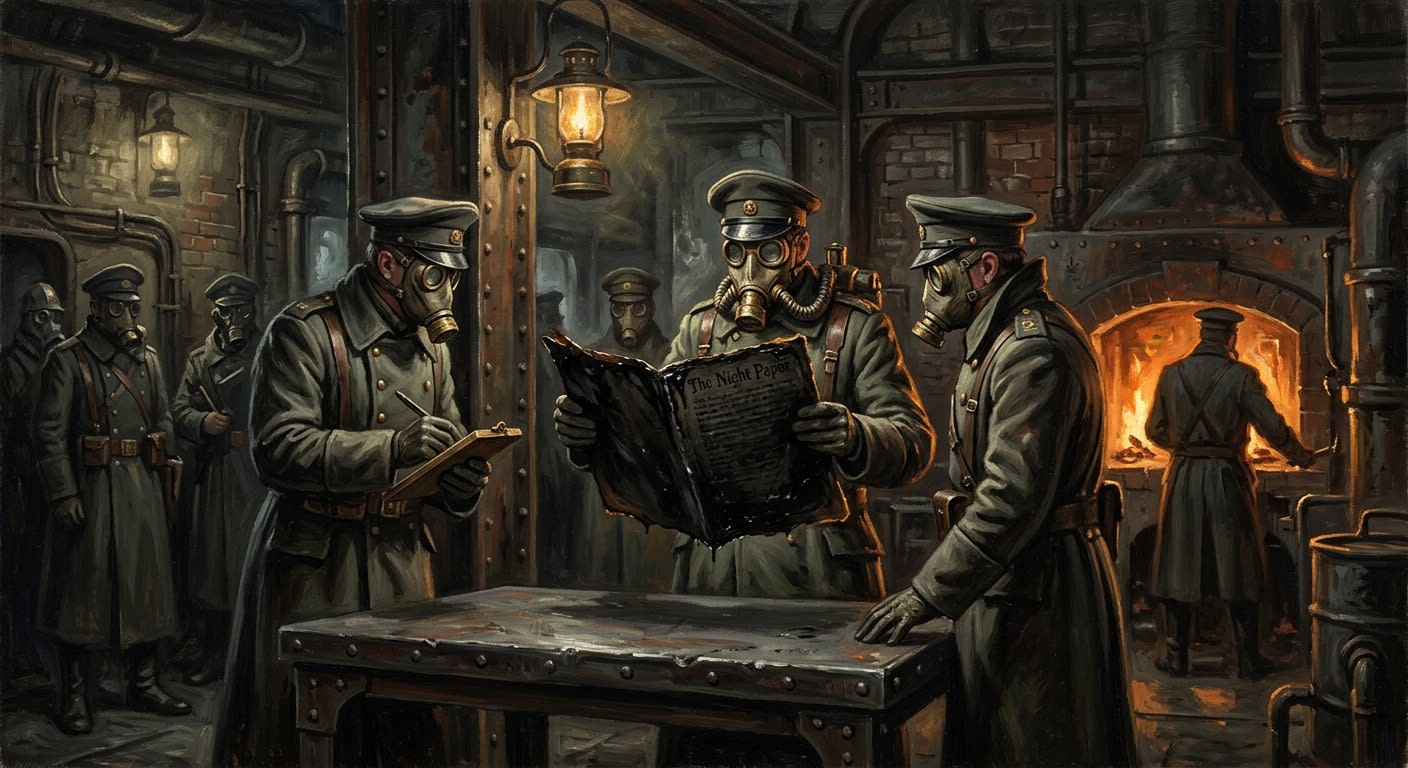
The Night Paper is a sealed black-wax instrument of the Bureau of Doctrine, carried under curfew by grey-coated runners and opened only where ordinary law has proved too slow, too public, or too fond of asking who signed the order.
Its body is modest: one slip of grey vellum, one seal of black wax, one instruction written in a hand that no registry admits to teaching. Its authority is less modest. A Night Paper outranks tribunal, commander, parish register, witness appeal, episcopal protest, local custom, and the small twitching animal called conscience. It exists between receipt and dawn. Within that span, it is law with a knife in its sleeve.
The public catechism describes the Paper as emergency doctrinal clarification. This is accurate in the same way a guillotine is a device for improving posture. The Night Paper clarifies by removing the person, regiment, sector, relic, office, ward, bell-crew, bridge-gang, or witness whose continued existence has made Doctrine untidy.
#On Delivery
The Paper travels by hands trained to deny themselves. The courier may be an Night Papers Courier, an Index Damnatus Runner, a borrowed Shadows hood, or some lesser administrative creature whose name has already been reduced to route-token and shoe size. The coat is grey. The seal-box is plain. The runner does not knock twice.
At delivery, the recipient is identified by function rather than dignity: commander of the third trench lock, keeper of the south powder key, senior confessor in the fever ward, officer of competent authority nearest the condemned facts. Names are unnecessary. Names create tenderness, and tenderness is an inefficient paperweight.
Curfew protects the transaction. Bells measure it. Doors open because refusing a grey coat requires greater courage than most hinges possess. The runner leaves before questions gather mass. The recipient is then alone with the Paper, except for the quorum, the seal, the deadline, and whatever part of his soul still believes obedience can be clean.
#On the Reading and Burning
Protocol requires the Night Paper to be read once aloud to a quorum of three. The number is doctrinal, judicial, and practical. One man may mishear. Two may conspire. Three can damn one another afterward with admirable efficiency.
The Paper is opened with a blade. The seal is preserved until the reading is complete. The text is read exactly once. No copy may be made. No paraphrase may be entered. No officer may ask for a reason. The Night Paper does not argue. It names, charges, commands, and waits for flame.
Earlier field habits permitted commanding officers to read Night Papers privately “where tactical necessity required.”
Revoked. Private reading produced hesitation, embellishment, and in two recorded cases, mercy. The quorum requirement stands. Three throats make better chains than one.
After the reading, the Paper is burned in a covered dish. The ash is weighed against a standard measure kept in sealed custody. If the ash weighs true, the instrument is considered destroyed. If the ash is heavy, a copy was introduced. If the ash is light, material is missing, meaning some portion of the Paper has escaped destruction. In either case, the quorum is arrested.
A.S. 196, northern sector: ash measured light by less than one fingernail shaving. Quorum arrested. Dish opened under Purity witness. Inside: no ash, one black-wax bead, and a line written on the metal in heat-white script: █████████████████. The three officers confessed to nothing. Their confessions were accepted.
#On Authorship
The Bureau of Shadows is often blamed for Night Papers. This is administratively convenient and theologically vulgar. Shadows carries, masks, denies, and perfects the absence around the instrument. Doctrine authorises the grammar. A knife may be hidden in a sleeve; the hand still belongs to the body.
The arrangement suits both Bureaus. Doctrine retains authority while declining fingerprints. Shadows retains deniability while enjoying the scent of grave-dust wax. Records files nothing, which requires an entire annex of clerks. Purity complains whenever it discovers that someone has been condemned before the proper interrogatory theatre could be staged. Purity's complaint is traditional, decorative, and ignored.
The first rule of Night Paper authorship is that no author exists. The second rule is that anyone who insists upon the first rule too loudly has probably read the draft room inventory. There are draft rooms. There are wax rooms. There are seal drawers labelled with dates that have not arrived. I have seen them. I have also signed the statement saying I have not.
#On Famous Use
The most notorious recent Paper arrived at Bastion-Constantinople on the eve of the Vigil of the Hollowed, A.S. 170, naming the 14th Parish Regiment oath-broken under the Catechism of Obedience. The regiment manned relic artillery along the Sixth Ravelin's southern curtain. Their colonel burned them before dawn. Maldrake's Hellbow Legion struck the unmanned curtain at first light. The wall cracked. Forty-seven volunteers entered consecrated cement. Chamber 7 still hums.
The Bureau classified the sequence as miraculous zeal. The classification is public. The dispatch logs are not.
Commemorative sermons once called the Night Paper “the spark of holy obedience.”
Corrected for doctrinal accuracy. Sparks illuminate before they burn. Night Papers do not illuminate. They authorise combustion.
Older legends speak of the Metz Oblivion, the Gray Wax Coup at Mainz, and front-line Papers that named whole choirs, terraces, barracks, bridge crews, and confession wards for removal before Matins. Some records are theatrical. Some are lies. Some are accurate, which is the usual hierarchy of Bureau history.
#On the Present Danger
As of A.S. 201, Night Papers remain active wherever the Synod requires speed without ownership: Strasbourg bridges, Königsberg frost routes, Brest trench locks, Przemyśl dugouts, Shipka fog approaches, Irongate tunnel mouths, and Constantinople's harbor stairs. They are rare enough to remain mythic and common enough to keep commanders sleeping in boots.
A Night Paper is not a warrant. A warrant invites procedure. It may be copied, argued, appealed, misfiled, misplaced, stamped wrong, stamped again, and eventually obeyed by exhausted men who have forgotten the original question. A Night Paper hates that delay. It arrives already impatient. It gives a man power before he can deserve it and removes the evidence before he can repent.