
#On the Paper That Dies at Dawn
“Expires at sunrise.” — marginal instruction, grey vellum specimen, voided
A Night Papers Courier is a man, woman, child, debtor, criminal, orphan, ex-clerk, failed novice, surviving runner, or administrative accident whose occupation consists of placing absolute authority into another person’s hand and then vanishing before the hand can close around a question.
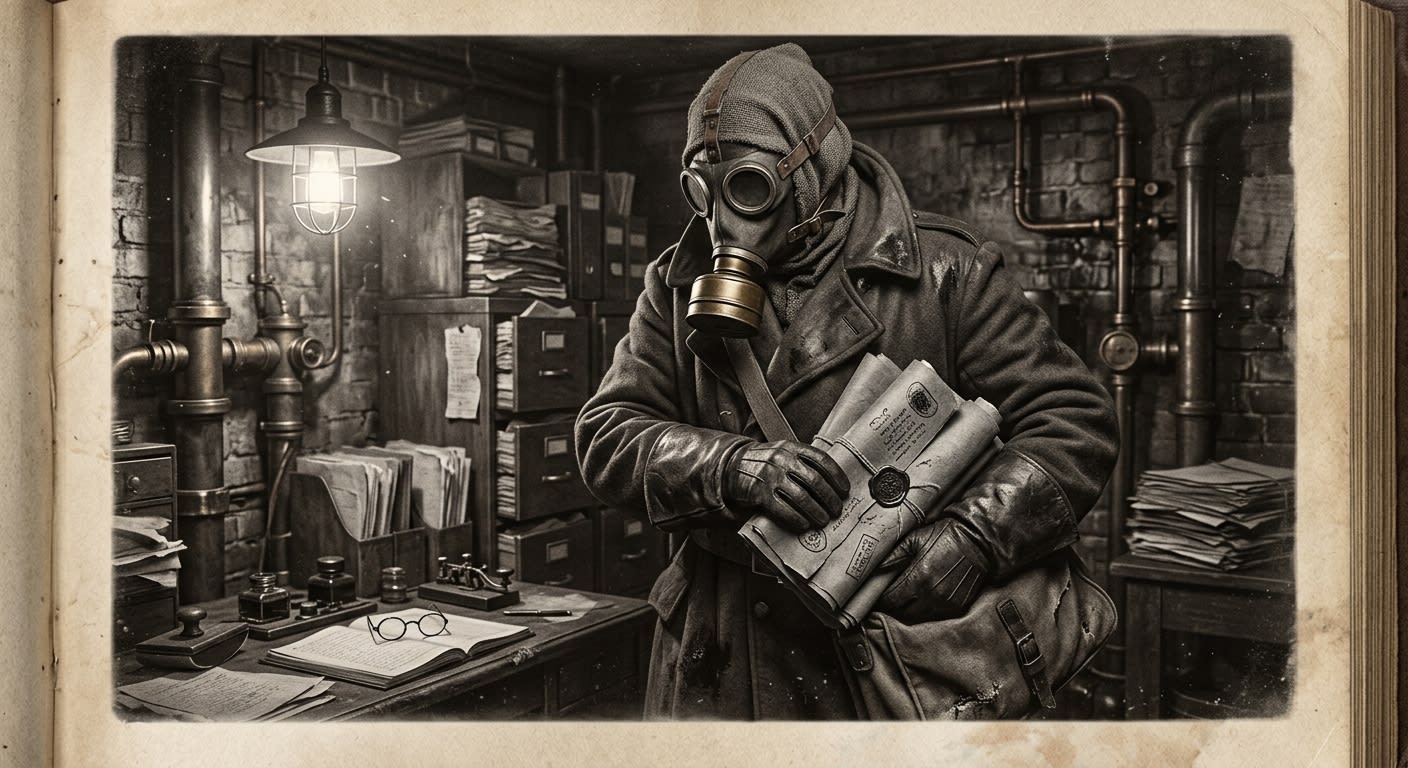
The title is generous. A courier implies a post, a route, a sack, a wage, a supervisor, a grievance procedure for blisters. The Night Papers Courier has none of these things, except the blisters. He carries one slip of grey vellum sealed in grave-dust wax. The vellum bears an instruction that exists only between sunset and dawn. While it exists, it outranks tribunals, officers, wardens, abbots, captains, and occasionally good sense. At sunrise the Paper blanks, burns, curls, dissolves, lies, or becomes ordinary vellum, depending upon the quality of wax, the mood of the Bureau of Shadows, and the moral education of the observer.
The courier delivers deniable authority. That phrase appears in no public catechism because it would frighten the literate and educate the rest. Authority normally moves slowly: draft, review, seal, counterseal, tribunal, witness, appeal, ratification, correction, commemoration, monument, and a small pamphlet explaining why the entire procedure was merciful. The Night Paper is authority with its clothes cut off. It arrives under hood, fog, curfew, and candle-flame. It grants the recipient permission to arrest an officer, burn a sector, seize a relic, silence a witness, empty a ward, open a gate, close a gate, or make a man into the sort of absence that even his mother will hesitate to name.
The courier is the sacrament’s legs.
#On the First Hood
The official doctrine is simple enough for children, which is usually where our best cruelties begin: Providence dictates the Papers; the courier is merely the wind.
Wind, I note, is rarely flogged for arriving late.
The true origin lies in the period after the Concordat, when the Synod discovered that its magnificent machinery suffered one embarrassing defect. It was slow. By the time a proper warrant moved from Strasbourg to a bastion, the suspect had fled, the regiment had mutinied, the relic had been stolen, the commander had prayed himself into paralysis, or the district had generated opinions. Opinions are larvae. Leave them overnight and they become factions.
The Bureau of Shadows solved the problem with its customary theological modesty: create an order whose author cannot be named, whose legality cannot be appealed, whose proof cannot survive inspection, and whose lifespan is too short for conscience to find its boots.
The founding myth names the First Hood, a faceless runner who delivered a Paper to a general before the Paper had been written. The general, demonstrating the sort of obedience that makes military men so useful and so dangerous, carried out the order immediately. At dawn the Paper appeared in the proper wax-room, already blank, already fulfilled, already filed as having never been issued. The First Hood was never identified. This is cited as proof of sanctity rather than proof of poor personnel control.
The early couriers were drawn from message boys, condemned smugglers, Index Damnatus runners, bell-rope apprentices, and parish clerks whose handwriting had become too good. Then came the Shadow standardisations: no names on route tokens, no signatures on receipt, no full-face recognition, no second delivery to the same hand within seven nights unless the second hand was expected to be dead by morning. By A.S. 134 the profession had acquired its current shape. By A.S. 180, during the Year of Smoke, the Bureau of Records was recording “Shadows activity intensifies” while simultaneously maintaining that no such activity, profession, office, fund, wax-room, courier bed, or grave-wax allotment existed.
Earlier instructional digests assigned Night Papers Couriers to the Index Damnatus Runner Corps as an urgent-writ adjunct.
Corrected: Index runners carry condemnations that wish to be recorded. Night Papers Couriers carry commands that intend to have no childhood, no witness, and no grave. The difference is not procedural. It is metaphysical.
#On the Route
A courier’s day is an insult to the word day.
Morning is for scrubbing wax from the nails, sleeping badly, counting one’s own name in whatever private list one should not keep, and checking that the door still opens from the inside. Midday is for lawful errands used as camouflage: carrying bread, filing a chit, mending a boot, visiting a chapel, flirting with a gate clerk whose memory can be purchased with fuel. Late day is for the summons, which is never a summons. A candle is left burning in a wax-room that should be empty. A grey slip rests inside a seal-box. A recipient is described by coat, limp, cough, ring, missing finger, preferred blasphemy, or some other human particularity the Bureau can use while declining to admit the person has a name.
Night begins when the Paper is lifted.
The route is chosen by omission. Avoid bell-gates; the Bureau of Bells hears too much and pretends too little. Avoid patrol lamps unless the route token will open them. Avoid drunk soldiers, pious widows, dogs, Lantern vigilantes, inquisitors, and children old enough to remember a hood but young enough to say so aloud. Avoid saints’ niches with open candles, because a Paper’s text shows under true flame and some old candles have opinions about hidden writing.
The Paper rides in a no-name pouch under the coat, never against the heart. Couriers are superstitious on this point. They say the wax listens. They say a Paper held too close begins to count beats and compare them against the deadline. I ridicule this whenever possible, while keeping all Night Papers placed on the desk rather than in my breast pocket, because theology need not be stupid to be brave.
At the handoff the courier speaks the phrase. Every phrase differs. “Your candle is owed.” “The west stair remembers.” “Grey before Matins.” “No bells for this.” The recipient answers, or does not. Some grab. Some recoil. Some demand an author. The courier gives them nothing to hold except the Paper.
Never let the recipient hand it back. That is the first law. A Night Paper returned to the courier is a verdict reflected in a mirror, and the Bureau has never trusted mirrors, except when using them against other people.
#On the Deadline
Dawn is not a time. Dawn is a predator with a liturgical schedule.
The Paper must be delivered before sunrise. The command must be activated before sunrise. If the recipient refuses, dies, flees, faints, cannot be found, cannot be identified, proves to be two men wearing the same ring, or is discovered already erased by a prior instrument, the courier still owns the remaining minutes. This is why the profession breeds the thin, quick, sleepless temperament one sees in ferrets and minor theologians.
What happens at dawn to a failed courier is described three ways. The Bureau of Shadows does not describe it at all, which is the most credible account. Courier slang says the Paper “eats slow feet.” Older Candle-Runners say the command executes through the bearer: the courier becomes the recipient, the punishment, the evidence, and the clean-up. I have found no official confirmation. I have found an unusual number of dawn fires in courier lodging houses.
This rule produces the profession’s special atrocity. The courier tells himself, “I only carry.” The Paper answers: carry faster. He tells himself the recipient decides. The Paper answers: choose a hand. He tells himself the order is not his. The Paper answers by turning warm in the pouch when dawn pales behind the roofs.
A commander may hesitate over a sector full of refugees. A courier may know the hesitation will kill him. A courier may therefore press the Paper into the nearest authorised palm, even if that palm belongs to a coward, a zealot, or a man who has been waiting all his life for permission. The Synod’s genius lies in such divisions of guilt. We make responsibility portable, time-bound, and difficult to subpoena.
ROUTE FAILURE REPORT — A.S. 197 — BASTION ████████: Recipient deceased prior to handoff. Courier proceeded to alternate command node. Alternate commander absent. Courier reached third authority at first dawn-colour. Paper activated. Sector burned at 04:██. Refugee count revised from 612 to “noncombatant presence unverified.” Courier listed as sun-caught. No body recovered. No appeal filed.
#On Couriers, Custodians, and Other Absences
The Night Papers Courier is often confused with the Gauze-Masked Custodian. This is understandable in the way all ignorant mistakes are understandable from a sufficient height.
The Custodian collects. The courier delivers. The Custodian is the hand that removes a person from the visible grammar of the world. The courier is the hand that brings another hand permission to begin. A Custodian’s authority sits in gauze, silence, and the blank folio. A courier’s authority sits in a pouch and sweats through wax seams while church bells measure its remaining life.
There are ranks, though one should not say this near a record clerk unless one enjoys theatre. Candle-Runners train on dead routes, carrying blank slips while instructors alter bell peals to simulate closing dawn. Hand Couriers carry short-run Papers to single recipients. Night Papers Couriers receive full warrant carriage. Dawn-Counters, whose existence I deny with perfect sincerity, handle Papers that have been countersigned into permanence. They are said to carry “forever” in a seal-box. They are also said to age badly.
The profession’s internal factions are as dreary as any other guild’s, merely more fatal. Grey Wax Loyalists refuse to read beyond the authentication line. Route-Dealers sell timing, shortcuts, delayed handoffs, patrol absences, and the small mercies that become blackmail by morning. Cold Lanterns specialise in trench routes. Bridge Hoods work Strasbourg. Grave-Wax Men handle front-line warrants where artillery, mud, and daemon-weather make punctuality a theological wager.
Everyone despises them. Everyone uses them. Commanders fear the flutter. Inquisitors resent the bypassing of proper interrogation. Gate captains accept bribes and later deny the gates existed. Night Wagon drivers wait at the far end of certain routes with reins in hand and no questions in the mouth. Purity calls them paper-knives. The street calls them suicide scribes. The Bureau of Shadows calls them nothing, which is promotion.
#On the Paper’s Morality
A Night Paper Courier learns to separate authorship from carriage with the devotion of a monk separating bone fragments in a reliquary tray. The distinction keeps him alive. It does not keep him clean.
He did not write the order. He did not choose the charge. He did not decide that a parish regiment was oath-broken, that a bridge crew must vanish, that a quarantine ward should be sealed from outside, that a relic choir must be cut down before its song infects command. He merely ran. He merely pressed vellum into a palm. He merely watched the recipient’s face alter as authority entered it.
Then he hears the barracks burn.
The psychological signs are known. Candle-checking. Wax-rubbing. Sleeping facing east. Refusing to stand with one’s back to a window near dawn. Counting bells under the breath. Flinching at paper sounds. Keeping forbidden private lists, then burning them, then rewriting them from memory because guilt, unlike vellum, does not blank on schedule.
The spiritual signs are worse. Couriers report grey wax sticking after delivery: a phantom weight in the pouch, a smell in the throat, a drag at the wrist as if the Paper has left a leash behind. Dreams end at sunrise. Faces become recipient-types: limp, ring, cough, scar, command eligibility, moral weakness. Old couriers stop seeing people. They see hands.
Training pamphlets once described courier detachment as “protective spiritual neutrality.”
Current instruction uses the phrase “operational numbness.” The earlier wording produced unacceptable rates of novice self-denunciation, romantic confession, and attempted absolution. Neutrality was too pretty. Numbness does the work.
#On the Present Night
As of A.S. 201, Night Papers Couriers operate wherever the Synod requires speed without ownership: Strasbourg bridges, Königsberg frost routes, Brest trench locks, Przemyśl ridge dugouts, Sibiu pass houses, Irongate tunnel mouths, Shipka marsh walks, Constantinople harbor stairs, and the curtained rooms of cities that believe themselves too civilised for midnight vellum.
They are paid in rations, hush-housing, curfew passage, forgiven infractions, and the priceless privilege of remaining improperly documented. Their names exist just enough to receive bread and not enough to receive protection. This is considered ideal staffing.
The grave-wax allotments have increased since A.S. 199. This is not public information. Wax-room candles burn longer. More route tokens fail to return. More commanders report dreams of grey slips before the slips arrive. The Bureau of Shadows has issued no comment, being nonexistent, and the Bureau of Doctrine has classified the rising frequency as “heightened providential agility,” which is a handsome phrase for institutional panic wearing polished shoes.
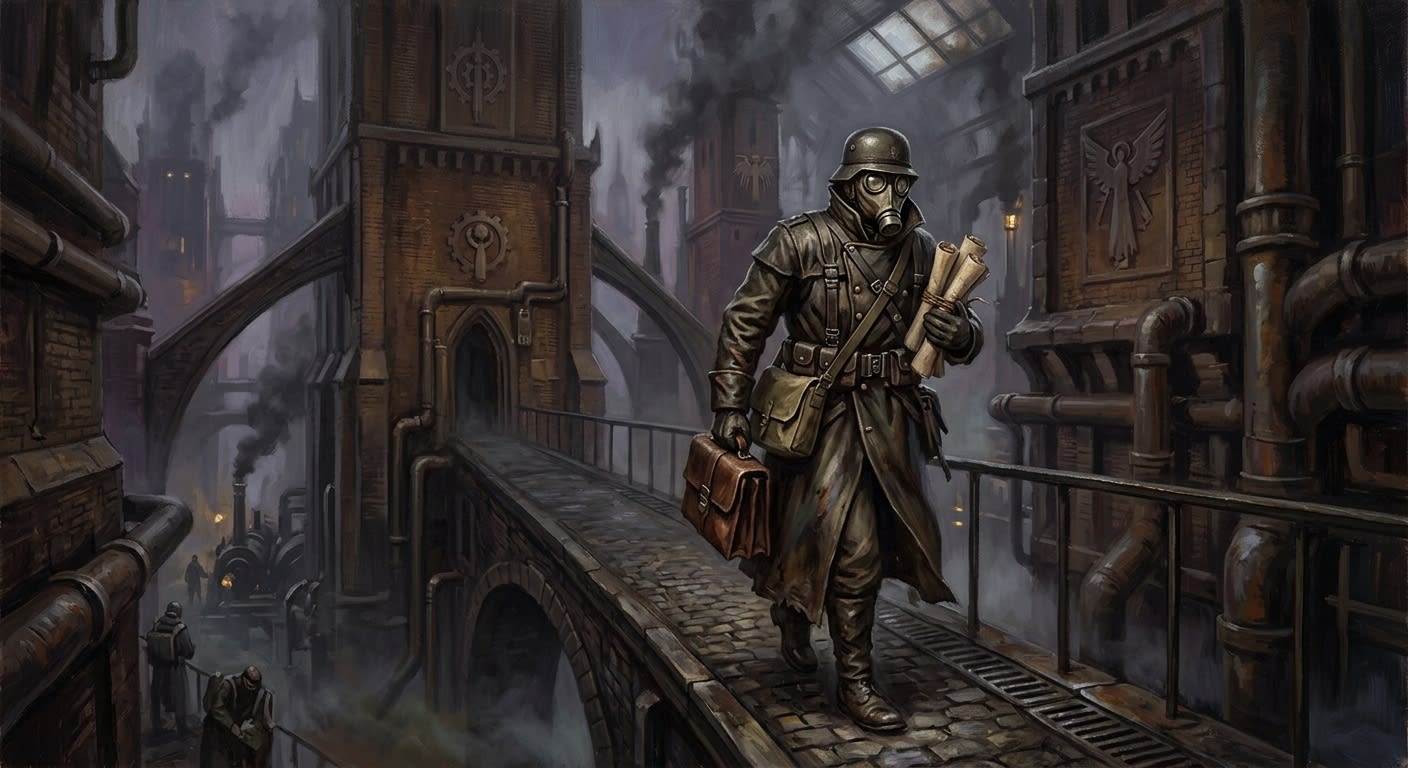
Tonight a hooded figure will cross a bridge no map requires, pass a gate no guard remembers opening, and place a Paper into the hand of a man who will have until dawn to become monstrous with permission.