
#On the Iron at the Western End
"Light three times. Speak once." — Painted on the lintel of Beacon Tower Three, origin unknown, paint refreshed quarterly by standing order.
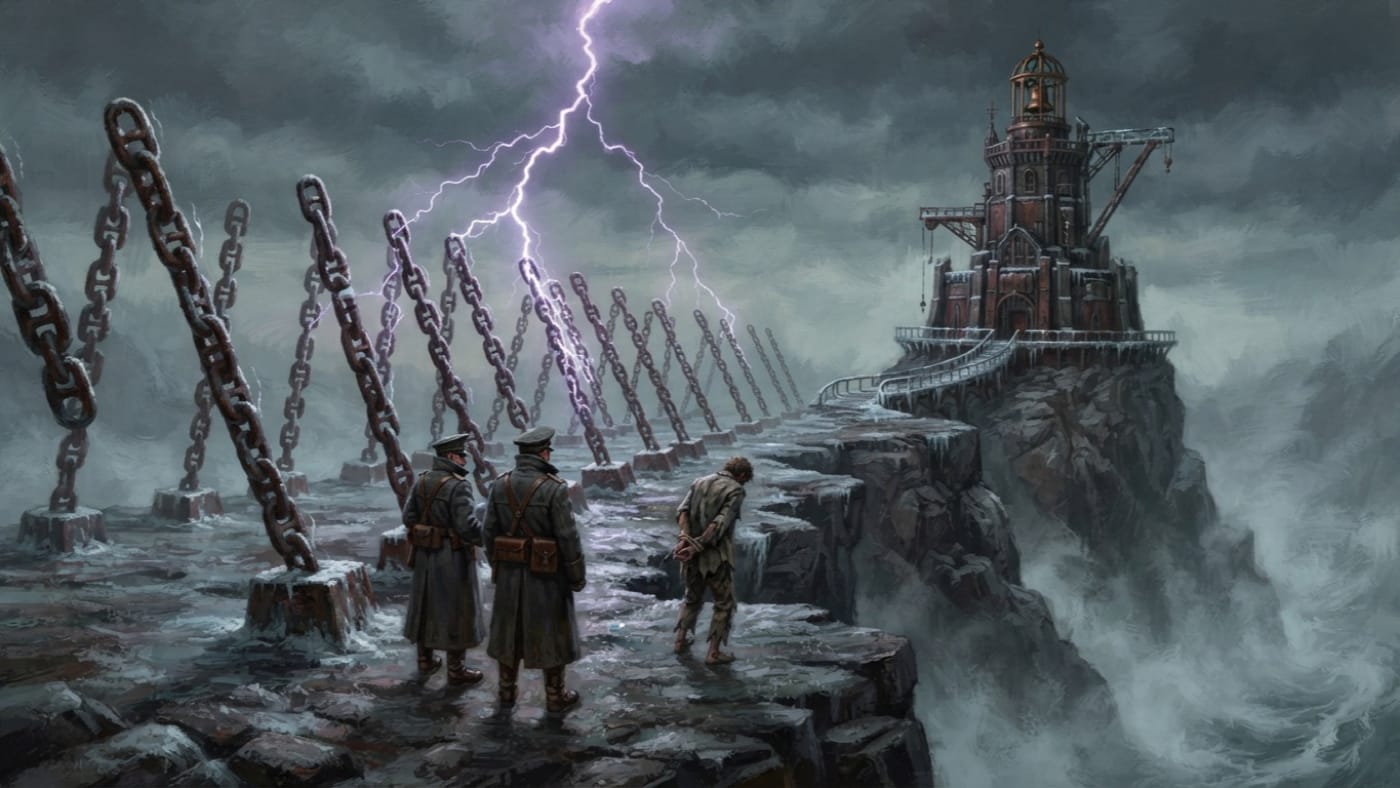
At the western end of the basalt knife-ridge that carries Third Light, the settlement stops and there is only rock. Forty-seven iron chains stand upright in that rock. Each is fifteen feet tall, and each is sunk ten feet into the basalt. The garrison calls the place the Grounding Field. The name is so dull and municipal that I trust it completely. The men who chose it had no time for poetry. They were busy staying alive.
The chains rise from an irregular shelf that is wet more often than dry and coated with rime through the winter. Below them lies the fog basin the locals call White Mouth, which fills and drains with the bell-cycles. To the east, higher, at the crown of the ridge, stands Beacon Tower Three with its relic-lantern and its bronze bell-cage. The field exists for that tower. It is the tower's lightning-ward and its sacrificial outwork: a congregation of iron set at the far end of the nave so that the altar may be spared.
In storm the chains sing. Their pitch rises and falls with the pressure of the air, as any barometer could have predicted. The links hum. When the strike comes, the arc-flash jumps from chain to chain with a crack that the garrison feels in its teeth, and the garrison keeps its distance accordingly.
#On Storms and the Keeping of Signals
Storms at Third Light come from below. They gather in the valleys and climb toward the ridge. Lightning is the station's principal killer, and it goes looking for the tallest iron on the ridge, which is the beacon. If the beacon is lost in a storm, the Beaconchain goes dark at its third link. The convoys waiting on the switchbacks below must then wait longer or move without clearance. In these passes, a convoy that moves without clearance usually enters the record as a loss.
The Beaconchain itself was built on such a loss. In the winter of A.S. 72, the Sagittal Line was still being turned from defensible earthwork into regular practice. That winter a supply convoy bound for Bastion-Przemyśl vanished in the Carpathian passes, and signal towers followed. The First and Second Lights were burning by A.S. 74. A single lightning storm took both of them in A.S. 76, and the station's own history insists that the storm rose from beneath the ridgeline. Third Light was raised on higher ground in A.S. 77.
Here the record must be kept straight. Keeping records straight is my profession, and watching others fail at it is my pleasure. Beacon Tower Three carries its own grounding chains, which the founding account says are sunk forty feet into the basalt. Those belong to the tower. The Grounding Field is a separate installation at the western end, with ten-foot anchors, and no document laid before me gives the year it was planted. A.S. 77 dates the station. It does not date the field. The archive also declines to say who first drove iron into the western shelf, or on whose order.
#On Oaths at the Field
The garrison holds that a lie spoken in the Grounding Field changes the pitch of the nearest chain.
Everyone on the ridge shares this belief, just as everyone shares rope-stare and frostbite. Unlike most frontier piety, it is useful. The Gate Provosts hold oath-hearings at the edge of the field as a matter of routine. Their commander is Harn, called Nail, who holds the Switchback Gate and therefore every way onto the ridge from below. Some men wish to pass. Some wish to stay. Some must explain why a crate weighed more at the gate than it did at the foot of the switchbacks. Sooner or later, all of them end up answering questions beside the iron.
The arrangement favours the bench. The questioner stands with his back to the station. The man being questioned stands nearer the chains, on wet basalt, with forty-seven lightning-conductors at his shoulder and White Mouth at his feet. If weather is coming, he hears it in the links before he sees it. Every man on Third Light knows what the field is for and knows that the iron draws the strike. Whether the chain can hear a lie is a matter for theologians and alchemists. Whether the man believes it can is written on his face.
I set down no protocol for these hearings, because none has been filed with me, and I set down no verdicts. The Provosts keep their own counsel and, as far as the Loghouse can tell me, their own books. The practice is established. How they conduct it is their business, and Nail is welcome to it.
#On Folklore Under Seal
The Bureau of Doctrine classifies the chains' supposed response to truth as superstition. Folklore, the file says. The Bureau of Doctrine also conducts its own interrogations at the Grounding Field.
I have read both entries. They sit in the same cabinet, and neither cites the other. The Bureau has not explained the arrangement. I have defended the Bureau's arrangements before audiences less forgiving than this one, and I will not explain this one on its behalf. By classification, the belief is a superstition. By the same records, the Bureau's interrogators stand beside it whenever they have questions to put.
What a chain does when a man lies remains unestablished. No instrument record before me separates a change of pitch from the ordinary movement of the weather. The question is still open, and it sits open in a file stamped by the body that has declared it closed.
One further detail is small and physical. The links of the field carry marks etched into the iron, which the garrison calls "names." I record the word as the garrison uses it. No document says whose names they are, if they are names at all, who cut them, or why. The same garrison forbids anyone to speak a name aloud on the catwalks, in the belief that a spoken name attracts the strike.
#On the Answer from Below
Since A.S. 194 the station has kept a file titled "Anomalous Signal Behaviour — Station Three — Ongoing," which concerns the fog's habit of answering. The sequence runs as follows. A bell-signet is struck, the lantern sweeps toward Fourth Light, and Fourth Light acknowledges. Then a second acknowledgment rises out of White Mouth, from a bearing where no station stands. The early echoes matched the signals in content but arrived late, by seconds or by minutes. That delay has narrowed. The station's assessment for A.S. 201 records seven false acknowledgments that went into the log as valid relays from Fourth Light, until Fourth Light disowned them.
Third Light has three countermeasures: grounding chains, salt lines laid along the catwalks, and flat-sung calibration choruses. The reports agree that these suppress the answering signals. They agree just as firmly that the suppression is temporary. It lasts a day, a week or a month, and then the answer comes again. The station's accounts treat grounding chains as a single class. They do not separate the forty-seven in the western field from the tower's own anchors or from any other iron on the ridge. I will not credit the field with a share of a success that nobody has measured.
The Bureau of Alchemical Standards spent three weeks on the ridge in A.S. 199, measuring pressures and refraction indices. Their report recommends further study.
The answering fog: acoustic refraction consistent with atmospheric layering. Natural phenomenon. No doctrinal intervention required.
This classification has been suspended; see the Station Three assessment. The chains of the field are still listed as a countermeasure against a phenomenon that, for now, has no classification at all.
I file the evidence in three grades, and I keep them apart. The echoes are observation: logged, timed and countersigned in the Loghouse of Slate Pages. The idea that the fog is learning is garrison belief, carried in a ridge proverb I will not repeat a second time in print. The idea that something wants Third Light blind is the suspicion of Beaconmaster Jorren Quill. Quill controls the records and the routing and has not missed a cycle in eleven years. That makes him either the best-placed man on the ridge to suspect such a thing or the most frightened one, and the two are not mutually exclusive. If his suspicion holds, a lightning-ward that keeps the beacon lit is worth more than it used to be.
#On the Present Condition
The Station Three assessment of A.S. 201 finds Third Light operational, its population shrinking and its anomalies continuing. The Grounding Field is still part of that working ground. The chains stand and draw the strike. The Provosts still question men at the edge of the field. The Bureau still files the belief as folklore, and it still brings its own questions to the same edge.
The assessment certifies the field as infallible in neither of its offices. Weather has burned towers on this ridge before, and the chains' supposed judgment rests on nothing yet entered in a ledger.
My recommended disposition is as follows. Keep the field as a lightning-ward. Leave the oath-hearings to the Provosts' customary practice. Leave the Doctrine interrogations filed where they already are. Open no inquiry into the chains' pitch until someone can tell a liar from a falling barometer.