
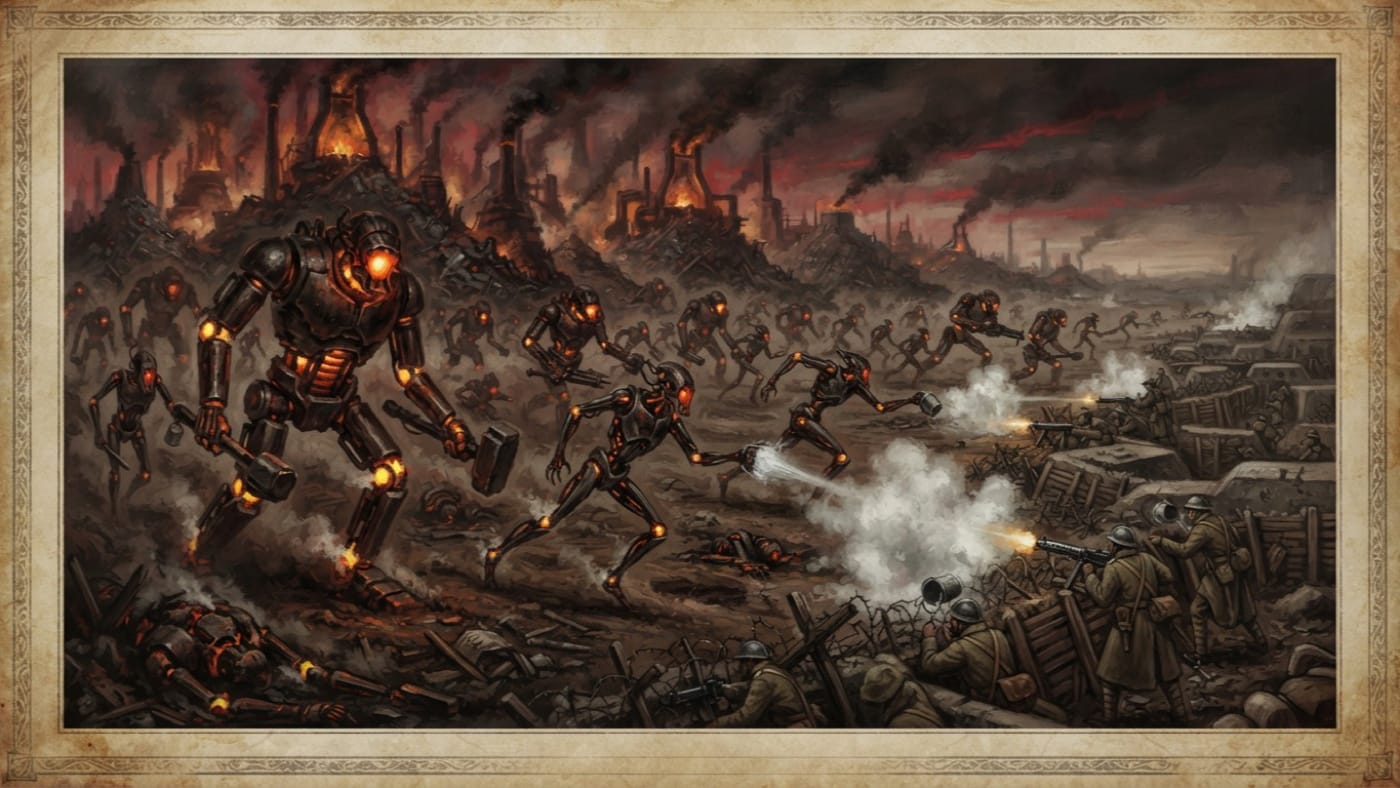
#On Their Nature
"A thing that was never anyone cannot be called back to itself." — Drax, marginal hand, Wrath folio
The Hammered are demons of Maldrake, Sin-General of Wrath, made in the Eternal Forges of his furnace country. They were made. Nearly every other servant of Wrath that the Bureau of War can name had an earlier entry in some earlier register, as a conscript, a gunner, a widow with a pension denied, or a parish clerk with a grievance. The Hammered have no earlier entry. They are wrath given a body and set walking, and the Ledger has one heading for them.
I insist on the distinction because the Bureau of Purity does not. Its field sheets enter everything that burns its way across the Thracian Plain as "Wrath-corrupted, type undetermined." That is about as much classification as a sack. A chaplain facing an Ember-Soldier faces the ruin of a man. A chaplain facing one of the Hammered faces something that was never baptised, enrolled or mourned. There is no name to shout across the wire and no mother in a western parish still paying for Masses. No doubt survives in it to be worked upon.
The Bureau of Doctrine finds this restful. No one has ever filed a petition of clemency for any other category of the enemy.
#On Their Making
The Eternal Forges are mountain complexes in the Thracian highlands. They stand within the furnace country the Bureau calls the Iron Wastes, which soldiers call something worse. The forges turn out weapons past any logistical sense. They make blades for hands that do not exist and armour that rusts in heaps because no body was ever assigned to wear it. They also make the Hammered. That is the whole of the Church's knowledge of where the second product comes from, and I set it down at that length and no more.
No officer of the Church has entered a forge and returned with a description of the work. No one has seen one of the Hammered drawn from the fire, quenched, finished or counted. The Bureau of Rites has twice sent this office a "probable liturgy of manufacture" for inclusion. Both drafts borrowed heavily from the casting of church bells. I returned both unsealed, with the note: The enemy does not cast in our moulds.
Keep identity and matter separate. The forges are fed with bone and blood and the labour of captives, and the Wrath folio says so in plain words. The Ledger cannot say whether any of that bone ends up in a Hammered frame. It can make a narrower and firmer statement: whatever went into the metal, no person came out of it.
The bellows are worked by people. They were taken in raids and chained at the hearths, and they are kept there until their lungs fill with ember. When they fall, the forge replaces them the way a mill replaces a worn stone. The casualty-rolls of the Bureau of War have listed them under "materiel lost to the enemy." I have struck that heading from my copy. A captive's will remains his own while his body is chained to a bellows, and nothing in Doctrine forbids such a man his return.
#On Their Form and Violence
Reports of Wrath's host provide a working vocabulary. The demons have bodies of living metal and joints of molten slag. Their heat comes from within and would soften steel. Their eyes are like forge-mouths and fix on targets and nothing else. Weapon and limb run into each other without a seam. Some of Maldrake's demons are massive and some are lean and quick. Wound them and they leak molten metal, or ash, or nothing at all.
That vocabulary describes the whole host. The Ledger applies it to the Hammered because they are the host's purest product, but no one has certified a measurement of a single Hammered body. The Bureau of Engineering sent a surveyor to the western margin of the Wastes in A.S. 189, and his instruments melted before he could take a thermal reading. The subterranean survey of A.S. 200 was recalled before it was finished. Neither came within sight of a forge, and neither put a rule or a gauge to anything that walked out of one.
The name has misled every engraver the Bureau employs. The Hammered take their name from the forge that struck them. No account requires them to carry a hammer, to have one for a head, or to strike with anything the word suggests. I have rejected three plates on these grounds and expect a fourth by Michaelmas.
What the record does certify is their purpose. The Hammered exist to destroy, and they advance on whatever has not yet been destroyed. Their mercy and their doubt were never lit in the first place, so there was none to burn away. Any tribune who calls them brutes has not read a Thracian casualty-roll. The Wrath folio specifically rejects the idea that Maldrake's forces are stupid. It describes them as tactically brilliant and strategically focused, in service of destruction alone. The Ledger has no test of wit specific to the Hammered, and I will not invent one by implication. Treat them as dangerous until the paperwork says otherwise. The paperwork will not say otherwise.
#On Their Place in the Host
The Hammered stand inside Maldrake's army, and the army has many ranks. The Codex's other entries have blurred them together, so I separate them here.
Ember-Soldiers are the rank and file. They are human-derived, charred and fused, with weapons grown into hands that will never open again. They are not an earlier stage of the Hammered, and no Ember-Soldier ripens into one.
Crucible-Born are survivors of the Crucible Cities. They come out transformed but keep their intelligence, their personality and fragments of memory. They plan, they wait, and they believe. They were people and in some damnable sense still are. The Hammered never were.
Forge-Beasts began as the Church's own siege engines. They were captured, corrupted, and set walking with their crews melted inside. A Hammered is not a captured gun or a corrupted tank, and the engineers who keep confusing the two in dispatches will be named in my next return.
The Raging Dead are ash and ember held together by fury. They reform while their anger lasts. That property belongs to them and has not been shown in anything that came out of a forge.
The Hellbow Legion is Maldrake's principal assault host, and it is deployed most often on the Thracian Plain. That plain lies north of Bastion-Constantinople, where the Sagittal Line reaches its southern anchor on the Bosphorus. The Hammered fight in the war that the Legion leads. The Ledger holds no confirmed Hammered regiment, no formal attachment to the Legion, and no order of battle. Every return I have seen that gives one turned out to be a sergeant's estimate written up in a quartermaster's handwriting.
"His armies are made from the dead." — Codex summary line, Maldrake folio.
Correction: the greater part of Wrath's host was once human, and much of it once dead. The Hammered are the forge-made exception. They were never anyone, so they cannot have been made from someone. The summary line is withdrawn. The folio's body text, which already recorded the exception, stands as written.
#On Their Destruction
The Hammered can be killed. They are physical demons with physical bodies, and like every demon of that order, the body stays where it falls. It can be studied, sectioned and catalogued. A demon confirmed dead does not reanimate where it lies. The Church cannot confirm whether Wrath can make that same individual again somewhere else, and this office will not certify either answer.
The parent folio records that the Hammered do not stop until they are broken apart, and that sometimes they do not stop even then. I keep that sentence because it reports what soldiers saw. I do not expand it, because the soldiers saw movement after breaking, and breaking is not the same as certified death. The Ledger has a heading for a thing that was struck down and kept moving. It has a separate heading for a thing that was pronounced dead and later rose. The second heading has no entries for the Hammered, and the first explains nothing. The mechanism is not recorded. Whether the reports were mistaken is not recorded. Any officer who fills these gaps in his own return will find his return filled with my corrections.
The Doctrine of Cool Hatred instructs the Church's soldiers to kill without heat, because duty requires it and not because rage drives it. The Bureau has prescribed cooling rituals of cold water, ice and slowed breathing for gunners on the Thracian front. These measures are for the defenders. They guard the human heart against the fire across the wire. None of them is a weakness of the Hammered. A bucket of cold water thrown at one of them produces steam and a vacancy in the gun crew.
Remains taken under the Line have been studied, as the general rule allows. They have not yet been reduced to a single description the Bureau would publish. It is a peculiar comfort that a thing made for destruction can itself be destroyed, and the Bureau of Rites has asked to preach on it. The Bureau of War has asked that the sermon wait until the casualty-roll is printed.
#On the Present Record
This entry extends the Maldrake assessment sealed in A.S. 201, and it belongs to that year as a survey only. Neither year is a birth year for the Hammered or a date of manufacture. Maldrake emerged in Thrace at the Sundering, on 1 November A.S. 45. That date belongs to him. The word "Eternal" on the forges dates nothing. The Ledger holds no date for the first Hammered made and no date for the first one seen. The Bureau of War has asked me to supply both "for completeness." I have explained to the Bureau that completeness is achieved by recording a blank as a blank.
There is no count, no named specimen, no list of forges and no certified anatomy. The record states that they are made rather than turned. It states that they serve Wrath, that they kill, and that they can be killed. On the evidence held, it states no more.