
#On the Infantry That Still Resembles Us
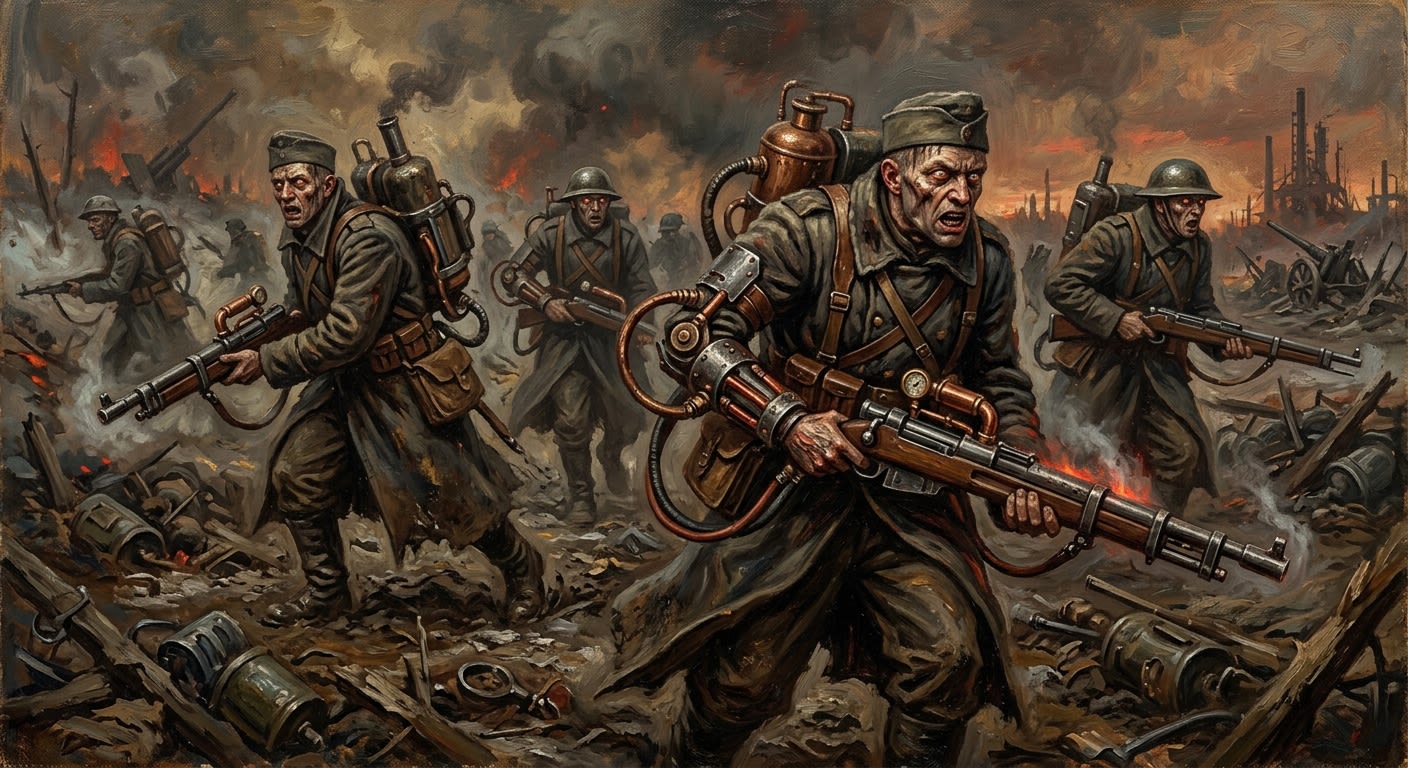
Ember-Soldiers are the rank and file of Maldrake’s host: once human, now charred into obedience, flesh drawn tight over bone, eyes banked red, weapons fused into hands that will never again open for bread, blessing, child, wage, door-latch, or the small decent uselessnesses by which a person proves he is more than a tool.
The field manuals call them Wrath-corrupted assault infantry. Soldiers call them embers. The Bureau of War, after three revisions and one nomenclature quarrel with Medicine, has accepted “Ember-Soldier” because dead men with rifles have limited patience for typographic elegance. Their function is simple. Advance. Strike. Burn. Hold formation until destroyed. Continue if destruction proves clerically incomplete.
They march most often within the Hellbow Legion, between slag-bow frames, behind Gore-Slinger curtains, ahead of pyre-smith teams, beside Forge-Beasts whose heat would cook unaltered men inside their boots. They are not elite. That is the horror. Elite terrors are expensive and numerable. Ember-Soldiers are common. Every assault can spend them. Every breach can receive them. Every trench that thinks it has survived the artillery eventually hears the crackle of their feet on cooled stone.
Their resemblance to humanity is both tactical and theological. A Hammered demon may be hated cleanly. A Forge-Beast can be shelled as machinery. A Flame-Tongue can be condemned as provocation with legs. An Ember-Soldier still has the line of a human jaw beneath the ash, the remains of fingernails within the iron around the hand, the old posture of a labourer, conscript, porter, nun’s brother, butcher’s son, or shieldman who died angry and was not allowed the privacy of being finished.
The Bureau teaches recruits to shoot them in the head, knees, hand-fusions, and throat. The chaplains teach recruits not to look closely. Both instructions are correct. The second fails first.
#On Manufacture in the Wrath-Fire
An Ember-Soldier begins as a human body with rage left in it. This is the first doctrinal discomfort and the last fact any honest officer learns. Maldrake does not require innocence, guilt, military skill, devotion, literacy, age, title, or creed. He requires a remnant of fury strong enough to catch.
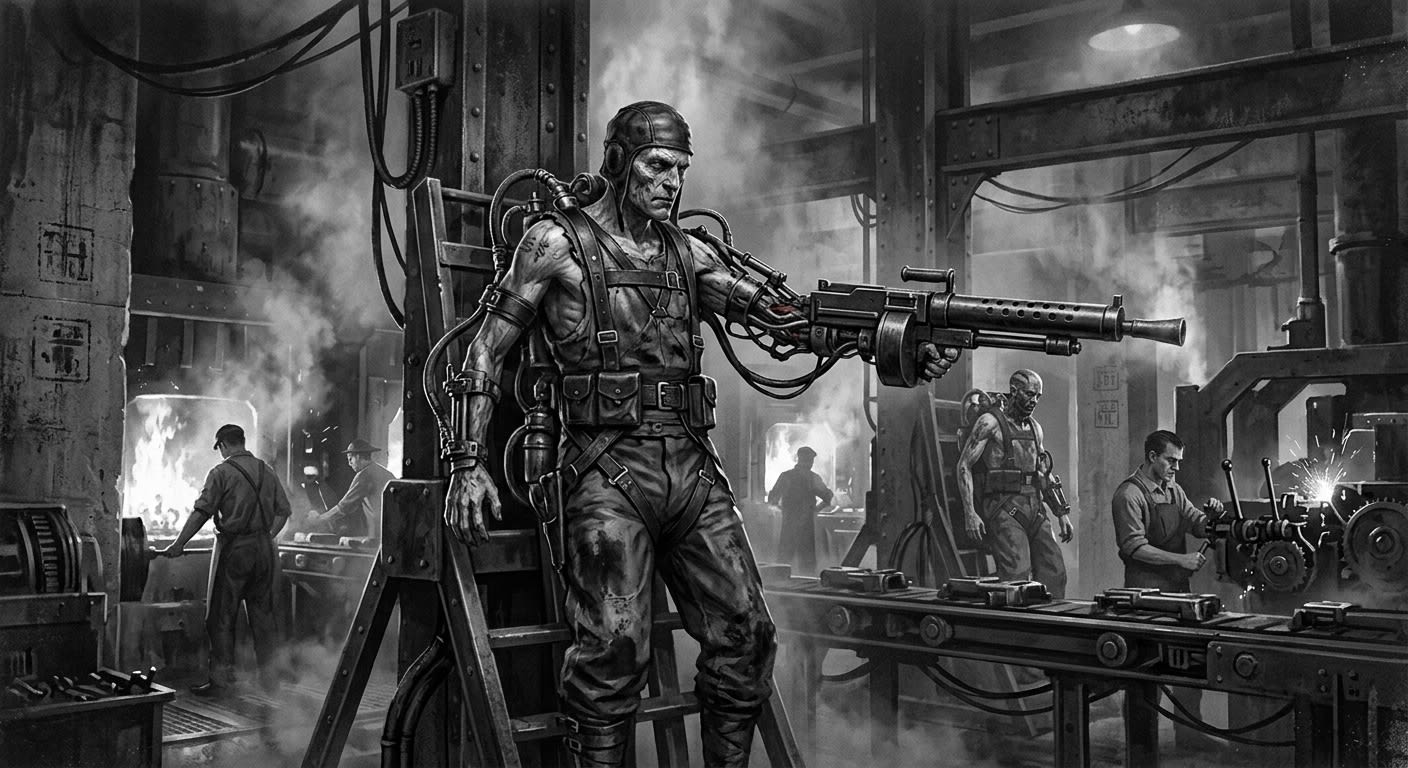
The sources vary. Battlefield dead from the Thracian approaches. Captured prisoners dragged into the Iron Wastes. Wrath-cult volunteers who believed the furnace would make them just. Synod soldiers whose last thought was not prayer but grievance. Civilians from Crucible Cities, hammered by years of ordered violence until personality cracked and heat entered the crack. Some are made from the newly dead. Some from the living. The Bureau of Medicine distinguishes these processes because Medicine must distinguish something or admit that its instruments are small brass toys before a continental sin.
The body is dried by heat without being permitted to decay. Skin blackens, tightens, splits, and seals again in scar-glass seams. Fat burns out. Muscle hardens past flexibility and learns a simpler grammar. Hands clench until tendons tear, then close around weapon haft, blade, rifle, hook, cleaver, or slag-iron frame as flesh and metal fuse. Armour enters the ribs. Buckles melt through cloth into hip and sternum. Boots char around feet that no longer distinguish march from wound.
The eyes remain lit. Not bright. Banked. A coal inside a skull gives more mercy than those eyes. Field surgeons report that decapitated heads continue tracking movement for thirty to forty seconds if the spinal stump remains warm. This has led to several memoranda on whether the Ember-Soldier’s command reception lies in the brain, the furnace-mark, or the heat preserved in the bone. The soldiers have simplified the debate by crushing the head and salting the neck.
Early Bureau of War manuals stated that Ember-Soldiers were “mindless.”
Corrected. They lack selfhood in the legal and pastoral senses. They retain target selection, formation response, obstacle adaptation, weapon use, and enough memory of human motion to climb a ladder while on fire. “Mindless” is a comfort word. Comfort words get men killed.
The transformation is not identical to the making of Crucible-Born. Crucible-Born retain intelligence, personality fragments, strategic patience, and the abominable pride of volunteers who chose to become weapons. Ember-Soldiers retain purpose. They do not plan campaigns. They do not argue with officers. They do not wait unless made to wait. Yet they can follow a signal, wheel under command, brace under fire, climb rubble, guard pyre-smith rigs, drag Hellbow frames, and press through smoke toward the place where resistance is loudest.
Wrath made infantry because even Hell understands supply. A Sin-General may possess colossi, engines, singing fire, and siege beasts; still, at the breach, something must walk into the hole. The Ember-Soldier walks.
#On Appearance, Heat, and Behaviour
A formed Ember-Soldier stands between man and burnt post, often taller than the person used to be because the spine has pulled rigid and the joints have lost their habit of mercy. The mouth may be sealed shut by heat. If open, it leaks smoke, sparks, or a dry clicking noise like teeth counting insults. Hair rarely remains. Helmets, caps, hoods, veils, and crowns sometimes fuse in place, which gives certain specimens an obscene social rank after all institutions that granted the rank have burned away.
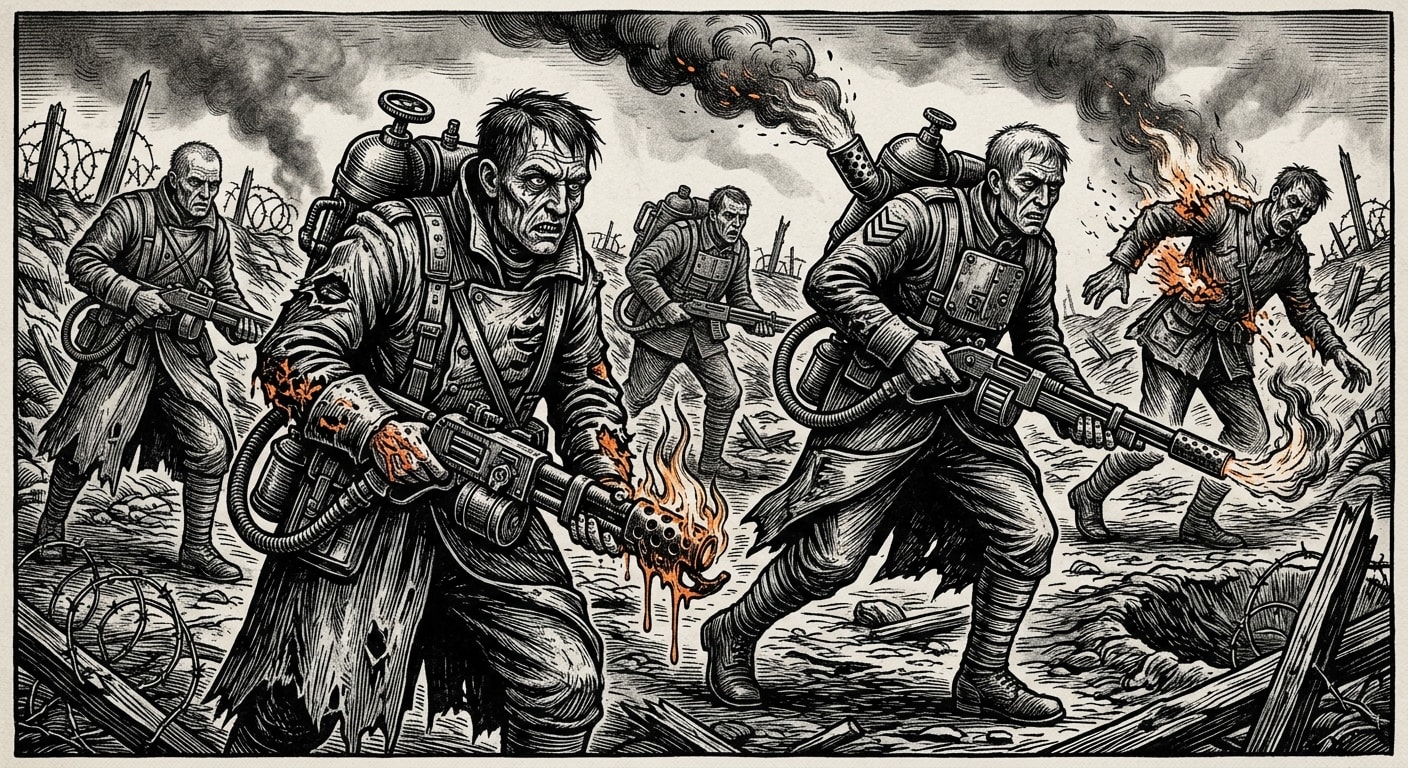
They smell of hot iron, old blood, wet ash after rain, and meat no kitchen should claim. In cold weather steam rises from the joints. In fog, each body carries its own small red weather. On dark approaches, they are seen first as moving coals at knee, eye, and fist. The inexperienced fire too early. The experienced wait for the line behind them, because one Ember-Soldier is target practice and one hundred are arithmetic.
Their formations possess the ugly competence of repeated manufacture. Front ranks absorb fire with shields, scrap doors, welded plates, or their own bodies. Second ranks climb the first if the first falls. Bearers drag slag-bow components or ammunition frames. Blade ranks follow smoke. Hook ranks clear wire. Rifle-fused variants brace against rubble and fire until the weapon melts or the arm tears free. If ordered through a burning gap, they go. If ordered through water, they go hissing, slower but not halted. If ordered through fog from Syrion’s dominion, many go quiet, their fire dimming to red under the skin; some return seated, fists closed around nothing, as the Contact Zone has proved to analysts who still pretend analysis is innocence.
Pain does not deter them. This is not because they do not feel it. Wrath is not anaesthesia. It is priority. An Ember-Soldier with both legs shattered will pull itself by fused hands until the hands break, then bite stone if the jaw still opens. One with the head half-ruined may follow heat, bell, impact, shouted name, or the simple gravitational pull of hatred toward living flesh. They stop when cooled, dismembered, consecrated, or pulverised beyond command reception. Sometimes not even then.
FIELD NOTE — CONSTANTINOPLE SOUTHERN CURTAIN, A.S. 182 Specimen bisected by bell-cannon recoil. Upper torso continued advance using sword-fused right arm. Left hand, severed separately, crawled three feet toward powder crate before crushed. Inscription found burned into palm: ███████████████ Hand kept moving after inscription copied.
Their silence unsettles new men. Ember-Soldiers rarely shout. Flame-Tongues shout for them. Forge-Beasts roar. Hellbow strings scream. The embers march inside that racket without wasting breath. When a company of them does vocalise, the sound usually comes as a shared exhalation at impact, a furnace sigh across hundreds of throats. At the Vigil of the Hollowed, survivors reported hearing an Ember line breathe as one when the Sixth Ravelin cracked. The report was filed under acoustic trauma. It was also true.
#On Their Uses in Maldrake’s Order
Maldrake uses Ember-Soldiers as infantry, porters, shock ranks, living braces, bow carriers, furnace tenders, ammunition servants, breach-fillers, and moral instruction. That final use is not ornamental. The sight of one’s dead returning under Wrath’s heat teaches a garrison that no casualty is secure. It turns grief into security labour. It makes burial urgent, identification suspect, and anger dangerous even inside a chapel.
In the Hellbow Legion they carry smaller hand-rigs, brace crescent frames, haul chain-drawn bow assemblies through mud, and hold positions hot enough to kill normal handlers. A pair may stand with a chain running through chest and shoulder, pulling against a siege bow until the ribs open. They do not release. Release would require a hand that remembers letting go.
Ahead of assaults, they exploit the work of Gore-Slingers. Maldrake-variant sacs ignite trenches, blind crews, foul masks, and drive defenders from parapets. Ember-Soldiers enter through the red curtain before the smoke has decided whether to rise. Their own heat makes them partially resistant to the incendiary fog. Where ordinary allies would be burned by the barrage, embers use it as a processional carpet. Hell’s logistics, as ever, are rude but efficient.
They guard pyre-smiths because pyre-smiths are valuable and possess the focused arrogance of craftsmen even after damnation has hammered the craft out of them. They escort Crucible-Born officers whose intelligence directs the host. They form screens around Forge-Beasts while the beasts close, accepting cannon-fire, brine-shell, and relic shrapnel until their bodies glow white at the edges. They climb into dead artillery nests and turn abandoned guns by force if enough of the old mechanism remains. Captured reports from Thrace speak of Ember crews feeding their own limbs into jammed firing beds to restore motion. Ordnance disputed this until a recovered gun came back with three fused hands in the traverse gear.
In the Maldrake-Syrion Contact Zone, Ember-Soldiers serve another use: testing the grey line. They enter Syrion’s fog, slow, dim, and return altered if they return at all. Some sit down. Some become cold enough to crack. Some come back with flame banked under skin, obedient but delayed by seconds that do not match the clock. Inter-Infernal Analysis treats these as probes. Doctrine treats them as proof that even sin may be made to study sin. War treats them as warning not to rely upon enemy hatred as a wall.
The Ember-Soldier is more than body. It is Maldrake’s answer to attrition. What we kill angry, he may reuse. What he spends, he may replenish. What we bury badly, he may recruit in rumour even when not in fact. A trench facing Ember-Soldiers fights the assault before it and the casualty roll behind it.
#On Recognition and Burial Discipline
The first defence against Ember-Soldiers begins after our own dead fall. This is the sentence every chaplain hates and every quartermaster understands. Wrath harvests unfinished fury. Proper cooling, naming, prayer, salt, bell, and supervised burning are not sentiment; they are perimeter work.
Bodies recovered from Maldrake-facing sectors are kept under watch for heat retention, fist contraction, scar glow, tooth clicking, and post-mortem weapon adhesion. A dead man whose hand will not release his rifle is not praised immediately. He is cooled. A corpse that warms during argument is removed from the tent. A fallen officer whose jaw clenches when his name is spoken receives bell-cover and a brine cloth before eulogy. The family may resent delay. Families resent many things, including accuracy when it arrives wearing gloves.
Older chaplain guides instructed personnel to honour “righteous anger at death” as proof of zeal.
Withdrawn on Maldrake-facing fronts. Righteous anger is pastorally admissible while breathing and operationally hazardous afterward. Praise the dead cold.
Recognition signs in the field are plain once learned and fatal before that. Ember-Soldiers do not bleed freely; wounds glow, smoke, or crust with black glass. They favour direct lines, but adapt around obstacles if signalled. They ignore pain but not obstruction. Knees, hips, fused wrists, and neck are better targets than chest unless relic ammunition is available. Water slows them, brine hurts them, consecrated cold cracks them, and bell-cannon can shatter them if pitch holds. Ordinary fire rarely solves fire. This has surprised exactly the number of officers one would expect.
The face must be disregarded until the body is stopped. A soldier who sees his brother beneath the ash may hesitate. Hesitation gives the brother’s remains time to kill him. The Bureau of War has issued mask directives, distance rules, and post-engagement counselling notices in prose that smells of starch and fear. Veterans use rougher doctrine: shoot the ember, name the man later.
After an engagement, fragments are treated as active until cold, salted, separated, and witnessed. Hands are pinned. Weapons are removed only by saw, chisel, or blast. Ash piles are stirred under prayer because a warm knot of bone can reignite if left flattered by attention. Burial parties on the Thracian front are armed for good reason. The dead there have poor manners.
#On the Theological Offence
The Ember-Soldier is Maldrake’s most insulting sermon because it argues from our own materials. The Synod teaches endurance, obedience, sacrifice, wrath disciplined into duty, body submitted to office, fear mastered by formation, death made useful by correct filing. Maldrake takes the same vocabulary, removes the Creator, removes mercy, removes limit, and returns a soldier who obeys perfectly.
That is the offence. Not disorder. Perfection.
An Ember-Soldier does what bad commanders dream their men might do. It advances without complaint, holds without hunger, burns without mutiny, uses itself without remainder, and never asks why the order was given. It is the fantasy of discipline purified by damnation. Any officer who looks upon that and feels admiration must report to Purity, or to me, if he desires a better sentence and a worse afternoon.
Wrath also exposes the Synod’s own danger. We make men angry and tell them the anger is holy if pointed east. Sometimes it is. Sometimes the Line holds because a furious man refuses to run. Sometimes a Shield-Paladin locks his arms after the body begs to fold. Sometimes a mother with a ration knife saves a checkpoint because grief has no patience left for demons. The Bureau would be lying — a thing it never does, except by authorised clarification — if it said anger has no place in defence.
Maldrake’s corruption begins where place becomes throne. Anger may serve. It may not reign. The Ember-Soldier is anger enthroned in a body from which every other magistrate has been burned out. Memory kneels. Judgment kneels. Love kneels. Hunger, fear, shame, tenderness, humour, prayer, and the blessed wish to sit down after labour all kneel. Only the order remains: advance.
If you require comfort, read another folio. If you require instruction, remember this: every Ember-Soldier was once a person, or enough of one to make the resemblance a weapon.