
#On the Warrant
"Qui se humiliat exaltabitur." A sentence the proud read from the end.
Four times a year, every officer of the Synod's armies above the rank of captain sets down the instruments of command and takes up a basin, a ladle or a coal-scuttle. The Bureau of Purity administers the programme. The Bureau of Doctrine supplies the teaching beneath it and takes no part in the administration, a restraint it calls modesty.
The Humility Practices exist because Atheron does not need to cross the wire to take a fortress. He needs only a commander who can no longer be told he is wrong.
This entry surveys the programme as it stands in A.S. 201. It does not record a founding, because the founding is absent from every file available to me, and I will not invent a council, a decree or a bishop with a basin to give the thing a birthday. It has a warrant and a quarter-day. The Bureau finds that sufficient.
The danger is operational before it is spiritual. An officer who cannot accept correction from below soon commands a unit that has stopped offering any. The sapper who sees the gallery flooding, the clerk whose arithmetic will not close, the sergeant who reads the ridge differently: each falls silent. No ledger records the silence until the casualty returns arrive.
#On the Service
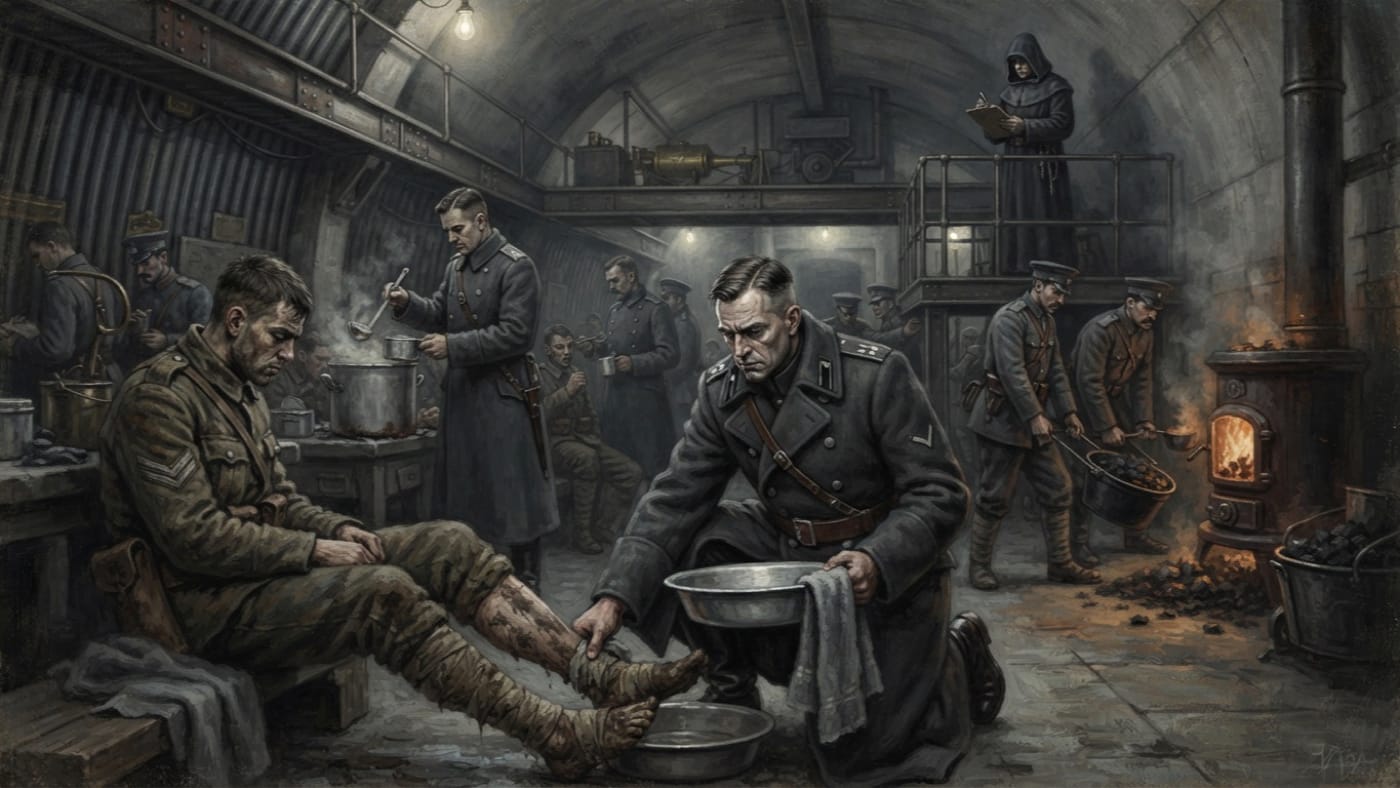
The warrant names three labours: washing feet, serving meals and performing tasks regarded as beneath one's station. It names nothing else. The sources prescribe no prayer, no vestment and no order of proceeding. The folded towel, the chaplain reading over the water and the bow at the threshold are local custom grown over a bare instruction. At Bastion-Przemyśl, which holds the western Carpathian passes of the Sagittal Line while Atheron's spires crowd the eastern heights, custom grows quickly.
The feet come first because they are the hardest. A soldier who has stood a winter watch on the eastern works has feet that are no longer entirely their own. Wool has dried into the heel with old blood. The nails are black. The sole has gone white and soft as wet paper. The officer kneels with water warmed on a mess stove, and the soldier sits on a bench with boots off and no idea where to look. In most cases the officer has no idea either. The water clouds and the towel comes away grey. If the exercise works at all, it works at the moment the officer stops performing a rite and starts attending to a pair of ruined feet that belong to someone whose name the officer ought to know.
Meal service is sharper at Przemyśl, where food and warmth have never been shared evenly and everyone can recite the difference. The officer stands behind the cauldron with the ladle: cabbage boil, bitter bread, tallow tea. The queue files past, tags in hand. The Practice changes no entitlement on any tag. The officer serves the portion the clerk would have served, and the soldier receives it with the same hunger. What changes is who holds the ladle. For one queue, someone who usually reads the ration-table has to look at every face.
The third labour has no fixed list. It covers latrine trenches, winding wire-spools, scraping mess tins and hauling coal to stoves the officer does not sit beside. The person usually assigned the work stands aside. They are not an instrument in anyone's instruction, and the Bureau's forms do not require them to be grateful.
#On Rank and Correction
The Doctrine of Equality Before the Divine holds that every soul stands at the same distance from the Creator, and that rank is an earthly, temporary arrangement for earthly, temporary business. A colonel may order a sergeant into a gallery. A colonel may not mistake the order for a measure of the sergeant's worth. Command is a function and worth is a fact. The armies require the function and the theology insists on the fact. Then the Synod hands out pews, stove-places and funerals by rank, and the trouble begins.
Pride, as the Bureau uses the word, is the inability to see another person as an equal, and so the inability to hear them when they are right. Competence does not enter into it. A gunner who knows she is the best gunner on the salient may simply be correct, and saying so is arithmetic. The Practices aim at hearing by way of seeing. An officer who has knelt at a sapper's feet should find it slightly harder to wave away the sapper's report on the gallery.
That is the theory. In practice, Atheron's influence-demons work best on wounded dignity: the able officer passed over, mocked or overruled by lesser minds. The grievance is often just. The contempt that grows from it is never justified by the grievance. A compelled kneeling in front of witnesses, with a Purity clerk taking notes, can feel very like the original injury applied a second time. Humiliation and humility share a root and nothing else. The first feeds what the second is meant to starve.
#On the Returns
The Bureau of Purity's internal review, which I obtained through channels the Bureau has since examined with interest, reports that sixty-three percent of participating officers called the exercises spiritually rewarding. The same sixty-three percent showed no measurable reduction in hierarchical rigidity. I give the finding as the review gives it. I cannot give its date, its sample or the instrument used to measure rigidity. The review does not offer them, and the Bureau did not offer me the review.
The other thirty-seven percent are not a success. They are a remainder. Some of them may have changed. Others may simply have declined to call a cold morning on their knees rewarding, which is a matter of honesty, ill-temper or a bad back. Nor is everyone in the sixty-three percent a cultist waiting for a pedestal. Most of them enjoyed a feeling and mistook it for a cure.
Two failures recur. The first is resentment, plain and loud. A major washes feet with his jaw set, counts the minutes and carries the grievance back to his quarters, where something patient and intangible waits to agree with him. The second is quieter and worse. An officer discovers that she submits beautifully. She kneels lower than her peers and ladles more graciously. Without ever saying so, she notes that lesser officers would resist the exercise while she does not, and she draws the obvious conclusion. The review's own words are short. Genuine self-examination is rare. Pride in one's own submission is common.
An officer whose quarterly Practice is entered complete and countersigned by the Bureau of Purity may be regarded as free of Pride for that quarter.
The author withdraws this sentence from the present entry. The register shows that a basin was carried and a ladle held, and nothing more. Compliance is a fact about the task. The condition of the officer does not appear in the column.
An inspector who wants to know whether a colonel can be corrected does not consult the basin register. He corrects the colonel and watches what happens.
#On the Other Defences
The Practices are one drawer in a cabinet, and people often confuse the other drawers with this one.
Humility Assessments are a separate examination. Under the Bureau of Purity's advisory of A.S. 199, Purity and Doctrine jointly assess Przemyśl's garrison commanders each quarter, and those who fail are relieved of command. The two programmes share a quarter and nothing more. On the documents before me, missing a Practice does not bring automatic relief.
Rotation of Command limits any officer to eighteen months in one Przemyśl post, so that nobody grows into the shape of a chair. It achieves this, and pays for it with lost expertise, broken continuity and a new commander every year and a half learning where the same galleries flood.
Confession of Pride asks officers to name their own contempt. By design, it catches those who can see their contempt and misses those who cannot. Peer accountability depends on the accused recognising anyone as a peer, and that is exactly the faculty the condition destroys.
The Catechism of Humility and the Humility Sequence are field recitations, said on the walls under fire. Neither is the liturgy of the quarterly service. I will not reproduce either here. Any recitation printed in a tract becomes, within a season, something officers memorise so they can recite it better than their colleagues.
When all of this fails and the spine has begun to set, Purity uses its last instrument, which it calls mercy. The Practices neither lead there nor prevent it. They are not an exorcism. No basin of warm water has ever driven an influence-demon out of anyone or unfused a spine. Repentance remains open to any officer who chooses it, because Purity cannot close it, and the Practices cannot make the choice on the officer's behalf.
#The Ratification
I have surveyed the Humility Practices with care. I find them sound in theory, honest in their limits and wanting in nearly every officer whose returns I have read. The fault lies with the officers. Over a long career I have corrected the doctrine of many people senior to me, and I can state with confidence that very few of them could take it. An officer who cannot accept correction is the danger this programme exists to meet. I have read every finding on the matter, and none of them applied to me.