
#On Its Warrant
"Nemo iudex in causa sua." — maxim of the canon courts
The Catechism of Humility enters the Codex the way most useful things enter the Synod: as a clause in someone else's file. Its warrant is one instruction in the Bureau of Purity's field manual for Atheron-contact engagements. I quoted that instruction in my dossier on Atheron, and I quote it again here, because a cleric who cites himself spares the Bureau the cost of a second clerk:
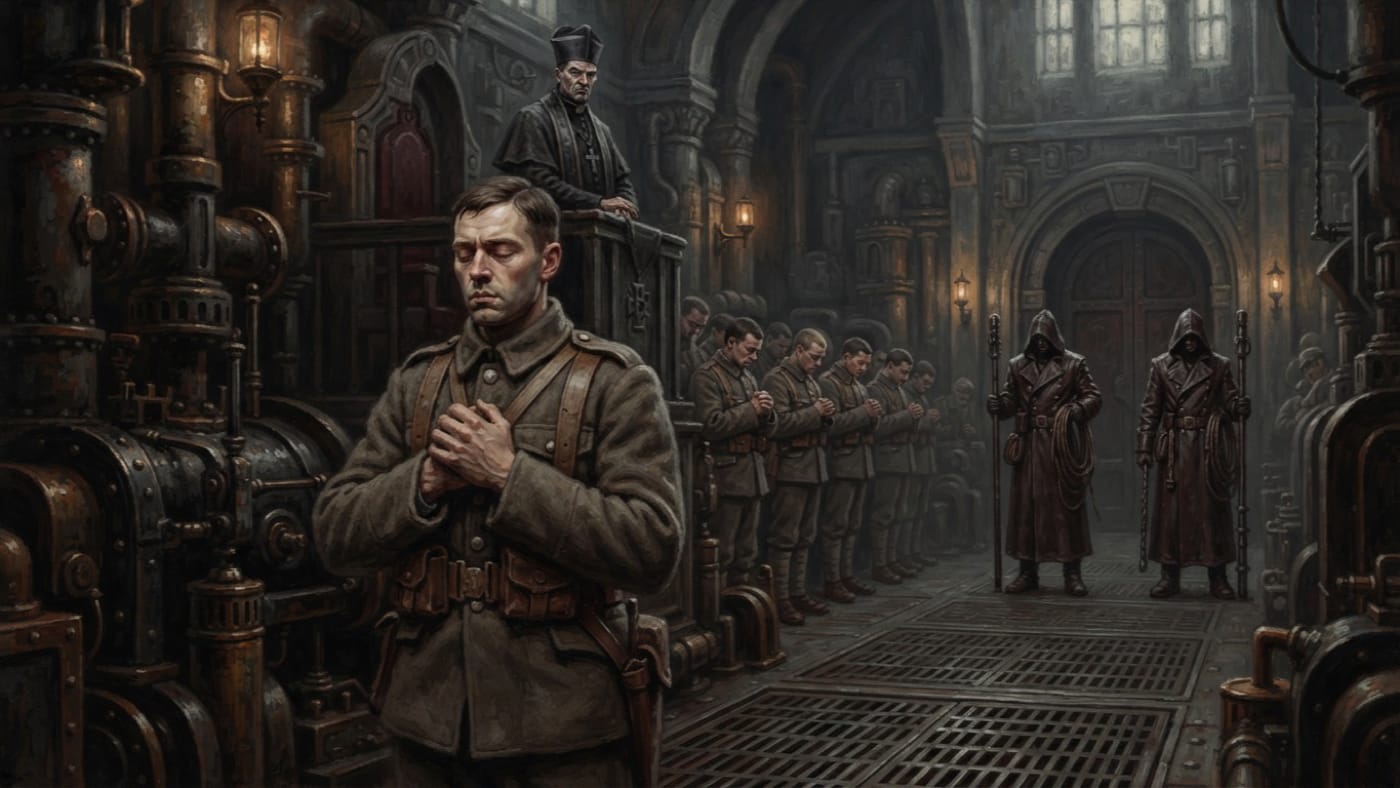
"If you find yourself believing you are the finest soldier in the regiment, close your eyes and recite the Catechism of Humility until the sensation passes. If the sensation does not pass, report to your chaplain. If you find yourself believing the chaplain is beneath you, report to the Lictors. If you find yourself believing the Lictors are beneath you, you are already lost."
That is all the warrant there is. Purity prescribes the recitation and does not print it. The manual names the catechism the way it names a ration tin, on the assumption that every man in the trench already carries one. The catechism was drafted by the Bureau of Doctrine, which drafts every catechism the Synod owns, in the same grey hand it uses on everything else.
The catechism was drafted by the Bureau of Doctrine, which drafts every catechism the Synod owns.
Corrected. Doctrine drafts catechisms as a rule. No register within my reach says who drafted this one, when it was first issued, or under what seal. An office's usual habit does not make it the author of a particular text. The Warden of the Sacred Ledger regrets the inference and has kept the sentence, so that his readers can watch him regret it.
The problem the instruction answers is operational before it is theological. A gun crew can survive a bad range table. It cannot survive one man who knows better than the range table, the sergeant and the battery commander put together, and who has stopped hearing all three.
#On the Pride It Addresses
Look at the trigger. The manual does not tell a soldier to recite when he believes he is a good shot, or a steady hand, or the best layer of a howitzer on the eastern salient. Some of those men are right. Every battery has one, and the battery would be dead without him. Competence is useful to the Creator. Confidence that fits the facts is accurate bookkeeping. The Synod does not brand men for being correct about their own aim, though I have known Purity officers who wished it would.
The trigger is finest in the regiment. That belief takes in every man in the order of battle and finds all of them lower. Pride, as Doctrine defines it and as the dossier on Atheron explains at length, is the inability to recognise another person's equal worth or the validity of his correction. Rank is not the sickness. The sickness comes when rank becomes the whole of a man and every man around him becomes furniture.
Atheron's influence-demons understand the overlooked. They do not seize a man. They agree with him. The officer passed over, the engineer whose plans a committee binned, the gunner whose good shots went into someone else's report: each hears that he deserves better, and each is often right. The agreement feels like justice because some of it is justice. Then the recognition becomes immunity. A man who has been wronged decides he can no longer be corrected. At that point he has lost every peer he had, because a peer is the person who is allowed to tell you that you are wrong.
The Mirror-Lords use this on whole batteries. In their presence the proud see a king who cannot take orders, and the uncertain see a worm who cannot give them. Both images are false. The manual's clause deals with the king. It says nothing about the worm, and I will not write a prescription for it on Purity's behalf. Other controls apply to him. Abasement serves Atheron just as faithfully as exaltation does, and anyone who defines humility as the conviction of one's own worthlessness has handed the enemy his second mirror.
#On Recitation and Referral
The first step is to close the eyes. A soldier with his eyes shut cannot see the regiment he is ranking, the brass that flatters him or the puddle a Mirror-Lord might use. He recites. The manual sets no count and no clock and puts no posture beyond the shut eyes. The words go on until the sensation passes. That gives the patient the job of judging his own recovery, using the very faculty the disease attacks. It is the manual's weak point, and the manual's authors seem to have known it, because they built a ladder underneath it.
If the sensation stays, the soldier goes to his chaplain. Look at what that step asks of him. He has to walk to a man and admit that this man may examine him. A soldier who can still make that walk has kept at least one peer. The chaplain is the first human witness in the sequence, and the first point at which the soldier's own report stops being the final word.
If the chaplain seems beneath him, he goes to the Lictors. That is a different kind of appointment. Lictors carry a leather roll that smells of tallow and hot iron, and they keep records on skin. The manual does not say what they do with a man sent to them under this clause. I have no plans to say it for them. The clause tests whether the soldier can still recognise any authority over him at all, even the one he has most reason to fear.
The fourth step is a verdict with no procedure attached: already lost. The manual prescribes nothing after that line, and neither will I.
Following the instruction proves obedience and nothing else. A soldier who closes his eyes, recites, and feels the sensation go has done what he was told. He has not shown that he is clean. The sensation can pass because the pride passed, or because the pride learned to keep quiet. The catechism cannot tell which, and the man reciting it is the witness least able to tell either.
#On the Humility That Becomes Rank
The catechism has neighbours, and readers should not confuse them with its contents. The Doctrine of Equality Before the Divine teaches that every soul is level in the Creator's sight. Officers above the rank of captain perform quarterly humility exercises: washing feet, serving meals, doing work beneath their station. Commanders at Przemyśl sit quarterly Humility Assessments, which Purity conducts jointly with Doctrine. Officers rotate out of their commands before they can fuse to them. Officers confess their pride, and equals hold one another to account. None of this is shown to be a clause, a schedule or an appendix of the catechism. These programmes simply sit on the same shelf.
Each one has its own way of failing. Forced foot-washing breeds resentment, or a quiet pride in being humble. Rotation guards against fusion and wipes out expertise along the way. Confession works only for men who can still see what they are confessing. Peer accountability assumes the proud man still has peers, and the whole problem is that he does not.
The catechism has the same flaw at a smaller scale. Picture the private who recites it more faithfully than anyone else in his company. Within a month he will be the most humble soldier in the regiment, and the finest in the regiment is exactly the sensation the manual tells him to recite against. The referral order is a ladder too. A private recites, a chaplain hears him, a Lictor inscribes him, and each rung outranks the one below. The Synod runs humility the only way it knows how to run anything, through the chain of command, so the cure arrives with seals, insignia and a countersignature, all of which flatter the men who hold them.
I implicate myself, since nobody else has volunteered to. Subdean Fossick is assigned to interrupt my work with questions I cannot answer. I accept every one of his corrections. I file each of them. Then I write a margin note explaining why the correction does not apply to me. My ledger of corrections received is immaculate.
#On Its Present Application
The documented use of the catechism belongs to Atheron-contact practice. Its main ground is the eastern face of Bastion-Przemyśl, where the Sagittal Line runs through the western Carpathians, Atheron's spires stand on the heights opposite, and the garrison wakes every morning beneath someone else's altitude. The field manual quoted in the dossier is the evidence. I have no older witness for its composition, first issue or revisions, and I enter none.
It is not the Humility Sequence. The Sequence is Przemyśl's eight-noun counter-recitation, used against Crownguard banners and Sun-Spear glare, and its words are its own. No register I have consulted makes either text the parent, the revision or the twin of the other. A soldier may well use both in one bad morning. The ledger keeps them in separate columns.
Against the Mirror-Lords, Przemyśl also dulls its brass, ashes its puddles, assigns witnesses, and makes men recite inventory. The Chapel of Counting keeps protocols and testimony on Pride-contact. I do not name it as the catechism's birthplace or as its only keeper, and anyone who has met its Archivist-Prelate will understand why I am careful with that man's jurisdiction.
#The Ratification
I followed the manual once, at my desk, on the afternoon I realised I was the finest theologian in the Bureau. I closed my eyes. I recited. The sensation did not pass. On examination it turned out to be a finding of fact rather than a sensation, and the catechism has no jurisdiction over facts.
The manual says to report to the chaplain next. The chaplain on my floor preaches in the passive voice and puts his commas where they please. I found him, on reflection, beneath me.
I have filed this paragraph with the Bureau of Purity, together with my forwarding address.