
#On the Name
A Hush Loft is a room high enough to be overlooked and quiet enough to be useful. The term belongs to the vocabulary of the Circle of Mute Radiance. In my survey of the Silence Domes I traced that vocabulary back to the trench: urban hand-codes, Mouth-Seals, Hush Lofts and silent dispersal formations, each copied from soldiers who learned to move after sound had been garrotted. Outside that company the word is loose. It names a kind of hideaway, whether attic, garret or upper room over a dead alley, where people who cannot trust their voices have gone to rely on their hands.
The singular must be kept apart from the plural. I keep it apart with the same care I give a rival's footnotes. The Hush Loft is one attic, the Circle's headquarters in Dome-Split Tenement 4B. Hush Lofts are the category. A clerk who confuses the two will next confuse a chapel with every room that holds a candle.
The category is easier to describe by what it lacks than by what it holds. It has no founding date, no charter, no register of rooms and no approved plan. The Bureau of Records keeps a heading for it and lets the heading starve.
#On the Air Outside
The Domes themselves are acoustic nulls. They are filed among the Wound-Sites and held in the custody of the Bureau of Orison. Doctrine attributes them to hostile sorcery. Engineering mutters about over-peal, reliquary pressure and damaged air, and lowers its voice to do so, which inside a Dome would be redundant. I will not settle the cause of the phenomenon in an article about attics. Nor will I pretend that every attic shares one.
The Circle's charter claims four kinds of terrain: bell-dead alleys, dome-scar districts, hush corridors and quake-splits. Read plainly, the list runs from the active pall down to the street that merely remembers one. A loft in such country might sit inside a full null, at its ragged hem, or in a lane where silence is kept by enforcement and nothing stranger. Silence-order and acoustic death resemble each other at a distance. Up close, one of them can be bribed.
Sound is how the Church keeps time in a city. It carries the curfew bell, the sermon through the hornline, the warden's call and the Quiet Hours proclamation. Where sound fails, civic sequence fails with it. My own field account records what follows. Private prayer grows. Forbidden melodies creep up stairwells. The Silent Godless find basements the broadcast cannot reach. A district that cannot hear the Synod does not become free. It becomes available.
Every upper room in such a district is a question that the bells can no longer ask.
#On the Orders That Remain
General Dome procedure, drilled in every bastion sector, uses the cheap tools of a frightened army: rope-tugs, chalk scratches, shuttered lamps, mirror glints and bent fingers. The Circle's recorded signs are narrower and belong to the Circle alone. Its charter orders that all commands pass by hand-code and mirror-shard flash. It marks three parallel chalk lines for speak softly or not at all. The Lantern Brotherhood field leaf, a folded wax-paper sheet that men memorise and then burn, records the mirror-flash 1–2–1 as Circle converge, for use in hush-zones and Dome aftershocks. These are signs of one company. I have seen no evidence that they are posted at the threshold of every loft, and I decline to invent a tariff of passwords for the convenience of novelists.
Every visual order shares a defect. A hand-code needs a hand that can be seen. A loft that wishes to coordinate must admit light, and light must be governed: a hooded lantern, a shard angled toward one watcher, a lamp kept low enough to read fingers and nothing more. With too little light the order dies between two people. With too much, the window becomes a confession to the street.
Orison's field advisory on reflective hazards applies here with unpleasant force. Hood the lantern. Cover the glass. Dull the buckle. At the Widow's Lantern Incident, reflected lamps spelled names, and the men who read them walked into the pall. The mirror shard is the Circle's instrument. It is also the surface on which something else might choose to write.
#On the Attic at 4B
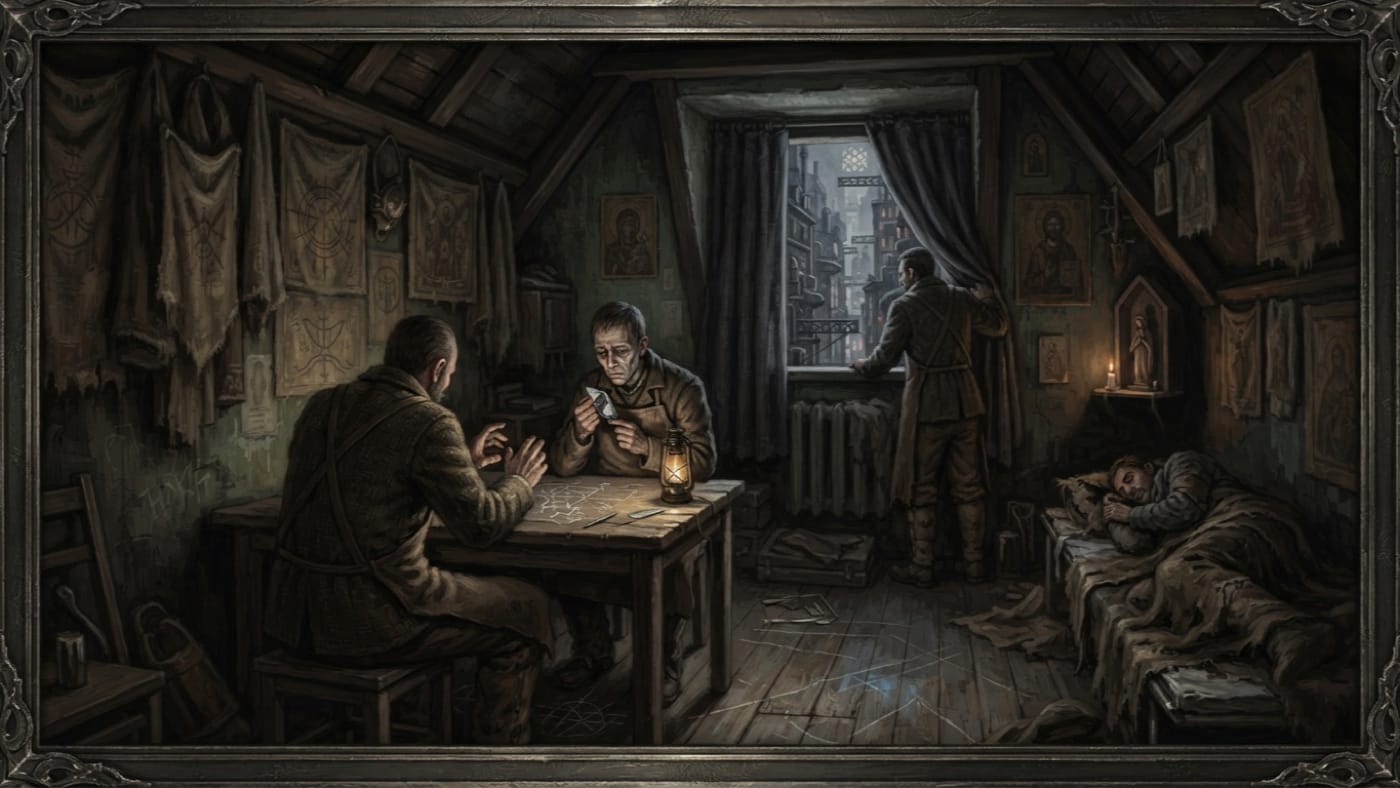
The one loft I can describe with any confidence is the headquarters. Its lore places it in a tenement attic inside a bell-dead zone, where sound, in the record's phrase, feels swallowed. Its floor is marked with hand-code diagrams and mirror-flash drills, a catechism chalked underfoot. Hanging cloth pads its walls. The cloth is an attic furnishing and should be filed as one. It muffles footsteps. It does not manufacture Domes, whatever an excitable sub-deacon tells his congregation.
A small shrine stands in the room. Its candle is kept barely lit, because too much flame makes noise in the glass.
Its dimensions, its city, its builder, the year it became an attic and the year it became something worse are all missing from what I have read. So is the saint to whom the shrine is dedicated.
The Circle's daily order is recorded, though the charter does not say which parts take place under this roof. At dusk come breath drills, shard checks and hood-clamp tests. At curfew, paired patrols deploy without a spoken word. In the early night they disperse gatherings before the gatherings become sound. At midnight come quiet removals and sealed-mouth detentions. Late at night they mark corridors and hunt leaks, by which the charter means people spreading stories. Before dawn they burn field notes, reset training marks and cleanse the shards in ash water. The drills and the reset belong naturally beside a marked floor. The rest belongs to the streets, and to whatever rooms the Circle has not told me about.
#On Those Who Keep Silence
The Lantern Brotherhood is tolerated, locally licensed and centrally deniable. Mute Radiance holds its share of that toleration by enforcing silence-order. Its charter states the mandate in nine words that I envy for their economy: no screams, no gatherings, no audible truth. In exchange the Circle provides two services. It suppresses panic, and it stages silent formations at festivals that frighten crowds into obedience without a single shouted word.
The tariff comes due behind closed doors. The Mouth-Seal is a dab of wax at the centre of the lips, symbolic and humiliating. The Hush Beating is methodical, non-lethal and conducted where no story escapes. The Circle's tolerated sin is extrajudicial removal: no sound, no record — unless we choose to write one. Rumour adds the Tongue Cabinet, a supposed store of trophies from those removals. I record it as rumour and no more.
The same discipline that keeps a trench alive under a Dome can make a witness disappear in a tenement. Hand-code saves the line. Hand-code also lets four men cross a courtyard, take a fifth, and leave the neighbours with nothing to testify except a feeling.
Who keeps the other lofts is beyond my evidence. Association proves vocabulary, which is a long way short of ownership. The Silent Godless work in cellars and concealed workshops, but no source calls those rooms Hush Lofts. A widow praying above a dead alley is not a cell. A quiet gathering is not, by its quiet, demonic. A Silence Dome Pass grants legal entry to a Dome district under Orison seal. It does not license an attic, sanctify its tenants or excuse them from a search.
#On the Price of Shelter
A Hush Loft offers concealment, which is a narrower thing than safety. A wardens' inspection climbs stairs like anyone else. A lamp left unhooded tells the street that someone is awake. A polished shard, angled carelessly, may show its holder something they would rather not have read. In terrain where sound has truly died, the loft's last defence fails along with everything else. If something comes up the stairs, nobody below will hear a shout. The scream reaches the teeth and stops there.
Earlier public summaries described Dome failures as morale deficiencies among affected troops.
The existing field correction stands, and it reaches attics as well as trenches. Audible command cannot cross a failed medium. Occupants who do not answer a warning shouted up the stairwell were never sent it in any form they could receive.
The hand-code drills, the chalk lines and the hooded lamp are what remain when that medium fails. They let a room keep its order. They do nothing to make that order righteous.