
#On the Pall That Eats Command
A Silence Dome is not quiet. Quiet is a mercy granted to libraries, graves, and certain committees once I have finished with them. A Dome is sound reduced to private failure: the scream reaches the teeth and dies there; the bell strikes bronze and falls drunk inside its own throat; the order leaves the captain's mouth and returns as warm breath on his lip. Men call it silence because men are lazy with terror.
The Bureau of Orison defines the phenomenon as a localised acoustic null under hostile or unstable providential pressure. The Bureau of Engineering defines it, off the record and with that charming tremor engineers acquire when truth has outrun permission, as a pressure failure in the lattice of over-peal, reliquary ash, and wounded air. Doctrine defines it as sorcery. Records defines it as a category. Soldiers define it by touching their throats and discovering that prayer has become a gesture.
#On Cause, or the Bureau's Preferred Ignorance
The official cause is simple because official causes are written for men with rifles and insufficient sleep: the Shadow Court wounds the world, and the wound stops sound. Pale Chanter pressure, sorcerous inversion, mirror-field occlusion, Sloth-fog thickening, and the unnamed hungers of No-Man's-Land all appear in operational reports. The Enemy does use Domes. A formation caught under one loses command, cadence, morale, confession, and the thin shared rhythm by which frightened men agree not to become animals.
The unofficial cause is less comforting. High-pressure reliquary events correlate with Wound-Sites. Bell overstrain correlates. Ash saturation correlates. Choir-engine discharge correlates. No Bureau has dared write the sentence in public with all its nouns intact: the Synod's own miracles may bruise the air badly enough to produce silence.
Records' Fifth Revision ordered all references to “Silence Domes” replaced with “temporary interruptions of Providence.”
Clarified for field copies. The interruption may outlast the men interrupted. Providence has not objected to the old term. Records has, which is less persuasive.
At Bastion-Irongate, veterans blame the Gasket Choir when a corridor goes briefly dead. At Shipka, Bellwardens blame Syrion. At Przemyśl, ridge crews blame frozen chalk, bad echoes, and the habit mountains have of returning prayers in worse condition than they received them. Each explanation is local, sincere, and incomplete. The Dome accepts all theories with equal appetite.
#On Passes, Seals, and Legal Breath
Certain cities and forward districts require a Silence Dome Pass (Unregistered): a card, tablet, ribbon, or stamped metal slip bearing the Seal of Orison (Unregistered). The form is absurd until one has watched a regiment enter without it and return carrying a banner no one could read. The Black Dome of Brașov remains the standard warning. The men entered with rifles, rations, and ordinary confidence. They emerged days later with eyes gouged, tongues absent, and a standard inscribed in an alphabet the Bureau of Records copied once before ordering the copy burned.
The Pass does not make sound work. Citizens misunderstand this and die improved by knowledge. It grants legal entry, registers liability, assigns escort, records silence exposure, and authorises the bearer to use hand-code, mirror-code, rope-signal, and emergency gesture liturgy without later prosecution for unauthorised signalling. A Pass shields nothing; it is a receipt for entering a place where breath may become evidence.
The phrase presumed hostile survival is one of the Bureau's little masterpieces. A dead man has been punished by terrain. A living man has brought something back.
#On the Liturgy of Hands
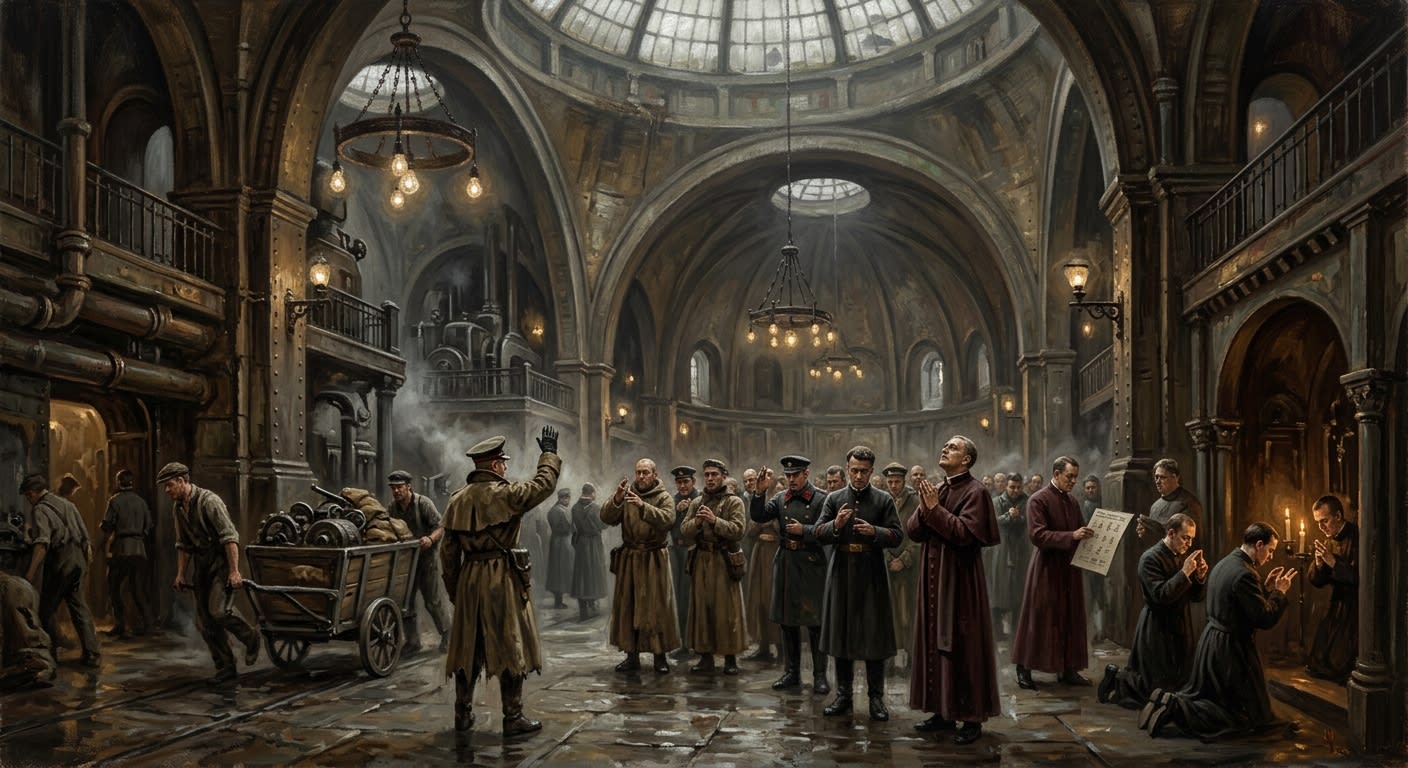
A Dome forces the Covenant to admit that language never belonged only to the mouth. Orders pass through bent fingers, shuttered lamps, mirror glints, rope-tugs, boot taps, chalk scratches, shield-rim pressure, and the ugly universal grammar of an officer striking a man until he points the correct way. Soldiers drill to pray with their hands. The Creed becomes angle, pulse, knot, flash.
The Circle of Mute Radiance learned much from Dome doctrine and should be thanked only under guard. Their urban hand-codes, Mouth-Seals (Unregistered), Hush Lofts, and silent dispersal formations descend from the same battlefield necessity by which a trench learns to move when sound has been garrotted. The Lantern Brotherhood steals from War with excellent taste. War steals it back with better stamps.
Rope lexicons are the oldest survival system. One tug: halt. Two: advance. Three: kneel. Four: wrong direction, fool. Knots mark ration point, corpse pit, mirror station, breach lip, and places where the rope should not be followed because the last man who followed it returned alone with someone else's hands. Lantern shards carry finer instruction. A green slit orders regrouping. A white blink authorises volley. A red shutter means burn what approaches even if it wears a familiar face.
The line must hold with or without music. This is a brutal correction to a civilisation that has made obedience audible. Under a Dome, obedience must become tactile.
#On Combat Failures
The first casualty inside a Dome is sequence. The second is shame. Men who cannot hear themselves praying become embarrassed before they become afraid, which proves how thoroughly the Synod has trained them to treat piety as a public act. Then the officers realise the bugles are dead. Then the Radiant Fusiliers fire off cadence. Then the Shield Paladins lose the breath-count that anchors the Lock Formation. Then Hell, which has been waiting for the sentence to lose its verb, enters.
At Belgrade Courts, a Dome unfurled across three miles of line. Paladins froze mid-lock. Fusiliers volleyed at random, their shots severed from banner-hymn and timing. The Litany-Engineers kept the trench alive by scribbling absolution-math in mud and performing the Counter-Sorcery Verses as pressure, pulse, chalk drag, and tooth vibration. Their mouths moved. No sound reached anyone. The charges obeyed.
BELGRADE COURTS — ORISON/ENGINEERING JOINT FRAGMENT Dome onset: unannounced Audible command: nil after first minute Paladin lock status: partial freeze; second-rank inward pressure; third-rank shield recovery impaired Engineer response: silent Verse sequence; chalk pressure marks; detonation successful Post-action anomaly: six survivors reported hearing their own pulse speak in command voice for ███ days Disposition: Orison custody asserted; Engineering objection filed in grease pencil and lost
Prague Gate (Unregistered) supplied the lesson in machinery. A shrine-platform trapped inside a Dome lost hymn-vox coordination. Cue-slates contradicted. Mortars fired out of phase and dropped shells into lower holds where pilgrims clutched relic-candles. Purity called sabotage. Engineering called hymn-jam interference. Doctrine printed both explanations because the truth had become expensive.
Earlier public summaries described Dome failures as morale deficiencies among affected troops.
Corrected. Morale cannot transmit through a dead medium. Men may be cowards, saints, or accountants; under a Dome, all three require visual command.
#On Civilian Ruin
A battlefield Dome kills command. A city Dome kills habit.
The Silence Siege of Kiev (Unregistered) remains the sealed domestic horror. Bells refused to carry. Sermons choked. Orders failed. Citizens disobeyed nothing so simple as ration schedules; they lost the civic sequence by which eating, prayer, queueing, labour, confession, and sleep were arranged into day. Investigators found moulded bread beside skeletal corpses, grain untouched in bowls, water drawn and never drunk. Doctrine ruled failure of civic catechism. Records' private margin states the better fear: the Dome fed on ritual itself.
This is why Orison terrifies itself with deadzones. A district that cannot hear the Synod does not become free. It becomes available. Private prayer blooms. Unauthorized melodies creep back through stairwells. Silent Godless organisers find basements where the hornline cannot reach. Worse things listen. Perfect compliance in a sound-dead block is now treated as hostile until proven otherwise, because still crowds facing silent receivers have taught the Bureau more than comfort permits.
#On Lanterns and Names
The Widow's Lantern Incident (Unregistered) belongs to the category of events so elegant in horror that even I resent it for trespassing on my profession. A Dome fell along Processional Road (Unregistered). Rope-road crews lit memorial lamps to maintain direction. The lamps, reflected in glass, spelled names. Not orders. Names. Each man saw his own written in trembling light and walked into the pall as though summoned by a clerk he trusted. None returned.
The Bureau now warns against reflective surfaces under Dome conditions. This has caused trouble for officers with polished buckles, reliquary glass, saint-lockets, mirror-code shards, wet cobbles, spectacles, tears, and other shining betrayals. Field instructions recommend smoked glass, hooded lanterns, dull buckles, and emotional continence. The last has never been successfully issued.
Names are hooks. Sound usually carries them. In a Dome, light volunteers.
#On the Present Discipline
As of A.S. 201, every bastion sector drills Dome procedure, though each lies about its competence in the local accent. Brest practises rope-lines in Bug fog. Przemyśl teaches chalk and ridge mirrors. Sibiu trains gatehouse hand-code against mountain echo failure. Irongate keeps lamp crews inside the Gasket Choir galleries, because silence there feels personal. Shipka combines wake-cant with slap signals against Sloth-fog muting. Constantinople trains everyone twice and trusts nobody.
The Dome remains filed among Wound-Site phenomena, acoustic class, with Orison custody, Engineering objections, War urgency, Doctrine certainty, Records euphemism, and soldier profanity attached in the usual proportions. No department owns the cause. Every department owns a procedure. This is how the Synod survives mysteries: it encircles ignorance with forms until the ignorance behaves like policy.
Sound is obedience made audible, says Orison. Under a Dome, obedience must learn other organs.