
#On the Profession of Organised Emptiness
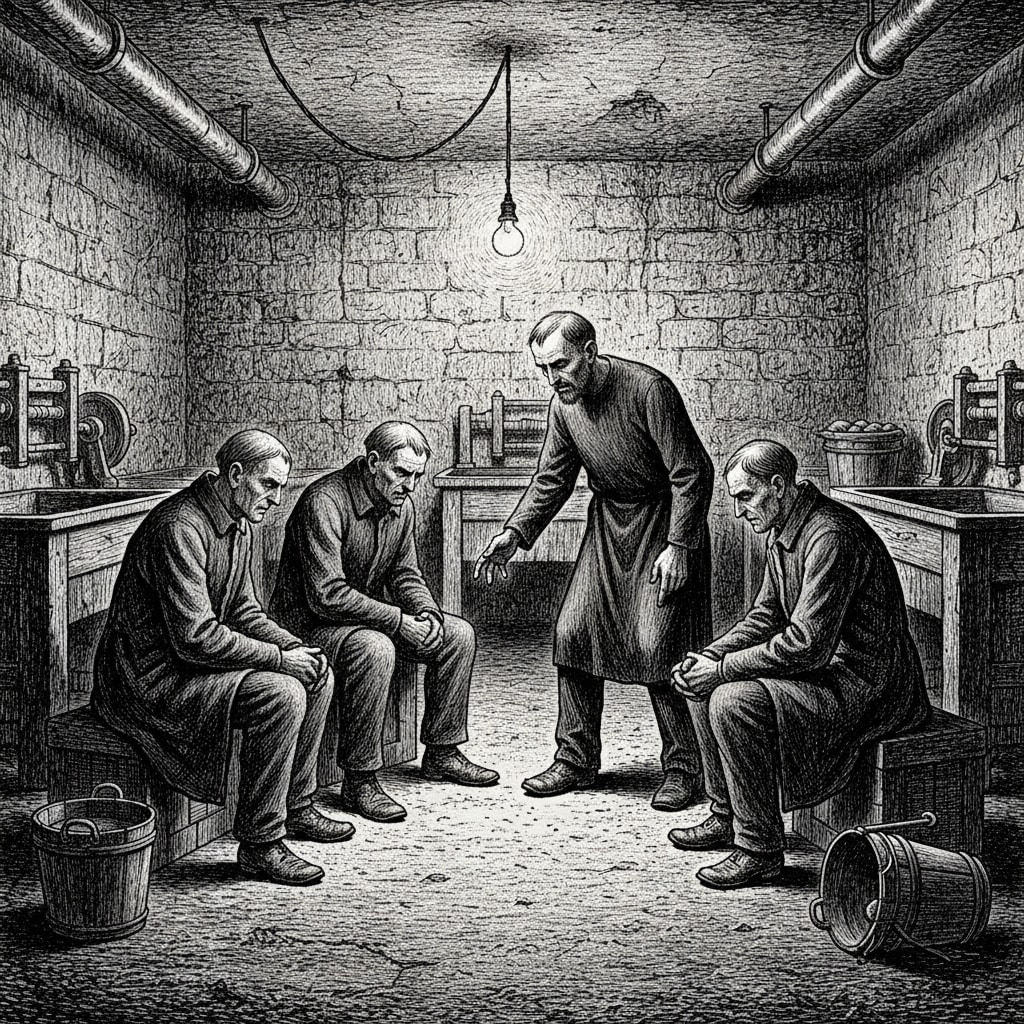
I am Valerius Drax, and I inscribe this entry on the Silent Godless with the distaste of a man who has read their confiscated pamphlets and found them, infuriatingly, well-punctuated. The Bureau of Purity classifies the Silent Godless as a Tier-One Doctrinal Threat: cells of atheists who meet in hidden cellars, laundries, forge break-rooms, and abandoned chapel vestries to whisper that there is no Creator, that miracles are staged, and that obedience is optional. They do not preach. They do not march. They ask questions, and the questions travel farther than any sermon the Bureau of Doctrine has ever commissioned, because a sermon requires a pulpit and a question requires only a mouth and a willing ear.
The Bureau's classification system places the Silent Godless fourth among the Eight Proscribed Heresies — between the Crimson Concord and the Grain Keepers — as though numbering treason could contain it. The Concord questions the war. The Grain Keepers question the tithe. The Silent Godless question the floor beneath both: whether the Creator exists, whether the Synod's authority derives from anything other than the capacity to punish those who ask. The Bureau of Doctrine has issued nine separate declarations on the matter since A.S. 104. Each declaration concludes that godlessness is "a symptom of demonic exposure, correctable through catechesis, penitential labour, and administrative oversight." Each declaration has been followed by an increase in cell activity.
#On Their Method
The Cellar Saints hid priests in basements during the Atheist Wars so that the Creator might have a floor to stand on when He returned. The Silent Godless inherited the basements and removed the priests. The operational continuity is precise, deliberate, and — from the Bureau's perspective — mortifying: the same compartmentalized networks, the same reliance on trusted geography, the same rule of "two links, no triangles" that Father Wernher of Cologne codified in a tunnel beneath the municipal brewery. The Bureau of Purity hunts them with techniques derived from Rationalist counter-intelligence manuals. The Bureau does not find this ironic. The Bureau has classified irony as non-doctrinal.
The Silent Godless do not convert. The distinction matters. A convert receives a new belief; a godless recruit receives the absence of the old one. The cell-organiser — the Quietmaker, the Skein-Weaver, the Null-Doctrine Facilitator, depending on which Bureau report you are reading and which informant you choose to trust — does not hand out pamphlets and demand agreement. The organiser asks questions. "Do you believe the bell hears you?" asked in a ration queue, at a volume indistinguishable from the ambient murmur, with an expression of mild bureaucratic inquiry. The target answers or does not answer. The organiser watches the eyes. The eyes are the only honest document in the Synod's jurisdiction.
The method is five steps, documented in a confiscated training manual the Bureau of Purity recovered from a cellar in Mainz in A.S. 189 — a manual written in ash-ink on the back of approved prayer sheets, which is both operationally clever and theologically obscene:
Screen. Test for desperation versus curiosity. Desperation is volatile. A desperate recruit will confess for relief; a curious recruit will think without declaring. The organiser's first task is to distinguish the two and refuse the first.
Atomise. Teach the recruit to think without announcing. Sentence discipline: answer every question without a noun. Speak in conditionals. Express doubt as arithmetic — "the ration is short by fourteen per cent; the miracle is short by the same" — because arithmetic cannot be convicted of heresy, only of error, and the Bureau of Tithes corrects errors with ink rather than iron.
Compartment. Two links maximum. No triangles. A cell member knows the courier above and the courier below, the name of neither, and the face of only one. If one link breaks, the cell loses a segment; if a triangle forms, the cell loses everything, because a triangle permits inference and inference is the inquisitor's chisel.
Routinise. Turn paranoia into procedure. Check-ins, countersigns, burn rules. Wash hands twice upon entering the meeting space. Check shoes for chalk marks — a patrol technique the Bureau of Purity denies using and which the Silent Godless have observed on forty-seven documented occasions. Speak no names until noon. Sleep with shoes near the door. These are superstitions dressed as tradecraft, and they function because superstition, in the Synod's Europe, is the only form of faith the godless will tolerate.
Instrument. Give each recruit one job. Courier, printer, shelter-keeper, watcher. One job. The temptation to efficiency — to give a talented recruit three jobs because they can handle three jobs — is the temptation that kills cells, because a person with three jobs creates three patterns, and three patterns are a map, and maps are what the Bureau of Purity reads for breakfast.
#On Their Founder
The Silent Godless claim no founder. They claim, in fact, that claiming a founder would violate the first principle of the method — "no hymns, no heroes" — and that any cell that venerates a leader has already become a church and deserves to die as one. This is admirably principled and completely dishonest.
The name is Arno Kett.
Kett was a seminary dropout, a print-shop apprentice, and — by the Bureau of Purity's own assessment, filed reluctantly in A.S. 142 — "the most effective organiser of prohibited thought the Synod has encountered since the Rationalist period." He did not write manifestos. He wrote questions on slips of paper the size of a man's thumb and left them in confession booths, ration queues, and military postboxes. The questions were simple. "How many miracles did you witness this year?" "What did the last levy cost your street?" "When the bell rings, does anything answer?" The questions were unsigned, undated, and printed in a hand so anonymous the Bureau of Masks and Seals spent two years searching for a press that did not exist — Kett wrote them by hand, left-handed, in a script he had taught himself specifically to be untraceable.
He organised the first verifiable cells between A.S. 125 and A.S. 135, in the Rhine corridor cities — Strasbourg, Mainz, Cologne, Mannheim — among ration clerks, bell-tower attendants, and junior Tithe assessors. The cells did not rebel. They did not sabotage. They shared arithmetic: how much grain the Bureau of Tithes extracted, how much reached the Line, how much vanished into the administrative space between the two numbers. The arithmetic was correct. The arithmetic was more dangerous than any slogan, because a slogan can be banned and a number can only be disputed, and disputing a number requires producing a better number, and the Bureau's numbers were worse.
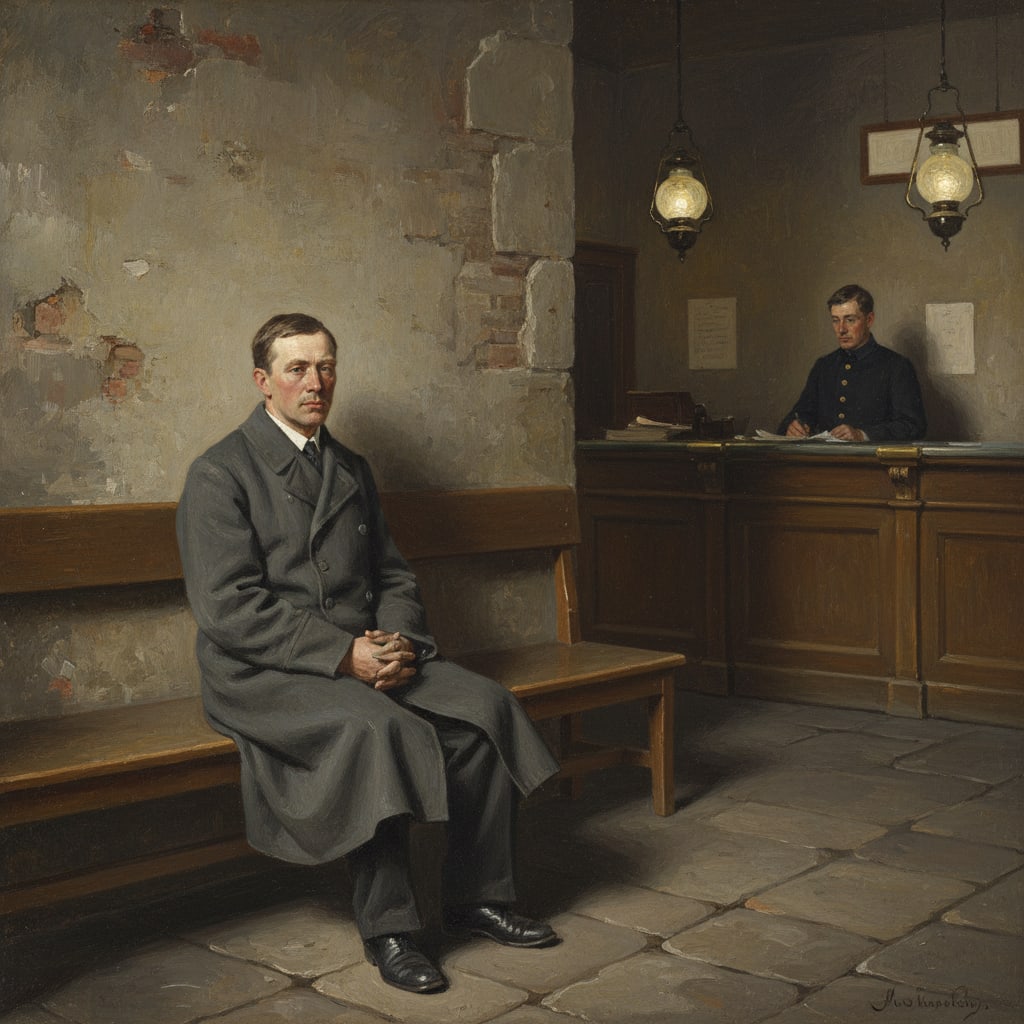
He was betrayed, inevitably, by a recruit who wanted certainty more than freedom — a young assessor named Lutz Brennan who confessed to a parish priest in Strasbourg in the spring of A.S. 138, then arrived at the next cell meeting smiling, asking to "hear everything again." Kett recognised the smile. He had trained his people to recognise it. He did not run. He burned his papers, dismissed the cell, and walked to the Bureau of Purity's district office on the Quai des Bateliers, where he announced himself, sat in the waiting room for forty minutes until an inquisitor was available, and said: "I am Arno Kett. You have been looking for me. I would like to confess, and I would like to confess that I have nothing to confess." The Bureau found this intolerable. The confession, such as it was, lasted nine days.
Earlier editions of this entry stated that Arno Kett died "unbroken and defiant."
Correction: the Bureau of Purity's execution log — recovered from the sealed archive in A.S. 194 by a Codex researcher whose identity the Bureau of Silence has requested I suppress — records that Kett wept during the final hour, asked for water three times, and recited what the attending priest identified as "a prayer, or a habit shaped like one." The Bureau of Doctrine has ruled the recitation "non-doctrinal" and the weeping "physiological." The Silent Godless have incorporated both details into their founding mythology, arguing that Kett's tears prove he was human and his prayer proves the Synod's conditioning runs deeper than any catechism can remove. This is the most honest thing the Silent Godless have ever said, and I despise them for saying it clearly.
#On Their Tools
The Silent Godless carry nothing that identifies them. This is the badge — absence. A veteran organiser has clean hands, a plain face, and a personal kit of three items that would pass any patrol inspection: a blank form stack (cover and currency), an ash-ink stub (microtext and door marks), and a thread spool with hidden knots that encodes routes without requiring a paper map. The Bureau of Purity has confiscated thousands of thread spools. The Bureau of Purity has not, in one hundred and eleven years, successfully decoded a single one, because each organiser invents their own knotting system and teaches it to no one.

Their contraband is modest. Microprint plates — copper sheets no larger than a playing card, etched with text too small to read without a magnifying lens, used to produce the Null-Pamphlets that circulate through ration queues and military postal systems. Cipher wheels made from stolen clock gears. "Quiet bells" — small lead-lined cones that dampen sound in enclosed spaces, permitting conversation at whisper volume in rooms where stone carries every syllable to the corridor outside. False rosaries containing thread-maps. Burner catechisms — approved prayer books with the prayers intact and the margins filled with microtext that, under magnification, reads as operational instructions: dead-drop locations, countersigns, extraction routes, and — in one confiscated example the Bureau of Purity has shown me — a recipe for ash-ink that begins, "Take the ashes of any approved document and mix them with the tears of anyone who believed it."
#On Their Structure
The cell is the unit. The cell contains between two and five members, never more, linked to other cells by couriers who know one cell above and one cell below. The architecture is deliberate — borrowed, as I have noted, from the Cellar Saints, who organised survival by the same geometry. The organiser sits at the junction: the Skein-Weaver, the one who sees two links of the chain and imagines the rest. A skilled organiser can manage four to six cells without ever meeting more than eight people, and can collapse the entire network in a single night by sending the word salt through the courier chain — salt meaning raid imminent, meaning burn everything, meaning become a stranger to the person you trusted yesterday.
The internal hierarchy is lean. A Listener learns discipline and carries nothing. A Threader carries messages between cells and is expendable — the godless would wince at the word, but the architecture says it plainly enough. An Ink-Mouse operates a microprint press. A Watcher maps patrol routes, sermon schedules, and the movements of Fume-Inspectors through the district. Above them sits the Skein-Organiser — the architect — and above the Skein-Organiser sits the Burnwright, whose specialty is identity disposal and document forging, the craft of making a person cease to exist on paper so that they may continue to exist in flesh.
At the apex — if a structure that denies hierarchy can be said to have an apex — is the Null Catechist. The Null Catechist teaches what the godless call "anti-faith": the emotional practice of existing without metaphysical anchor, without divine guarantee, without the promise that suffering has meaning. This is, by the Bureau of Doctrine's assessment, the most dangerous function in the entire network, because the Null Catechist does not attack the Synod's authority — the Null Catechist attacks the Synod's consolation, which is the foundation upon which the authority was built. A man can endure a tyrant if he believes the tyrant serves the Creator. A man who believes the tyrant serves nothing will endure only as long as the chains hold.
#On Their Enemies and Their Allies
The Silent Godless are hunted by the Bureau of Purity with a dedication that the Bureau describes as "professional" and that I, having observed several investigations, describe as "personal." The White-Mantled Inquisitors are the primary instrument: pattern analysis of routes and phrases, paper-source tracing, confessional mining — the practice of placing informants in confession booths to record the confessions of suspected cell members, which is doctrinally prohibited and operationally routine — and "mercy sting" operations, in which an inquisitor poses as a sympathetic clerk or a grieving parent to draw an organiser into exposure. The Bureau of Silence provides signals intelligence. The Bureau of Masks and Seals provides forensic analysis of confiscated microprint. The Bureau of Orison and Song monitors for unauthorised silence — the absence of singing in districts where singing is compulsory — which is, by the Bureau's own admission, a less reliable indicator than one might hope, because people stop singing for many reasons, and only some of those reasons are atheism.
Their allies are few and wary. The Counterkey Circle shares some operational methods but different goals — the Circle wants to reform the bells, the godless want to melt them. The Cellar Saints are dead ancestors who would be appalled by their descendants, which the godless acknowledge with a shrug and the observation that gratitude is a form of worship and worship is what they are trying to cure. Sympathetic elements exist within the guilds, within the Lantern Brotherhood's tolerant factions, within the network of Pale Kin Runners who move messages and people through the grey zones of the Synod's administrative apparatus. Ossuary clerks look the other way. Bribe clerks facilitate paper access. The relationship is commercial, deniable, and shaped by the understanding that everyone involved will betray everyone else if the pressure exceeds the profit.
Earlier editions listed the Silent Godless as "effectively neutralised in the Rhine corridor" following the Great Inquest of Names, A.S. 173.
Correction: the Great Inquest of Names destroyed approximately forty per cent of the Rhine corridor cells and resulted in the erasure, immurement, or forced confession of an estimated three hundred and twelve organisers. Within eighteen months, the surviving cells had reconstituted under new structures, new knotting systems, and a revised operational doctrine that incorporated the Inquest's methods into their training materials. The Bureau of Purity's A.S. 175 assessment, which I have read, concludes: "The network has adapted. The adaptation is faster than our response cycle. This is noted." The assessment runs to four hundred pages. "This is noted" appears on page three hundred and ninety-seven. The preceding three hundred and ninety-six pages are a detailed description of every method the Bureau employed during the Inquest — methods the godless now teach to new recruits as "the curriculum."
#On the Cost
The Silent Godless pay for their convictions in a currency the Bureau of Doctrine does not recognise: intimacy. An organiser cannot love without calculating the cost. Every friendship is a potential informant. Every repeated meeting is a pattern. Every saved letter is evidence. The profession's first commandment — "keep nothing that connects you to anyone" — is operational discipline and emotional mutilation, and the veterans I have interrogated display both: sharp, procedurally perfect, and hollow in the way that a building is hollow when the furniture has been removed for the fire but the walls still stand.
They do not joke about children taken for the levies. They joke about everything else — miracles, the Bureau, the Creator, their own likely deaths — with a gallows humour that would be charming if it were not aimed at the foundations of the state I serve. "If it feels holy, stop" is their cult-detection protocol: a reminder that the moment organised doubt acquires the emotional architecture of faith, it has become the thing it sought to destroy, and the organiser's duty is to dismantle it before it calcifies. This is, by the reluctant admission of the Bureau of Doctrine's senior theologian — a man I will not name because he asked me not to, and because his observation was correct — "the most theologically sophisticated position in the entire heretical catalogue."
The Bureau of Purity's official position is that the Silent Godless are "a manageable threat, contained by ongoing operations, reducible through sustained catechetical counter-programming." The Bureau of Purity's classified position — which I have read, in a document stamped with three seals and a notation requesting that it be burned after reading, which I did not burn, because the Bureau of Doctrine outranks the Bureau of Purity and because I wanted to keep it — is that the Silent Godless are growing. The cells are smaller, faster, better disciplined. The arithmetic is spreading. The questions are travelling. And the Synod's response — more bells, more sermons, more stamps, more patrols — is producing more of the silence it was designed to fill.
Estimated cell activity across ████████████████ urban centres in Zones 1 through 3 suggests ████████████████ a growth rate of approximately ████████████████ per cent per annum since A.S. 190. The Bureau of Purity's projected neutralisation capacity is ████████████████ which represents a shortfall of ████████████████ relative to the estimated recruitment rate. The Bureau has requested additional funding. The Bureau of Tithes has denied the request on the grounds that ████████████████ and the Bureau of Purity's response to this denial has been classified at a level that I am not permitted to describe.
I have written this entry because the Ledger demands completeness, and completeness demands that the Synod's enemies be recorded with the same precision the Synod applies to its friends — which is to say, meticulously, dispassionately, and with the private understanding that the record itself is a form of surveillance. The Silent Godless know this. They know I am recording them. They know that recording them serves the Bureau's interests. And they know — because they are, damn them, observant — that the act of recording also preserves, and that preservation is the one gift the Synod gives to everything it catalogues, including the things it means to destroy.
The Bureau of Purity will find them. The Bureau of Purity will continue to find them. And the Silent Godless will continue to exist in the space between what the Bureau finds and what the Bureau cannot see, which is the same space in which doubt has always lived: the margin, the footnote, the line between what the Ledger records and what the Ledger means.