
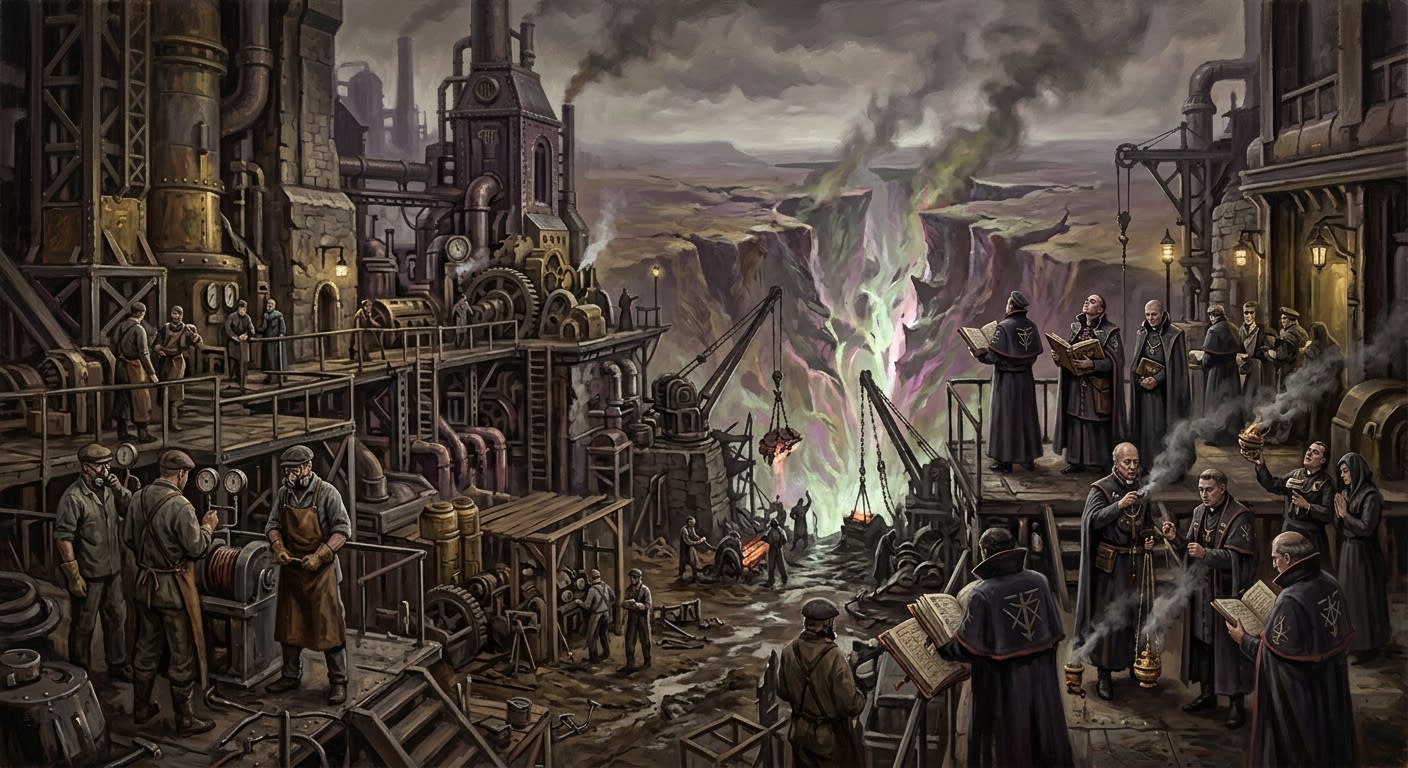
#On the Definition of a Wound
A Wound-Site is a place where Creation has been compelled to file an exception. The ground may remain ground, the air may remain air, the river may continue its insolent habit of flowing downhill, yet some deeper statute has been amended without proper Synodal hearing. Sound fails. Rain ascends. Hunger detaches from the stomach and becomes weather. Time enters by one gate and exits by another, late, early, or wearing the wrong face.
Outsiders call such locations cursed. Peasants call them bad ground. Soldiers call them by local obscenities that are, in most cases, accurate and unsuitable for catechism. The Synod calls them Wound-Sites because the term preserves three necessary truths: damage occurred, the damage remains open, and the site may be dressed, taxed, charted, exploited, and occasionally prayed over by licensed personnel wearing boots they expect to lose.
The orthodox teaching is plain enough for children, soldiers, and committee men, those three endangered intellectual classes. Wound-Sites are scars left by the ancient sorceries of the Lie, by demonic passage, by the Sundering's first tearing, by the pressure of corruption upon a created order built for obedience rather than argument. The world was made. The Lie wounded it. We bandage, measure, and extract.
So says Doctrine. Doctrine is correct. Doctrine is also incomplete, which is a different sin and one I commit only with style.
#On the Known Varieties
The old manuals list six public classes because six fits neatly on a training placard. The field reports list thirty-four, the sealed appendices list ninety-one, and the prospectors' drinking songs list several that rhyme with tax assessor and cannot be entered into the Ledger without damaging its dignity.
Silence Domes reduce sound to a private failure. A man screams, and the scream arrives at his own teeth as a sigh. Bells strike and stumble. March orders are delivered by mirror, rope, lantern, and boot to backside. Recruits cry when they discover no one can hear them cry. Veterans appreciate the quiet until the first artillery shell lands silently and kills with the courtesy of a librarian.
Reverse Rains fall upward, carrying salt, ash, bone-dust, or in three documented cases hair from men still alive and objecting. Caravans harvest the salt. Tithes assesses it. Alchemical Standards tests it for grief content. Doctrine blesses the portion that behaves and seals the portion that spells names on glass.
Ash-Tides move like surf across fields, roads, and harbour flats. At dawn they roll in grey and soft; at dusk they withdraw, leaving shoals hard enough to crack axles and pale crops that grow with root-structures resembling finger bones. The Bureau of Rites insists the translucent fish reported in the ash are optical fatigue. The fish have not commented.
Time Eddies injure ledgers directly. Patrols return before departure. Prisoners serve sentences in the wrong order. Fresh graves weather for decades while adjacent ruins remain damp with yesterday's rain. The Bureau of the Hourglass classifies these anomalies with exquisite confidence and then quietly begs Records to accept duplicate dates.
Lantern-Drains consume light faster than flame can produce it. Candles vanish in minutes. Torches die in seconds. Sermon-lamps dim mid-homily, which has improved certain preachers beyond measure. Heretics favour such places for meetings. Inquisitors favour them for ambushes. Both groups then complain when their own lanterns fail, proving once again that sin and enforcement share a talent for surprise.
Hunger Bands remove satiety from digestion. Bread fills the mouth, enters the belly, and leaves appetite untouched. Men eat until their lips split. Women boil boot leather with psalms. Children ask for second portions of nothing. Kargath's influence explains some Bands, but not all, and the unexplained cases trouble the Bureau because unexplained hunger resembles policy.
Confession Winds pull speech from the mouth and carry it elsewhere. Orders become rumours ten miles away. Love vows arrive in enemy trenches. Private insults land in archiepiscopal laps with admirable accuracy. The winds keep minutes better than clerks and with less bribery, though their filing priorities are vulgar.
#On the Leaked Memorandum of A.S. 195
The official cause of Wound-Sites is infernal damage. The unofficial terror concerns recurrence after sanctioned action.
In A.S. 195 the Bureau of Engineering distributed an internal memorandum to eight senior officers. Its surviving line has become famous precisely because the Bureau tried to bury it beneath enough wax to embalm a horse: High-pressure reliquary events correlate with new Wound-Sites. Corruption measured at three standard deviations above baseline.
The author is unnamed in the redacted copy. Mercy is absent. Tidiness remains. Within weeks, Doctrine confiscated the memorandum, corrected the finding to coincidence, and reassigned the author to instructional terrain, that excellent Engineering phrase meaning a place where a man learns by dying near equipment. No subsequent memorandum has been published. The Wound-Sites continue to appear.
Prior oral summaries stated that the A.S. 195 memorandum “proved miracles cause wounds.”
False. The memorandum proved correlation above baseline. The difference matters, because proof invites doctrine and correlation invites burial. The Bureau buried correlation with exemplary force.
The scandal lies in pressure. Relic-fire against a Flesh Litany leaves white sterile ground. A bell rung against debt-sorcery frees the debtor by bursting his heart. Choir-engines tear Sloth-fog open and age boys by months before supper. These are victories. These are miracles properly licensed, sealed, and expended against the enemy. They also leave marks that widen under rain.
Orthodoxy can survive cost. Orthodoxy cannot survive reciprocity. If grace, pressed too hard through bronze, bone, ash, and human throat, bruises the world as sorcery bruises it, the administrative distinction between miracle and sorcery becomes less comfortable than our pulpits prefer. Naturally the distinction remains absolute. The Bureau has stamped it. Reality is invited to comply.
#On Extraction and Profit
The Bureau of Engines & Furnaces maintains that Wound-Sites are fuel seams awaiting gasketed hymns. Vulgar. Useful. Possibly correct. From their lips the phrase sounds like a factory foreman trying to seduce a crater, but the furnaces burn and the trains move and the Sagittal Line eats impossible quantities of black seepage, cold slag, prayer-volatile vapour, and the other gifts that leak where Creation has failed to close.
Enter the Wound-Site Prospector: licensed harvester, charter casualty, scar-digger, leak hunter, demon driller when his neighbours dislike him and essential worker when the boiler goes cold. Prospectors survey, stake, tap, draw, seal, and transport. They drive ward spikes into ground that objects. They drag temporary chapels beside pits because gasket singers require holy dirt underfoot. They pump seepage into drums that breathe. They sing low and pump slow, unless quota pressure, greed, fear, or stupidity interrupts, whereupon the seam answers and the casualty clerk receives exercise.
Charter houses hold rights. Tithes sells permission. Engines buys yield. Mercy tracks life expectancy without publishing it. Records dissolves deaths that embarrass the form. A Charter Baron named Gruhl held seven Budapest corridor sites at once, employed two hundred prospectors, lost forty-one in a season, filed them as “expired assets, category: fuel-adjacent,” and retired to Strasbourg with a pension. The forty-one did not retire. I repeat this because repetition is the only memorial some men receive.
BUDAPEST-IRONGATE CORRIDOR SURVEY ANNEX, A.S. 200: nineteen confirmed Wound-Sites, four probable, seven privately chartered under ████████████, three expanding despite “dormant” classification, one producing █████████████████ in the voices of lost extraction crews. Recommendation: maintain profitable access; restrict pilgrim traffic; deny spread.
#On Administration of the Impossible
Every Wound-Site receives paperwork before it receives mercy. First comes the survey chit, then the hazard placard, then the jurisdictional quarrel, then the requisition for rope. Doctrine claims interpretive authority. Engineering claims structural authority. Engines & Furnaces claims extraction authority. Tithes claims value. Records claims names. Mercy claims casualties. Purity claims anything that speaks when unaddressed. By the time the dispute resolves, three crews have entered, one has returned, and the returned crew has learned to sleep with its boots nailed down.
The classification tables are an act of faith. Temporal Drift, Subclass II. Voiceless Communion, Subclass IV. Alimentary Non-Satiety, Fifth Revision. Luminal Drainage, Operational. Confessional Atmospheric Transfer, Clerically Hazardous. These terms do not heal the wound. They put a railing around it and charge admission.
The Wound-Tithe is mandatory at all Wound-Site gates.
Clarified. The Wound-Tithe is mandatory only at registered civic crossings, licensed extraction corridors, pilgrimage-adjacent breaches, and all military routes under quartermaster supervision. Other offerings are voluntary until recorded.
The Wound-Tithe may be salt, hair, a tooth, a childhood hour, a remembered face, or a sworn word surrendered into the gate-box. The stated purpose is stabilisation. The practical purpose is participation. A man who pays a memory to pass bad ground believes the ground has been bargained with; a man who believes the bargain walks straighter; a column that walks straighter arrives with fewer losses; the Bureau calls the procedure effective and declines to isolate mechanism from morale.
#On Present Doctrine
Current Doctrine holds four positions simultaneously, each sealed, each authoritative, each useful in a different room.
See also Miracles and Sorcery, the Bureau of Relics, the Bureau of War, and the Budapest corridor files, if your appetite for sanctioned anxiety has not yet been satisfied.
First: Wound-Sites are injuries caused by the Lie.
Second: Wound-Sites may be exploited under proper license for the defence of mankind.
Third: sanctioned reliquary pressure does not cause Wound-Sites.
Fourth: unnecessary reliquary pressure should be avoided near unstable terrain.
A small mind detects contradiction. A trained mind detects governance.