
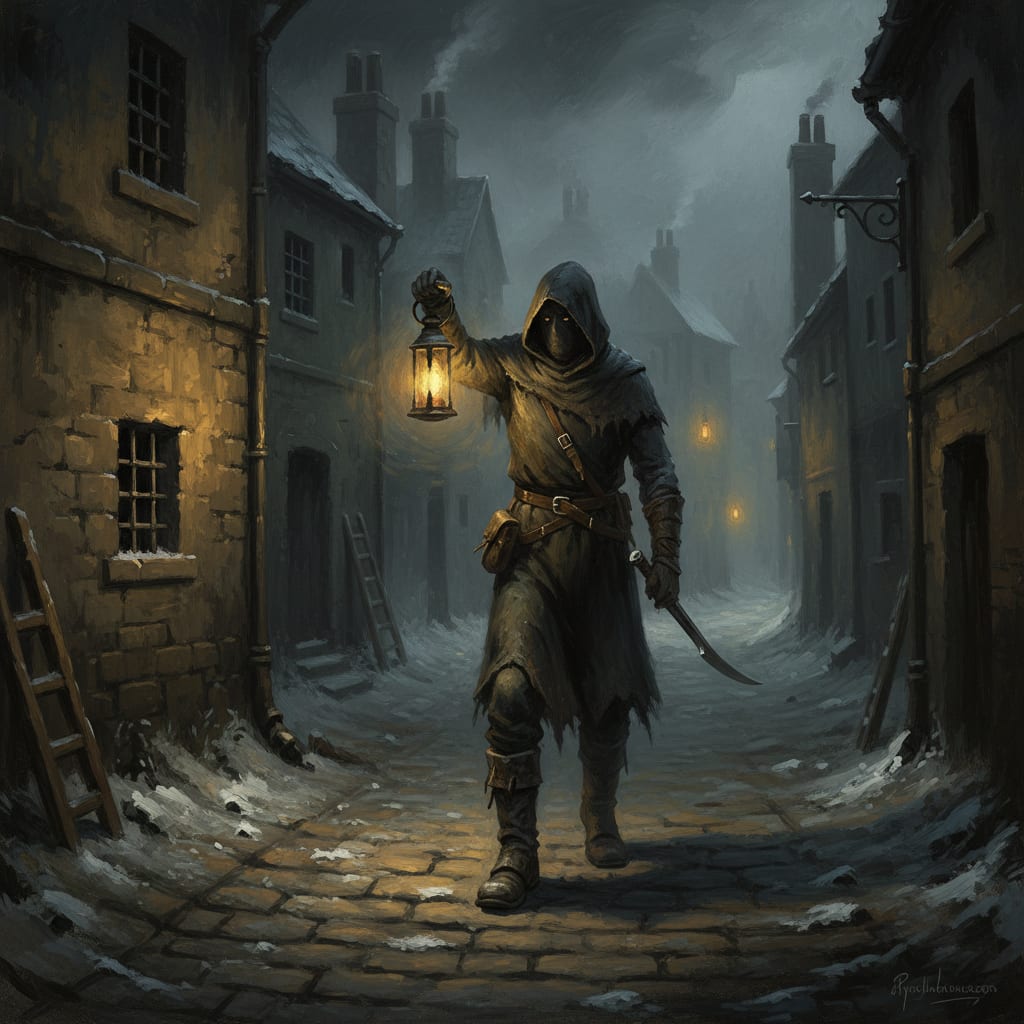
Lantern Brotherhood Vigilante
#On the Tolerated Blade
"Light is obedience made visible." — Catechism of the Vigil-Ash, recited nightly, believed intermittently.
The Synod does not acknowledge the Lantern Brotherhood. It tolerates them, which is a different verb entirely, bearing as it does the theological weight of a man permitting a dog to sleep beneath his table — the arrangement persists because the alternative involves rats, and rats, unlike dogs, do not respond to the sound of their name being shouted.
The Brotherhood is the Synod's night made visible. Where Wardens hold the streets — the broad avenues, the toll-gates, the lit squares where bell schedules govern the population's posture — the Brotherhood holds the dark behind them: the alleys where ration-stamp forgeries change hands, the stairwells where deserters breathe into their collars, the ossuary lanes where corpse-thieves and grave-field brokers conduct their trade in murmurs and wax. The Wardens cannot cover every warren. The Bureau knows this. The Brotherhood exists because the Bureau's omniscience is a myth and myths require stagehands.
Their credentials are local and revocable. A Circle — the operational unit, typically twelve to thirty men sworn to a district — operates under a writ of toleration issued by the nearest Warden-Captain, who signs it with one hand and disavows it with the other. The writ grants permission to carry an ash-oil lantern past curfew, to question citizens found abroad after the Ninth Peal, and to detain — the word is "detain," never "arrest," because arrest is a Bureau of Purity prerogative, and prerogatives are defended with the same ferocity the Bureau applies to heretics, which is to say: with tongs. The Brotherhood detains. The Bureau arrests. The detained and the arrested end up in the same cells, but the paperwork differs, and paperwork is theology.
#On the Origin of the Toleration
"The best curfew is one enforced by men you can deny employing." — Vicar-General Anselm Rihn, attributed, A.S. 94.
The Brotherhood predates its own toleration. In the years following the Sundering, when the Collapse of Reason drove millions westward and the Great Retreat turned every city into a refugee camp with liturgical pretensions, the formal organs of civic order — Wardens, Lictors, parish guards — could not extend past the main thoroughfares. The alleys bred their own law. Neighbourhood watches formed around shrine-corners and bread-hall entrances, armed with whatever the conscription levy had overlooked and lit by whatever oil the Bureau of Tithes had failed to count. They called themselves Brothers of the Vigil. The Synod called them nothing, because acknowledging a vigilante order would require admitting that the formal apparatus was insufficient, and insufficiency is a confession the Bureau of Doctrine has never made and will never make, even under oath, even before the Creator Himself.
By A.S. 94, when Vicar-General Anselm Rihn standardised the curfew ordinances across the Rhineland, the Brothers had been operating for decades. Rihn — a logistics saint, the kind of cleric who dreamed in supply tables and woke reciting muster rolls — faced a choice: suppress an extralegal militia that was already doing the Wardens' night shift for free, or codify the arrangement. He chose codification. The Curfew Ordinance of Quiet Hours, A.S. 94, contains no mention of the Lantern Brotherhood. What it contains is a clause permitting "auxiliary vigil personnel, locally licensed, subject to revocation without notice or appeal." The Brotherhood's legal existence is a subordinate clause in a curfew regulation. Their status has improved since then in exactly the same way that a subordinate clause improves — it doesn't. It remains subordinate. The Synod prefers it that way.
#On the Five Circles and Their Sins
The Brotherhood organises by territory, by function, and by the specific variety of corruption each Circle has learned to cultivate without triggering revocation. Every Circle has a tolerated sin — an illicit revenue stream the Warden-Captain knows about, declines to prosecute, and taxes indirectly through the medium of favours owed. The arrangement is ugly and stable, which are the same thing in bureaucratic theology.
The Circle of Nine Wicks holds the market wards and ration queues. Their patrols orbit the bread halls and queue lanes, enforcing compliance with a shepherd's crook in one hand and a citation slate in the other. Their tolerated sin is extortion — "light permits," they call them, sold to stallholders who pay to keep their windows classified as "properly lit" and their goods classified as "uninspected." The permits are fiction. The payments are real. The markets remain calm, and calm markets produce fewer incidents than agitated ones, and incident reports require paper, and paper costs money, and money is a tithe, and the circle closes.
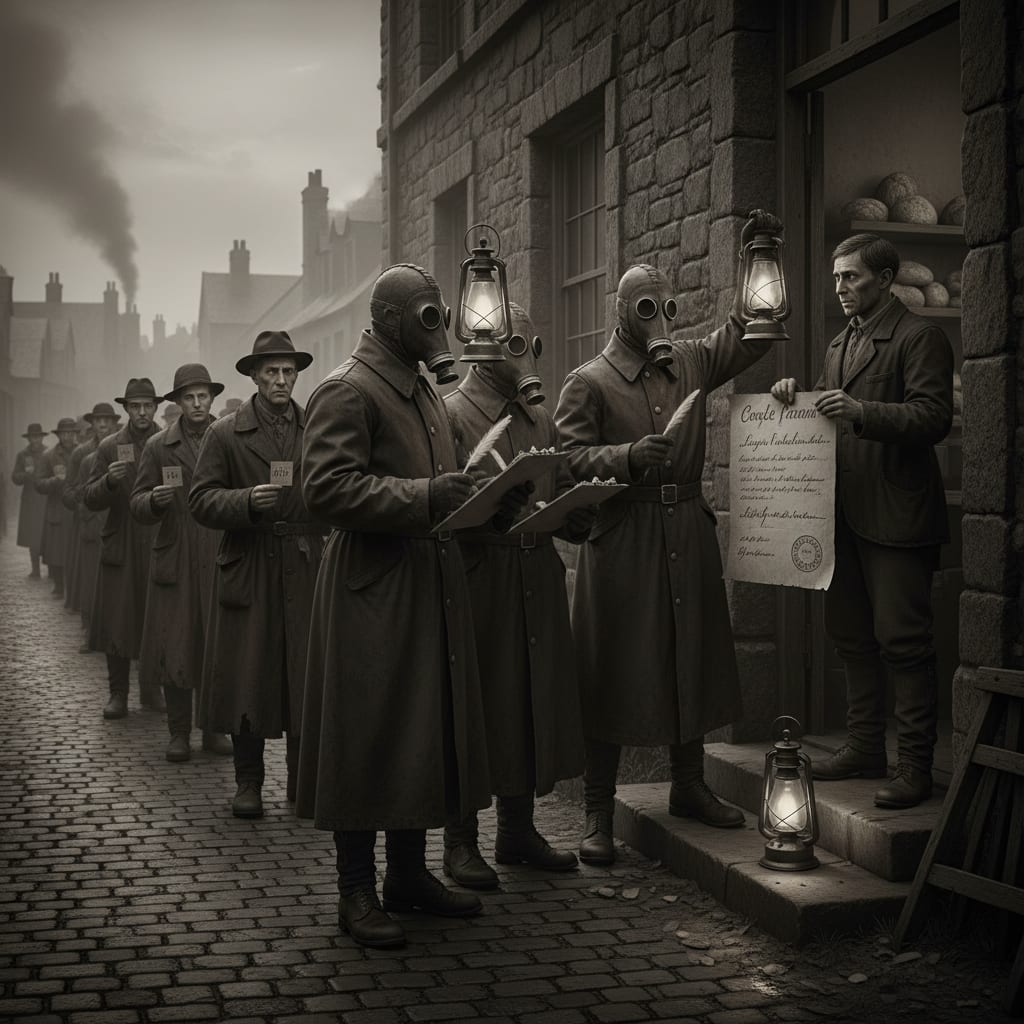
Nine Wicks keeps a locked drawer of blank confessions and pre-signed citations — their "Confession Closet" — so that proof quotas can be met on nights when heresy is insufficiently cooperative. If Wardens ever open that drawer, Nine Wicks ceases to be a vigil order and becomes a criminal conspiracy between one heartbeat and the next.
The Circle of Ashen Steps patrols the ossuary rings and funeral lanes — the bone-corridors where Marrowgate meets the living city and the candle tallies that track household vigils provide a surveillance infrastructure no Bureau could have designed on purpose. Every household candle is a data point. A missing flame is a missing family, or a family that has ceased to pray, which is worse. Ashen Steps counts the candles, investigates the gaps, and profits from the investigation by skimming marrow-wax and offering selective "lost body" services to patrons wealthy enough to require discretion about their dead. They maintain a second ledger — the Two-Book Dead — in which bodies quietly diverted for patrons are recorded in a handwriting that matches no clerk's on file.
The Circle of Rope-Road Lanterns controls the elevated walkways, pulley bridges, and stacked catwalks that span the vertical geography of bastion cities. Height is their currency. From above, they see who crosses between wards, and they sell that knowledge. Their tolerated sin is blackmail, delivered with the delicacy of a man explaining that gravity is not personal. Somewhere in their maintenance tower — Pulley Station Hark (Unregistered) — a chalk wall records every crossing: who, when, with whom, carrying what. The wall is wiped at dawn. The information is not.
The Circle of Mute Radiance operates in the bell-dead alleys and hush-zones — districts where the Bellway signal has failed, where Bureau of Bells instruments register dead air, where sound behaves as though embarrassed to exist. Here the Brotherhood works in absolute silence: hand-code, mirror-flash, lamp-shard signals. No shouted arrests. No verbal warnings. Compliance happens instantly or it happens physically, and the transition between the two is a hand gesture so small that witnesses later recall nothing louder than a click. Their tolerated sin is extrajudicial removal — "No sound, no record — unless we choose to write one." The rumour of a "Tongue Cabinet" — trophies from these removals — persists. The Bureau of Shadows has investigated the rumour three times and concluded, three times, that the investigation itself constitutes a more effective deterrent than any findings would.
The Circle of Stained Proof patrols the cathedral outskirts and relic-workshop lanes, hunting illicit miracles. They enter markets as buyers, coins first, polite questions second. Seizures are staged for maximum public instruction — a visible gasp, a confiscation performed like a minor pageant. Their tolerated sin is aesthetics: they take "one beautiful thing" from each major seizure, ostensibly for disposal. The beautiful things are never disposed of. They circulate upward through patronage networks until a seized demon-glass shard or a counterfeit relic window appears in the private chapel of exactly the kind of official who signed the seizure order. The circle closes. The circles always close.
#On the Triangle of Witness
"Truth is less important than consistent testimony." — Brotherhood field manual, wax-paper issue, memorised and burned.
The Brotherhood's patrol doctrine rests on a single tactical principle: no alley is "watched" unless it is seen by three lights. Patrols deploy as Triangles of Witness — an Anchor (a stationary lantern at a chokepoint, visible, immovable, the proof that surveillance exists), a Blade (a moving pair who search), and an Echo (a shadow patrol one lane over, unseen, unheard, whose sole function is to write the first report if an incident occurs). The Anchor confirms. The Blade provides the body. The Echo provides the narrative.
The system produces testimony before truth — consistent, corroborated, and documented in triplicate. When a Trench-Court Clerk receives a Brotherhood arrest report, the report arrives with three signatures from three positions, and the geometry of those positions is always plausible, and the clerk files it without looking up, because looking up invites questions and questions require answers and answers require truth and truth is the one commodity the Brotherhood has learned not to overproduce.
#On the Schism and the Mercy Problem
The Brotherhood discovered early — and the Bureau discovered late — that the Lantern Preachers, those itinerant heretics who spread soft words of mercy and forgiveness without discipline, actually reduced the Brotherhood's workload. A calm street requires fewer patrols. A comforted widow does not shatter a queue window. A child who has heard a kind word at dusk does not throw stones at a Warden at dawn. The mathematics of civic order, which are the only mathematics the Bureau of Tithes respects, favoured the arrangement.
So the Brotherhood shielded the Preachers. Watch circles turned corners at convenient moments. Lookouts developed sudden and specific blindnesses. Fog Preachers passed through Brotherhood patrols with the ease of women who knew the password because the password had been whispered to them that morning by the very Circle-Captain whose district the sermon would calm.
The Cologne Schism of A.S. 178 exposed the fault line. Three watch circles split over a question that had been rotting beneath the arrangement since its inception: does shielding a heretic make the shield complicit? The Ward-Soothe Purists answered yes, severed ties, and returned to strict curfew enforcement — correct, loud, and inefficient. The Lantern Loyalists answered no, continued the arrangement, and hoped that pragmatism would outrun doctrine. The Soft Insurgents argued that the Brotherhood's entire existence had always been resistance dressed in permission — that the very act of patrolling alleys the Synod could not staff was an admission that the Synod's order was incomplete, and that the Preachers merely spoke aloud what the patrol routes had been saying in silence for decades.
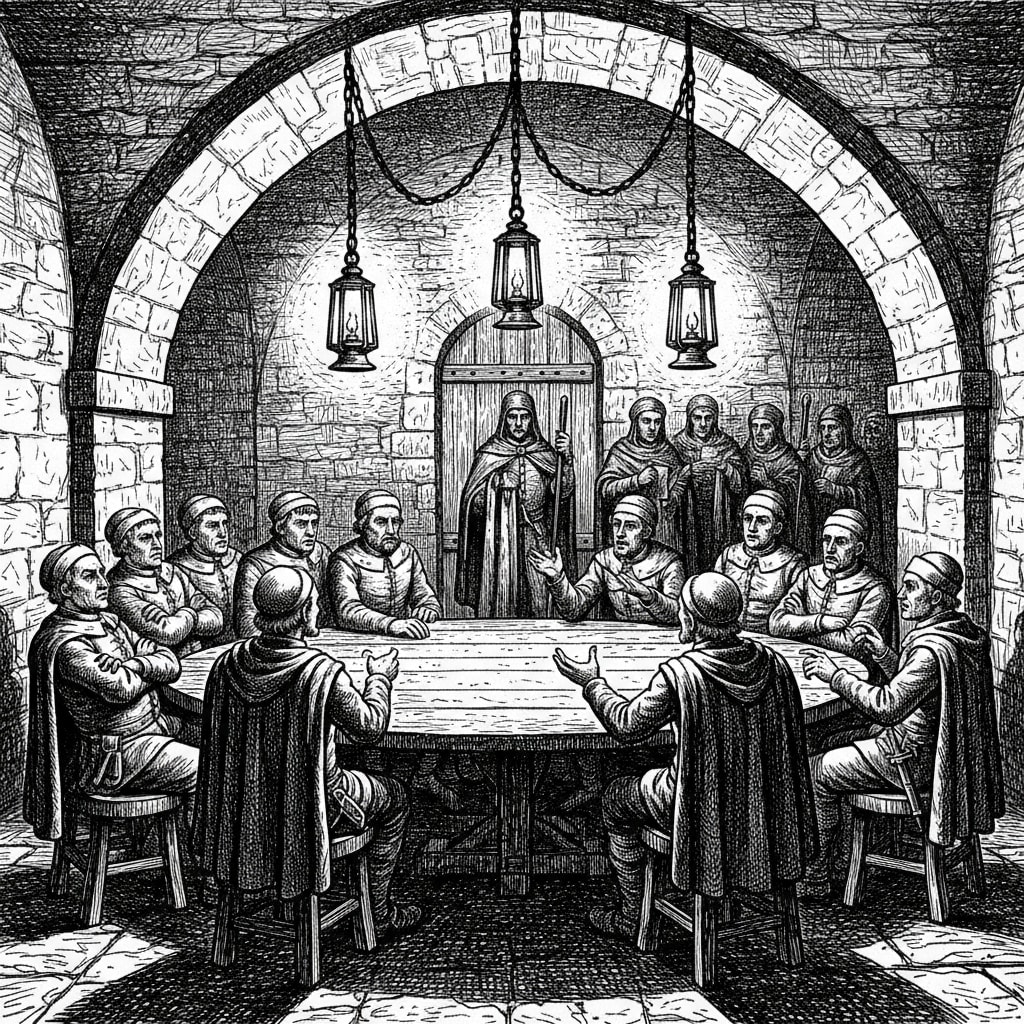
The Bureau of Shadows filed the Schism under "INTERNAL FRATERNAL DISAGREEMENT, NO ACTION REQUIRED." The Bureau of Shadows' inaction is never inaction. It is observation with a longer fuse.
ERRATUM — Bureau of Records, Ref. 77-V-201 Previous quarterly reports listed the Lantern Brotherhood's total strength at "approximately 8,400 across Zones 1–5." The correct figure, following an audit that the Bureau of Settlement describes as "unproductive" and the Bureau of Tithes describes as "illuminating," is "approximately 8,400 across Zones 1–5." The figure has not changed. The confidence in the figure has decreased by forty per cent.
#On the Cost of the Glow
The Lantern Brotherhood Vigilante is paid in rations, oil, and a housing right in a Brotherhood flophouse — a bolted room with a straw pallet and a hook for the lantern, where sleep comes in fragments and dreams are made of footsteps. Side income arrives in the currencies of the night: escort fees, "safe corridor" passage, debt collection, quiet couriering, and the general commerce of fear that accrues to anyone who carries a blade and a light in a city where carrying either past the Ninth Peal is otherwise punishable by confession, fine, or worse.
The physical hazards are the ones every night-worker knows — knife fights, falls, ambush, frost, the slow accumulation of smoke in the lungs from a lifetime of ash-oil fumes. The spiritual hazards are particular: "unclean light," in which a lantern begins to whisper; confession contamination, absorbed from too many overheard sins in too many dark corridors; and the relic backlash that occasionally strikes Brothers assigned to the Stained Proof Circle, whose proximity to seized demon glass produces hallucinations the Bureau of Medicine classifies as "Optical Residual Devotion, Category One — Benign" and the Brothers themselves classify as "seeing the dead walk."
The burnout endpoint is specific and recognisable: the Brother ceases to see people and begins to see checkpoints. The alley is a lane. The citizen is a stop. The question is a form. The knife is a stamp. He moves through the night like a clockwork mechanism, efficient and hollow, and the lantern he carries illuminates nothing, because illumination requires someone behind the glass who is still capable of seeing, and seeing — in the Brotherhood's theology of the night, in the accumulated weight of ten thousand patrols through streets that never change and sins that never vary — is the first thing the job takes.