
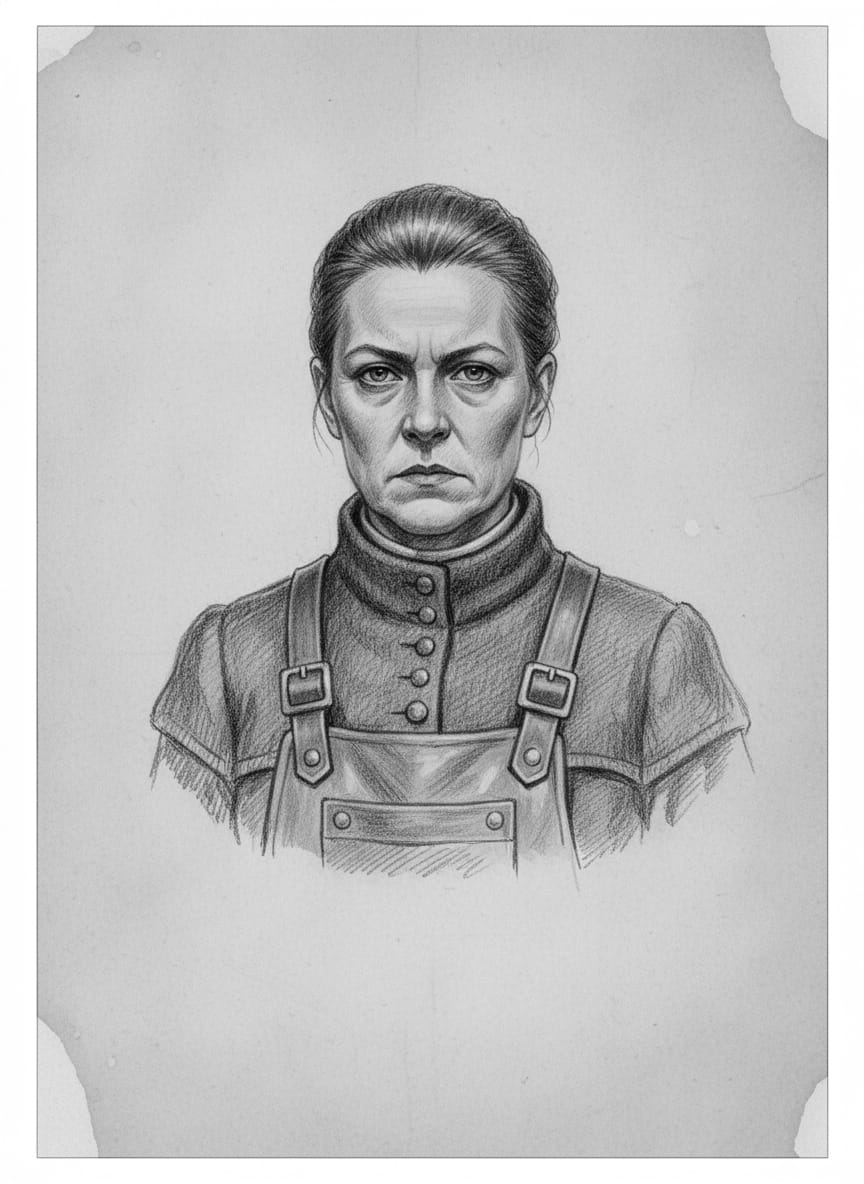
#On the Mistress of Intake
Jossa Rill stands on the Intake Porch of the Lost Procession Yard and makes cargo of the devout. This is her genius, her sin, her office, and — should the Bureau ever grow sentimental enough to prosecute usefulness — her confession.
She is Mistress of Intake at the Cloister of Miscounted Beads, a title that sounds hospitable only to people who have never entered by the western gate with wet boots, a dead aunt, and a bead string warming in the fist. Rill controls the first sorting: who receives a chalk mark, who is sent toward the Counting Hall, who is held under fever cloth, who is expelled before dusk, who becomes Chapel, who becomes Awaiting, who becomes red-lane evidence with a runner already looking for Purity.
Her power is triage, and triage is a theology when performed often enough. A pilgrim enters as a person. Rill’s eye reduces him to condition, weight, fever risk, sponsor mark, route coherence, resistance potential, child liability, fraud smell, and resale value in delay. The process appears brutal because the observer is usually standing on the wrong side of the rope.
#On Her Hands and Eyes
Rill’s eyes are hard. This is the common phrase, and for once common speech has stumbled into accuracy without cracking its shins. They count, assess, price, and discard. They pass over a crowd the way a quartermaster’s scale passes over sacks: accepting weight, rejecting story. At Rill’s table, a mother with two children ceases to be maternal grief. She is three bodies, one unstable adult, two custody questions, and a likely plea at the north awning.

Her hands are soft.
The softness has become Yard legend. Rill folds tags without tearing the cheap card. She lifts fevered infants without waking them. She takes a pilgrim’s wrist so gently that the bruise blooms later, round and private, like a seal applied beneath the skin. She does hard work through soft means, which is how one recognises a professional. The amateur bruises immediately.
Earlier district gossip claimed Rill keeps her hands soft out of vanity.
Corrected. Vanity is too innocent. Rill’s hands are tools, kept smooth because cloth, cord, wax, fever skin, and frightened wrists all answer better to pressure they do not first recognise as force.
She dresses practically: dark skirt cut for movement through mud lanes, sleeves pinned clear of ink and vomit, boots thick enough for the Yard’s toothy clay, no ornament except whatever small token she has taken as payment and not yet converted. She stands in doorways. She watches from thresholds. She prefers frames: gate, porch, awning pole, fever tent flap. A framed person becomes easier to measure.
#On Speech That Lands Like Threat
Rill speaks with professional courtesy. That courtesy makes her dangerous. A shouted threat can be witnessed, resented, repeated, and, in rare cases, avenged. A courteous observation enters the ear dressed as weather and leaves as sentence.
“Your boy is very steady.” Said to a mother whose child has not blinked for six minutes.
“Your route leader has been generous with his memory.” Said to a column whose march tallies contradict in three hands.
“Enjoy your meal, Marshal.” Said to a Queue Marshal who has just sold the order of his own followers for a yellow tag and will discover, by nightfall, that the betrayed are housed within arm’s reach.
She rarely commands twice. Deputies shout. Runners shove. Matrons slap. Rill says one small thing from the Porch and the Yard reorganises itself around it, muttering, limping, hating her with the temporary privacy allowed to the powerless.
#On the Cargo Doctrine
Rill survives by believing people are cargo if viewed correctly. Cargo has weight, condition, risk, destination, spoilage, and price. Cargo does not look back from a bunk six weeks later with the face of the first person you condemned to expulsion. Cargo does not dream in your doorway. Cargo does not whisper your name from the wrong side of a locked chain gate during anomaly week.
She learned this doctrine from necessity, or claims to have done so without saying it aloud. No confirmed file proves she was once among the desperate. Records offers a childhood blur, a parish mark scraped thin, and an early service notation in intake labour. The absence is itself suggestive. The Cloister often promotes those who know how it feels to be sorted, then rewards them for forgetting.
INTAKE MEMORY FRAGMENT — SOURCE UNVERIFIED First expulsion under Rill’s hand: adult male, no sponsor, fever suspected, string count disputed. Weather: rain. Disposition: expelled cityward before Vespers. Body recovered: ██████████████. Rill’s later correction to report: “Material removed before Yard contamination.”
A Pilgrimage personnel summary praised Rill for “unusual emotional resilience.”
Revised under Doctrine review. The phrase is sentimental fog. Rill displays trained detachment, transactional speech, high threat recognition, and selective memory. Resilience is what pamphleteers call damage when it remains employable.
#On Fear
Rill fears being reduced to the status of those she processes. She fears the wrist tag. The chalk mark. The moment when a runner seizes her arm and asks lane, origin, fever, sponsor, string, name.
This fear sharpens her. Under stress she becomes more observant, more dangerous, more precise. She catalogues weaknesses for later use. She smiles when she has advantage because smiling is the cheapest way to make a man notice he has been measured. During crowd surges she stands higher on the Porch step, less from courage than from the need to see where the machine is about to bite.
Anomaly weeks trouble her differently. Fever can be isolated. Riot can be broken. Brokers can be fed. A bead anomaly refuses her categories. Wrist tags appear in her handwriting before she has touched them. Names answer from wrong lanes. A procession leader absent at arrival is recorded as cleared two days earlier. Rill’s doctrine says people are cargo. The anomaly says cargo remembers the warehouse.
#On Vale and the Porch
Prior-Scribe Erem Vale and Jossa Rill maintain a relation of mutual contempt polished by dependence. Vale controls the end of waiting. Rill controls the beginning. Vale’s seal can turn Tuesday into next month; Rill’s chalk can turn a person into a class before the person has drawn a full breath inside the gate. They need each other in the ugly way organs need blood.
Vale speaks in euphemism. Rill speaks in observations. Vale calls a locked gate protective narrowness. Rill asks whether the man outside the gate has begun coughing blood yet. Vale delays. Rill sorts. Vale fears an anomaly that proves the system wrong. Rill fears an anomaly that makes her sortable.
#On the Yard Under Her Hand
The Lost Procession Yard under Rill has become a creature of chalk, twine, wet wool, fever cloth, and disciplined fear. Lanes hold longer than they should. Runners move before orders finish. Deputies shout where shouting is useful and fall silent where silence costs less. Broker stalls hide beneath cloth and common knowledge. The sixth table remains empty until anomaly week; no one leans on it because Rill once broke a man’s finger for doing so and described the act as instructional contact.
She has reduced stampedes without reducing suffering, which is why the Cloister values her. Her classifications are fast, often correct, and sufficiently profitable to keep several minor officials fed. She misclassifies saints, children, liars, and the merely unlucky with the same hard neatness. When challenged, she asks for the route writ. Most moral arguments die looking for paperwork.
The city magistrates dislike her because expelled bodies become municipal inconvenience. Pilgrims hate her because she is the first face of the machine. Brokers respect her because she can smell desperation before they can price it. Clerks fear her because she remembers hands. Vale tolerates her because the Yard would choke without her and because replacement candidates have the soft fatality of men who think intake is a desk job.
#On the Present Mistress
As of A.S. 201, Rill’s Yard is beyond capacity, her runners are overworked, her fever tents are insufficient, her skim is safer than honesty, and anomaly weeks have begun writing too close to her hand. She has requested awnings, clerks, fever canvas, and a second bell. She will receive partial cloth, no one competent, and praise.
Praise is dangerous. It tells a useful sinner she has been noticed.
At dusk she stands on the Porch with hands folded, soft as folded linen, watching the last legal arrivals press toward the chain gate. A child cries in lane two. A monk lies in lane four. A marshal eats in silence after selling his own column. Rill sends a runner left, taps a slate twice, and smiles at a woman whose yellow tag has just become expensive.
Somewhere under the mud, the Yard keeps what falls.
Phase 2a correction log: no unresolved links, date errors, bastion errors, or geography errors found.