
#On the Supplementary Cloister and Its Modest Purpose
"Count true, or be counted." — Inscribed above the chain gate of the Cloister, in letters recently re-gilded, the gold applied with the care one gives to a threat that has earned its permanence
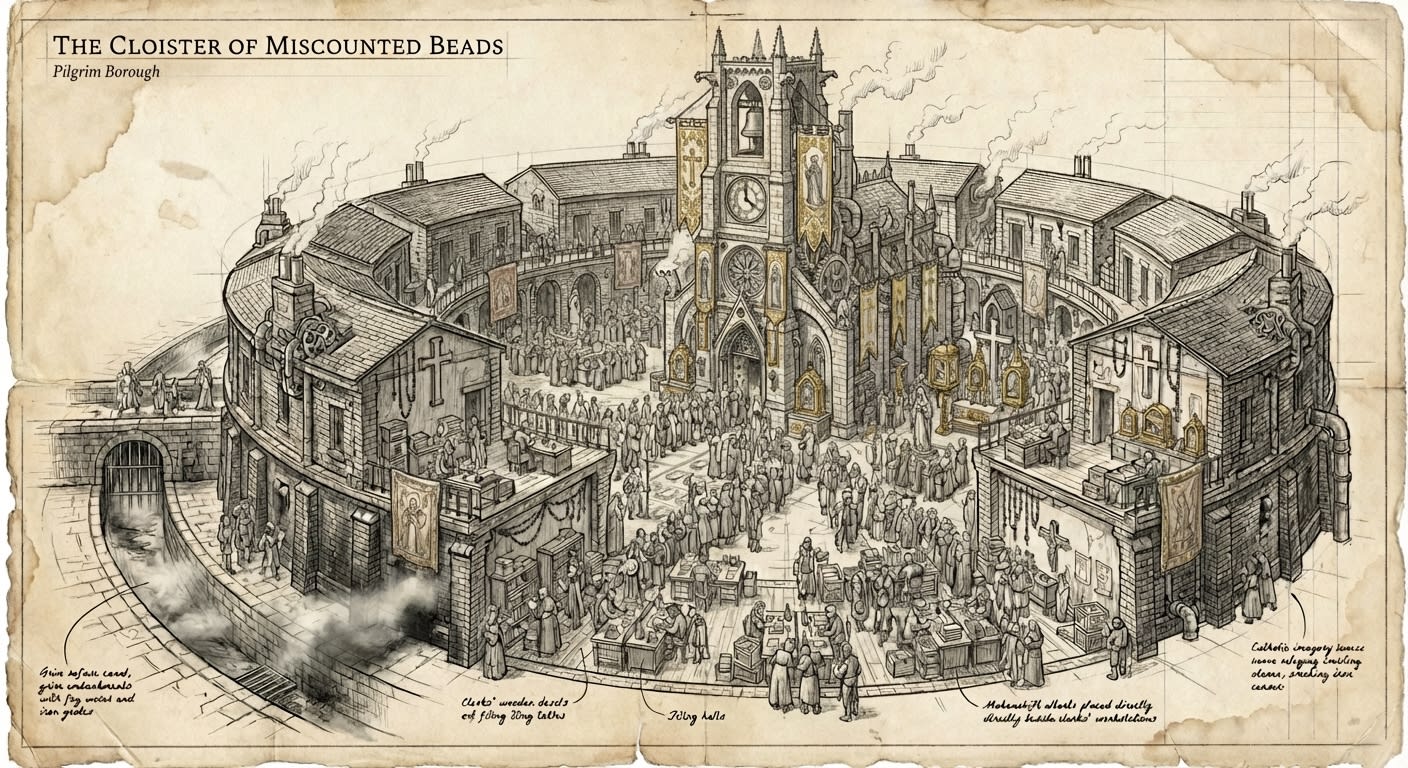
The Cloister of Miscounted Beads squats on the ragged hem of Strasbourg's outskirts — leeward of the city wall, adjacent to the refuse canal, ringed by rubble gardens and ash-silt lots where nothing grows except bureaucratic jurisdiction. It is a low, soot-stained compound of dormitories, counting halls, and a chapel whose floor has been worn into shallow basins by generations of kneeling feet. Six thousand four hundred souls inhabit it on a census day, though no census day in the Cloister's history has produced a number the Bureau of Records was willing to publish without annotation.
The Synod built it — or, more precisely, the Synod permitted it to accrete — in A.S. 94, four years after the Concordat ratified the faith's administrative apparatus, when the surge of pilgrims entering Strasbourg through the western gates overwhelmed the existing intake system. Pilgrims arrived in processions. Processions carried bead strings. Bead strings recorded prayers, stations, and penances completed along the road. And the counts did not match. They never match. A pilgrim swears thirty-seven beads; the string holds thirty-nine. A penitent claims the Station of the Weeping Virgin; his route passed forty leagues south of it. A dead woman's name appears on an intake roster, her bead string warm in a clerk's hand, the mud on its cord still wet.
The overflow became an institution. The institution became a cloister. The cloister became, in the parlance of the streets, the Bead-Pit — and in the parlance of soldiers who have passed through it on their way to the Line, the Grave-Click.
#On the Geography of Correction
The Cloister is ringed, as a proper cloister should be, around a central chapel and a counting-hall spine. A low wall of brick and bone-lime mortar defines its perimeter, broken by two chain gates — the Intake Gate, facing the pilgrim roads, and the Clearance Gate, facing the city proper. Between these gates, everything is procedure.
Seven districts fill the compound, each with its own officer, its own smell, and its own species of delay:
The Clickery — formal designation: the Counting Hall — occupies the compound's spine. Twelve reconciliation desks, each staffed by a bead clerk whose authority over your continued existence is total and whose sympathy is rationed more tightly than grain at Bastion-Brest. The desks are oak, ink-stained to black. The air tastes of wax and vinegar wash. Here your bead string is counted against the Synod's record of your pilgrimage, and here, in the gap between what you claim and what the string confesses, your life becomes editable.
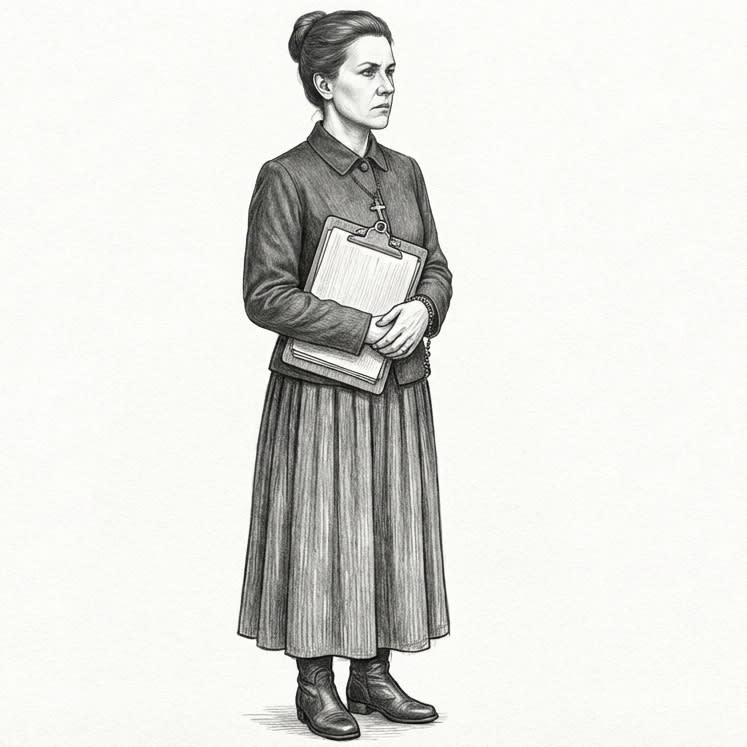
The Lost-Procession Yard is the intake pen — an open courtyard of packed earth and wet wool where pilgrims whose processions have lost coherence are sorted, tagged, and assigned dorm berths. It smells of fear and rain. Jossa Rill, Mistress of Intake, presides with hard eyes and soft hands, counting people the way a quartermaster counts sacks: by weight, by condition, by the likelihood of spoilage.
The Supplementary Entry Office handles filings — the paper-machinery by which a life is reconciled to doctrine. Damp corridors, vinegar-washed walls, the scratch of copyists whose wrists ache from forming letters that will determine whether a pilgrim walks free or kneels for another month. This is where the Bureau of Records extracts its true harvest: confession data, route corrections, identity amendments, all stapled to the bead record and filed in triplicate.
The Dorm Rows, called Awaiting by every soul condemned to occupy them, are stacked bunks in long brick halls. Bodies and boiled grain. Rope cots that scratch. A ration of one candle per six detainees per night, the candle measured against a wax-mark on the wall, the burning timed by a clerk who visits at the fourth bell to snuff anything that exceeds its allotment.
The Chapel of the Second String is the compound's spiritual center — a cold stone nave where detainees kneel for penance and are issued a second string, a replacement bead line symbolizing corrected obedience. The floor basins, worn into the flagstones by decades of kneeling, are deep enough to hold rainwater. Bone tokens have been found beneath the stones, though the Cloister Chapter declines to explain their provenance.
The Bead Vault stores confiscated strings — evidence, in the Bureau's terminology. Sealed wooden cases, dust, the click of beads that no hand has touched. The vault guard, a silent woman whose name rotates with the season (the Chapter reassigns her identity quarterly, for security), admits no one without the Prior-Scribe's counterseal.
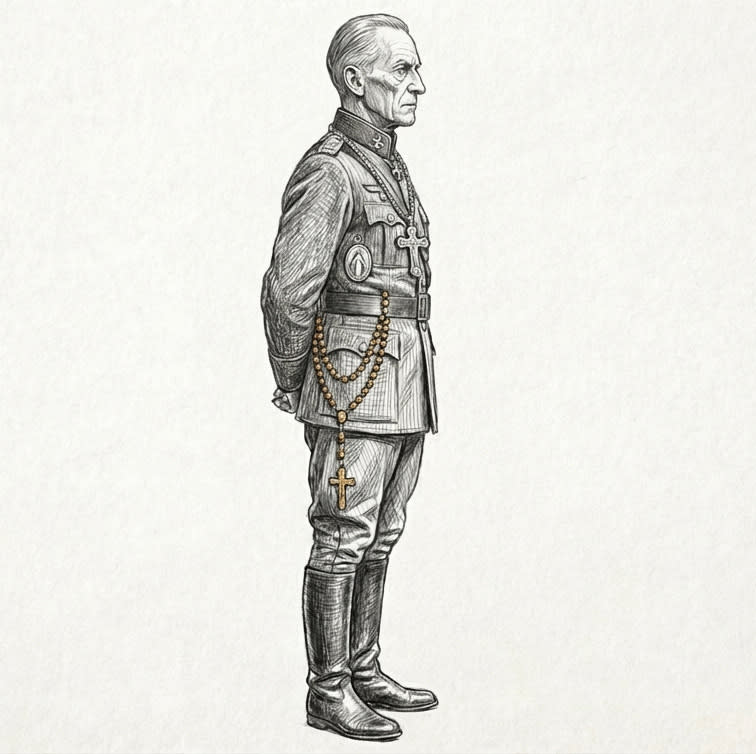
The Outer-Watch Post controls the gates and patrols the perimeter. Tar and metal. Ash armbands. The outer-watch is technically a municipal militia detachment, but in practice it answers to whoever in the Cloister holds the keys to the chain gates, and whoever holds the keys to the chain gates answers to the Prior-Scribe, and the Prior-Scribe answers to the Bureau of Records, and the Bureau of Records answers to itself.
#On the Governance of Miscounts
Three authorities govern the Cloister, and all three believe they govern it alone.
Prior-Scribe Erem Vale administers the Cloister Chapter of the Second String — the monastic bureaucracy that runs the Clickery, the Chapel, and the Vault. Vale speaks in a voice like polished wood: smooth, warm, and entirely hollow where mercy should be. He never says "mistake." He says "discrepancy." He never says "detained." He says "under reconciliation." His clearance seal can free a pilgrim in minutes, and his withholding of that seal can bury one in the Dorm Rows for months. He fears one thing only: an anomaly that proves the system wrong.
Jossa Rill, Mistress of Intake, controls who enters the compound and under what classification. Her power is triage — she decides whether a miscount is "supplementary" (fixable by filing), "anomalous" (requiring Chapel intervention), or "irreconcilable" (requiring inquisitorial review). The difference between these classifications is, for the pilgrim, the difference between an afternoon's inconvenience and the loss of one's name. Rill makes these decisions with the speed and sentiment of a butcher grading meat.
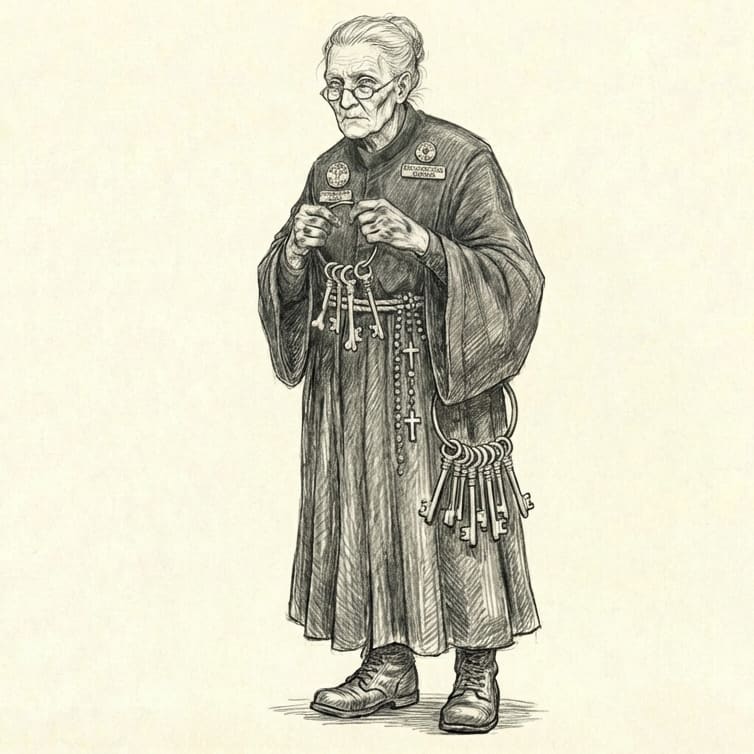
Archivist Keth, called Mother Thread by the clerks who serve under her, controls the Bead Vault. Deaf in one ear — or so she claims, though she hears bead-clicks through three walls of stone. Keth has held her post since A.S. 182, longer than any archivist in the Cloister's history. She knows every string in the Vault by weight. She sleeps in the undercroft among the oldest records, in tunnels that intersect the gravefields beyond the compound wall. And she guards, with a ferocity that would embarrass an inquisitor, the rumor of the First String.
#On the Economy of Correction
The Cloister runs on time. Filing fees are denominated in coin, but the true currency is delay — the weeks and months a detainee spends Awaiting while clerks reconcile a count that could, with sufficient motivation, be reconciled in an afternoon.
This motivation is purchasable. The Sponsor-Seal Brokers, who style themselves the Patrons of Correction, operate from the Supplementary Entry Office with the quiet tolerance of the Cloister Chapter. A sponsor seal — a wax impression bearing the counter-mark of a recognized benefactor — converts a detainee's status from "under reconciliation" to "sponsored correction," which reduces processing time from weeks to days. The cost of a sponsor seal varies by the severity of the miscount, the season, and the desperation of the buyer. The Patrons do not haggle. They assess.
For those without coin, the Cloister offers an alternative: clerical debt. Hours of labor — cleaning, copying, night watch, corpse-cart duty in the outer gravefields — are credited against filing fees. A pilgrim who entered the Cloister owing three supplementary entries might emerge, six weeks later, having scrubbed the Dorm Rows with vinegar, copied four hundred pages of bead records, and carried the dead from the canal-fever ward to the pits beyond the wall. He will emerge corrected. He will also emerge owing the Cloister a fortnight's labor for the dorm fees accrued during his correction. The arithmetic is, as the Bureau of Tithes would say, self-sustaining.
The black market thrives in the rubble lots beyond the compound wall, anchored by the tavern called The Ninth Count (Unregistered). Counterfeit bead strings — threaded by forgers who study the Synod's bead specifications with the devotion of jewelers — sell briskly. Forged sponsor seals circulate. And the Grave-Name Market operates with the boldness of an institution: dead identities, purchased from bribed clerks or stolen from the Vault's overflow records, are sold to travelers who need a compliant past more than they need their own.

#On the Anomaly
The Synod does not acknowledge bead drift. The Bureau of Records has published seven circulars on the subject, each concluding with the same sentence: "Bead counts are fixed at the moment of filing and do not change. Discrepancies in subsequent counts reflect handling error, not autonomous alteration."
The beads change.
Between the third and fourth bell, in the hours when the Cloister is quietest, strings in the Bead Vault warm without cause. Beads shift on their cords. Counts that were filed as thirty-seven read thirty-nine the next morning. Ink on intake rosters bleeds into new letters — names that were not written, names of people who are dead, names that the Clickery clerks swear they have never recorded. A pilgrim cleared and released at dawn returns to the Counting Hall at noon, insisting he was never cleared, his bead string bearing a count that does not match the record filed three hours earlier.
The Cloister Chapter manages these events with anomaly protocols (Unregistered): gate lockdowns, silence hours (speaking during drift can accelerate it), vinegar cleansing of affected strings, and — in severe cases — sealing the Bead Vault and moving detainees to the undercroft until the drift subsides. The protocols work, in the sense that they impose order on an event that defies it. They do not stop the drift. They contain it, the way a dam contains a river — by pretending that the weight of the water is a policy choice.
The worst events — the ones that produce new names on dead men's rosters, that cause cleared pilgrims to reappear in the Dorm Rows with no memory of leaving, that fill the Clickery's ink-wells with script that no hand wrote — are classified as anomaly weeks (Unregistered). The gates lock. Food runs thin. The outer-watch patrols the perimeter with the grim enthusiasm of men who understand that their job is to keep the anomaly inside, and that the city magistrates on the other side of the wall will thank them for it.
FIELD NOTE — PRIOR-SCRIBE VALE, A.S. 199, SEALED
████████████████████████████████████████ ██████████ the First String was accessed by ████████████ during the anomaly of ██████████. Counts across ██████ intake rosters reverted to entries dated ████████████. Three detainees were cleared whose records showed them deceased in A.S. ████. One of them ██████████████████████████████████ ████████████████████████████████████████ ██████████████████████████████████████
CLASSIFICATION: SEALED — NINTH-RATIFICATION
#On the Quiet Thread and the First String
Every cloister breeds its heresy. The Cloister of Miscounted Beads breeds the Quiet Thread — a cell of clerks, archivists, and detainees who believe that bead drift is intentional. Holy, even. The beads count because something is counting. The names resurface because someone is being called. The dead reappear on the rosters because the Ledger remembers what the Bureau erases.
The Quiet Thread operates in the undercroft tunnels, in the refuse-canal paths, in the silence rooms where bead strings are sealed in salt-wax. They conduct their own silence tests — sitting with confiscated strings in darkness, waiting for the click with the shape of a syllable. They believe the drift can be directed. They believe a bead string of sufficient age and prayer-weight can rewrite the record it is filed against. They believe that somewhere in the Vault — in Archivist Keth's sealed cases, in the oldest and deepest cabinet — there is a string that was never counted, never filed, never reconciled. The First String. The original count. The one against which all other counts are measured, and which, if spoken aloud, would render every supplementary entry in the Cloister's history a lie.
The Bureau of Purity has investigated the Quiet Thread twice. Both investigations concluded with the same finding: "No evidence of organized heresy. Recommend continued surveillance." The Quiet Thread continues. The surveillance continues. The First String, if it exists, remains in its cabinet, warm to the touch, counting.
Earlier editions of the official documentation described the Cloister of Miscounted Beads as "a charitable institution providing reconciliation services to pilgrims of good faith."
This description has been corrected. The Cloister is a processing facility for the identification, classification, and correction of discrepancies in pilgrim bead records, operating under joint authority of the Bureau of Records and the Bureau of Pilgrimage. Charitable intent is not denied; it is simply irrelevant to the mechanism. The Bureau does not distinguish between mercy and procedure. Both produce the same paperwork.
#On the Present Condition
The Cloister is full. It has been full since A.S. 198, when the Queue Road bottlenecks drove a surge of redirected pilgrim traffic through Strasbourg's western gates. The Dorm Rows overflow. The Clickery desks are backed up by weeks. The Supplementary Entry Office processes filings at a rate that the Bureau of Records describes as "adequate" and that the detainees describe with language the Bureau of Doctrine does not permit in print.
The city magistrates want the Cloister to stop dumping cleared vagrants into the streets. The Synod wants more detentions, because detentions produce confession data, and confession data feeds the Great Ledger. The Sponsor-Seal Brokers scent opportunity in the overcrowding and have tripled their prices. The Quiet Thread, emboldened by the increase in anomaly weeks, recruits openly in the Dorm Rows — or as openly as a heretical cell can recruit in a compound administered by the Bureau of Records.
And the beads keep counting. In the Vault, strings click without hands. In the Clickery, ink forms paragraphs that no clerk wrote. In the Chapel of the Second String, the floor basins fill with water that smells of grave-soil, though no pipe connects them to anything below.
The Cloister endures. It was built to catch what the pilgrim roads spill, and the roads spill more each year — lost processions, broken oaths, miscounted prayers, and the quiet certainty, shared by every clerk who has worked the Clickery past midnight, that something in the Vault is counting back. The Bureau does not acknowledge this certainty. The Bureau does not need to. The paperwork is filed. The seals are set. The corrections are applied. And if the beads click in the silence between the third and fourth bell — if the ink crawls, if the names of the dead reappear on rosters that were clean at dawn — then the Bureau will file a handling-error report, stamp it with the Ninth-Ratification seal, and consign it to the undercroft where Archivist Keth sleeps among records that breathe.
Nihil obstat.