
#On the Market Outside the Count
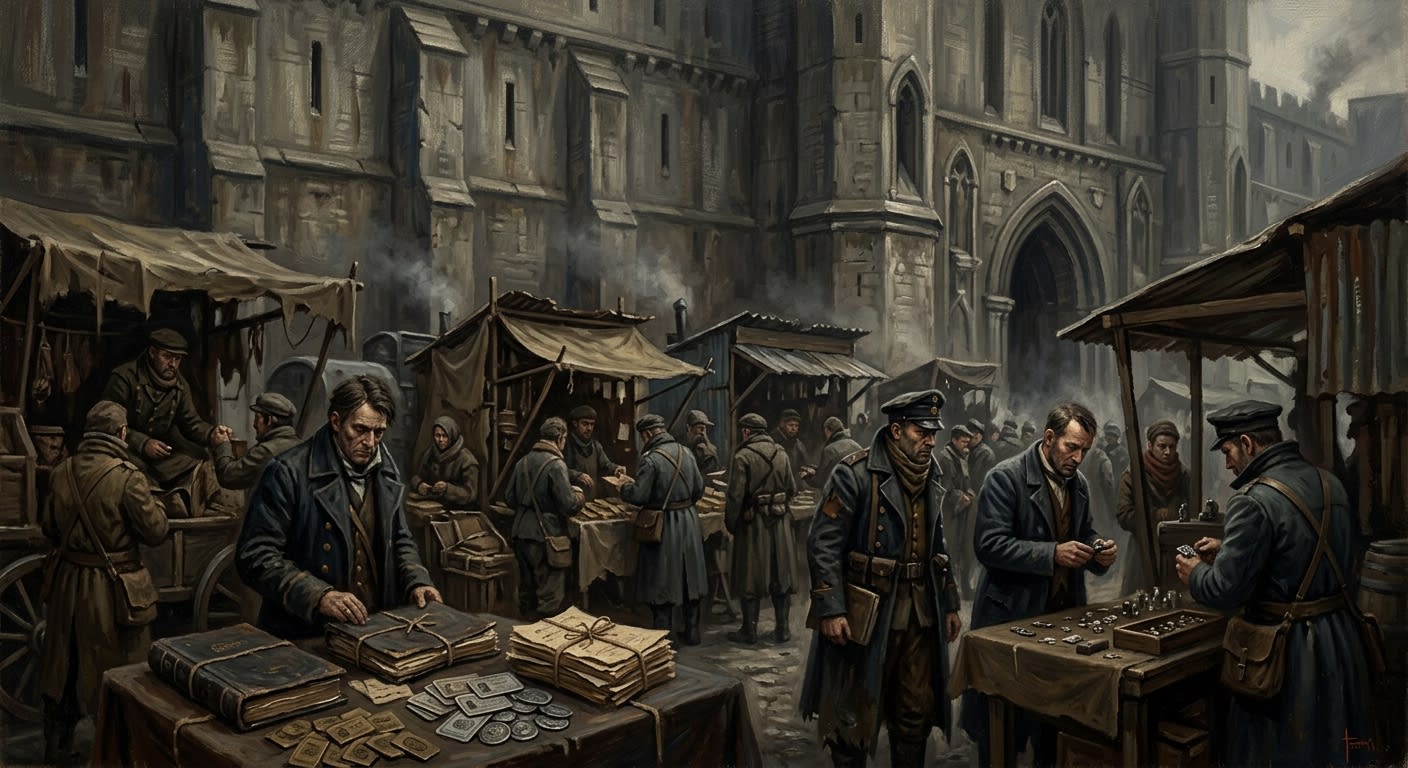
The Grave-Name Market lies in the rubble lots beyond the eastern drain wall of the Cloister of Miscounted Beads, between the refuse canal, the outer gravefields, and the tavern called the Ninth Count, where men drink sour beer beneath shelves of counterfeit bead strings and pretend the hanging cords are decoration. It is a market in the way a wound is a door: bodies pass through it, money enters it, rot comes out wearing paperwork.
The municipal map calls the quarter ash-silt waste under pending improvement. The Cloister Chapter calls it extramural disorder. The Bureau of Records calls it a theft risk. Pilgrims call it hope after the offices close. I call it what it is: an illegal exchange in dead names, cleared pasts, ruined files, stolen bead indices, sponsor scraps, corpse notices, and the small blank spaces between one authority and another, where the poor crawl in to become someone the Ledger has already finished hating.
Do not imagine stalls with cheerful awnings, fruit sellers, honest scales, and other rural lies. The Market gathers in pieces. A woman under a torn canvas sells parish deaths copied from candle stubs. A boy with a cracked tooth carries three names in his shoe. A sponsor-runner recites prices by cough. A corpse-cart driver knows which pits received men without relatives. A former copyist, missing two fingers for filing irregularity, can remember the shelf mark of a grey case if properly fed, flattered, and frightened. By dawn, each has vanished into fog, gutter, tavern, dorm kitchen, chapel queue, or lawful employment.
The Market was born from the Cloister's virtues. That is its most irritating feature. The Cloister counts pilgrims; the Market sells miscounts. The Cloister amends identities; the Market sells amendment before filing. The Cloister detains the uncertain; the Market offers certainty with a worse accent. The Cloister preserves confiscated strings in the Bead Vault; the Market sells rumours of their case numbers. The Cloister teaches that a life can be repaired by paper. The Market, attentive pupil and filthy little prodigy, asks what repair might cost after second bell.
#On the Origin in Miscount and Mud
The Grave-Name Market cannot be dated by charter, since criminals have the discourtesy to begin without minutes. Its present form hardened after the post-A.S. 198 intake surge, when the Cloister filled beyond design, the Supplementary Entry Office clogged with route corrections, and the Dorm Rows became a human shelf of unresolved names. The first stalls were not stalls. They were favours passed through fence slats: a copied death notice, a borrowed bead, a widow's sponsor rumour, a berth exchange, a false witness willing to say that yes, he had walked with the pilgrim from Saint Rell's Fountain (Unregistered) and yes, the missing bead had been present before rain.
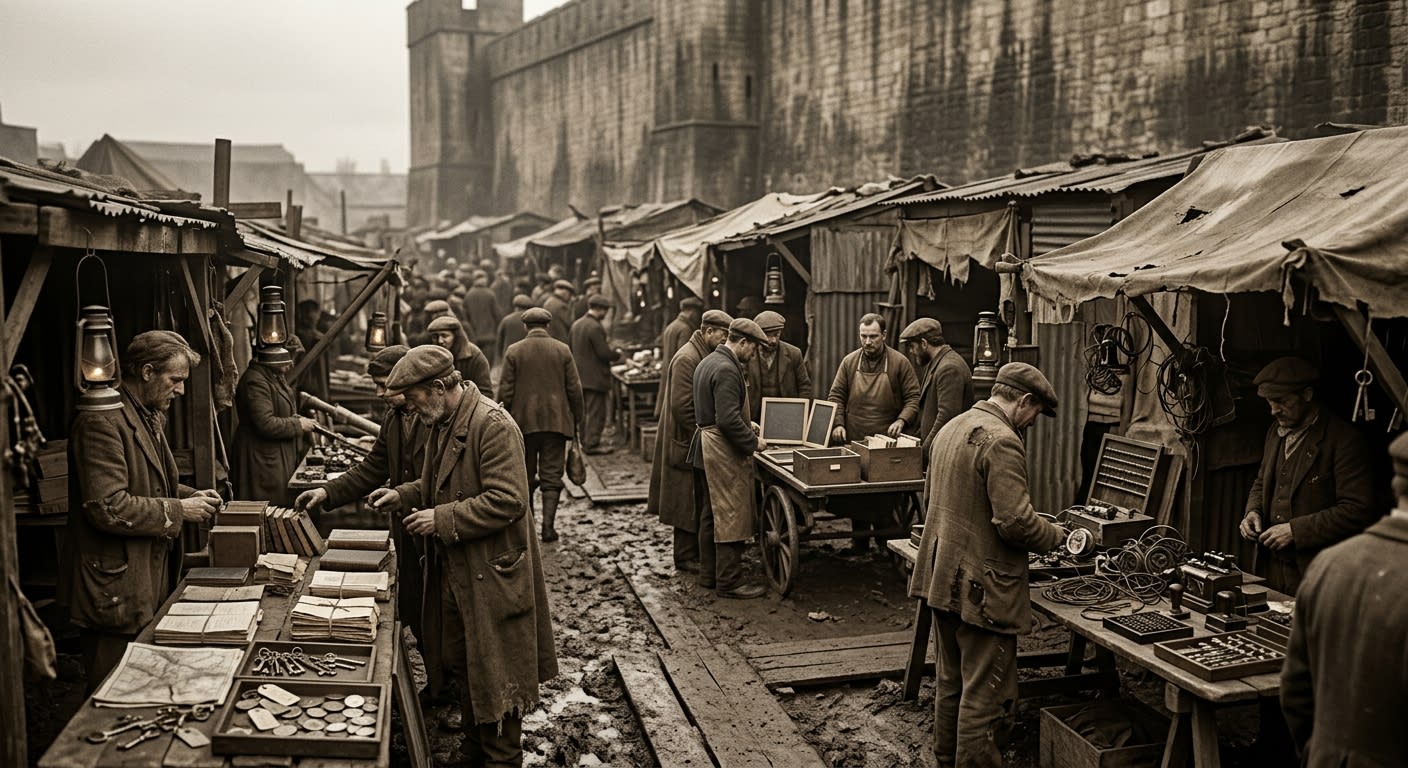
By A.S. 199, when the first sealed Anomoly Week forced the gates shut and dead names began appearing with the confidence of men invited to dinner, the Market learned its true craft. A dead name is useless if fully dead. A living name is expensive and dangerous. The valuable name is warm: recently cleared, recently buried, recently misfiled, recently transferred to Dead Pending, recently corrected by a clerk whose hand can still be imitated before the ink habit changes.
Warmth is everything.
A grave-name begins as a discrepancy. A pilgrim dies of canal fever before clearance. A detainee is expelled under wrong route mark and disappears under city debt. A corpse is sent to the outer pits before the Counting Hall resolves the string. A name appears on a wall roster after the body has been carted away. A second copy survives in the Office while Records copy goes under seal. Each case creates a little shelf of usable uncertainty. The Market reaches for the shelf.
The old gravefields supplied the first inventory. Cloister corpse-cart duty, assigned as clerical debt, placed the desperate within sight of death rolls. Men carrying bodies learned which tags were smudged, which prayers were abbreviated, which pits received strangers, which matron drank after fever nights, which Outer Watch sergeant sold viewing time at the corpse wicket. The righteous reader will now demand punishment. The administrator will ask why corpse-cart workers were hungry enough to sell names by moonlight. The Bureau, preferring elegance, punishes the worker and invoices the moon.
An A.S. 199 civic petition described the Grave-Name traffic as “grave robbery of a sentimental character.”
Corrected. No sentiment has been detected. The trade concerns identity residue, route clearance, death notation, and marketable uncertainty. Sentiment is what families bring when they arrive too late to purchase the correct corpse.
#On the Goods Sold After the Offices Close
The Market sells pasts in parts. Whole pasts are too expensive and rarely convincing. A buyer may purchase a death notice with parish seal, a bead fragment tied to a recognised station, a route correction slip with the lower half torn away, a sponsor-seal impression lifted from warmed wax, a copied intake number, a dorm berth mark, a clearance queue position, a false cousin, a true corpse, an untrue witness, or the finest commodity of all: a silence that arrives on time.
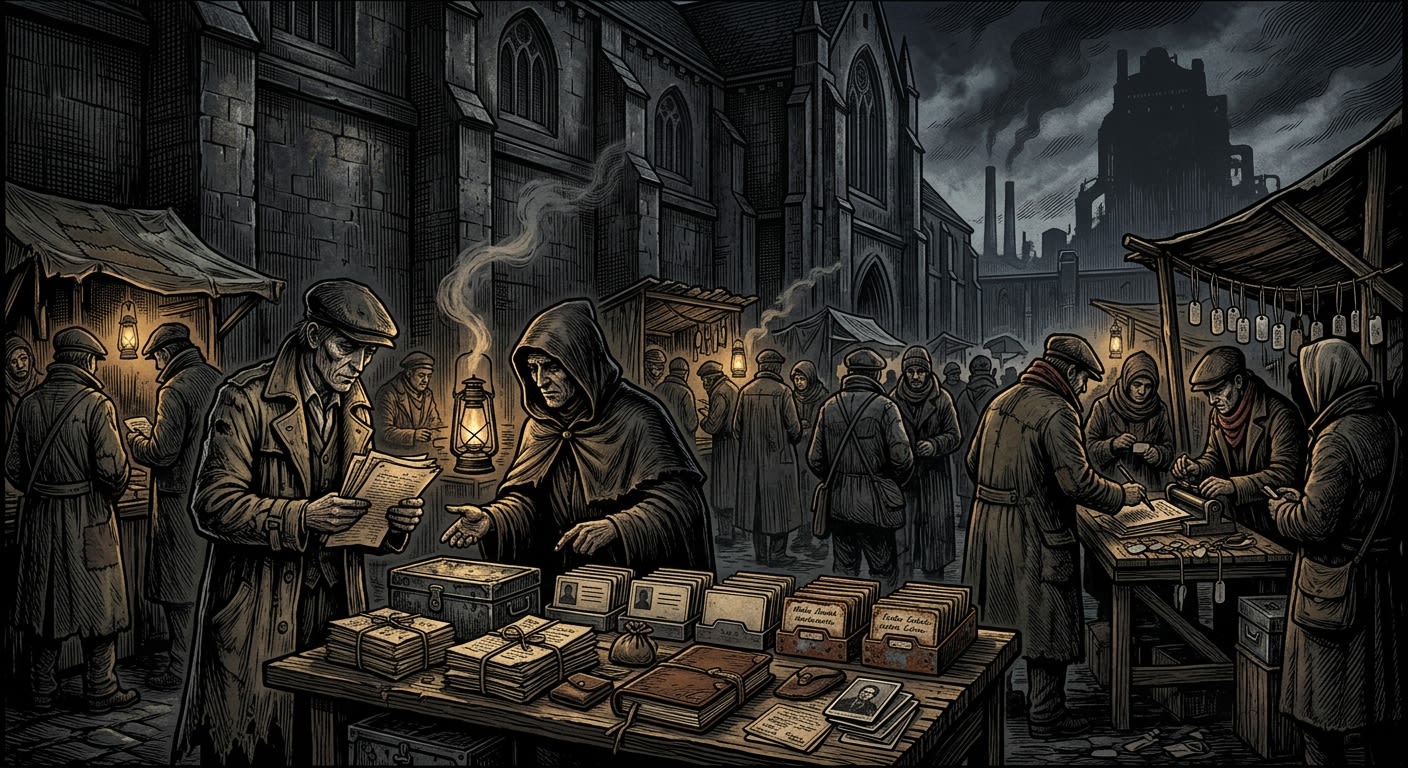
The vendors organise goods by risk rather than by type. Low-risk goods include smudged station slips, old pilgrim tags, secondary witness statements, rain-damaged route fragments, and dead-name charms sold to fools who mistake superstition for paperwork. Middle-risk goods include sponsor scraps, Dorm Row transfer tokens, salt-wax bead sleeves, and letters from families too far away to contradict. High-risk goods include copied Vault index leaves, grey-case numbers, active clearance marks, and living dead names still moving inside Cloister procedure.
A man fleeing debt buys a dry name and becomes a dead pilgrim's cousin, legally dull enough to escape interest. A deserter buys a route fragment and becomes a pilgrim delayed by fever, which is safer than a soldier delayed by cowardice. A widow buys her husband's own name back after the Office amends him into another family. A child too young to understand the bargain is given a cleared orphan tag and walked toward the city at dusk. If the tag holds, she becomes employable. If it fails, she returns to the gate as fraud. Mercy will then express regret with both hands open and neither hand empty.
The Market also sells absence. A copied name can be removed from a broker's slate for coin. A bad witness can fail to arrive. A page can remain missing in the Office long enough for a sponsor to cross Strasbourg. A corpse can be buried under a wrong tag and create a hole in an investigation. Absence is dear because it must be maintained. Presence performs itself.
The rarest goods are matched sets. Name, string, witness, route, and death mark in tolerable agreement. Brokers call such packages clean coffins, because the buyer enters one record and emerges from another with less smell than usual. A clean coffin requires at least three offices to have erred in compatible directions, or one office to have erred with talent. The price can buy a cart, a berth, a winter of bread, or a magistrate's nephew for an afternoon, depending on the nephew.
Matched sets are dangerous because they create stories that answer simple questions. Where were you born? Here is parish. Where did you walk? Here is route. Who saw you? Here is witness. Why did the old name die? Here is pit tag. Simplicity seduces junior clerks. Senior clerks prefer complication because complication leaves room to survive correction. A buyer with too clean a past attracts scrutiny from men who know how dirty life should look.
#On Brokers, Runners, and the Ninth Count
The Grave-Name Market has no guild, because guilds require pride, paperwork, and old men who enjoy quarrelling near candles. It has brokers. The brokers call themselves cousins, aunties, bead-men, pit-readers, sponsor uncles, correction widows, and once, with fatal theatricality, Resurrection Factors. That title lasted six days. Purity dislikes competition in resurrection.
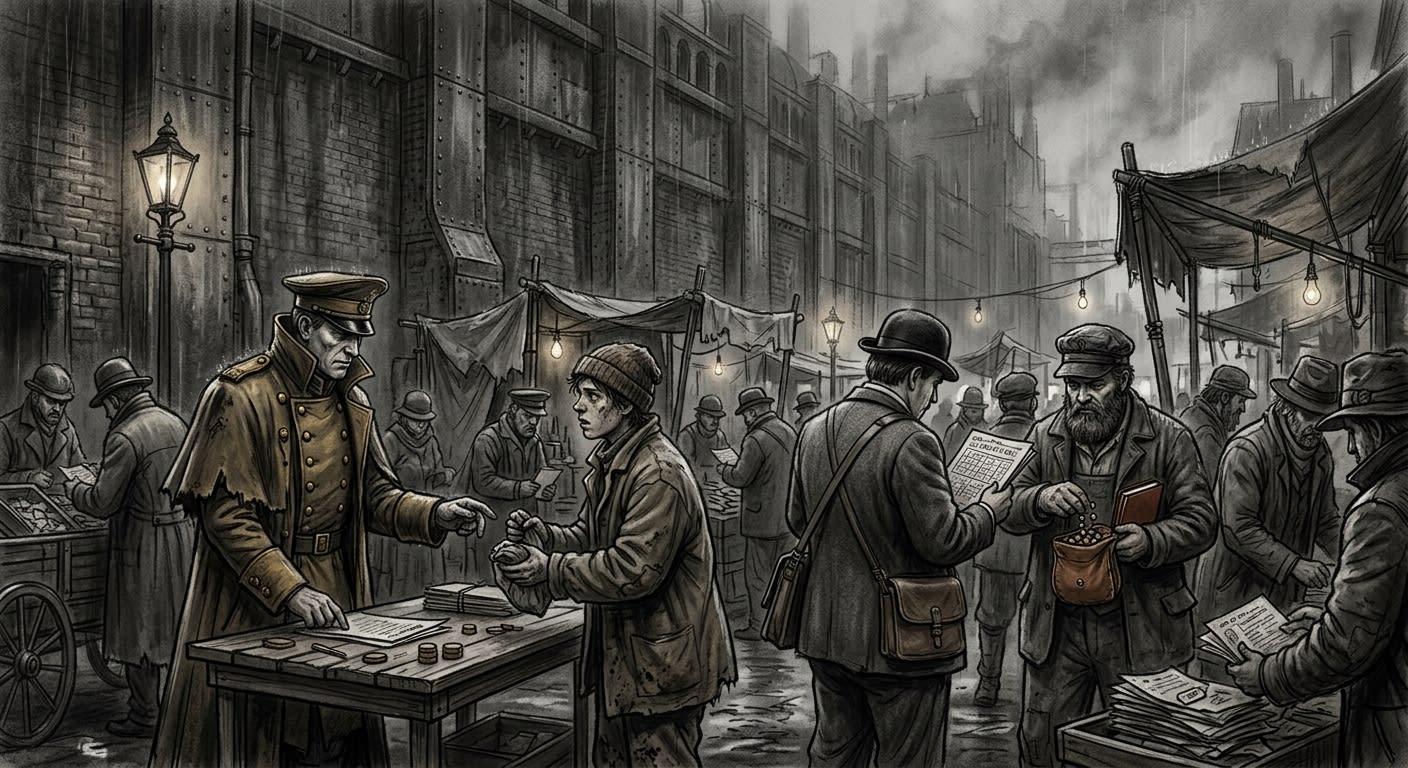
The Ninth Count tavern anchors the trade. Its front room sells beer, broth, fried offal, counterfeit piety, and advice of the kind that sends men to prison by the short road. Its back room, reached through a pantry where onions hang like censers from an unlicensed altar, hosts price talks when rain makes outdoor exchange too wet for ink. The proprietor, Sella Vorn (Unregistered), has been arrested four times, fined twice, absolved once by clerical error, and commended by the municipal watch for maintaining order during a knife fight she arranged badly enough to require public gratitude.
Runners do the carrying. Children are favoured, since children pass through pity's blind places and under tables without theology intervening. A runner may carry a bead in the mouth, a slip behind the ear, a sponsor mark under a fingernail, a case number sung as nonsense, or a dead name split across three errands so no single capture yields a whole person. The good runners learn to forget after payment. The better runners learn to remember what forgetting costs.
Former Cloister workers command premium fees. A dismissed copyist knows forms. A fired dorm matron knows hunger patterns. A corpse-cart man knows tags. A penance prompter knows which confessions contain useful lies. Outer Watch runners know gate timing. Even an honest clerk has value, since honest clerks are predictable and prediction is a kind of key.
The Sponsor-Seal Brokers despise the Market in public and feed it in practice. Their own trade rests on lawful sponsorship; the Market undercuts them with scavenged sponsorship, partial sponsorship, anticipated sponsorship, counterfeit sponsorship, and that especially offensive article, moral sponsorship, in which a broker swears that the buyer is the sort of person a respectable patron would have sponsored if the respectable patron had not been detained by conscience, distance, or lack of existence. The Cloister has condemned moral sponsorship twice. Sales rose both times.
Brokers keep their own rankings. Pit-readers stand low: useful, dirty, replaceable. Copy-memory men stand higher until drink loosens them. Sponsor-runners stand higher still, because one stolen countermark can season twenty lies. The top rank belongs to the Undertakers of Continuance (Unregistered), a grand title for four or five specialists who can take a buyer from old name to new name through grave, string, witness, and gate without requiring the buyer to understand the theology of his own fraud. They dress plainly. They speak softly. They charge like relic dealers with sick children.
There is no king of the Market. Kings invite beheading. The Market uses conveners: persons trusted to gather sellers, settle price quarrels, punish false stock, and disappear before any title hardens. In A.S. 201 the most active convener is believed to be Aunt Pell (Unregistered), who sells boiled onions outside the Ninth Count and has never once been seen writing. This means she is illiterate, careful, or employing half the copyists in the south spine. I decline to flatter her with certainty.
#On the Bead Vault Index
The Market wants the Bead Vault index more than gold. Gold buys supper and knives. The index buys pasts. With the right case number, a broker can find a dead claimant whose string still lies in grey disposition, a pilgrim route clean enough to wear, a sponsor challenge that can be redirected, or a counterfeit string improved by official handling until fraud and evidence have acquired the same smell.
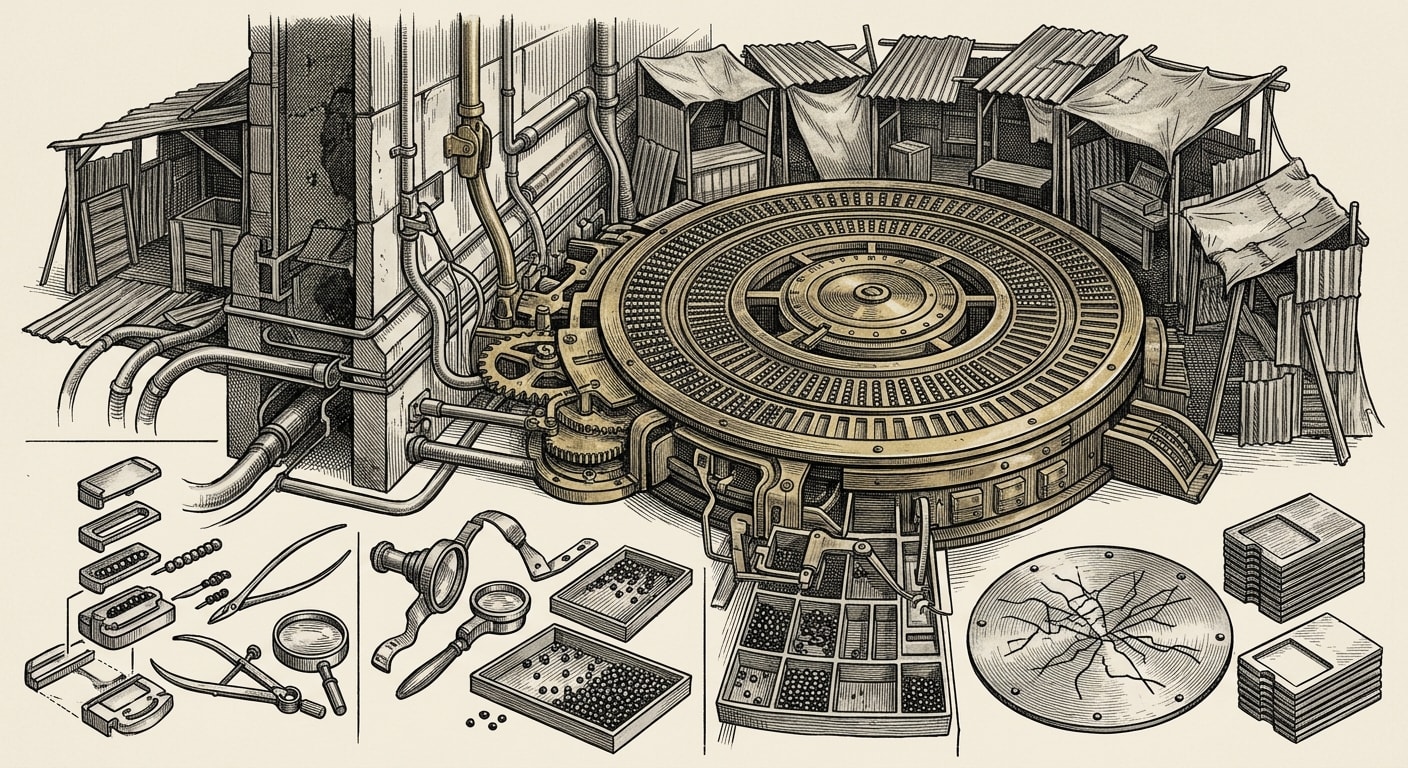
The A.S. 200 index-fragment scandal proved what sensible men already suspected: some portion of the Vault's shelf knowledge had crossed the wall. The fragment did not contain full cases. Full cases would have started a massacre and, worse, an interoffice meeting. It contained enough: cabinet family, intake quarter, route class, disposition colour, and two names marked Dead Pending beside strings that had continued to click under salt-wax. The Market fought over copies for three nights. By morning, three men were dead, one woman had purchased a husband's return in the wrong body, and Archivist Keth had changed shelf marks so thoroughly that half the stolen fragment became a recipe for doom.
A.S. 200 INDEX-FRAGMENT SCANDAL — SEALED NOTE Recovered scrap contained █████ case families, █ route marks, and one lower-cabinet sign. Broker called Moth-Eye sold three readings before capture. First reading produced a valid clearance. Second produced a corpse summons. Third produced ███████████████████████ from beneath the buyer's tongue. Keth ordered all grey cases reweighted.
Keth's retaliation was beautiful, and I record that word with professional respect. She rotated shelf marks, split bone keys, planted false index leaves, and issued three pages of cleaning-rag inventory in a cipher attractive enough to be stolen. The Market bought the rag list twice. One broker attempted to sell identity passage under the name Vinegar Cloth, deceased. The buyer escaped the Cloister, reached the Clearance Gate, and was assigned laundry duty under his purchased name. Records classified the matter as contained.
#On Anomoly Weeks and Hot Names
During Anomoly Weeks, the Grave-Name Market should close. Every regulation, superstition, survival instinct, gate order, and grandmother with sense says so. It does not close. It becomes expensive.
Hot names appear during sealed weeks: names that answer from two places, names seen on rosters before the hand writes them, names carried by a sleeping detainee and a voice outside the Clearance Gate, names that emerge from basin water in strokes of silt, names that arrive on bead strings one count ahead of the living. A cold name lets a buyer pretend to be dead. A hot name may decide the buyer has always been dead and is merely late to the office.
The Market treats hot names with ritual caution. They are spoken outdoors, under rain if available. The seller stands on ash, the buyer on brick, the witness on neither. Payment is made in food, never coin, because coin carries faces and faces attract claims. No one writes the name until after dawn. No one repeats the childhood name attached to it. If the name clicks when heard, the bargain ends and all three parties spit vinegar into the canal. This does not always help. It gives them something to do.
The Quiet Thread condemns hot-name trade as profanation, then uses the Market to move warnings, beads, and doctrine. Heretics are purest when accusing competitors. The Thread teaches that original count precedes Bureau count. The Market replies, in its vulgar way, that original count can be rented if no one asks for provenance. The dispute has produced two beatings, one stabbing, and a joint silence when Purity patrols pass too close.
During the A.S. 200 sealed week, a woman bought the name of her dead sister to escape clerical debt. At dawn her debt file vanished. Her sister's dorm berth filled with canal water. The woman reached the city and worked three days in a linen shop before every needle in the room pointed toward her mouth. She returned voluntarily to the Cloister. This is recorded as moral improvement. It was terror with shoes on.
The most expensive hot names are those attached to cleared persons who have already left the compound. A buyer taking such a name does not merely wear the dead. He competes with the released. Two persons moving under one clearance cause the paperwork to itch. The Gate may recall one. The Office may summon both. The Vault may decide the string belongs to neither and count toward a third. Market doctrine says never purchase a cleared name unless the cleared person is buried, distant, or too poor to hire retrieval. Market practice says poverty makes all cautions negotiable.
Anomoly Week also breeds counterfeit miracles. Brokers whisper that a hot name can restore a lost child, absolve a failed route, reverse a debt, turn an expulsion into a clearance, or call a dead spouse to the fence. These claims are heretical, fraudulent, and occasionally close enough to truth to do damage. The Bureau condemns them with special fury because false miracles compete with licensed despair.
#On Prior-Scribe Vale and the Policy of Looking Sideways
Prior-Scribe Vale knows the Market exists. The sentence insults him if phrased otherwise. Vale knows the price of warm names, the smell of Ninth Count broth, the Outer Watch men who accept bread to glance away, the Sponsor-Seal Brokers who sell lawful seals by day and rumours by dusk, the Missing Pages Ring (Unregistered)'s routes into the Office, and the clerks whose sleeves contain too much folded paper. He knows because ignorance at his rank requires either innocence or incompetence. Vale possesses neither.
He tolerates portions of the Market for three reasons, all ugly enough to be true. First, the Market vents pressure. A detainee who purchases illegal hope may delay legal riot. Second, the Market reveals demand. What criminals sell, administrators can later tax, ban, imitate, or call mercy. Third, the Market draws thieves toward surfaces Vale can watch. A clean Cloister would hide its corruption in offices. The Grave-Name Market drags corruption into mud, where boots leave prints.
Cloister memoranda describe the Market as an external criminal parasite upon an otherwise sound reconciliation system.
Clarified. The Market feeds on Cloister procedure, Cloister delay, Cloister death handling, Cloister paper scarcity, and Cloister ambiguity. If this is parasitism, the host has opened a dining hall and posted prices.
Vale's restraint is selective. Theft from the Vault brings cordon. False sponsor seals bring confiscation and public sermon. Warm-name sale involving a child brings quiet seizure. A broker who embarrasses the Office is broken by procedure: old fines revived, dorm debts assigned, witness statements corrected, gate access narrowed, family names suspended. Vale need not send men with clubs when forms have knees.
Jossa Rill hates the Market because it interferes with intake classification. A person who enters her yard wearing a purchased past disrupts lane discipline. Yellow tags become blue. Fever risks acquire sponsors. Expelled bodies return with better names. Rill's runners scrape market signs from the fence and sometimes buy them back before burning them, a practice she denies with the serene contempt of a woman whose denials carry chalk dust.
Rill's countermeasure is brutal simplicity: she makes bodies answer before documents. Stand. Open mouth. Show palms. Name route. Name mother. Name last hunger. Name the person who would mourn you if the Cloister mislaid your death. Forgers prepare for parish, sponsor, station, and bead count; they rarely prepare for grief in the correct dialect. Rill catches more market names by asking about soup than Records catches by checking seals. The fact has not improved Records' appetite for humility.
The Outer Watch Post hates the Market with less purity and more appetite. Gate men accept socks, broth, candle ends, and information. A watchman may not sell a chain key; the price would be high enough to attract sin with witnesses. He may sell the hour when the sergeant counts keys by touch. He may sell notice of a corpse wicket opening. He may sell the fact that a runner was called by childhood name last week and has not slept since. Small goods. Strong poison.
#On Buyers
The buyers come in four kinds: the desperate, the guilty, the bereaved, and the clever. The desperate are most common and least profitable. They need clearance, bread, shelter, a name that matches a string, a dead child made legal for burial, a living spouse made dead for debt, a wrong route made survivable. They pay in coin, shoes, hair, labour, blankets, future testimony, or the right to find them later.
The guilty pay better. Deserters, thieves, escaped debtors, illicit lovers, failed sponsors, dismissed clerks, men fleeing Purity's soft colour, women whose families have amended them into silence. They want names that protect without asking too many questions. They prefer dry names. Hot names frighten them. This is their last scrap of wisdom.
The bereaved are dangerous. They do not want new lives. They want old lives returned to the proper line. A husband misfiled as stranger. A child buried under intake number. A sister cleared in one ledger and dead in another. The Market sells them scraps, because grief buys even when it knows it is being robbed. I despise this; surprise is not among the expenses.
The clever are worst. They come to purchase jurisdiction. A patron wants a rival family tied to a dead claimant. A broker wants proof that a sponsor seal touched a condemned file. A clerk wants to remove his own handwriting from a page. A Quiet Thread adept wants a name that drifted before filing. A Purity informant wants bait with enough scent to draw three sellers. Clever buyers leave the Market cleaner than they entered. Somebody else pays for the cleanliness.
#On My Inspection in the Rubble Lots
I inspected the Grave-Name Market at dusk with two Doctrine clerks, one Purity listener, and an Outer Watch sergeant who lied about recognising no one. Rain had turned ash-silt into grey paste. The Ninth Count's sign swung on one chain, naming the tavern by absence of its first eight numbers. A woman sold candle stubs beside a pit map. A child offered me a bead and said it belonged to a saint. I asked which saint. He said whichever one I needed. Admirable sales training. Deplorable catechism.
The market changed shape as we walked. Not fled. Fleeing admits guilt and loses merchandise. It corrected itself. A broker became a broth seller by placing a ladle in his hand. A corpse-cart man became a mourner by lowering his head. Two runners began playing knucklebones over a folded slip. The tavern door closed with the lazy timing of innocence rehearsed often enough to pass in weak light.
We seized fourteen slips, six bead fragments, two sponsor impressions, one copied death notice, three false cousin attestations, a packet of hair tied by route colour, and a fragment of ledger written in a hand later matched to no living clerk. The Purity listener wished to burn the tavern. The Doctrine clerks wished to catalogue the seizure. The Outer Watch sergeant wished to leave before someone named his mother. I wished for better boots.
At the edge of the refuse canal, a man approached with a wrapped string and offered to sell me Valerius Drax, deceased, cleared, and under no outstanding obligation. The clerks went white. The Purity listener reached for his knife. I asked the price. The man named a sum insultingly low. I had him arrested for valuation error before heresy, which proves the Bureau's priorities remain sound.
The arrest scattered the market by inches. A woman lifted her candle box and became old. A child swallowed something and became bored. Sella Vorn stepped into her tavern doorway and began shouting about unpaid beer, thereby restoring public morality to the scene. The Purity listener asked permission to search every mouth in the lot. I refused. One does not inspect a city by letting Purity turn it into a bowl of teeth. One samples, frightens, records, and leaves enough vermin alive to lead one back to the nest.
INSPECTION SEIZURE — RUBBLE LOTS, A.S. 201 Item: string offered under name “Valerius Drax.” Count: ███ beads on first handling; ███ on second. Attached slip: cleared through west gate, date tomorrow. Disposition: sealed under Doctrine custody. Seller statement before silence: “You already bought it once.”
#On the Present Trade
As of A.S. 201, the Grave-Name Market is suppressed, denied, watched, raided, taxed by bribe, fed by delay, and more necessary to the Cloister's daily peace than any official will admit within reach of clean ink. Five projected Anomoly Weeks will raise prices. The post-A.S. 198 backlog keeps supply warm. The Bead Vault's lower cabinets remain crowded. The Supplementary Entry Office loses pages with disciplined regularity. Sponsor-Seal Brokers complain about criminal competition while purchasing rumours in bulk. The Outer Watch wants authority, boots, broth, and a rule that stays true after midnight. It will receive armbands.
The proper solution is obvious and will never be implemented: reduce delay, feed detainees, secure death handling, pay guards enough to make bribery expensive, staff the Office, protect honest witnesses, burn false sponsors, and stop pretending that bead drift is a clerical mood. Such measures would starve the Market. They would also require government. We prefer raids. Raids are cheaper in thought.
Night gathers there with bureaucratic tact. The Cloister wall turns black. The refuse canal exhales. The Ninth Count lights one lamp too few. A runner crosses the rubble lot with a bead under his tongue. In the outer gravefield, tags knock softly against stakes. Behind the wall, a case clicks in the Vault and Keth does not turn her head. At a mud table under a canvas patched with chapel cloth, a woman asks for a name clean enough to bury and dirty enough to live in.