
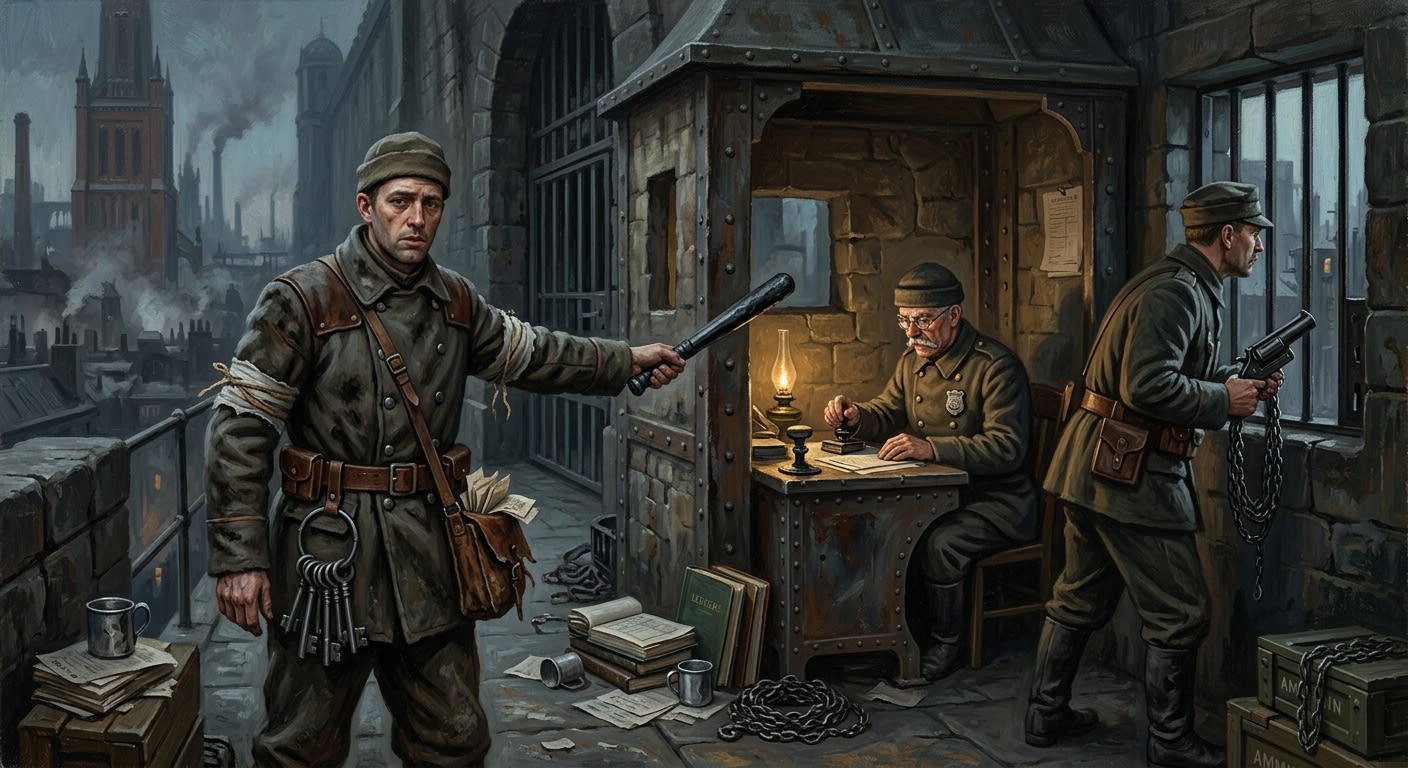
#On the Post at the Wall
The Outer Watch Post of the Cloister of Miscounted Beads is a squat enforcement house built against the low bone-lime wall, where tar, metal, wet rope, chain oil, ash armbands, and municipal resentment combine into a smell so honest that the clerks avoid it. This alone recommends the place to my attention.
It controls the Intake Gate and Clearance Gate, patrols the perimeter, holds the chain keys during ordinary hours, and pretends to be a municipal militia detachment while obeying the Cloister Chapter whenever obedience has better paperwork. The distinction is dear to city magistrates. It is less dear to the men with cudgels, whose practical theology fits on the back of a ration chit: the signer commands the gate.
The Post is the Cloister’s outer eyelid. It opens for pilgrims, closes on detainees, twitches during anomalies, and occasionally develops an infection requiring Purity’s lancet. Its men stand where civic authority becomes ecclesiastical procedure: one boot in Strasbourg mud, one boot on Cloister brick, both boots dirty and admirably informed.
#On Tar and Metal
The Post itself is not large. Two rooms, a covered key rack, a rain-blackened gate desk, a cudgel stand, three holding hooks, a brazier, a slate for night entries, and a roof gutter that leaks directly onto the bench reserved for petitioners. The leak has been repaired four times in the files and never once in the ceiling. A minor marvel of Records.
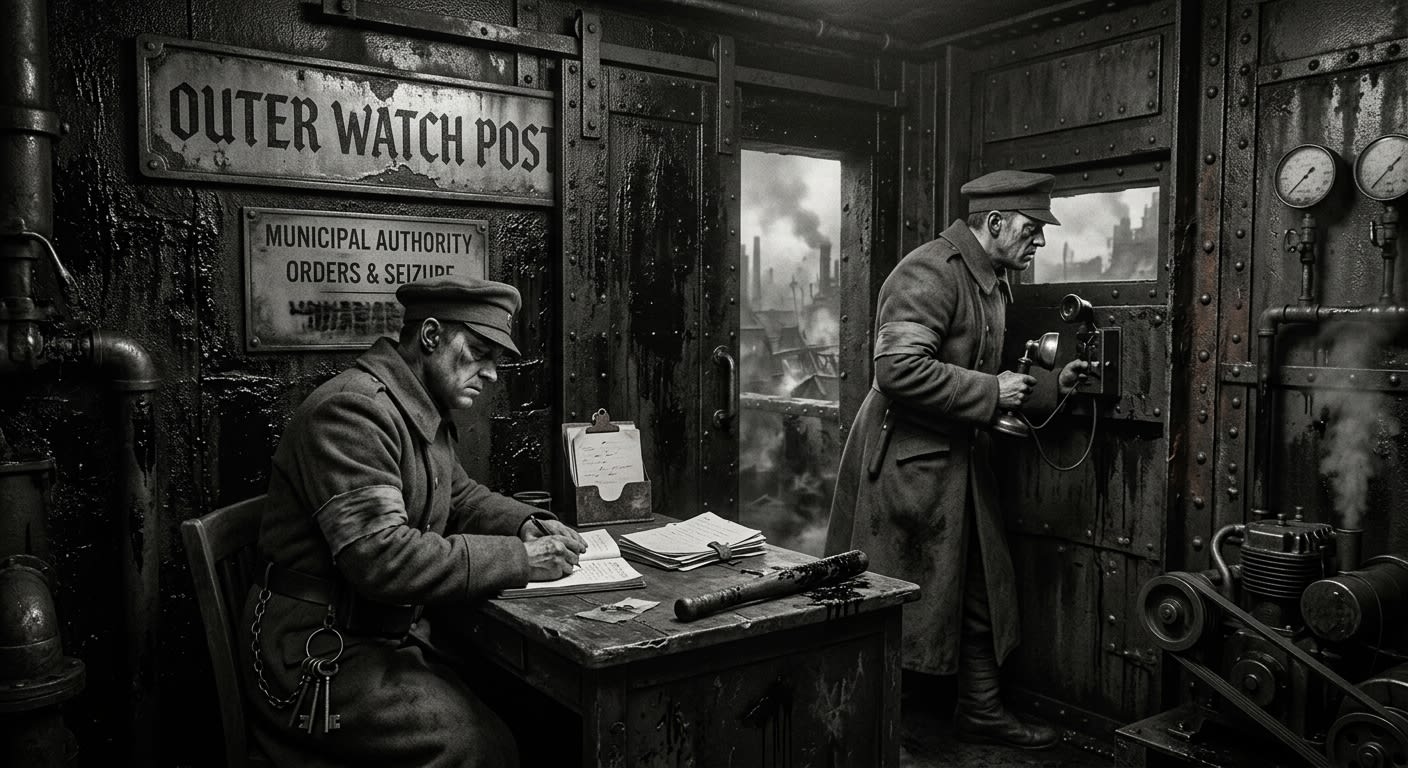
The eastern room faces the compound and watches the Lost Procession Yard. From there, runners can see chalk lanes, fever cloth, Rill’s Porch, the low bell, and the south awning where commerce hides beneath weather. The western room faces the pilgrim road and the cityward rubble lots, where families, brokers, expelled souls, and persons with insufficiently boring intentions gather by dusk. Between them hangs the key bar: Intake, Clearance, fever sally, corpse wicket, ash canal hatch, outer chain, inner chain, and the little black key no watchman admits recognizing.
An A.S. 187 municipal inventory described the Post as “a civic guard station attached for public convenience.”
Corrected. The Post is an enforcement hinge attached for administrative appetite. Public convenience occurs there accidentally, and usually by bribery.
The walls are smoked brick. Iron plates reinforce the gateward side at shoulder height, where crowds press hardest during rain and anomaly rumour. Tar seals the lower joints against canal damp and, by local superstition, against dead names crawling under doors. The Bureau of Records calls the tar a maintenance measure. The watchmen call it black prayer and apply it thicker after every week in which the gates have answered knocks from people already inside.
#On the Ash Armbands
Outer-watch uniforms are a study in incomplete belonging. Municipal coat, Cloister armband, Records pass-token, Pilgrimage queue whistle, Purity referral cord, and boots purchased by the wearer because no authority wishes to fund soles that stand in blame. The ash armband marks jurisdiction inside the wall. It is grey, easily soiled, difficult to forge badly, and difficult to respect too much.
A watchman’s kit is plain: tarred baton, gate-hook, whistle, chalk stub, wrist-tag knife, rope loop, waxed arrest slip, and a small slate for names too unstable to trust to memory. Senior runners carry the iron half-key that opens the Intake Gate when paired with the clerk’s chain key. No single hand opens the main gate by design. In practice, design must sometimes wait while two men argue about breakfast.
The Post’s common ranks are outer-watch runner, gate sergeant, chain-keeper, night cordon man, discrepancy seizer, and ash corporal. The titles sound martial because every petty office dreams of a parade. Most of the work is dragging, standing, refusing, counting heads, receiving insults, and deciding whether a pilgrim has fainted from exhaustion, fever, fraud, or Providence’s excellent sense of timing.
#On Gate Control
The Intake Gate opens toward the Queue Road and the western approach. The Clearance Gate faces Strasbourg proper, which likes cleared pilgrims better in theory than in doorways. Both gates are chain-hung, iron-braced, and old enough to have acquired personalities from men who spend too many wet nights listening to metal contract.
At Intake, the Post holds crowds outside until Jossa Rill sends for bodies. Processions are divided before entry: coherent columns, broken columns, fever suspects, sponsor-marked families, leaderless groups, child clusters, and the floating debris of pilgrimage — men who have attached themselves to the rear of sanctity because starvation walks slower in company. A runner grips collar, wrist, sleeve, pack strap, or beard according to what presents itself. Dignity receives no special handle.
At Clearance, the Post performs the uglier courtesy of release. A cleared person may be beloved by Records and unwanted by the city. The watchman checks seal, wrist, name, face, and whether the released soul understands which side of the wall now owns his hunger. Some kiss the gate. Some spit. Some turn back within an hour claiming the world outside has miscounted them. Those cases are sent to the Counting Hall if calm, to the Dorm Rows if inconvenient, and to Purity if they know too much of where they went.
#On Seizure for Count Discrepancy
The Post seizes for count discrepancy before the clerks do, which is why clerks resent it and rely on it with the tenderness parasites reserve for skin. A watch runner may pull a pilgrim from the outer line if his bead string clicks out of turn, if his route slate bears scraped wax, if two names answer from one mouth, if his leader denies him too quickly, or if his shadow falls toward the gate while the sun stands behind him. The last criterion is unofficial and has saved three lives, none of them grateful.
The seizure slip contains four boxes: name, claimed name, discrepancy, witness. The second box is often longer than the first. During crowded hours, runners write descriptions instead: scar over lip, green child, monk with wrong sandals, woman carrying aunt, man who laughs at red cord. Such language offends Records, which prefers names. The Post prefers catching bodies while names are still deciding.
Seized persons are held at the three wall hooks until a clerk arrives, unless Rill’s runner claims them first. The hooks are iron waiting points, whatever gentler inventors call them. The difference is architectural, not moral. Children are not hooked unless carrying adult papers. Nobles are not hooked unless no one has noticed. Priests are hooked facing inward so the crowd cannot see the expression the cloth makes across their mouths.
#On Patrol and Perimeter
Perimeter patrol is dull until it is fatal, which makes it proper Bureau work. The wall is low by fortress standards, high by hungry standards, and patched with brick, bone-lime mortar, old rails, and sections of fence purchased after the A.S. 187 revision with funds intended for dorm ventilation. One applauds economy wherever it steals from lungs.
Patrols move clockwise in pairs at first bell, third bell, dusk, and after snuff. The Ash Canal side is worst: damp, refuse-sweet, crowded with rubble lots, broker shadows, expelled sleepers, and rats fattened on correction. The gravefield side is quieter. Sensible watchmen distrust it more.
They look for wall chalk, loose mortar, tunnel scratching, counterfeit clearance knots, children pushed under the corpse wicket, bead strings tied to drainage grilles, Quiet Thread marks, sponsor-broker signals, and names written in ash at ankle height. Ordinary criminals climb. Desperate mothers dig. Heretics leave signs. The anomaly knocks.
PERIMETER REPORT — ASH CANAL WALK, A.S. 200 Night cordon heard three knocks from fever sally. Sally remained barred from inside. Voice outside requested entry under name ██████████. Same name recorded in Row Five, asleep under matron watch. Runner opened view-slit. Runner’s statement after recovery: “It had my armband on.” Disposition sealed; armband burned; gate retarred.
#On Anomaly Cordon
During anomaly weeks the Post ceases pretending to guard the Cloister from Strasbourg and begins guarding Strasbourg from the Cloister. Gates lock. Chains are doubled. The corpse wicket is salted. The Ash Canal hatch is nailed and blessed by whichever chaplain can still write his name without listening to the drains. Food runs thin. The city magistrates send inquiries from a safe distance and receive answers full of nouns.
Outer-watch men do not enjoy anomaly cordon. Soldiers at Bastion-Brest at least know which direction the enemy prefers. At the Cloister, the threat may arrive as a returning clearance slip, a child who names the next hour, a bead bouncing against the inside of a locked gate, or a voice outside speaking from a throat already counted in the Vault.
The last rule is recent. It has a history. The history is sealed because the Bureau has learned that some warnings become invitations when explained too well.
#On Vale, Rill, and the City
Prior-Scribe Vale holds the Chapter authority that makes the Post’s civic fiction useful. He issues gate suspension orders in prose so calm that even iron seems ashamed of its hinges. The watchmen dislike him, fear him, and obey him, the trinity by which most competent administrators are known.
Rill uses the Post as muscle, screen, and disposal. Her runners signal the gate sergeant with chalk taps: two for families, three for fever, crossed mark for red-lane seizure, flat palm for expulsion. The Post grumbles. Then the gate opens or closes. Rill’s Porch and the Post’s chain bar are the two hands of the same unlovely saint, one sorting bodies, one deciding which side of the wall receives the mistake.
The city magistrates resent the arrangement because the Clearance Gate spills corrected inconvenience into civic streets. Cleared vagrants sleep under market awnings. Expelled bodies beg near licensed shrines. Sponsor-broker violence travels outward after dusk. The magistrates complain that the Post answers to the Cloister. The Cloister replies that the Post is municipal. Both statements are true enough to be useless.
City petitions after the A.S. 198 intake surge claimed the Outer Watch “operates outside lawful municipal supervision.”
Clarified. The Outer Watch operates inside municipal supervision whenever the city provides wages, blame, burial, or boots. It operates under Cloister instruction whenever a gate must actually move.
#On Small Economies at the Chain
No gate remains innocent after its first queue. The Post has its economies: holding a family nearer the awning, delaying an expulsion until a cousin arrives, allowing a broker’s runner to whisper before seizure, ignoring one extra bundle, finding a lost child too quickly for the official search fee, finding one too slowly after payment fails. These are not grand corruptions. Grand corruption requires carpets. The Post works in mud.
Bribes come as candle ends, bread, shoe leather, copper, sealed broth, dry socks, and, in winter, glove rights. A watchman who accepts coin is either new or ambitious. Coin leaves traces. A pair of dry socks vanishes into virtue.
Yet the Post is less corrupt than the offices it guards. Call it geometry, not praise. A man visible at a gate has fewer hiding places than a clerk behind paper. The watchman steals under eyes. The clerk steals under procedure. One of these crimes leaves bruises; the other leaves minutes.
#On Drax’s Inspection
I inspected the Post in rain, which is the only honest weather for it. The gate sergeant saluted with a baton because his right hand held a chain and his left held the collar of a pilgrim claiming three mothers. Efficient fellow. I made note of him for future punishment or promotion, those being neighboring cupboards in the Bureau.
The key rack impressed me. Each key hung beneath a stamped tag, and each tag had been corrected at least twice. The corpse wicket key bore old wax from three seals; the ash canal hatch key smelled of vinegar; the Intake chain key had been worn smooth where thumbs had worried it during crowd pressure. Objects confess when men are too frightened to speak. Keys are particularly talkative.
A runner showed me the holding hooks and insisted they were rarely used. A man was attached to the middle hook while he said this. I admired the courage of the lie. The hooked man admired nothing, being gagged with his own route sash.
At dusk the Clearance Gate opened for seventeen corrected persons. Six went cityward. Four turned back and were struck away. Three waited for sponsors who did not come. Two were seized by city debt men before reaching the gutter. One laughed until the watchman hit him. One woman kissed the chain, then wiped her mouth as if the chain had tasted of her.
#On the Present Post
As of A.S. 201, the Outer Watch Post is undermanned, overused, underpaid, overblamed, and still more functional than several decorated offices in Strasbourg. The post-A.S. 198 intake surge has increased crowd pressure at Intake, expulsion traffic at Clearance, perimeter sleep camps along the Ash Canal, and broker signals on the south wall. Five anomaly weeks are projected. The tar stores are low. The armbands are fraying. The chains hold.
The Bureau of Records wants cleaner seizure slips. The Bureau of Pilgrimage wants quicker intake. The city wants fewer bodies at its threshold. Purity wants immediate notice of red-lane irregularities and the pleasure of arriving late with moral certainty. The Post wants boots, hot broth, and a rule that stays true after midnight.
At fourth bell the gate sergeant counts keys by touch. Intake. Clearance. Fever. Corpse. Canal. Outer. Inner. Black. He does not look at the wall when something scratches from the far side. He has been trained well, or frightened correctly. The chain settles in its bracket. Tar cools on the lower hinge. Beyond the gate, the road breathes against the Cloister like a mouth waiting for permission.
The Post does not grant permission. It sells delay in the shape of iron.
Phase 2a correction log: no unresolved links, date errors, bastion errors, or geography errors found.