
#On the Yard of Broken Processions
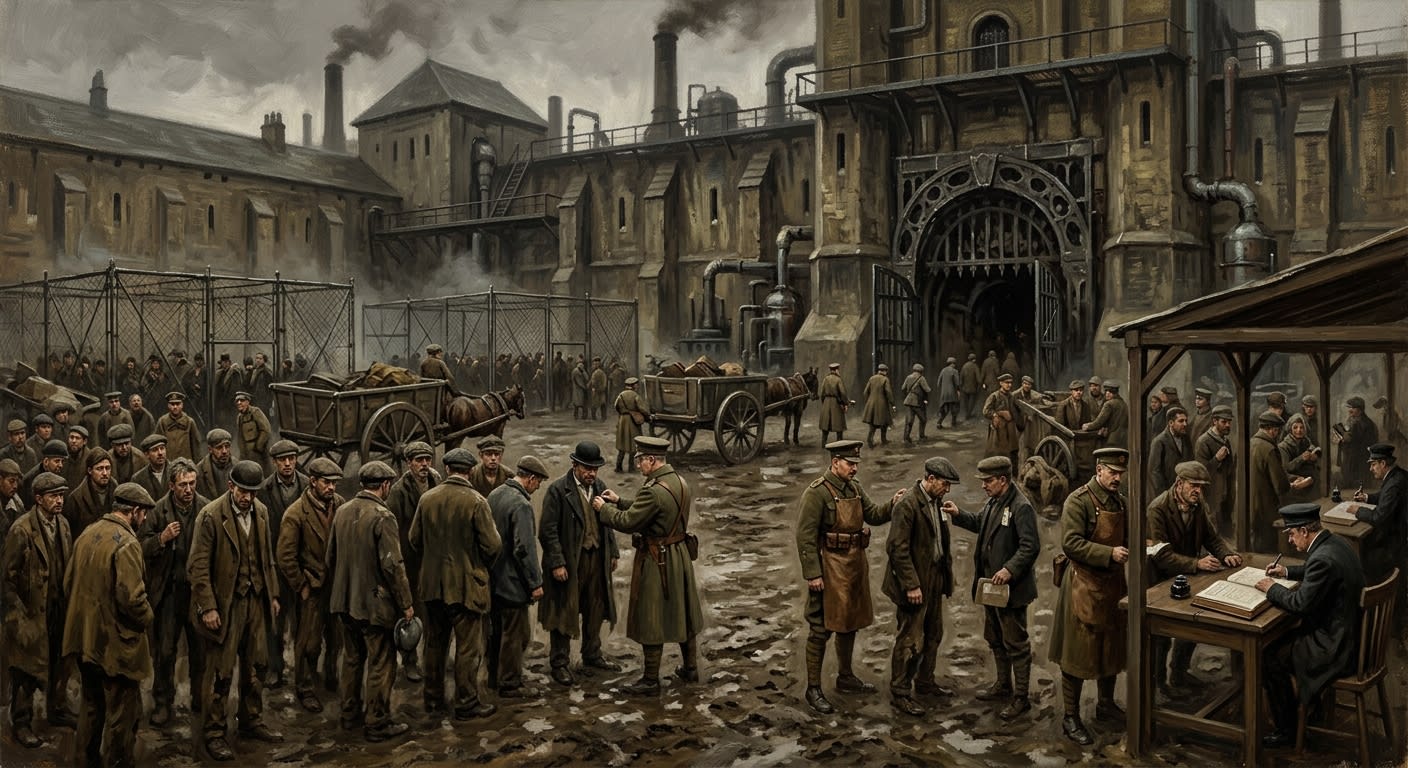
The Lost Procession Yard is the mouth of the Cloister of Miscounted Beads: an open court of packed earth, wet wool, shouted surnames, buckling knees, and pilgrim lines whose sacred coherence has failed within sight of Strasbourg. Here the road stops pretending that pilgrimage is a devotion and admits its office. It becomes intake.
The Yard lies just inside the Intake Gate, facing the western approach from the Queue Road and the waystation spur. Its surface is beaten clay mixed with straw, gravel, and a surprising quantity of tooth. Rain pools in the old hoof-hollows. Chalk lanes divide the arriving processions by origin, route colour, declared station, fever risk, sponsor mark, and degree of visible panic. A low bell hangs from the sorting post. It is rung for collapse, riot, plague cough, returned dead, and clerical impatience. These categories overlap.
A procession loses coherence in several approved ways. The leader dies. The route slate contradicts the bead strings. The rear third arrives before the front. The penitents have exchanged names too often to be sorted without knives. The road behind them, by reliable testimony and unreliable geography, is no longer the road by which they came. The Bureau of Pilgrimage calls this devotional disorder. The Yard calls it Tuesday.
#On Arrival
The first sound is wool. Wet cloaks scraping wet cloaks. Packs slumping from shoulders. Children crying through the cloth tied over their mouths against canal fever. Prayer beads clicking beneath sleeves because pilgrims are told not to count while awaiting intake and pilgrims are, as a class, incapable of obedience unless watched by someone with a stick.
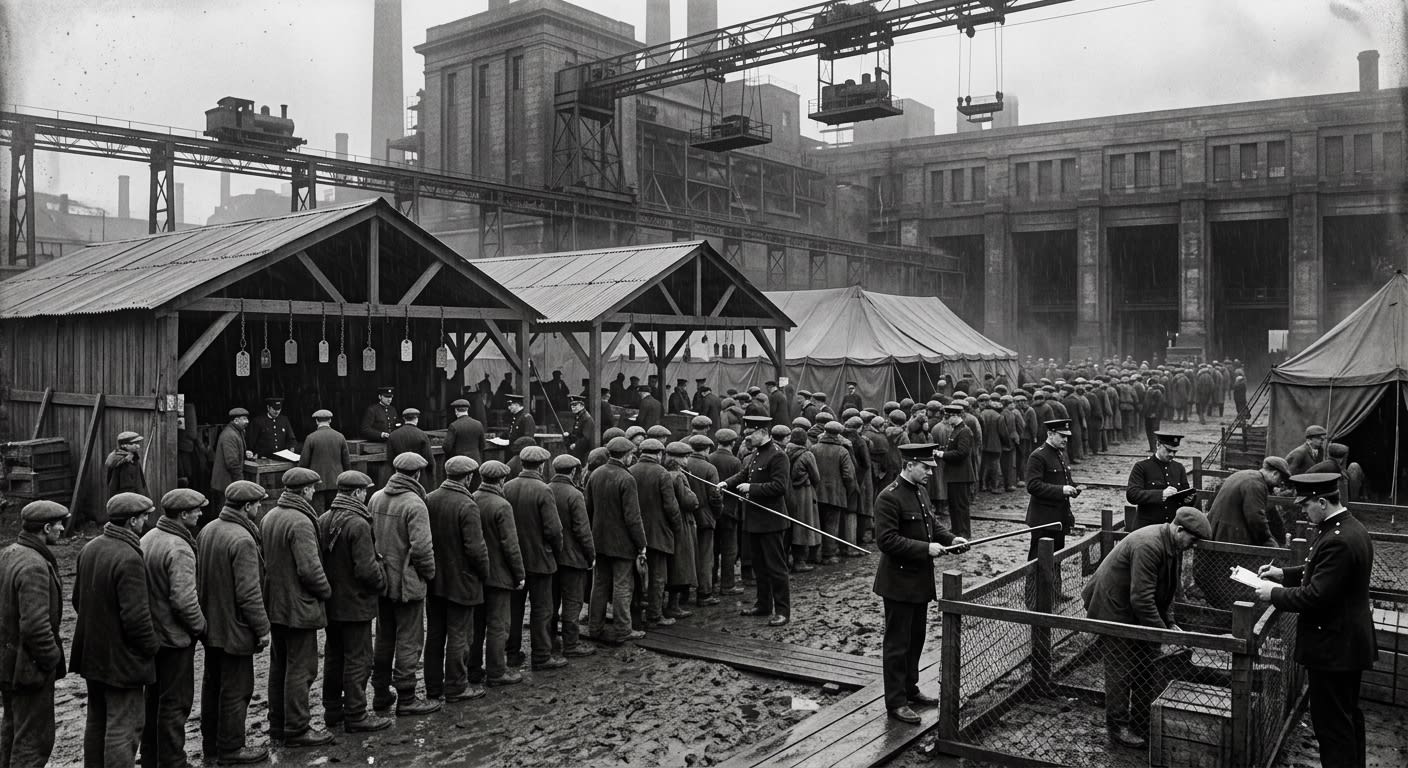
The second sound is names.
Names are shouted from the Intake Porch by clerks with slate-boards and lungs hardened by contempt. Parish names. Family names. Dead names. Names that answer twice. Names that no one claims until an Outer-Watch runner grips a pilgrim by the collar and discovers the man has been carrying a different identity under his tongue for three days. Those cases go to the red lane.
Each arriving body receives a chalk mark at the shoulder and a temporary tag at the wrist. White for ordinary miscount. Grey for illness. Blue for route contradiction. Yellow for sponsor interest. Black for suspected counterfeit string. Green for child unaccompanied by stable adult. Red for cases requiring Purity review. The tags are made of stiff card and tied with poor twine because mercy is never issued in durable materials.
A procession that remains coherent may pass in groups of twelve toward the Counting Hall. A procession that breaks is disassembled. Leaders are separated from followers. Children are counted twice. The dead are counted once, then again if they are warm. Packs are searched for duplicate strings, blank confession books, corpse-dust packets, and old route permits scraped clean for reuse.
#On Sorting
The Yard’s genius is reduction. A procession arrives as a story: three hundred souls from a hill parish, bound by oath, guarded by two chain handlers, singing a licensed road hymn, carrying eleven dead and a silver toe of Saint Odran (Unregistered). Within an hour it has become columns, tags, slips, fever marks, disputed sponsors, dorm requirements, and a small locked box containing the toe while the Bureau decides whether Odran ever possessed one.
Sorting tables stand beneath oilcloth awnings. At the first, names are spoken and matched to temporary slates. At the second, bead strings are inspected for obvious fraud. At the third, route leaders surrender march tallies. At the fourth, children are assigned to adult custody or removed from adult custody, depending upon which adult has the better paperwork. At the fifth, berth clerks mark the Dorm Rows allocations in grease-pencil. The sixth table is empty except during anomaly weeks. No one leans on it.
Stampedes begin at bottlenecks. A rumour of full dorms. A claim that sponsor marks expire at Vespers. A child dragged into the wrong lane. A bead string warming in someone’s fist. The Yard has channels cut into the clay to drain rain and blood alike toward the Ash Canal Walk. Records praised this as efficient drainage in A.S. 187. Records did not specify which fluid prompted the improvement.
#On Hidden Commerce
A hidden sponsor-broker stall operates under the south awning, though “hidden” in the Cloister means visible to anyone who matters and invisible in the next audit. The broker sells introductions, not seals. A glance toward Desk Four. A whispered name in the Supplementary Entry Office. A berth changed from upper rot-row to wall-side. A child’s tag tied with yellow twine instead of green. Small mercies, priced by desperation.
The Yard is perfect for such trade because arrivals still believe time can be saved. They have not yet learned the Cloister’s first law: every hour saved must be purchased from someone who stole it earlier. Rings vanish. Reliquary pins change hands. A mother trades a winter cloak for two lines on a slate. A route leader sells the order of his own column, then stands astonished when the betrayed recognise him.
The Cloister Chapter has repeatedly denied the presence of sponsor-broker activity inside the Lost Procession Yard.
The denial is true in the technical sense. No broker is licensed to operate inside the Yard. The man under the south awning is registered as a weather-cloth repairer, and the Bureau respects clothing maintenance.
Outer-Watch runners tolerate the stall because it reduces violence. Rill tolerates it because yellow tags move bodies faster than arguments. Prior-Scribe Vale tolerates it because tolerance, when recorded properly, is indistinguishable from policy awaiting tariff.
#On Lost Leaders
A lost procession leader is the most pitiable tyrant in the Synod. He arrives wearing a road badge and the expression of a man who has spent ten days being obeyed by people he cannot save. In the Yard he is stripped of both dignities. The badge is taken for verification. His followers are divided by route, fever, string count, sponsor, age, and willingness to accuse him. Within minutes he is leader of nothing except his own defence.
Some insist the road changed. Some claim the map sang. Some swear the last waystation sent them west twice. One elderly captain from the Pilgrim Waystation Spur arrived in A.S. 199 with eighty-two penitents, all holding bead strings that counted the homeward stations before the outward ones. Rill sent the captain to Desk Eleven, the penitents to silence housing, and the map to the Bead Vault. By morning the map showed only a pond.
INTAKE INCIDENT — A.S. 200, RAIN QUARTER Procession of forty-six entered under Saint Merrow badge. Leader absent. All pilgrims claimed to be rear column. Front column recorded as cleared two days prior. Three wrist tags bore handwriting of Jossa Rill, who had not yet seen them. Disposition: ████████████████ under Ninth-Ratification.
The Yard is cruelest to leaders because it reveals how little leadership survives contact with a desk. A Procession Marshal may command cadence on the road. A chain handler may keep penitent bodies in order. A shrine captain may quote route law until the crows learn it. Inside the Yard all such authority becomes testimony, and testimony is raw material.
#On Rain and Night Intake
Rain is the Yard’s natural weather, even in sunlight. It gathers in cloak hems, tag knots, ledger satchels, children’s sleeves, and the clay underfoot. Wet wool carries the smell of failed sanctity better than incense carries prayer. When the western gate sends arrivals after dusk, lanterns are set along the chalk lanes and the whole court becomes a page written in mud, flame, and breath.
Night intake is avoided unless the Queue Road has vomited more bodies than the city gate dares hold. The reason is practical. Tags blur. Fever hides. Faces resemble one another under lamp. Bead anomalies spike between the third and fourth bell. A voice called from the wrong side of the wall may be mistaken for a delayed pilgrim, admitted, tagged, and assigned a berth before anyone asks why its feet leave no clay.
During sealed anomaly weeks the Yard reverses its purpose. It keeps bodies out, bodies in, and explanations away from both. Chain gates lock. The north fever tents become holding pens. The empty sixth table receives salt basins. Rill’s runners carry no spoken names after midnight; they show slate, point, and move. Anyone who answers to a name not written on his tag is struck quiet and brought to the Chapel (Unregistered).
#On the Present Condition
The Lost Procession Yard has been beyond design capacity since A.S. 198, when redirected traffic through Strasbourg’s western gates turned the Cloister’s intake from a throat into a choke. Annual intake reached fourteen thousand two hundred in A.S. 200. The Yard was built to shame disorder into lines. It now manufactures lines faster than shame can discipline them.
Rill has requested more awnings, three additional fever tents, six berth clerks, and a second bell for riot distinction. She will receive one awning, no clerks, and a memorandum praising the Yard’s adaptive spirit. The Bureau of Pilgrimage wants faster intake. The Bureau of Records wants cleaner classifications. The city magistrates want fewer expelled vagrants. The Sponsor-Seal Brokers want panic with purchasing power. The Yard supplies all parties and pleases none of them, which is the closest any office comes to administrative virtue.
At dusk, when the last legal arrivals press against the chain gate and the clerks prepare the night slates, the Yard looks less like a place than a sentence awaiting punctuation. Wet wool. Chalk. Tags. Rill on the Porch, hands folded, deciding who becomes Awaiting, who becomes Chapel, who becomes red-lane evidence, and who is thrown back toward the city with a corrected past and nowhere lawful to sleep.
Phase 2a correction log: restored local-office links where records now resolve. No date, bastion, or geography corrections required.