
#On the Row's Station
"Never sign under a fresh lamp. Lamps make promises hungry." — Nemea saying, of no certified origin
Lampglass Row smells of heated sand and oil. Of all the districts of Nemea, it is the one whose smell suggests the work might be finished by evening. The Inkhouse Quarter smells of vinegar and the dead. The Redaction Yards smell of sweet paper smoke. The Row smells like a trade.
The trade is panes and lenses. A copying hall without lampglass is a room full of novices squinting at ash-ink through the fog. A squinting novice makes a bad copy, and in Nemea a bad copy is a legal event. Every decree copied in the Scriptorium is copied by the Row's light, and every document passed at the gatehouses is passed under the Row's glass. The Bureau of Records considers itself the governor of Nemea's archive. It is entitled to that view, provided it does not need to read anything.
The Silence Test Collegium goes further. Its testers will tell you, and keep a straight face while doing it, that a document which has not been examined under lampglass has not been proven to exist. I record this as the Collegium's pronouncement. The Row records it in its order book.
Nemea stands on a chalk ridge above a slow river, among ash groves and lime pits, stacked above the ridge and burrowed beneath it. It imports its glass and its lamp oil. Every crate of either crosses the Inkhouse Bridge, the town's single span, before it reaches the Row's benches. The Row makes no light of its own. It buys light in, grinds it, and sells it on at a higher price.
#On the Trade in Light
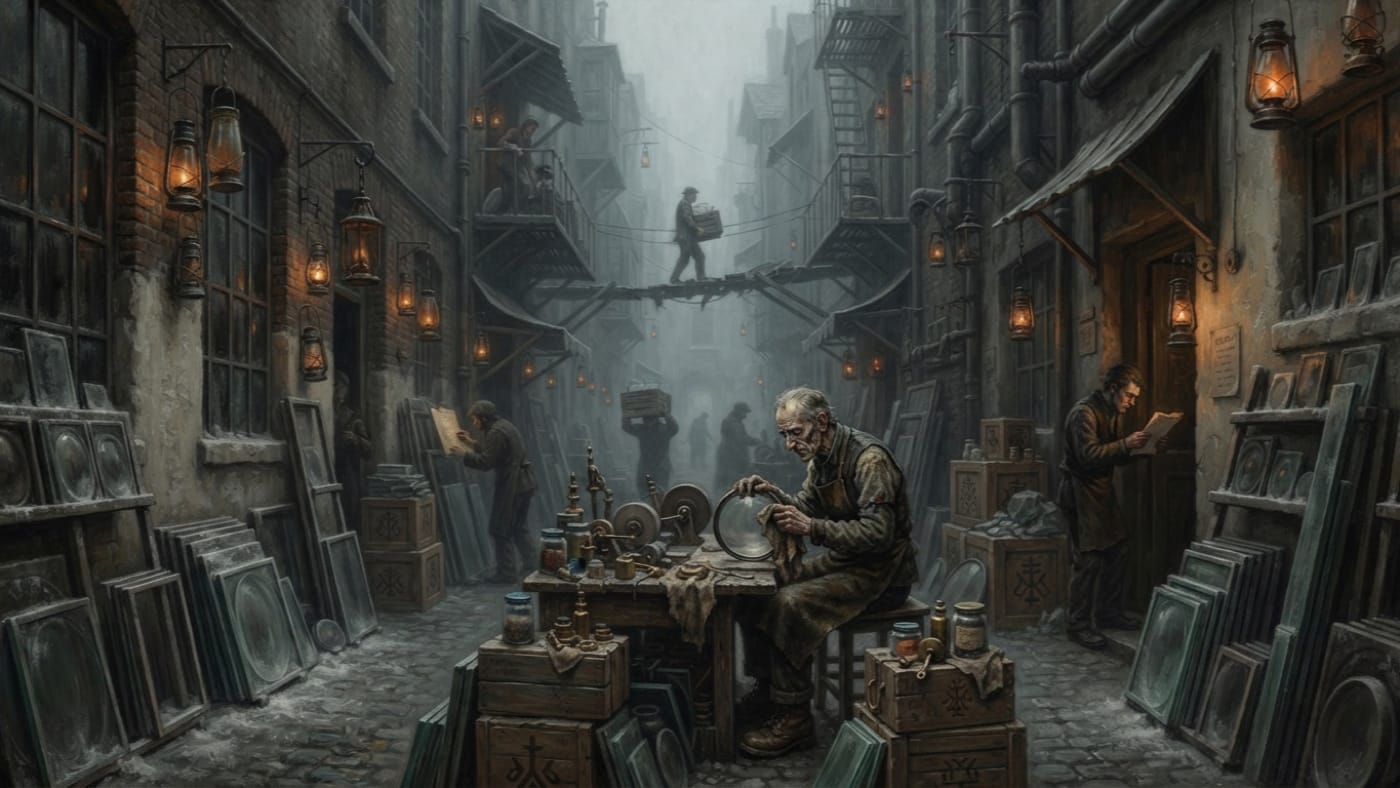
The lane is narrow and fog-muted. Salvaged glass lamps hang in soot-brick doorways. Racks of panes lean against the bone-lime plaster like ledgers awaiting audit, and chalk dust from the ridge settles on everything, so that every pane must be wiped before it can be sold and again before it can be used. The lampglass polisher is the Row's characteristic citizen, bent over a disc of glass with a rag, cracked about the knuckles, with the last good eyes in Nemea. The scribes in the copying halls lose their sight a little at a time. The polishers sell it back to them, also a little at a time.
The Row's customers are the copying halls, which need panes; the gatehouses, which need lenses; and private persons, who need light after their oil ration has run out. The halls and the gatehouses pay by requisition. Private persons pay in lamp-debt.
Lamp-debt means owing oil, or favours, for light. A scribe who falls behind quota in Nemea owes night shifts, and nobody works a night shift in the dark. A scribe who cannot afford the oil borrows it. The oil is lent against pages, and the pages are lent against the scribe. Small accounts are settled in blank leaves, unregistered paper passed from hand to hand as informal currency. Large accounts are settled the way everything in Nemea is settled: in night labour, in confession, or by surrendering a family name to correction.
The Compact's position is that it sets no debts and sells lamps. I have always found this position unanswerable. Nobody in Nemea who might answer it can afford the oil to write a reply.
#On the Compact
The Lampglass Row Compact is the Row's trade guild. It is a separate thing from the district: the Row is the streets and benches, and the Compact is the hand on the Row's purse. It publicly provides light and panes, and it does provide them. The halls are lit. The gatehouse lenses are ground. The Bureau's requisitions are filled in the end. No charter year for the Compact has reached my desk, and neither has the name of any master, so I supply neither. Ask the Abbot-Registrar and he would produce a charter from the vaults, and it would be original by ratification.
The Compact uses the methods of any guild that has noticed its customers cannot do without it. It makes shortages: some weeks there are fewer panes than the halls require, and the halls learn what a lamp is worth. It takes special orders: a lens ground to one client's need, at one client's price, delivered through a side door. Its third method, selective breakage, is the most refined. A pane cracks in one hall and survives in the next. A testing lens is flawed on exactly the morning a particular document comes up for examination. No one can prove intent. Everyone pays in advance for the next delivery.
Then there are the lenses. To clients with coin and discretion, the Compact sells lenses said to reveal hidden names written in counter-ink. The street calls them truth lenses. I recorded in my entry on the Scriptorium that the Chapterhouse denies these lenses exist and buys six a month. The Chapterhouse has not corrected that figure, and it has not confirmed it. In Nemea, a figure that nobody confirms or corrects soon becomes permanent.
What the lens shows is disputed. The Compact says it shows a name. The Collegium says it shows contamination. On Nemea's ink generally, the Bureau of Doctrine has ruled that a document which rewrites itself raises a theological question rather than an archival one, and has referred it to a sub-committee. No authority has ruled that the lens shows the truth. The Compact prices it as though one had.
#On Hidden Names
The Row and the Courier Spur at the town's eastern edge together keep Nemea's black market. It sells forged seals, erased histories, and "clean identity packets": a new name, a new ledger entry, a new past, bought with blank leaves and lamp oil. Every item in that catalogue is a purchasable past. One item is missing from it. No broker on the Row or the Spur will sell an authentic vault-index key, at any price, to anyone.
That exception is the edge of everything the Row can sell. A truth lens may show a name, but it does not deliver the original document on which that name was first written. An identity packet gives its buyer a past to carry through the gatehouse. It does not give access to the originals against which that past will be checked. The originals belong to Abbot-Registrar Maelen Voss, who holds the Chapterhouse seal and the keys to the vaults. Nothing ground on the Row opens a vault.
Each of Nemea's powers wants something different from the glass. The Bureau of Records wants hidden names found so that they can be erased properly this time. Silence-Master Rhu Tern's Collegium works the gatehouses and verification rooms with lamps, mirrors and controlled reading. Its tests are only as good as the glass they are read through, and every lens the Compact sells privately might end up with someone who has a document to get past those tests. Tern keeps his mirrors covered until the moment of testing. He does not say where his lenses come from, and he does not need to.
"Sister" Halvein, Nemea's ledger-broker, trades in redaction drafts and blackmail. A name revealed under glass can be sold twice: once to the person it belongs to, and once to whoever wants it gone. No record ties her to the Compact, and her trade does not require one.
The Second-Draft Circle is the heretical cell that preserves originals and works to undo erasures. It uses smuggling, acrostics and mirror-writing, and hidden names are its entire concern. The Circle and the Compact therefore want the same lens for opposite reasons. So far as the Bureau can establish, they are not on speaking terms. Neither body should be confused with the Courier Spur's own brotherhood, which carries goods for anyone who pays the freight.
Demand for verification has risen since the Night-Rewriting Contracts were classified in A.S. 198. When the Chapterhouse's contracts began rewriting themselves overnight, so that every revision added to someone's obligation, the Chapterhouse ordered more lamps, more mirrors, and longer nights of watching. The Row supplied all of them. The cause of the rewriting remains unresolved, and the Compact has not been asked to resolve it.
Contracts in Nemea rewrite themselves at night unless they are kept under salted lampglass.
CORRECTED. The assurance struck above circulates in Nemea as settled local knowledge, and the Row sells a great deal of glass on its strength. Salt-lamp circles are a standing countermeasure under Chapterhouse practice, along with mirror checks, silence tests and the order to burn the second draft. Nevertheless, the Bureau's own account of the Scriptorium records that the countermeasures are obeyed and that the documents keep rewriting. Salted lampglass is a precaution. It has never been a guarantee, and the Bureau of Records declines to certify it as one.
#On the Present Condition
Nemea is still burning through glass. Correction cycles are speeding up, and every cycle produces more documents to read, test and certify, each of which needs light. The Abbot-Registrar requisitions lamp oil along with his gloves. The Collegium wants more mirror-pins and the lenses that go with them. The copying halls work through the night to pay off page-debt by lamplight, and the lamps belong to the Row. Each name the Scriptorium recommends for erasure from the Great Ledger must first be read correctly. Somebody has to sell the means of reading it.
The Compact understands its position exactly. Should the lamp-oil ration ever collapse, the Row would hold most of whatever light Nemea had left, and the Row's prices would decide who could read and who could repay. The Compact has never had to test this. It has only needed the rest of the town to understand it.
Inquisitor-Corrector Sel Durn has been dispatched from Strasbourg to Nemea this year. His previous assignments involved archives whose records had begun behaving independently. No dispatch I have seen names Lampglass Row, and no account of his work there has yet been filed with the Bureau of Doctrine. He will need to read his warrants by somebody's lamp.