
#On the Dispatch Yards
"Correction is mercy." — Chapterhouse proclamation, as posted at the gates
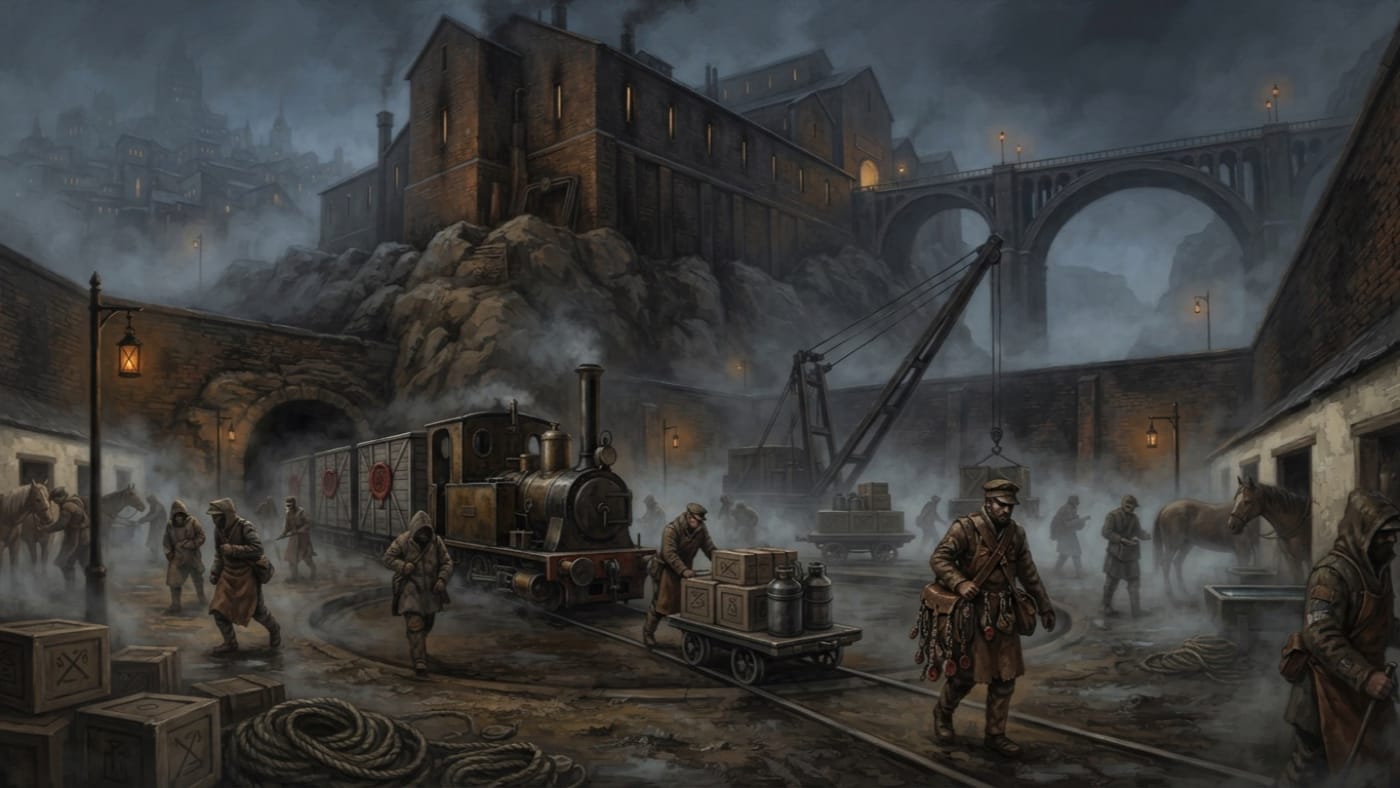
Nemea's eastern edge smells of wet rope and sealing wax, and that is how the Synod's promises smell before they are delivered. This is the district where the Hollow-Script Scriptorium stops copying and starts sending. The halls on the crown of the ridge produce the work. The Courier Spur ships it. Sealed carts stand in yards walled with soot brick. Relay horses stamp in stables plastered with bone-lime. Runners with sealed satchels cross the yard in fog thick enough to swallow a hoof-fall before it reaches the next wall.
The district takes its name from its courier spur line, the branch of rail by which Nemea's product reaches the wider administration. I will not describe its gauge, its length or the habits of its engines. No one has sent me those figures under seal, and I do not certify what I have not been handed.
The rest is labour. Courier certifiers bind each consignment to the man who carries it. Seal-waxers bend over their tallow pots. Archive guards count the carts out and count them back. When the town's lanterns dim to Archive Glow, the yards dim with them and the work goes on by touch. A man who loads sealed carts in the dark learns the weight of a decree in his wrists.
The cargo goes to Strasbourg, to every office of the Bureau of Records, and to the tribunals, gate-courts and bastion registries of the continent. The scriptorium writes the Synod's memory, and the Spur carries it out of town.
#On Certified Cargo
On the manifests the cargo looks harmless: sealed copies, corrected decrees, certified identities, confession abstracts. There are also ink bricks, compressed, stamped and rationed, for every Records office that wants Nemea ash-ink on its most sensitive pages. Most of it is paper and wax, and a child could lift it.
What matters is what the paper does when it arrives. A certified absence delivered to a gate-court tells the court that a man was never born, and the court turns him away at the gate on the strength of a sheet he has never seen. An identity correction received at a bastion registry moves a soldier's name from one roll to another, and his pay follows the name, wherever the soldier happens to be standing. A corrected copy of a debt can arrive with the debt left out. The creditor is then holding a paper the Synod no longer recognises, and the debtor walks home owing nothing without knowing why. The Church has devised no cleaner mercy. When the Great Ledger strikes a name on Nemea's recommendation, that person ceases to have existed, and the courier who carried the recommendation is paid by the stage.
The yards handle each consignment by its weight, its seal and its destination. The courier chain seal binds a packet to its route. The copy-cert seal binds a copy to the original it claims to repeat. The wax mark tells the receiving clerk that Nemea pressed it, and no cheaper house. I leave out the designs, because forgers read the Codex.
All of this depends on two imports the town cannot make for itself, blank paper and lamp oil. Without paper there is nothing to seal. Without light nothing can be proven, and an unproven document leaving the Spur is a rumour with postage paid. Rags, grain, lime and glass come in across the same bridge as everything else. The Chapterhouse counts the paper and the oil twice.
#On Passage and Verification
The town has one road gate and one spur line, and the Chapterhouse means to keep it that way. Freight, couriers and novice intake all cross the Inkhouse Bridge, a single stone span over the river gorge below the ridge. How the rails fit that arrangement is a question for engineers, and the engineers have not written to me. The principle needs no drawing. Nemea can be strangled at one point, and the Chapterhouse keeps its hand on the throat.
To enter, you need a courier summons, novice intake papers or a licensed trade permit. Leaving asks more of a document. Every page that comes in or goes out is put through the silence test by the Silence Test Collegium under Silence-Master Rhu Tern. In gatehouses and verification rooms, the testers use lamplight, mirrors, the observation of breath and a reading protocol to decide whether a page is what its seal says it is. The reading protocol is classified. I have read it, and I will say nothing more about it.
Some things may not pass at all: unstamped ink, unsealed memoirs, bodies without death papers. The gate clerks take bribes in clean paper, lamp oil and blank leaves. That list tells the careful reader exactly what the town is short of, and exactly what it will agree to forget.
The parent assessment puts Strasbourg two days from the Spur by rail. The Chapterhouse's own estimate allows two to three days by wagon or rail, depending on the mode and the season. Nemea lies between the Rheinscarp supply corridor and the southern tributaries of the Queue Road. Neither corridor owns the Spur, and neither runs its carts.
#On the Brotherhood
The Courier Spur Brotherhood calls itself a union. Its territory is the stables and the sealed-cart yards, and its stated purpose is safe delivery. No one in Nemea disputes that purpose, because no one in Nemea can send anything anywhere without the Brotherhood.
Street talk accuses the Brotherhood of skimming packets and swapping them, and I record that as accusation and nothing more. The methods are attributed to it, never proven against it: control of routes, bribes, and the "lost" manifest. That last is a document which stops existing, in a town whose entire industry is documents that stop existing. The Brotherhood has learned Nemea's main lesson faster than any novice. A swapped packet still arrives sealed and on time, certified by a courier whose chain of custody is unbroken. Nobody at the other end complains, because nobody at the other end knows what was supposed to arrive.
Its power has a limit, and the limit is the Chapterhouse. The Brotherhood moves carts. Abbot-Registrar Maelen Voss holds the chapterhouse seal, and the originals lie in vaults that only he opens. The Brotherhood can delay a decree, but it cannot write one. It can lose a manifest, but it cannot make the Margin Court forget the manifest was ever filed unless someone pays the Margin Court separately, and that is a different trade on a different street.
None of the papers I hold names the Brotherhood's leaders. The Brotherhood prefers this, and on that one point it and the Bureau agree. The listed hazard of the trade is a sealed packet that goes missing. When one of real consequence does, the Chapterhouse will learn which of its two powers it truly holds: the seal, or the carriage.
#On the Uncorrected Copy
The Second-Draft Circle is a heretic cell. It works to preserve originals and to undo erasures, by smuggling, acrostics and mirror-writing. It keeps to the crawl-shelves and to the Courier Spur, and its reason for the Spur is plain. An original that never leaves the vaults can be burned whenever the Chapterhouse likes. One that has been carried out becomes someone else's problem.
The Circle and the Brotherhood are different bodies. The Brotherhood trades in packets for profit, and the Circle steals pages for conscience, which the Church considers the more expensive vice. That they share the stables is a fact of geography the Bureau has not yet corrected.
The Courier Spur Stables hide a tunnel route out of town. No record gives its course, its builder or its age, and an unrecorded tunnel in Nemea is a small heresy all by itself. No certifier has ever stamped a passage through it. Whether it comes out in open country or in a collapsed cellar, I leave for the next person who tries it to report, if they can.
The Spur also shares a black market with Lampglass Row. It sells forged seals, erased histories and "clean identity packets," each a new name, a new ledger entry and a new past, bought for the price of blank leaves and lamp oil. One commodity is not sold at any price, and that is an authentic vault-index key. Whoever held the index would know where every original lies. No courier has carried one, and no broker has offered one.
#On the Present Condition
Contracts in Nemea's vaults change overnight. Obligations grow, and names move between roles: a guarantor becomes a debtor, a witness becomes a party. The Chapterhouse classified the phenomenon as Night-Rewriting Contracts in A.S. 198. When it actually began is a separate question that nobody has answered. The countermeasures in force are salt-lamp circles, mirror checks, silence tests and the standing order to burn the second draft. The documents keep changing anyway.
This leaves the Spur carrying cargo under a suspicion it has done nothing to earn. A decree that passes the gate on one morning spends the next two days on rails, and no silence test rides with it. Nothing on file shows that any packet has changed in transit, or that the ink bricks carry anything to their destinations except ink. Nothing on file shows the opposite either. The Chapterhouse blames the Circle, and the Circle blames the ink. The Brotherhood's swaps are an old sin, too ordinary to explain this one without proof that nobody holds. The Bureau of Doctrine has ruled the theology heretical and the causes unresolved. I signed that ruling, and my signature now travels on these carts more often than I do.
Inquisitor-Corrector Sel Durn was dispatched from Strasbourg in A.S. 201. The dispatch is on record. His arrival, his findings and any purge are not. If he comes by rail, he will step down in the Courier Spur among the wet rope and the sealing wax, and a Brotherhood certifier will put a chain seal on his luggage.
Earlier Nemea material in this Codex, following the Chapterhouse's house explanation, blamed the rewriting of contracts on a contaminated batch from Inkhouse vat number seven. On that account, bricks dispatched from the Spur needed no particular watching once vat seven was quarantined.
CORRECTED. The Chapterhouse has withdrawn the vat-seven explanation. The Bureau of Alchemical Standards found that vat seven's ink is chemically identical to the ink of every other Nemea vat. The cause remains under classification. Nothing in this entry certifies that the ink bricks leaving the Courier Spur are clean, and nothing in it certifies that they are not. Receiving offices will keep their lamps lit.
The Bureau of Records lists the Spur as loyal, necessary and adequately supervised. All three hold until the first packet goes missing.