
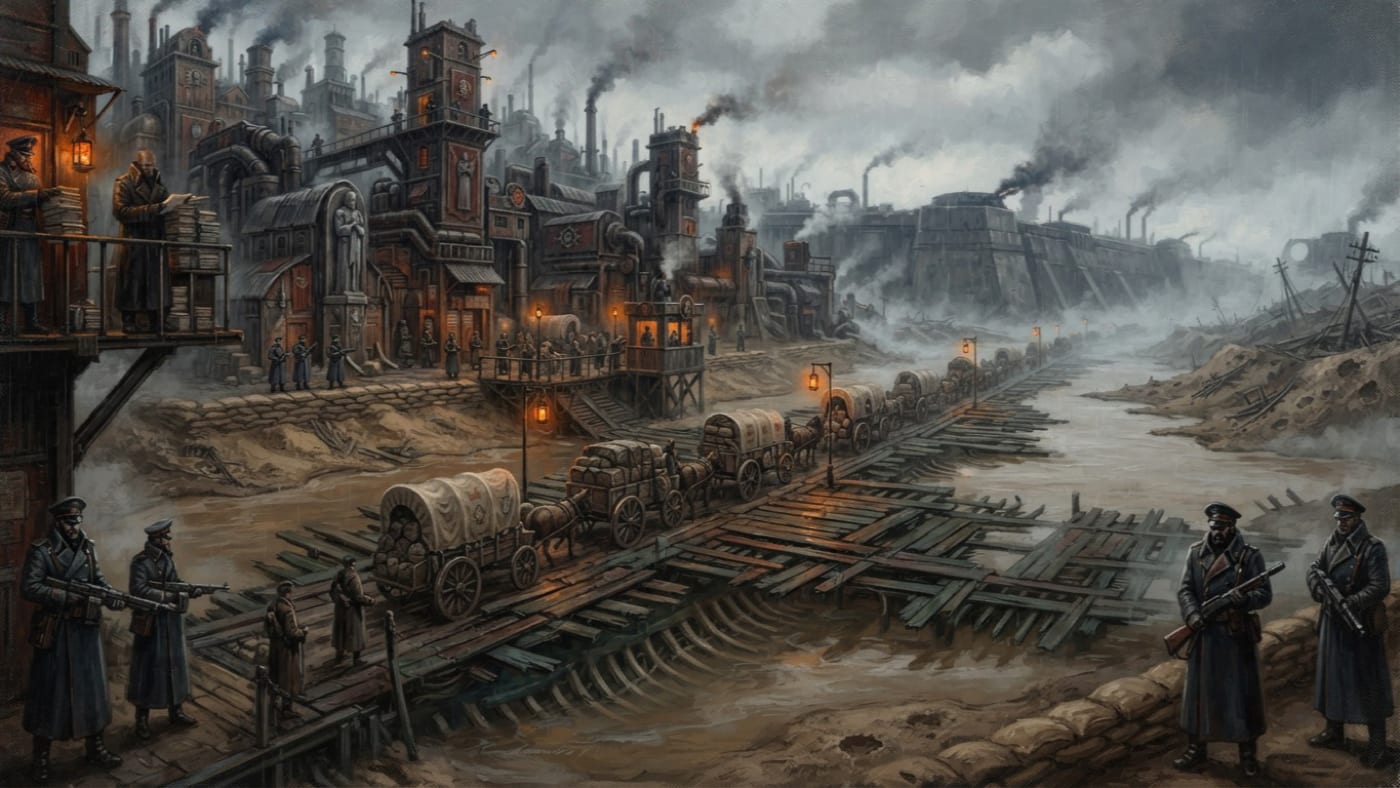
#On the River and the Crossing
"If it isn't stamped, it didn't happen." — Yard motto, Latchford
The Latch River is a small water with a large file. At Latchford it hardly runs at all. It spreads, cold and brown, across a mud flat too shallow to drown a standing man and too soft to bear a loaded wagon. It lies exactly where the Sagittal Line's rear-approach corridor comes down off firmer ground on its way to Bastion-Constantinople. A lesser river would have been forded and forgotten. This one was forded and administered.
I cannot tell you where the Latch rises, where it empties, what feeds it or how far it runs, and I will not make it up for the reader's convenience. The Codex concerns itself with the reach that concerns the Synod, and that reach is the crossing. On either side of it lie drainage canals, shell-pocked berms and the cordoned shellfields, and a convoy commander who sends his wheels into any of those deserves the axles he loses. So everything comes to the one place: wagons, conscripts, pilgrims, ammunition, bread, and the dead. The clerks call it Latchford Crossing. Everyone else calls it the ford.
Latchford Permit-Yards sits on a low causeway beside it, looking down. Every stamp the Yards issue, every window, seal and tribunal fine, comes down in the end to one permission: to get wet.
#On the Banks and the Buried Village
"The queue remembers." — Latchford proverb
Nothing at the ford's edge remains as the Creator left it. Sandbag levees hold back the flood surges, which arrive without notice and leave without apology. Behind the levees, trench drainage canals cut the flats into lanes so narrow that the canal skiffs pole along them in single file. Beyond the canals the berms are cratered, and the craters hold rainwater the colour of weak tea. The rain comes in sheets and contrives to fall at shift-change, as though the sky kept a duty roster and resented it.
The crossing is made of plank, laid over older plank, laid over older plank still. Traffic presses each generation of boards into the mud, the next generation is laid on top, and no one has ever been paid to lift the old. When the water drops, the result can be seen from the low bank in layers: grey timber, then black timber, and under the black something darker, ribbed and regular, which the queue calls the bones. The Bureau of Rites has inspected them and refused to classify them. They may be the remains of earlier bridges, or something with a better claim to the name. I record the refusal and leave the pattern undescribed.
Beneath the sandbags lies whatever stood here before the Yards. Drowned foundations show at the margins in a dry week. Culverts of older masonry run under the levees and now serve people who prefer to stay uncounted. There is a chapel, or the stump of one, with names scratched into its stone by hands no ledger recorded. When the village rose, who lived in it, and whether flood or war unmade it, the Bureau of Records cannot say. It holds no file, and I have none to lend.
The ground keeps its own grudges. Old trenchworks undermine the approaches and open into sinkholes under a loaded axle. Trench-fever breeds in the standing water. The queue calls its seasonal spikes ford-fever, and the lime pits do steady business.
#On Permission to Pass
"Never trust a bell you didn't see struck." — Latchford proverb
Latchford confuses two acts, and the confusion is policy. To cross the Latch, you walk wet board to the far bank. To be permitted to cross it, you must first survive everything else.
Take a carter with a wagon of flour for the Line. At intake he hands his papers to the clerks of Records, who examine them. His cargo goes to the quartermen of the Bureau of War, who examine that. His face goes to the Wardens, who examine it with less charity than either. He shows his papers with two hands and declares his destination aloud. Then he waits for the Master Gate Clock. Perfect documents will not move him a yard until the clock posts a window and his Transit Window Pass shows the matching minute in its grid. His flour travels under a Cargo Sanctification Slip bearing the dual seal of War and Records. If either seal is smudged, the flour waits, the carter waits beside it, and the queue behind him stretches toward the horizon.
If he carries a corpse, he must also carry a death receipt. The yard command punishes anyone who moves a body over the ford without one as severely as it punishes ringing an unsanctioned bell or counterfeiting a master-seal. The dead may be stinking, beloved, or on their way to their own funerals. Without a receipt they will not cross.
There are other ways to the far bank. Beneath the catwalks, Old Sable sells minutes: forged extensions of a window, priced by the buyer's desperation. Prefect Mavren Tull holds the blank permit stock, and with it the right to exist at all. Quarter-Commander Hesta Brune holds convoy priority. She can put a wagon at the head of the line or at the tail of next season. Each of the three owns a share of the right to cross the Latch. The water itself appears in nobody's ledger.
Of all the powers at Latchford, the river alone charges no fee. It takes boots.
#On the Missing Minutes
"If you argue with time, time wins." — Latchford proverb
The ford keeps irregular hours. The locals call the irregularities Minute-Eddies and report them mainly in two places: at the water and around the Master Gate Clock. A pocket-watch drifts against the bell. The bell strikes twice where it should strike once. A carter swears he stepped onto the planks with five minutes left on his window and stepped off with three, and cannot account for the two he lost. Sometimes, afterward, his papers carry a stamp he does not remember receiving.
The precautions are domestic and devout. Salt is laid across thresholds. Boots are sealed with wax at the welt. Sensible people walk only on the painted queue boards and regard anyone who steps off them as either a theologian or a fool. I certify nothing about whether these measures work. Their observance, kept up at the price of salt and wax by people who can afford neither, is the most consistent liturgy in the settlement.
The children learn one rule before the rest: if you hear your name in the bell, you do not answer.
I have stood at the ford. During my pastoral inspection in the spring of A.S. 197, at dusk, on the planks, I was for some four seconds certain I had already crossed and was standing on the far bank, looking back at myself. The certainty passed. When I examined my papers I found a stamp I did not remember receiving, dated three hours ahead of the bell. I have set this down once already, in my report on the Yards. I set it down again here because it happened at the river, and the river is my subject.
I offer no mechanism, because I was given none. The Bureau of Records classified the days by which my visit overran as "clerical weather" and closed the matter. The Bureau of Rites has looked at the planks and filed its silence. The Bureau of Shadows knows of everything at Latchford and has acted on none of it. The queue has a theory of where the missing minutes go. I have heard it, and I decline to file it. A document once filed must be answered, and no one in the Synod has volunteered to answer this one.
#On the Present Passage
In A.S. 201 the crossing works, and the Bureau of War may record as much, since it records little else in the Yards' favour. Each dawn the fog lies low on the flats and holds the sound, so the axles of the first convoy are heard screaming across the water long before anyone sees them. Wardens stand at the bankside gates with their key-rings. Clerks in ink cuffs keep the tally from the catwalks. The planks flex, the mud takes what it is owed, and the wagons go over in their windows toward the Line.
After curfew the lanterns go counting-bright, and the crossing belongs to the patrols and to whoever the patrols fail to see. By morning, people are missing. Some were last seen near the water. Their absence prompts no inquiry, and the erratum below gives the reason with the Bureau's customary precision.
The Latch River at Latchford, with its ford and immediate banks, lies within the administrative bounds of Latchford Permit-Yards, and no disappearances attributable to institutional action have occurred within those bounds.
The first clause is withdrawn. As recorded in my report on the Yards, the Bureau of Records defined the settlement boundary in A.S. 194 to exclude the culverts, the Silent Zones, the Paper Sump, and the ford. The river therefore lies outside the place built to supervise it. Anyone lost at the crossing is lost outside Latchford, and the Latch keeps no ledger in which to enter them.
The ford endures. The boundary holds. By definition, the river has lost no one.