
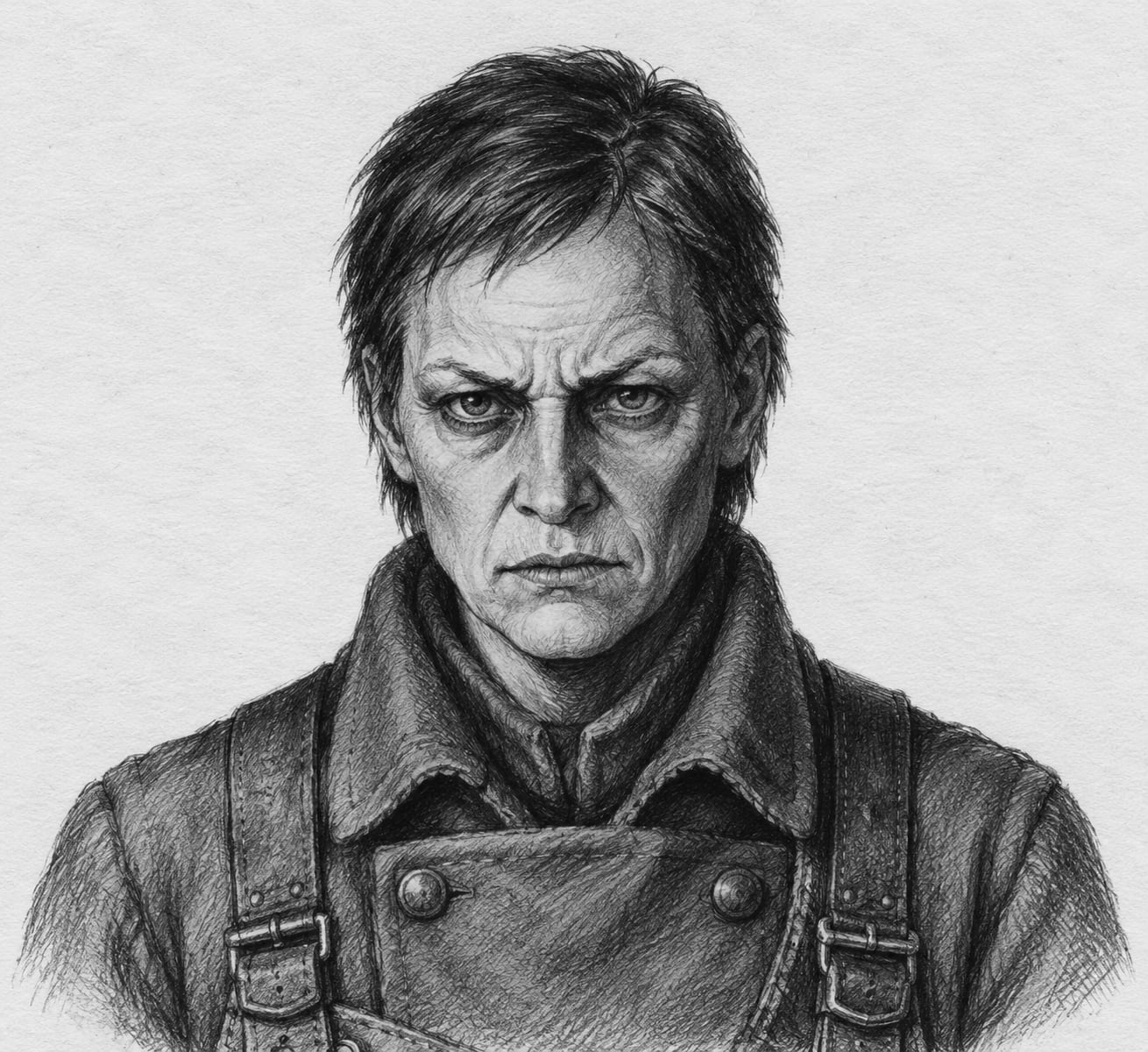
#On Her Station
Lisabet of Graz appears in the files of the Bureau of Cartography with one function and one year. The function is Rod-Bearer. The year is A.S. 174. She served on Adept Harlen's survey of the Drava, and most of what the record says about her was written by the people who disciplined her.
A rod-bearer carries the brass sighting rod that the adept fixes in his transit. The adept owns the angle, the bearing and the signature at the foot of the sheet. The rod-bearer owns a patch of mud at the far end of his attention. She stands there, upright and visible, while a man with better pay decides where the world is. If she drifts, the map drifts with her. Cartography is a liturgy for two, with a celebrant at the instrument and a server at the mark, and only the celebrant's name goes in the colophon.
The record calls her "of Graz." That tells us what the clerk wrote. It says nothing of her birthplace, family, recruitment or age, and I will not supply any of them. I have read enough invented biographies to know that people who invent biographies are usually after a pension.
#On Her Testimony
The A.S. 174 survey was ordered to reconcile the Drava's western course with existing charts, because patrols had reported bends that no earlier survey admitted. The Bureau's term was lateral instability. The river once carried grain through the southern Pannonian plain. It now runs yellow-grey through Kargath's province and the Blightmarsh, and a river in that country moves house the way a debtor does, at night and without leaving a forwarding address.
The party was Harlen, Assistant-Mapper Krail, Lisabet, an expedition chaplain and a patrol. The surviving record does not give the full roster.
Lisabet's statement is short. She reported that Harlen stepped from firm mud onto firmer mud, sank to his belt, and apologised for obscuring the line of sight.
Read it twice. Some at the Cartographic Bench took it for shock. I take it for training. She was posted to watch the line, and she reported what crossed it. By her account the apology was his. The observation was hers, and it is the most exact sentence the expedition produced.
Krail gave a different account: the river divided around Harlen "like a closing parenthesis." The chaplain wrote only that the transit remained visible longest. That makes three witnesses with the eyes of a surveyor, a grammarian and a confessor, and not one of them names a mechanism. The Bureau has not named one since. Nor shall I. The file has enough authors.
The first loss notice described Harlen as having fallen into the river.
Amended by Cartography after objection from two surviving witnesses. Harlen did not fall. The river accepted him while he was standing.
The record does not name the two objectors. Readers who would like Lisabet to be one of them may wish it in private.
#On the Withdrawal
No recovery was attempted. The patrol had overrun its exposure clock by fourteen minutes, and the east wind had begun to smell of fresh bread.
Fresh bread, on the Drava, where no honest oven has been lit in living memory. Anyone who has served along the edge of the Abundance Fields knows that the smell of food with no food in sight is a hazard sign. The patrol primers list it beside sweet water and singing ditches. No Abundance Field was recorded at the survey site, and the patrol did not need one. The smell was instruction enough.
The chaplain rang the withdrawal bell. On a perimeter patrol the bell outranks the adept, the mapper and the private opinion of everyone in earshot. When it sounds, the party leaves.
Krail objected.
The file does not keep his words, and I will not write them for him. It is enough that a man stood on a corrupted bank, fourteen minutes into borrowed air with bread on the wind, and argued with a bell. His adept had gone into the river standing up. A loyal subordinate may be forgiven for wanting to stand where his master stood, and on every piece of evidence on file the Drava would have let him.
Lisabet struck him with a sighting rod.
The published account gives the result plainly: she saved his life. It does not say how many times she struck him, whether he was injured, or how he got off the bank. Krail came home and Harlen did not. As far as the file can tell, the difference between them was a length of brass and the woman holding it. She hit a colleague with Bureau property, and the bastard lived. Cathedrals have rung for smaller mercies.
#On the Reprimand and Transfer
She was reprimanded for misuse of Bureau instruments.
I admire that sentence the way a binder admires a well-kept sewing frame: everything is in its place, and nothing living is on it.
The charge is accurate. A sighting rod is issued to mark a bearing. It is graduated for distance, lacquered against damp and entered in the instrument ledger by number. It is not issued for correcting assistant-mappers, and Lisabet used it on one. Judging by its title, the finding is about the rod. Krail's continued breathing belongs to another folio. The instrument ledger has a column for brass and none for consequences, and a clerk can only reprimand what his columns allow.
At some later point came a quiet transfer to indoor ink duty. The file gives no date, office or term. Quiet is the Bureau's word for a decision nobody wants to defend out loud. Some readers call the transfer a punishment. Others call it a mercy, since a woman who watched the Drava take a man standing up might be owed a roof. The file gives no motive, and I may not invent one. I will only observe that once Cartography learned she would act decisively when the bell rang, it moved her somewhere no bell rings.
Her testimony settled nothing at the Cartographic Bench, and could not have. Harlen's notebooks did not return. Three contradictory maps did. The Bench kept them under separate seals and declined to choose between them. The witness signatures on Map C were removed under Seal Amber, and the file does not say whose they were. One rod-bearer's sentence about a line of sight cannot outvote three maps that disagree with each other. It can only sit in the folio, accurate and unread.
#On the Limits of Her Record
Indoor ink duty is her last recorded posting. The record does not follow her to the present year. It does not say whether she served there for a season or a career, whether she still lives, or where. The file is silent, and silence in the Bureau of Records is not an invitation to fill it.
In A.S. 200, twenty-six years after the survey, a patrol at Kestrel-11 reported a figure standing waist-deep in the Drava. It resembled Harlen, appeared unchanged, and held what looked like a transit. The figure has not been identified. Nothing in the file puts Lisabet on that patrol, shows that she saw the report, or records that anyone asked her about it.
Some readers will call this a lapse. They should remember that she is the only witness on record whose testimony concerns the line of sight. They should also remember that the Bureau of Cartography already knows what she does with an instrument when men stand too long at the water.