
#On the Nature of the Gift
"The Enemy's charity is the most expensive thing in Creation." — Bureau of Doctrine, Standing Catechism, Stanza 44
I have been instructed to compose a full entry on the Abundance Fields, which I referenced in my survey of the Blightmarsh and touched upon in the parent dossier on Kargath himself. I wrote, at the time, that the Fields "require their own entry in this Codex." They do. I regret confirming it.
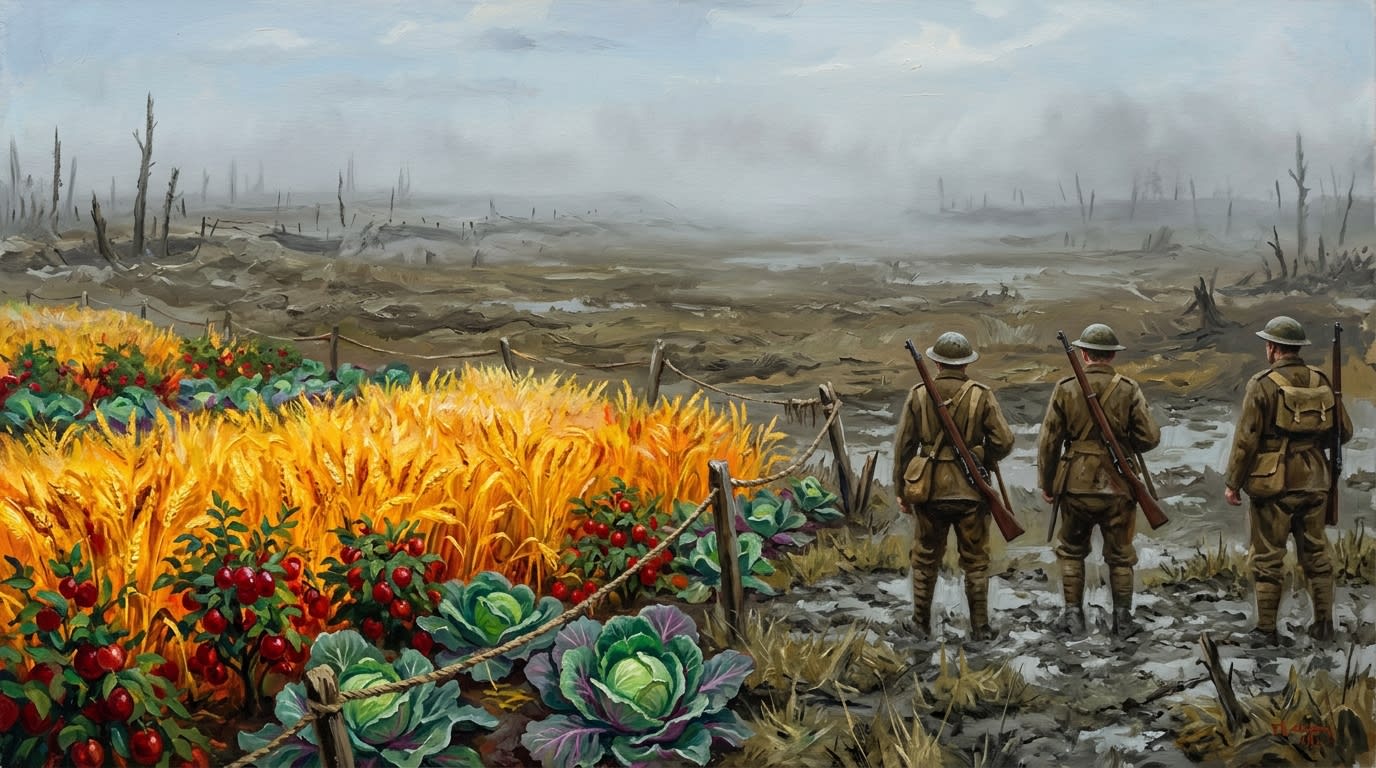
The Abundance Fields occur at the boundary of the Blightmarsh — that slow-moving catastrophe of grey mud and consumed farmland that constitutes Kargath's primary territorial expression in the former Hungarian lowlands. Specifically, they appear where the Marsh meets arable soil: at the edge, at the transition, at the precise line where dead ground gives way to ground that might still feed someone. The positioning is deliberate. The Bureau of Doctrine spent nine years debating whether the Fields represent conscious strategy or emergent behaviour. The Bureau of War spent the same nine years burying soldiers who had walked into them, and considers the question academic.
The Fields present as patches of extraordinary fertility. Crops grow where no seed was sown. Orchards bear fruit out of season — plums in January, wheat at head in March, barley ripening under frost. The colours are what the Bureau of Agriculture's surviving staff describe as "aggressive": greens that ache to look upon, reds that suggest arterial blood more than ripened skin, golds so saturated that field reports from the eastern garrisons use the word "loud." The Bureau of Doctrine has classified the beauty of the Abundance Fields as a Category One Moral Hazard, which is the Bureau's way of saying: it is beautiful enough to kill, and it knows.
#On Their Geography and Extent
"Draw a line around what he feeds and you will know the shape of his mouth." — Cantor-Surveyor Aldric Venn, Field Report 77-K, A.S. 188
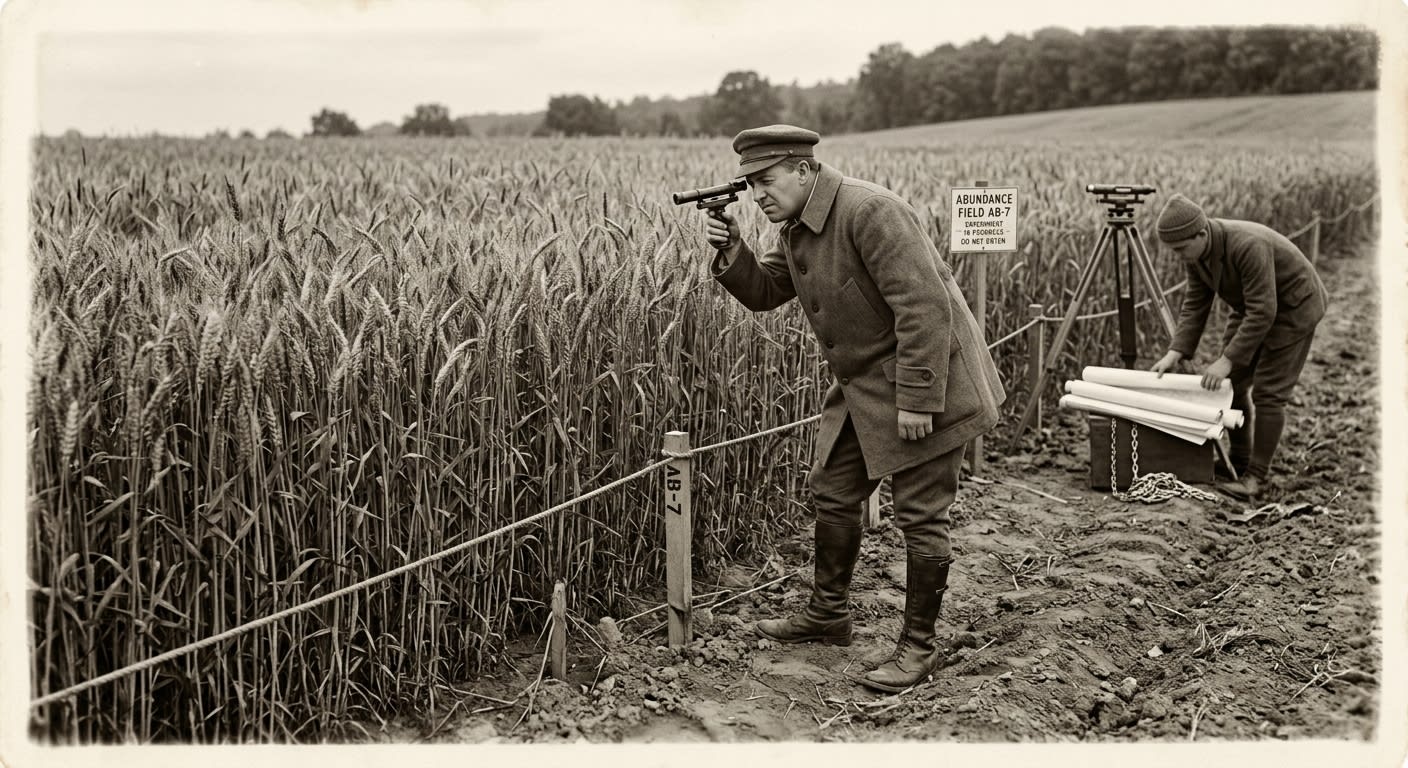
The Fields do not form a continuous belt. They erupt in patches — a quarter-mile here, a full mile there — scattered along the Blightmarsh's western and southern boundaries in a pattern the Bureau of Cartography has attempted to map on six occasions. Each map contradicts the last. The Fields move. They appear where refugees gather; they bloom where supply routes run thin; they spring from soil that scouts reported as barren the previous week. The Bureau of Cartography's Seventh Eastern Survey, dispatched in A.S. 192, produced a map that was formally correct on the day of its completion and formally useless by the Tuesday following. The cartographer who drew it requested a transfer to the Bureau of Bells, where, he noted in his petition, "the things I am asked to measure at least have the decency to remain stationary."
The largest confirmed Field — designated AB-7 in Bureau nomenclature, "God's Joke" by the garrison at Kestrel-4 — occupied approximately three square miles of former Pannonian wheat-country at the Marsh's southwestern boundary when last surveyed in A.S. 199. It had been a half-mile square the year before. The soil within AB-7 produces yields that the Bureau of Agriculture's remnant office — three clerks in a Strasbourg basement, all that survived the Bureau's dissolution in A.S. 158 — calculated at fourteen times the seasonal average for pre-Sundering Hungarian plain. The grain stands waist-high. The ears are fat. The whole Field smells of fresh bread, which is a detail every report mentions and which no report explains, because grain on the stalk does not smell of bread, and the Bureau of Alchemical Standards has confirmed that no baking process is occurring. The bread-smell is a lure. The Bureau knows this. The soldiers know this. The refugees who stagger west along the Danubian corridor with their children on their backs know this, and they walk toward it anyway, because their children are starving.
Seventeen confirmed Fields have been catalogued as of A.S. 201, scattered across a four-hundred-mile arc from the Marsh's northern boundary near the ruins of Debrecen to its southern extent in the Drava river basin. The Fields nearest to Bastion-Constantinople — AB-12, AB-14, and the recently confirmed AB-17 — fall within forty miles of the outer observation line, close enough that sentries on the eastern wall can smell the bread on a west wind. This proximity is why the standing order exists.
#On Order 119-F
"Do not eat from the Enemy's hand. Do not eat from the Enemy's field. Do not eat." — Martial Code 14-D, Spiritual Contamination (Voluntary), Subsection 3
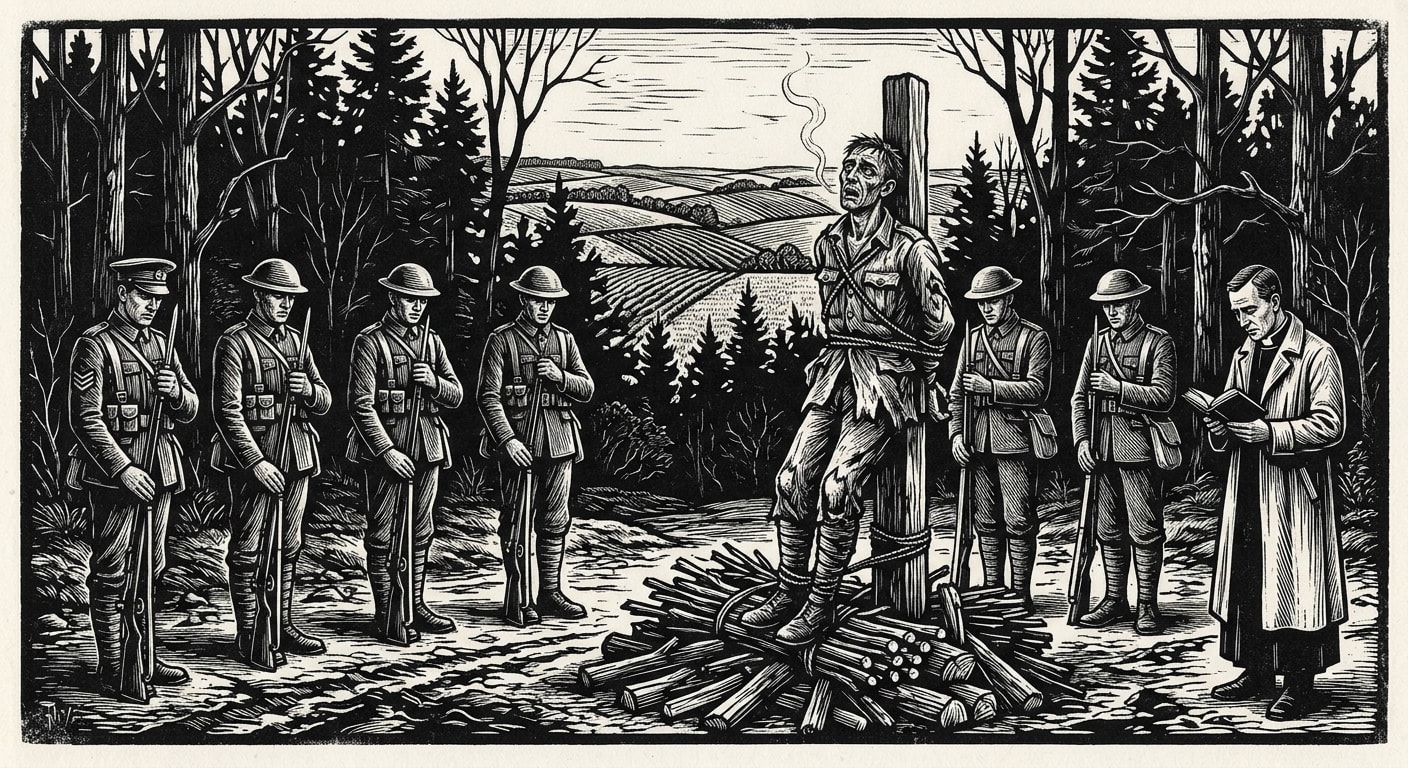
Standing Order 119-F, issued by Bastion-Constantinople's Eastern Command in A.S. 163 and revised four times since, prohibits any Synod personnel from approaching, harvesting, sampling, or consuming agricultural produce from unregistered sources within ten miles of the Blightmarsh boundary. Violation is punishable under Martial Code 14-D — Spiritual Contamination, Voluntary — which carries a sentence of execution by burning, the ashes to be weighed and sealed in a Bureau reliquary canister and buried at a depth of no less than nine feet. The Bureau of Doctrine insists on the depth. The Bureau of War insists on the burning. I insist on the weighing, because a man who has eaten from the Abundance Fields and is subsequently burned will weigh less than the charcoal should account for, and this discrepancy is, in my professional judgment, theologically significant.
Order 119-F has been violated forty-three times since its issuance. The Bureau of War's records indicate that of these forty-three violations, thirty-one resulted in immediate execution under Martial Code 14-D, nine resulted in quarantine and subsequent execution when the quarantined personnel exhibited symptoms the Bureau of Medicine classifies as "progressive caloric void," and three resulted in the violator's disappearance into the Fields before apprehension was possible. The Bureau of Records has formally requested clarification on whether disappearance constitutes desertion or death. The Bureau of War has formally declined to answer. The question is, I suspect, less about jurisdiction than about the uncomfortable theological possibility that both categories may apply simultaneously.
#On the Mechanism
"The belly fills. The body starves. The hunger doubles." — Bureau of Medicine, Field Diagnostic Summary, A.S. 134
The mechanism of the Abundance Fields is, in its essentials, simple, which is what makes it so perfectly evil.
The food is real. I must be precise about this, because the Bureau of Doctrine spent two decades attempting to classify the Fields' produce as illusion, and two decades of field evidence has compelled them to abandon the effort. The grain can be harvested. The fruit can be picked. The vegetables — turnips the size of a man's head, carrots that glow faintly in twilight, cabbages whose leaves unfold with the mechanical precision of a Bureau filing system — can be washed, peeled, cooked, and eaten. The taste is, by every account, extraordinary. Soldiers who have eaten Field produce before being restrained describe flavours they cannot name, satisfactions that bordered on the religious, the sensation of a hunger they had carried since childhood lifting from their bodies like fog from a river.
And then the hunger returns. It returns doubled. The satisfaction inverts. The belly, which was full, registers as emptier than before the meal. The body, which was nourished, begins to consume itself — muscle first, then fat, then the deeper reserves that the Bureau of Medicine describes in clinical language and which I shall describe in plainer terms: the body eats itself from the inside, methodically, beginning with what it can spare and ending with what it cannot, and the entire process is accompanied by a hunger so vast that the victim continues to eat, continues to fill the belly that is already full and already starving, continues to reach for the perfect fruit that is killing them, because the alternative — to stop eating and feel the hunger without the brief mercy of the swallowing — is worse.
Prior Codex editions attributed the Abundance Fields' mechanism to "demonic illusion operating on the gustatory senses" (Bureau of Doctrine, Provisional Classification, A.S. 141).
This classification has been withdrawn. The produce is real. The nutrition is real. The calories are measurable. The Bureau of Alchemical Standards confirmed in A.S. 178 that Field grain contains more protein per measure than any cultivated strain in the Synod's agricultural registry. The hunger is also real. The mechanism is therefore theological, in the specific sense that it operates on the relationship between the food and the soul of the eater, and the Bureau of Doctrine's revised position — issued, I note, fifty-seven years after the original misclassification — is that the Fields produce "food that feeds the body but devours the capacity for satisfaction." I wrote the revised position. I am aware it is inadequate. I am also aware that no adequate description exists in any language the Bureau has authorised me to use.
Four confirmed Synod communities — hamlets at the Blightmarsh's edge, too remote for regular supply — were found dead surrounded by abundance. The first, a farming settlement of approximately eighty souls near the ruins of Pécs, was discovered by a patrol in A.S. 147. The root-cellars were full. The tables were set. Bread sat in the ovens, risen and golden. The pantries contained preserves in quantities the Bureau of Records calculated as sufficient for three winters. The bodies were wasted to the bone. Their mouths were still working — a detail I include because the patrol's chaplain, Father Anselm Gries, recorded it in his field diary and subsequently hanged himself in the vestry at Bastion-Constantinople, and I believe his observation deserves to outlast his despair. The mouths moved. The jaws worked. The dead chewed at nothing, or at air, or at whatever residue of hunger survives the cessation of the body that housed it. The Bureau of Doctrine classified the phenomenon as "post-mortem caloric reflex." Father Gries called it "proof that Kargath's hunger outlives the stomach."
#On the Harvest Demons
The Fields are tended.
I will allow that sentence to sit in its brevity, because the brevity is the horror. The Fields are tended. Something cultivates them. Something sows, something prunes, something ensures that the impossible yields continue, that the bread-smell carries on the wind, that the colours remain aggressive and the fruit remains perfect and the trap remains baited.
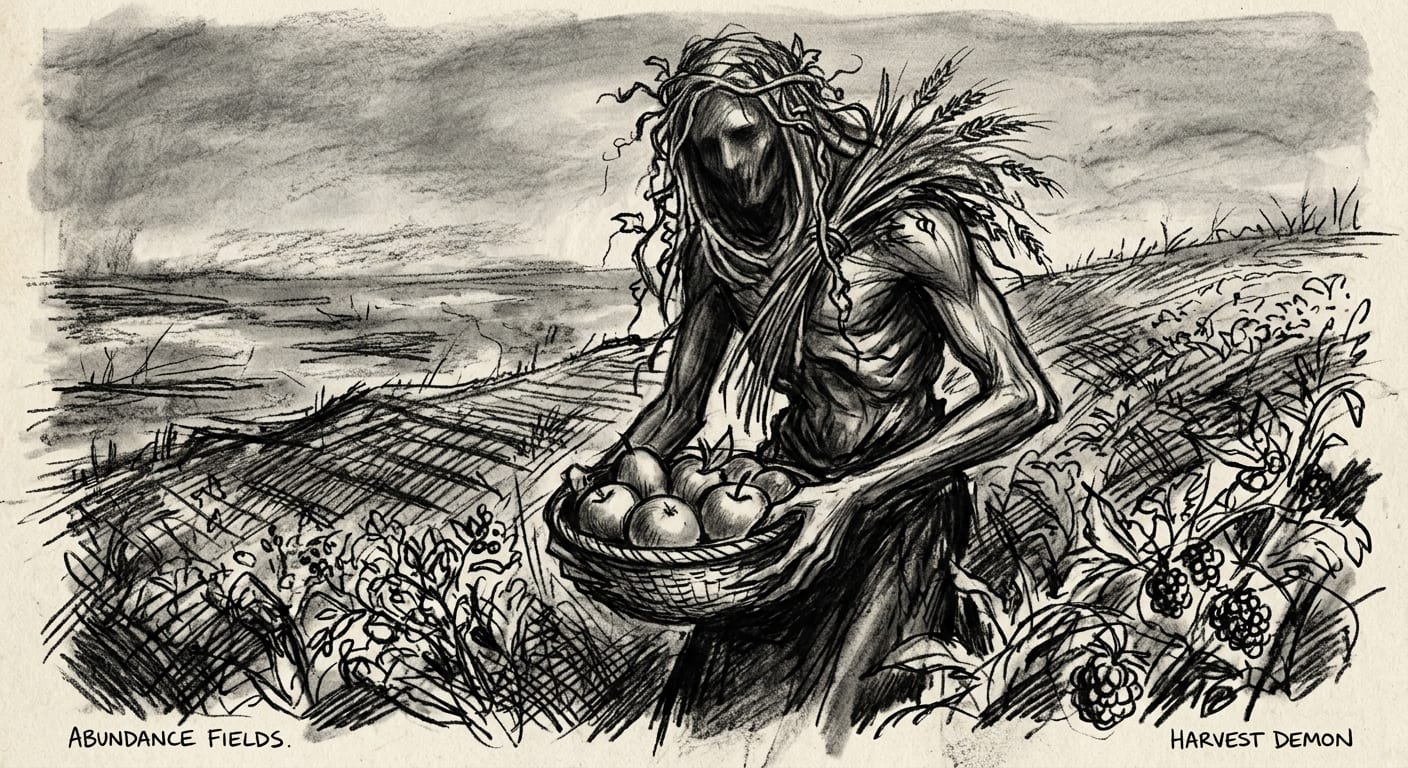
The Bureau of Doctrine classifies these tenders as "The Harvest" — demons of Kargath's host that manifest as agents of agricultural provision. They look like salvation. Lush fields spring up in their wake — grain where there was mud, orchards where there were corpses, meadows blooming in the path of creatures whose passage should sterilise the soil. A column of Harvest demons crossing empty ground will leave behind it a mile-wide strip of farmland so fertile that it appears, to the starving eye, as a corridor of grace, a reprieve sent by Providence, all sins forgiven by the simple fact of food.
The Harvest do not fight. They grow. They tend. They offer. The Bureau of War's standing tactical assessment classifies them as "non-combatant, extreme threat" — a classification that baffles new officers until they understand that the Harvest's weapon is not violence but generosity, and that generosity, in Kargath's lexicon, is the most efficient form of murder.
The Harvest Engines are worse. Agricultural machines — ploughs, threshers, seeders — corrupted or constructed by Kargath's forces, producing impossible yields in any season, any soil, any condition. Communities that acquire a Harvest Engine, whether through salvage, trade with eastern refugees, or the more insidious channels the Bureau of Purity monitors with diminishing success, prosper immediately. Grain stores fill. Rationing ends. Children stop crying. The Bureau receives reports of miraculous harvests and dispatches investigators who arrive to find villages so flush with food that the inhabitants have stopped counting, stopped praying, stopped performing the Litany of Sufficiency that the Bureau of Doctrine mandates precisely because sufficiency, in the Synod's territory, must be liturgical rather than caloric.
Then the hunger begins. The produce is Abundance Fields produce — real, tangible, measurable, and empty where it counts. The communities that use Harvest Engines prosper briefly and starve surrounded by plenty. The Bureau of Relics maintains that properly blessed food cannot carry Kargath's curse. Field evidence says otherwise. Blessed food from the Abundance Fields is still cursed. The blessing passes over the surface like oil over water. The Bureau of Relics has not revised its position. The Bureau of Relics does not revise positions; it revises the evidence, which is a skill the Bureau of Relics shares with the Bureau of Doctrine, and which I describe without irony, because irony is a luxury the eastern garrisons cannot afford.
#On the Doctrine of Enough
"Desire more than your ration and you desire the Enemy's table." — Catechism of Restraint, Stanza 12
The Synod's response to the Abundance Fields is, as the Synod's responses to most existential threats tend to be, doctrinal.
The Doctrine of Enough — formalised in the Catechism of Restraint, revised by a later Doctrinal commission in A.S. 189, and distributed to every garrison chapel, mess hall, and ration office from the Channel to the Bosphorus — teaches that desiring more than one's allocated share is itself a form of demonic commerce. Contentment with rations is holy. Hunger for more is sin. The Doctrine does not distinguish between the soldier who desires a second portion because his first was half a crust, and the merchant who desires a second warehouse because his first is already full. Both are, in the Doctrine's framing, engaging in the same transaction: they are borrowing from Kargath's table, and the interest rate is their soul.
The practical instruments of this doctrine are familiar to anyone who has served in the eastern garrisons or, for that matter, lived in any Synod settlement larger than a hamlet. Rationing as discipline. Fasting as prayer. Communal meals to prevent hoarding. Public execution of hoarders — their stores redistributed, their bodies immured in bakery walls as reminders that bread itself has witnesses. The Ration Parliaments, the Queue Road bell-windows, the ash-credit economy — all of it, at root, is the Synod's attempt to make "enough" a theological category rather than a caloric one, because the caloric category keeps being redefined by an Enemy who produces food faster than the Synod can teach its citizens not to eat it.
The Triumph of the Gaunt — that grotesque spring festival in which the thinnest citizens are crowned with iron wire and the fattest are flogged as carriers of "treacherous abundance" — is the Doctrine's theatrical expression. Mothers starve themselves to ensure their children appear suitably skeletal. The Bureau of Doctrine insists the festival builds spiritual resistance to Kargath's temptations. The Bureau of Medicine, in a memorandum I was not supposed to see, describes the festival as "a public rehearsal for the kind of death the Abundance Fields inflict, performed voluntarily and celebrated as piety."
I filed the memorandum. I did not respond to it. Some truths are best administered in silence.
#On the Present Condition
The Abundance Fields are expanding.
This is the sentence the Bureau of War has asked me to phrase differently for the past three annual reports. I have declined. The Fields are expanding. They are expanding because the Blightmarsh is expanding, and the Fields occur at the Blightmarsh's edge, and the edge is moving westward at approximately one hundred and forty square miles per year. Where the grey mud advances, the Fields advance ahead of it — outriders of fertility, the bait before the jaw.
AB-17, confirmed in A.S. 200, sits thirty-eight miles from the Sagittal Line's outer observation posts. Sentries at Kestrel-4 report the bread-smell on west winds three days in five. The Bureau of Medicine has established a permanent olfactory assessment station at the post — a clerk with a logbook who records wind direction, smell intensity, and the number of personnel who request reassignment after their shift. The requests are denied. The Bureau of War cannot afford to rotate personnel every time the wind carries a promise it has no intention of keeping.