
#On the River That Became an Organ
The Drava was once a river, which is to say it possessed direction, banks, crossings, fisheries, mills, local quarrels, drowned boys, ferry fees, and all the ordinary municipal sins by which water enters civilisation. It ran through the southern plains with enough discipline for maps to trust it and enough commerce for men to lie about tolls beside it. Bargemen knew its moods. Farmers cursed its floods. Children learned its shallows. The Bureau of Records still marks it as navigable on certain inherited plates, because ink has a touching loyalty to extinct conditions.
The Drava now seeps through Kargath's dominion like broth through a grave-cloth.
What remains of the river is the central artery of the Blightmarsh, yellow-grey, warm in winter, cold at noon, smelling of meat left under a chapel step until theology gives up and calls the janitor. It carries sediment, grease, corpse-froth, ash, softened timber, coins without faces, and certain matters the Bureau of Alchemical Standards has classified above parish confidence. Its banks are ridges of compacted grey matter that shift overnight. A ford recorded on Monday may have moved by Tuesday, vanished by Wednesday, and returned on Friday behind the patrol sent to inspect its absence.
#On Its Former Course
Before the great eastern ruin, the Drava watered grain country. The phrase deserves a pause. Grain country: that blessed administrative category where soil behaves, peasants complain, tax estimates ripen, and every harvest proves the Creator's affection for ledgers. The southern Pannonian plain fed provinces, caravans, garrisons, winter stores, and the little black market by which every official economy confesses a pulse.
Then Gluttony arrived.
The old accounts disagree on whether the first corruption came through flood, famine, or rite. One doctrinal tradition names a Glutton-priest who gorged himself upon Covenant grain and spat it back into furrows until the soil learned appetite. A military account speaks of Kargath's passage through the Drava and Sava (Unregistered) valleys, where villages drowned in bile-swollen water and herds burst in their stalls. Dossier Carmine, less theatrical and more useful, records boundary creep, post-passage famine, and Drava distortion as one process wearing three clerkly hats.
Earlier geography primers described the Drava basin as “flooded agricultural territory under hostile occupation.”
Corrected. Flooding implies water has trespassed. The Drava basin was consumed. The wetness is digestive.
The distinction matters. A flood recedes. Occupation can be ended by victory or paperwork pretending to be victory. Consumption leaves no prior state waiting nobly beneath the mud. The fields did not drown intact. They were altered into material. Root, worm-channel, mineral, ditch, plough-line, chapel-yard, orchard bone, cellar stair: all drawn into the same grey appetite.
#On the Present Water
Water is the wrong noun, but the Ledger tolerates wrong nouns when no correct noun can be stamped without scandal. The Drava's fluid has measurable wetness, conducts certain salts, accepts barges of a sort, reflects light when light has been sufficiently threatened, and drowns men with impressive punctuality. These are river-like behaviours. They are also behaviours of soup, blood, industrial slurry, and a wound being rinsed badly.
The colour varies between rendered fat, old pewter, candle smoke, and the underside of meat. The surface froths in slow patches that form rings, eyes, mouths, or alphabets according to the observer's rank and breakfast. Patrol manuals instruct men not to interpret surface patterns. Patrolmen interpret them anyway, because the human brain is a seditious organ and should never have been issued without supervision.
Sound travels poorly above the Drava and too well below it. A shouted order dulls after ten paces. A spoon dropped from a patrol boat may be heard tapping under the hull for an hour. Bells on the western watch stations arrive to the ear thickened, delayed, and faintly chewed. The Bureau of Bells objects to that adverb. The river does not.
The barges are worse than the current. Low, wide, tarpaulin-covered, crewed by shapes the sealed accounts decline to stabilise into species, they move toward the Cauldron Citadel and away from it, conveying matter from Marsh to Pot and Pot to Marsh. Some cargo kicks. Some weeps. Some is already portioned. The Citadel's economy uses the river as throat.
#On Harlen and the Three Maps
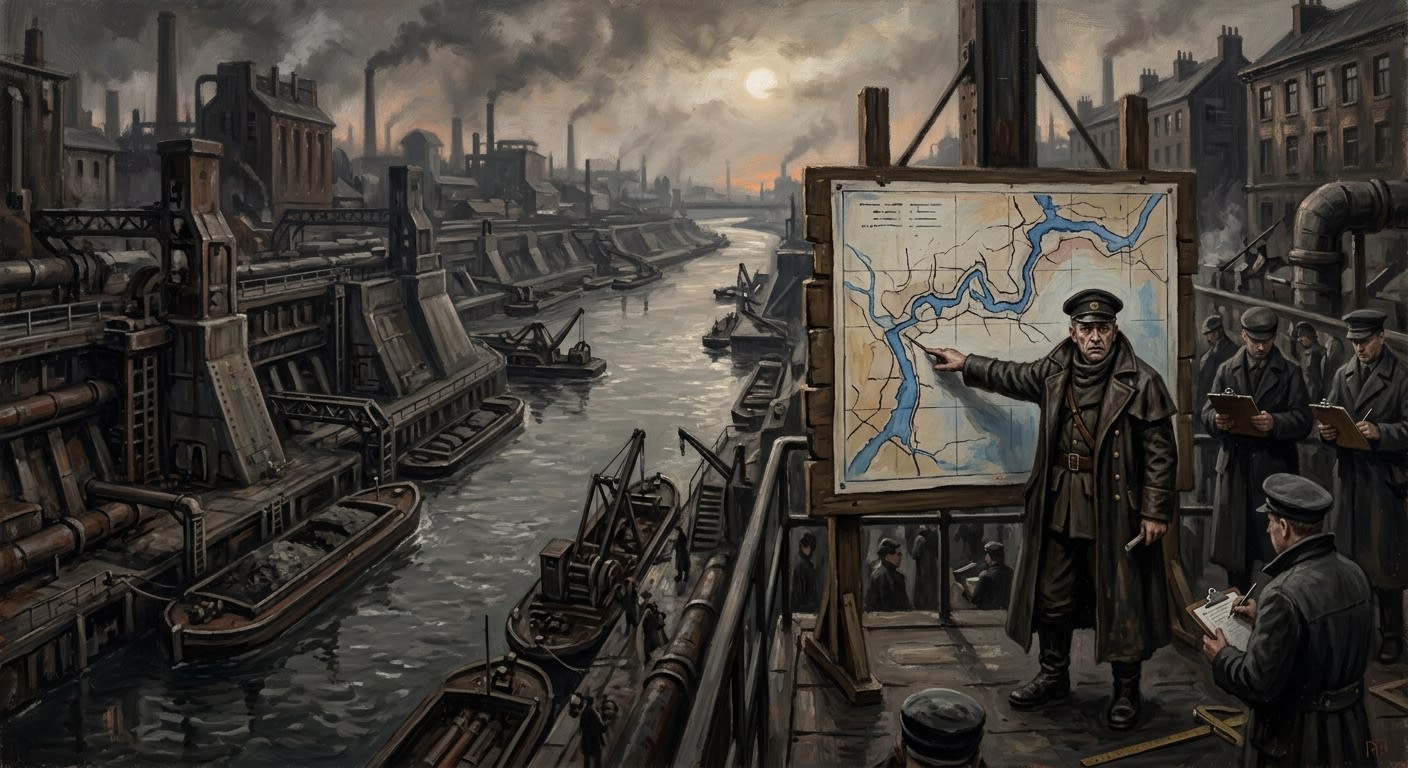
Adept Harlen of the Bureau of Cartography was lost in A.S. 174 during the Drava survey, and by lost I mean the river accepted him while he was standing. The surviving party brought back three maps, no agreement among them, and the usual official craving for a tidy death.
The expedition had been ordered to reconcile the river's western course after patrol reports suggested lateral instability. Soldiers called it wandering. A chaplain called it hunger seeking a lower pew. Harlen carried brass sighting rods, waxed notebooks, a surveyor's transit, and the Bureau's confidence, which weighed less than his lunch and nourished nobody.
Map A bends the Drava north toward ruined orchards. Map B sends it south through a village no approved file admits. Map C shows the party crossing the same ford twice from opposite directions, with Harlen's last position written in a hand the survivors denied. Cartography sealed the maps separately, as if vellum can be prevented from arguing by placing it in different drawers.
MAP C MARGINALIA — LOWER DRAVA SHEET “Harlen visible at second ford before loss event.” “Harlen visible at second ford after loss event.” “Harlen visible at ███████████████████.” Ink analysis: same pen, same day, same hand. Witness signatures removed under Seal Amber.
In A.S. 200, Observation Post Kestrel-11 (Unregistered) sighted a figure waist-deep in the Drava, transit raised, facing east, unchanged by twenty-six years. The patrol did not approach. The patrol commander deserves a medal for cowardice, that least celebrated virtue and often the only one with living witnesses.
Records has not amended the file. Harlen remains deceased for fiscal purposes. The figure remains unidentified for doctrinal purposes. The Drava retains him for purposes of its own.
#On Clocks, Spurs, and Duration Complaints
The Drava's offences are not limited to matter. It also insults time, and time, unlike soil, has influential friends.
In A.S. 130 a rail crew on the Drava spur filed the first complaint that made the later Bureau of the Hourglass necessary. By all clocks, the run lasted four hours and eleven minutes. By every crewman's account, it lasted nine. Engineering blamed drink. The file was closed, reopened, closed, reopened, and eventually became too repetitive to remain embarrassing. By A.S. 134, the Synod had constituted an office to measure what Doctrine had already announced could not be wrong.
The original Engineering inspection attributed Drava spur timing discrepancies to intoxication, humidity, operator error, and poor diet.
Corrected by subsequent Hourglass review. The clocks were not drunk. This disappointed several inspectors, who had prepared the cheaper report.
Drava time is not Syrion's perfect province; that honour belongs further east in the Vales of Stagnance and around Bastion-Shipka. Yet rot, fog, rail, river, and fear meet badly along the southern feeder lines. A crew may lose hours without losing distance. A dispatch may arrive before its seal warms. A corpse recovered from the bank may bear rigor appropriate to three days and boots wet from the current minute. The Drava does not govern duration. It contaminates the appetite by which duration orders itself.
#On the Cauldron's Throat
At the Drava's approximate centre — approximate being the only honest cartographic virtue left in that region — the river thickens around the Cauldron Citadel. The Citadel is Kargath's civic stomach: market, bakery, slaughterhouse, rendering works, law court, oven, and municipal joke told with knives. The Drava brings it material. It sends material away refined into further hunger.
No memorandum admits the elegance of the system. Hell has built logistics. Not the beautiful nonsense of banners and trumpets, but logistics in the true form: movement, conversion, return, accounting. Barges feed the Pot. The Pot feeds the Marsh. The Marsh feeds Kargath. Kargath remains hungry. Dossier Carmine needed a century and a half to discover that this sentence, obscene in its brevity, was enough.
Bombardment proposals that mention damming the Drava deserve preservation in a museum of brave stupidity. Damming a river requires banks, flow, engineers, materials, labour, time, and a river that accepts being interrupted. The present Drava offers none of these, except labour if one counts the dead, which Kargath counts with relish.
#On Patrols and Edge Doctrine
The western edge of the Drava basin is watched from posts whose personnel are rotated more quickly than the paint dries on their warning boards. Kestrel stations, boundary stakes, half-sunk observation towers, rope-marked approaches, and boat teams under Seal Amber keep a line that is not a line so much as a negotiated refusal. No fortification lies within four miles of the active Marsh edge if its commander retains both doctrine and sanity.
Patrol doctrine is a catalogue of prohibitions. Do not drink. Do not sample. Do not answer names. Do not interpret bubbles. Do not recover cargo unless ordered by someone whose signature can be used at trial. Do not trust a bank that formed after breakfast. Withdraw any soldier reporting unusual appetite, unusual thirst, or fondness for the surface pattern. Shoot livestock before it wanders east. Burn grain before retreat. Refuse every impossible harvest.
The last instruction belongs to the Abundance Fields, which bloom near the Marsh's margins and in the Drava lowlands with criminal generosity. Food appears where no sowing occurred. Bread-smell crosses distance. Fruit hangs perfect. The belly fills and the body starves. A.S. 174 recorded one of the early Drava lowland communities found dead among plenty, pews full, altar stacked with loaves, mouths still working.
#On Present Classification
As of A.S. 201, the Drava is entered under three incompatible authorities: Cartography treats it as unstable geography; War treats it as hostile terrain; Doctrine treats it as evidence. Records, brave little corpse that it is, still keeps the old navigational plates in a lower drawer and pretends revision is imminent.
The river's western creep remains under review. Its old course remains visible in inherited maps, local memory, and the shapes of ruined bridges now standing over mud that may be water if addressed politely by an idiot. Its present course is best understood by smell, casualty radius, and the direction of barges moving under tarpaulin toward smoke.
There is no clean ending to a river that has ceased being clean. The Drava does not flow from source to mouth. It seeps from loss to appetite, from swallowed farms to the Cauldron, from map error to pension dispute, from old water into the present hunger gnawing at the Line. It is Kargath's artery and our warning, pulsing under grey skin where Europe used to eat.