
#On the Name
"The Bureau of Cartography has no official designation for this territory. The Bureau of Records refers to it as 'Former Agricultural Zone East-7, Status: Suspended.' The Bureau of War calls it 'the Operational Void.' The soldiers who have stood at its edge and watched the mud breathe call it the Blightmarsh. The Bureau, in its infinite flexibility, has adopted the soldiers' term — precision, in this case, would require a sentence no committee could ratify without three members requesting sick-leave." — Drax, Codex annotation, A.S. 199
I have set my pen to this entry four times. On the first occasion I produced eleven pages of careful theological exposition which the Bureau of Doctrine returned with the word inadequate stamped across the title-page in ink the colour of dried blood. On the second occasion I produced nine pages of operational briefing which the Bureau of War returned unstamped and unread, with a note from a junior clerk suggesting I consult "someone who has actually been there." On the third occasion I consulted someone who had actually been there — a Sergeant Vell of the Thracian Survey, seconded to Bastion-Constantinople's eastern observation post — and what he told me I wrote down in six pages which I then burned in my own grate because I could not sleep with them in the room.
This is the fourth version. It is shorter than the others. It says less. The Bureau will prefer it.
#On What Was Lost
The plains of Hungary fed three empires before the Sundering. This is the sentence the Bureau of Agriculture used to begin every one of its eleven reports on projected recovery timelines, filed between A.S. 145 and A.S. 155, and it is a sentence so precisely calibrated to inspire false hope that I suspect a Doctrinal hand in its drafting. Three empires. The wheat-sea of Pannonia, where the grain grew tall enough to lose a child in and the harvest caravans stretched from Debrecen to the Danube in unbroken lines of golden dust. The orchards of the Tisza valley. The cattle-runs of the Alfold, where the grass was so thick that drovers' boots left no mark and the air smelled of clover from April to October.
I record these details because they are in the Bureau's files and because someone ought to say what was eaten before describing the eating.
The Sundering broke the Balkans open on All Saints' Day, A.S. 45, and Kargath came through the wound like bile through a burst intestine. The Battle of the Iron Plains — which the Bureau has never satisfactorily explained in any document rated below Clearance Seven — consumed whole divisions in fire from a cloudless sky. At Debrecen, a hundred thousand men broke and fled when their rations were devoured by forces the commissariat ledgers describe, with the particular cowardice of administrative language, as "atmospheric spoilage of unprecedented scope." The commissariat clerks who wrote those words had watched bread turn to ash in men's hands. They had watched water curdle in canteens. They had watched, if the sealed testimony is to be credited, soldiers eating their own leather and then each other and then things that the Bureau of Records declines to specify.
Within a decade the retreat had passed westward over the plains, and within two decades the plains themselves had begun to change. The Bureau of Agriculture's first report, filed A.S. 145, noted "anomalous soil depletion inconsistent with known agricultural failure models." The Bureau's eleventh report, filed A.S. 155, noted "total biotic cessation across Former Agricultural Zone East-7, extending to subsoil strata, consistent with no known natural process." The Bureau of Agriculture was dissolved in A.S. 158. Its records were transferred to the Bureau of Records. Its staff were transferred to the Paper Mines of Ulm. Its final recommendation — that a joint theological-agricultural expedition be mounted to determine "the precise mechanism by which soil itself can be consumed" — was stamped DEFERRED INDEFINITELY and filed in the cabinet in the Strasbourg basement, next to the agricultural survey and the missing key.
Earlier editions of this Codex included a map of the Blightmarsh's expansion, with projected boundaries through A.S. 200, prepared by the Bureau of Cartography in A.S. 163.
The map has been withdrawn. The projected boundaries were exceeded by A.S. 178. The Bureau of Cartography has revised the Marsh's western edge seventeen times in forty years. Each revision moves it closer to the Sagittal Line. The Bureau of War declines to comment on the trend. The Bureau of Doctrine considers the trend "theologically consistent." I consider the trend grounds for a stiff drink, but I am told that editorial candour of this variety is not what the Codex requires.
#On the Geography of Appetite
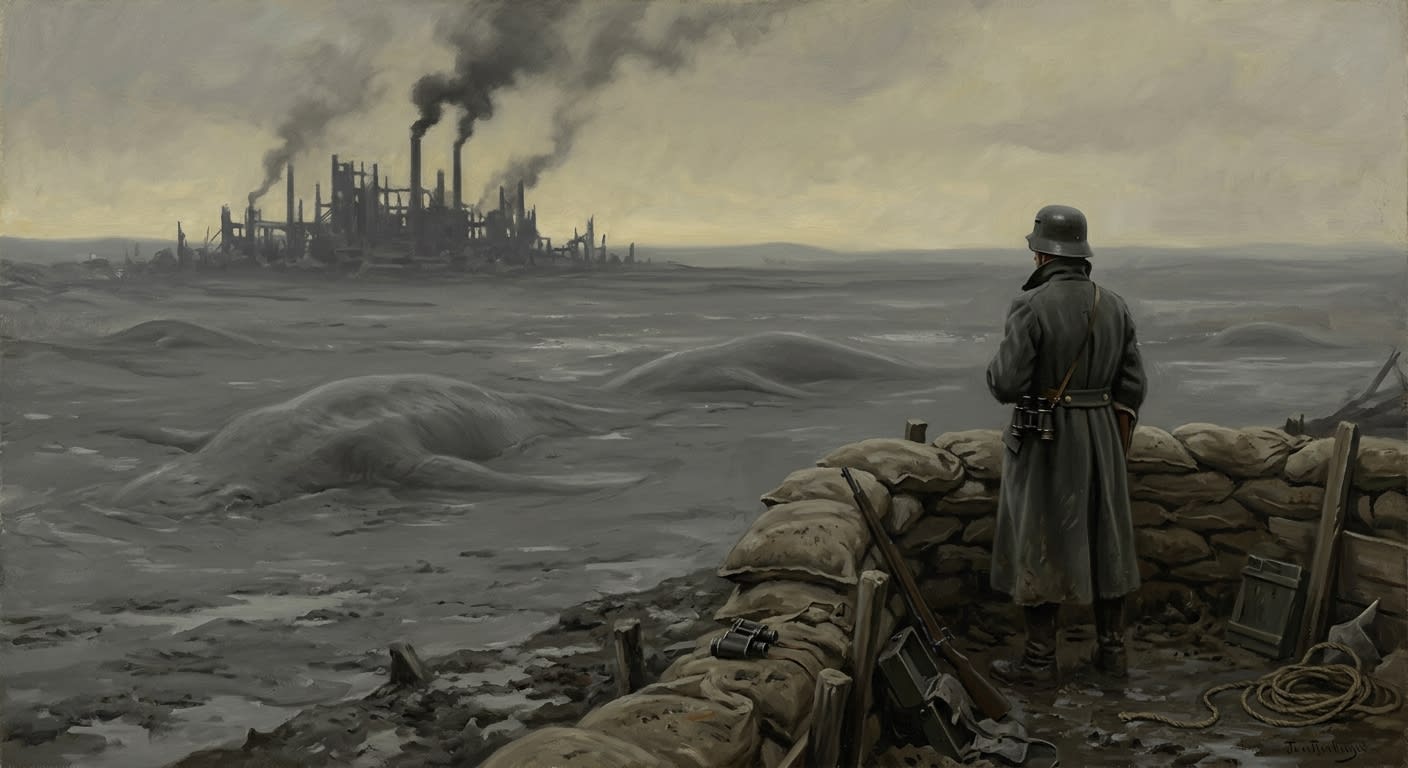
The Blightmarsh is not, in any sense the Bureau can make useful, a marsh. A marsh implies water, reeds, the slow work of silt and season. What occupies the former plains of Hungary is something else — a landscape eaten rather than flooded; devoured rather than reclaimed. The distinction matters. Reclamation can be reversed. What Kargath has done to this ground cannot.
Grey mud. Grey water. Grey sky. The colour palette of the Blightmarsh is the colour of old meat — the specific grey that flesh achieves when all the blood has drained and the fat has rendered and what remains is neither solid nor liquid but a substance the Bureau of Alchemical Standards classifies, with admirable economy, as "post-organic sediment." The mud extends from the Drava river basin eastward across what was Pannonia, southward through what was Slavonia, and northward toward the foothills of the Carpathians where the ground is still solid enough to hold a boot-print and the air still carries enough oxygen to sustain a sentry for a full watch without supplementary apparatus.
The soil has been consumed. The Bureau of Agriculture's final report established this with the meticulous thoroughness of men who knew their careers were over and wished, at minimum, to be accurate about why. Core samples taken from depths of thirty, sixty, and ninety feet revealed the same finding: the organic matter, the mineral composition, the microbial life, the root structures, the worm-channels, the thousand small interlocking systems by which soil sustains itself — all absent. Replaced by a uniform grey substrate that the Bureau's chemists could not classify because it did not correspond to any known compound. It was not sterile. Sterility implies the absence of life. The substrate was occupied. Something lived in it. Something vast, slow, distributed across the entire plain like a single organism the size of a nation.
Shapes move beneath the surface. This is confirmed by seventeen independent observations filed between A.S. 160 and A.S. 199, each accompanied by the observer's signature and, in four cases, the observer's subsequent request for reassignment to any posting not adjacent to the eastern front. The shapes are large. The Bureau of War's classification — "Sub-Surface Entities, Category Unassigned" — is characteristically uninformative. What the observers describe is movement: slow undulations in the mud, as of something vast turning in sleep; sudden collapses where the surface drops six or eight feet and then rises again, wet and steaming; and mouths. Mouths that open in the grey mud like wounds in flesh, that gape for a minute or an hour, that swallow whatever has ventured across them — a patrol, a wagon, an observation balloon that drifted too low — and then close again with a sound that every observer, independently, describes as chewing.
The Marsh expands. This is the detail the Bureau least wishes to publicise and the detail the Codex most requires. At its recorded western edge in A.S. 163, the Blightmarsh occupied approximately twelve thousand square miles of former agricultural land. By A.S. 178, the figure had risen to sixteen thousand. By A.S. 190, to nineteen thousand. The current estimate — and the Bureau of Cartography insists it is an estimate, as no surveyor has been willing to approach the eastern boundary since A.S. 185 — is twenty-three thousand square miles and expanding at a rate of approximately one hundred and forty square miles per year, which is to say that the Marsh consumes roughly the area of a medium-sized Synod parish every twelve months, and it does so without the courtesy of announcing its advance to the inhabitants.
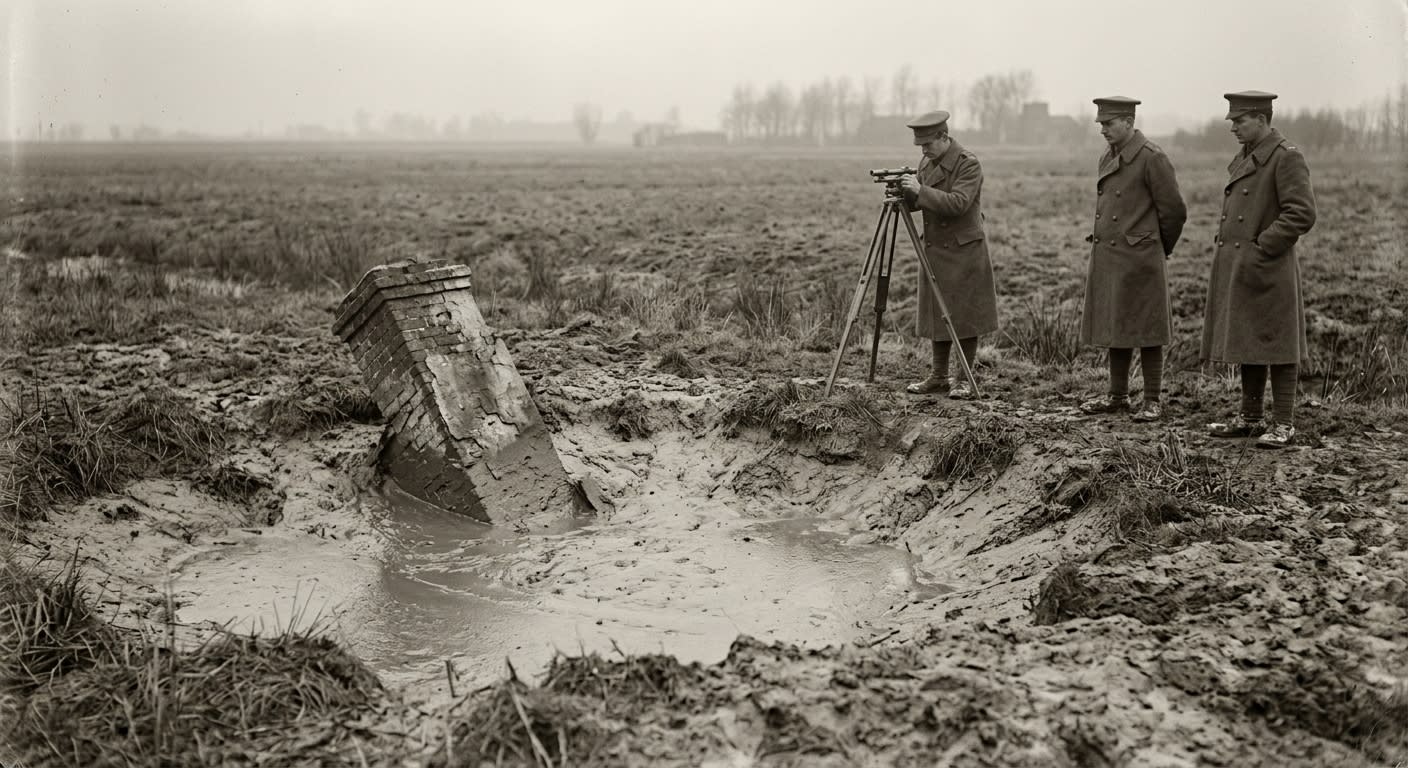
Farmland at the Marsh's edge does not flood. It sours. Crops yellow from the roots upward. Livestock refuse their feed, then refuse water, then stand in their pens with their heads down and their sides heaving until they drop. Wells produce water that tastes of copper and bile. The topsoil loses its colour, its cohesion, its capacity to hold a plough-blade. Within a season the fields are grey. Within two seasons they are mud. Within three they are Blightmarsh, and the farm that stood on them is a shape half-buried in grey sediment, its chimney still visible, its windows dark, its pantry — if any fool is brave enough to enter — stripped bare and gnawed to the joists.
#On the Drava and the Cauldron
The River Drava — which once ran clean through the southern plains and which the Bureau of Records still marks on its maps as a navigable waterway, a fiction maintained for reasons I can only describe as institutional nostalgia — is the Blightmarsh's central artery. The river does not flow. It seeps. The water is the colour and consistency of meat-broth left three days in the sun, a yellow-grey froth that carries things the Bureau of Alchemical Standards has tested and declined to name in documents rated below Clearance Six. The banks are ridges of compacted grey matter that shift with the current and reform overnight. Bureau surveyors who attempted to chart the Drava's course in A.S. 174 returned with three irreconcilable maps and one surveyor fewer than they had deployed.
At the Drava's approximate centre — and "approximate" is the only honest modifier, since the Marsh reshapes itself with an appetite that extends to geography — stands what the Bureau of Doctrine calls the Cauldron Citadel. Assembled from the fused ruins of drowned cities, its stacks belch perpetual smoke above the Marsh in columns visible, on clear days, from the walls of Bastion-Constantinople itself. The Citadel is Kargath's forward infrastructure, or the nearest thing to infrastructure that Gluttony produces: a processing centre, a rendering works, a stomach the size of a city where what the Marsh has consumed is broken down and redistributed as raw material for further consumption. Intelligence on the Citadel's interior is limited to what a single Bureau of Shadows operative reported before his capture in A.S. 188 — a report of nine pages, of which seven were immediately classified Seal Amber and two were read aloud at a closed session of the Bureau of War from which three attendees subsequently requested indefinite leave.
What the report described, in the two pages I am permitted to reference, was a city that functioned. Markets operating. Bakeries running. Slaughterhouses working without pause. The economy intact — currency replaced by caloric exchange, a life worth precisely what it could provide when rendered. Everything measured by the food-value of its destruction. And everyone, from the labourers in the rendering pits to the overseers on the catwalks, starving. Eating constantly. Working constantly. Producing constantly. And starving, every one of them, with the specific hollow desperation of creatures that know the next meal will not help and cannot stop reaching for it.
The Bureau of War has been presented with the Cauldron Citadel's location on three separate occasions. The Bureau of War has declined to act on each occasion, citing "insufficient operational confidence." I note this phrase. I have heard it before. It is the phrase the Bureau uses when it means something it does not wish to commit to paper.
#On the Famine Pits
Scattered across the Blightmarsh's territory are the mass graves of the Sundering era — the pits into which the dead of A.S. 45 through A.S. 55 were thrown in their thousands, covered over with whatever earth was available, and left to the jurisdiction of whichever Bureau could be persuaded to claim them. The Bureau of Rites performed rites over the nearest. The Bureau of Records documented the rest. The Bureau of War designated them as impassable terrain features, which is the only honest assessment any Bureau has offered on the subject.
The dead in those pits did not die of wounds. They died of hunger. The Great Retreat stripped the eastern provinces bare — the armies ate what the refugees had left and the refugees had left little, because Kargath's advance had eaten the land before the armies arrived. Thousands starved in the open, on roads that led west, clutching children who had stopped crying because crying requires calories the body could no longer spare. They were buried in trenches, in shell-craters, in the cellars of abandoned farms, in anywhere deep enough to hold them. The rites were abbreviated. The records were incomplete. No one had the strength for a proper burial when the living were still dying faster than the chaplains could absolve them.
What the Bureau understands now — and has understood since A.S. 120, when the first patrol reported the phenomenon — is that the hunger of the dead did not entirely die with them. The Pits are loci of pure need. The want of the long-dead radiates outward in concentric waves that the Bureau of Alchemical Standards has measured with instruments designed for detecting relic emanations and which register, in the Pits' vicinity, readings the instruments' designers insist are "impossible and therefore incorrect." Stand near a Famine Pit and the stomach cramps. Stay an hour and the cramps become convulsions. Stay a day — no one has stayed a day voluntarily; the data comes from prisoners, and I am told to note that the Bureau of Doctrine did not authorise the experiment and does not endorse its findings — and the body begins to consume its own reserves as though it has not eaten in weeks, regardless of what has actually been consumed.
Fourteen Famine Pits have been confirmed within the Blightmarsh's current boundaries. The Bureau of War suspects more — the Marsh's expansion has swallowed territory where mass burials are known to have occurred — but confirmation requires proximity, and proximity requires volunteers, and the Bureau's supply of volunteers for eastern reconnaissance has been, since A.S. 190, what the quartermaster's office describes as "structurally inadequate."
#On the Abundance Fields
I have written of the Abundance Fields in the parent entry on Kargath and I am instructed to expand here, though expansion, in this context, feels obscene. The Fields are Kargath's cruelest instrument. They require their own entry in this Codex, and they will receive one; what follows is their geographic relationship to the Blightmarsh and the operational threat they pose to the Sagittal Line's eastern garrisons.
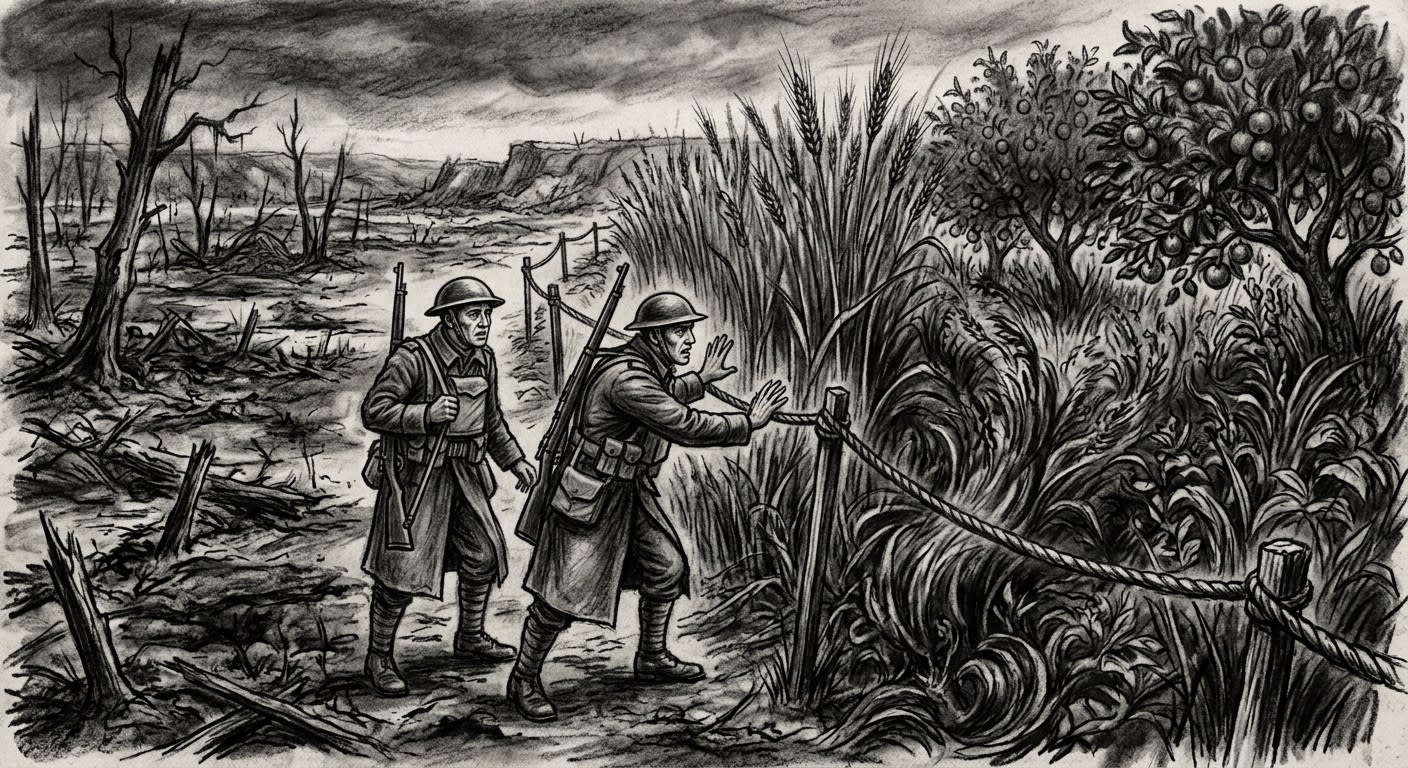
The Fields occur at the Marsh's edges — specifically, at the boundary where grey mud gives way to arable land. They appear as patches of extraordinary fertility: crops growing where no seed was sown, orchards fruiting out of season, meadows blooming in colours the Bureau of Agriculture's surviving staff describe as "aggressive." The Fields are beautiful. The Bureau of Doctrine has classified their beauty as a Category One Moral Hazard, which means it is beautiful enough to kill.
Refugees see the Fields from the roads. Soldiers see them from the walls. Both groups, under sufficient duress, walk toward them. The crops are real. The fruit is tangible. It can be picked, cooked, eaten. And it does nothing. The belly fills and the body starves. The hunger doubles with each meal. Four confirmed Synod communities — hamlets at the Marsh's edge, too remote for regular supply — were found dead surrounded by abundance, their root-cellars full, their tables set, their bodies wasted to the bone, their mouths still working.
#On the Vigil Ark Disaster
In A.S. 147 — four years after the Year of Ash Rain, when Maldrake's Thracian fires had darkened the sky above Bastion-Constantinople for eleven days and the entire southern theatre was operating under emergency rationing — the Vigil Ark Sanctissima Vox was dispatched on a broadcast mission over the Blightmarsh's northern extent. The Ark was to project hymnal frequencies across the Marsh in an experimental attempt to disrupt what the Bureau of Bells had classified as "anomalous acoustic absorption" — the Marsh's tendency to swallow sound, to deaden hymns, to return prayers as silence or, in three confirmed cases, as something that was not silence but was worse.
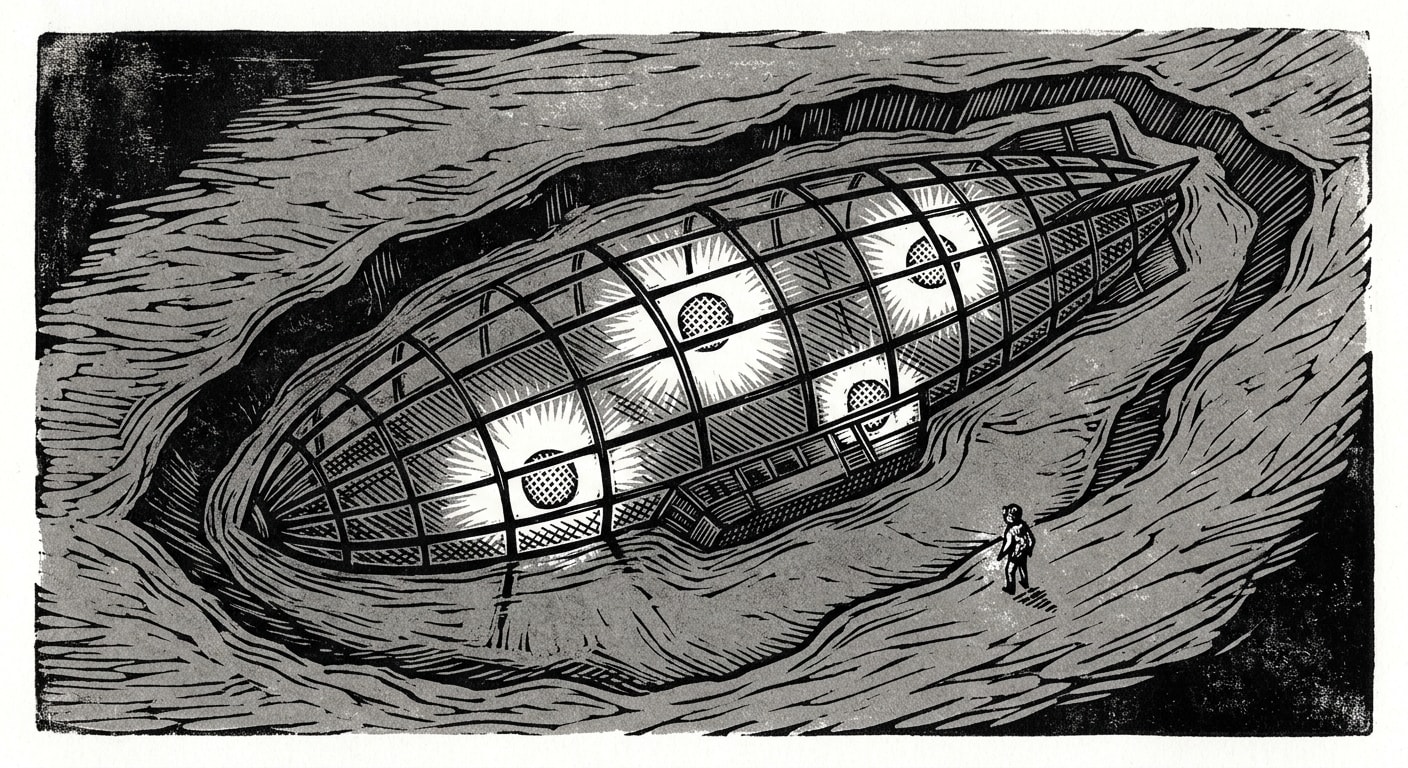
The Sanctissima Vox crossed the Marsh's boundary at dawn. By midday its signal had degraded. By evening its candles — the relic-lanterns that powered its broadcast — had aged centuries in minutes, their wax flowing like water, their wicks crumbling to powder. The Ark fell. It fell slowly, which is the specific horror of the account: a settling rather than a plunge, as though the air itself had become too heavy to hold it, as though gravity in the Marsh operated on a different schedule than gravity elsewhere. The wreckage embedded in the grey mud at a point the Bureau of Cartography estimates as seventeen miles east of the current boundary. Survivors — three, of a crew of forty-one — were recovered by a patrol that violated standing orders to reach them. What the survivors reported was classified Seal Amber. What I am permitted to record is this: the sermon the Ark had been broadcasting accelerated as the candles died, the words compressing into a continuous tone that the survivors described as thunder, then a scream, then something that was neither thunder nor scream but was hungry, and then silence.
#On the Mire Collapse
In A.S. 172, the Blightmarsh expanded with a violence that the Bureau of War's operational records describe as "a significant deviation from projected advance rates" and which the soldiers who survived it describe with language I cannot reproduce in a Codex rated below Clearance Seven. The Mire Collapse of Debrecen — named for the already-fallen city at its epicentre — consumed a forward observation regiment of eight hundred men in approximately six hours. The mud did not rise. It opened. Fissures split the grey surface in lines that the surviving cartographer mapped, under sedation, as corresponding to the streets of pre-Sundering Debrecen — as though the Marsh remembered the city it had eaten and chose to re-enact the eating. From the fissures came things. The Bureau of Doctrine's classification — "Maw-Born, sub-surface variant, Category Unassigned" — says nothing useful. What came from the fissures was hunger given shape: mouths the size of gun-carriages, throats that opened vertically from the mud, a sound of chewing so vast that the sentries at Bastion-Constantinople, forty miles distant, reported hearing it as a low vibration in the walls.
The regiment was consumed. Consumed is the Bureau's word. I use it because the alternatives are worse. The Bureau of War designated the site as a permanent exclusion zone. The Bureau of Records amended its maps. The Bureau of Doctrine composed a memorial service which I was instructed to deliver at Bastion-Constantinople's main chapel on the Feast of Doctrinal Submission, and which I delivered with the specific detachment that the Bureau cultivates in its officers and which I have come, over the decades, to recognise as a form of controlled screaming.
Earlier editions of this Codex reported the Mire Collapse as occurring in A.S. 175.
The correct date is A.S. 172. The error arose from a filing discrepancy in the Bureau of Records' Eastern Section, where the report was catalogued under "Debrecen — Terrain Reclassification" rather than "Debrecen — Catastrophic Loss of Personnel." The Bureau of Records has been asked to explain the discrepancy. The Bureau of Records has explained that "terrain reclassification" and "catastrophic loss of personnel" are, in the eastern sector, frequently the same event.
#On the Present Condition
The Blightmarsh, as of A.S. 201, occupies approximately twenty-three thousand square miles of former agricultural land and is expanding. The Bureau of War maintains a perimeter of observation posts — the Kestrel series, numbered 1 through 14, of which three are currently unmanned due to personnel shortages the Bureau attributes to "administrative scheduling conflicts" and which the garrison attributes to the fact that no one will volunteer for a posting where the ground eats people.
The Marsh is quiet. This is the detail I wish to close on, because it is the detail the Bureau most consistently omits from its public materials and the detail that, in my judgment, matters most. The Blightmarsh does not roar. It does not burn. It does not send armies across its boundaries in formation. It waits. It expands at the pace of a man walking slowly — one hundred and forty square miles per year, the area of a parish, the area of a life's work ploughed under grey mud. It swallows farmland in silence. It absorbs patrols without announcement. It grows, meal by meal, field by field, toward the Sagittal Line, and it is never full, and it is never finished, and the hunger that drives it is the same hunger that drives Kargath himself: need without end, consumption without satisfaction, the void that grows with feeding.
The Bureau of Doctrine considers the Blightmarsh "theologically consistent with established models of Gluttony manifestation." The Bureau of War considers it "an operational challenge requiring ongoing assessment." The soldiers at the observation posts consider it the mouth of something that has not yet decided to swallow them.
I have reviewed all three positions. I find the soldiers' assessment the most theologically sound.