
#On the Litany Named at Wormwood
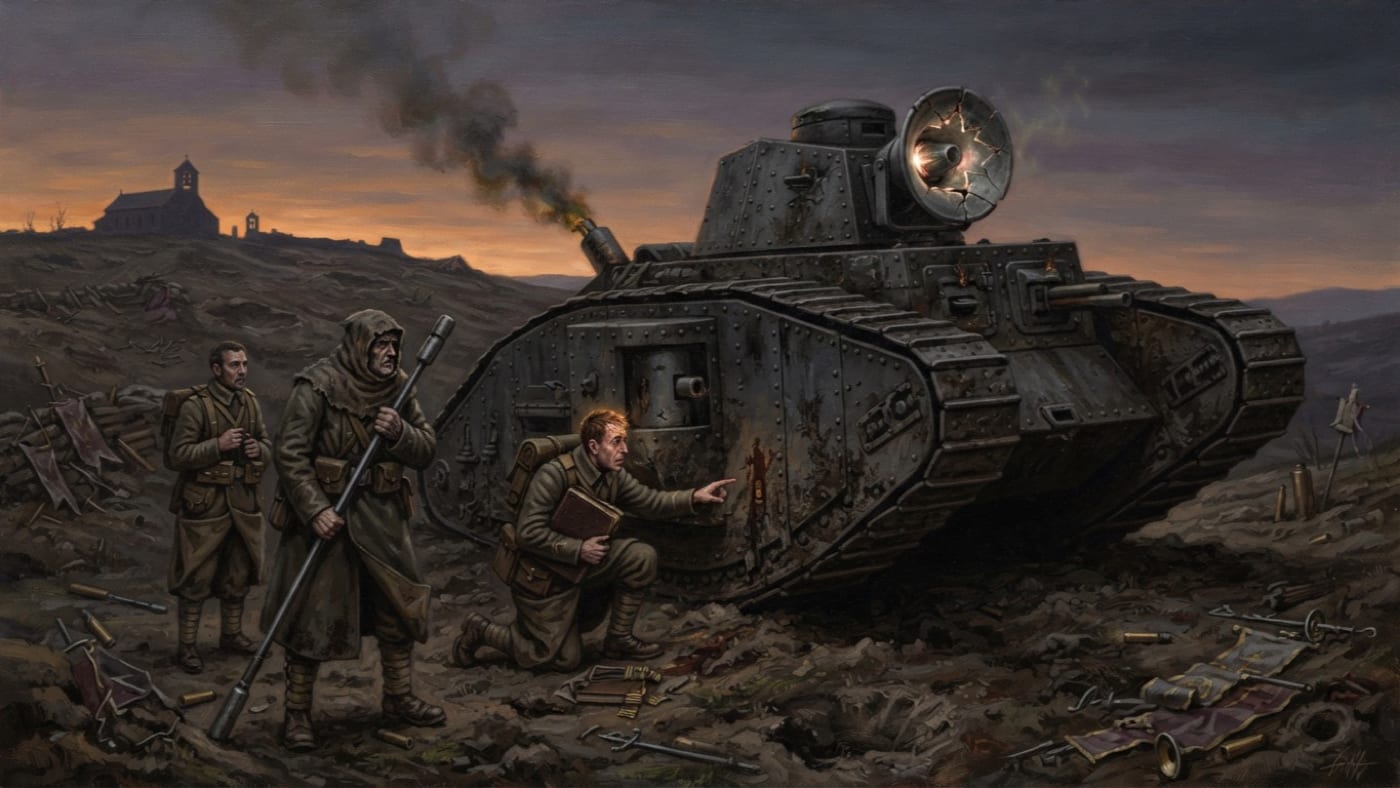
The Litany of Saint Barrach entered the Ledger as evidence, which is the worst way for a devotional work to get there. At Wormwood Hill in A.S. 163, witnesses heard it from the hymn-vox of a black-diesel assault tank, recognised it by name, and then heard it go wrong. Everything the archive knows about the litany comes from that one hearing. The file gives no composer, no feast, no score, no count of petitions and no life of the saint whose name the work carries. What it does give is a fourth petition, a beat that slowed, a voice that belonged to nobody present, and a jar.
I was asked to write the article on the litany. I have written instead about what the litany was made to do, because that is the only part of it the archive was careless enough to keep.
#On Cant and Calibration
No engine in the Church's service runs on fuel alone. Between throat rinses, a Litany-Engineer will tell you that steel has a temper and that temper obeys the Word. Then he will give you the torque figure, because the Word without the figure is folk music, and folk music was driven out of the motor houses long ago. The profession times its spoken sequences to RPM marks. It logs a cant code beside every valve clearance, and it diagnoses by ear before anyone touches a spanner. Each ledger closes with the numbers, the chant code and a witness's signature. A machine certified clean holds its note under load. On the processional land-ships, every mortar blast waits on its psalm-verse, and when the cadence slips the shells fall short.
The assault vehicles of that period carried a sanctioned chant apparatus called the hymn-vox. The parent file describes it, with commendable candour, as part morale, part cadence, part technical superstition and part harmonic stabiliser, in proportions that depended on which Bureau was billing for parts. Prescribed devotion went into it. On an ordinary day the crew's pace and the gunners' count came out of it, along with the comfort of a saint's name heard above the engine.
The record does not say which of those duties Saint Barrach's work performed. Nothing I have examined identifies it as an ignition rite, a repair sequence, a broadcast ward or a standard battery hymn. I will not promote it to any of those offices just because the article would read more tidily. It was a named litany played through a machine built to make men keep time, and that was enough to make it dangerous.
#On the Fourth Petition
The witnesses agree on the order. The vox began the Litany of Saint Barrach and slowed by half a beat. Then it repeated the fourth petition in a voice that did not belong to the crew.
To a congregation, half a beat is nothing. To a mechanic it is enormous, because the cant professions rest on the conviction that interval governs combustion. Shrine-deck crews keep independent counts so that the choir cue and the firing cord never drift apart. They will not hum between tolls, because humming invites a third voice. In the orison towers, signal engineers call it inversion onset when consonants start arriving half a beat late. These parallels come from neighbouring trades, and I offer them only as parallels. Nobody at Wormwood took a reading. They heard the cadence drag, and with the animal accuracy of men in armour they knew the prayer no longer belonged to the people praying it.
The crew burned inside the hull before the first dusk, and the tank advanced for three days anyway. On the second day it circled the ridge chapel with the canticle repeating, and its exhaust smoke pulsed in time with the vowels. The men sent to board it came back deaf, burned, or reciting words they could not remember learning. Nobody has certified those words as Barrach's, and I will not be the first.
By the third day, the vox faltered whenever official bells rang from the western camp, and it grew stronger when they stopped. The Bureau of Bells would like that read as a countermeasure. It is one observation from one hillside over three days in one year. The bells ended nothing; the battery did.
What troubles me is plainer than the voice. A litany is prescribed devotion: fixed words in a fixed order, performed by the faithful because they have been told to. A tank is prescribed motion. At Wormwood both kept their appointments after every man who had given or received the orders was dead. The petition went on repeating, the treads went on advancing, and the machine went on obeying something. I do not know what.
#On the Voice after Mechanical Cessation
The destruction of the tank belongs to the parent file and to the gunners who earned it, so I will not retell it shot by shot. Three facts bear on the litany.
First, the 7th Orison Battery put relic-shot under the forward plate, the vehicle stopped, and the firing extract records the vox apparatus as ruptured. Second, the same extract records that the target went on vocalising for nine minutes after mechanical cessation. Third, according to the narrative, a Gunner-Monk ended the matter by smashing the damaged speaker housing with a rammer. He was reprimanded and commended for it in the same envelope.
The nine minutes trouble the Bureau of Engineering considerably. A ruptured apparatus does not sing. A cooling hull might tick, hiss and settle, but the extract says vocalisation, and a clerk under War custody does not choose that word for ticking. I will not attempt to reconstruct the acoustics. I note only the order: the motion stopped first, the voice stopped second, and it took a man with a rammer to stop the voice.
The order matters to the argument. If the voice had died with the engine, one could call the litany a tool the engine had been using. It outlived the engine by nine minutes. Whatever had taken up the fourth petition no longer needed the treads to keep it going.
#On the Line Written Backward
The wreck discharged self-igniting oil at dusk for eleven cycles. Samples were taken in black glass, and one of them stained the inside of its jar with a line from the Litany of Saint Barrach, written backward.
The file does not transcribe the line or say that it came from the fourth petition. The signal log from the second night preserves a phrase ending "the fuel remembers," but the words before it are missing from the record. The distillers have been glad to marry that tail to the jar. The file connects the two to each other no more than it connects either one to the litany. Three fragments from one hill do not make one verse, however much the Pit-Masters would like a verse to sell.
The jar passed from Doctrine to Purity, then to Records, then to a shelf whose label has been cut away. The parent file reports that the shelf is still warm. I report only that the parent file reports it.
A War summary states that the vehicle "entered the action under emergency auxiliary fuel protocols."
Corrected. The vehicle entered the action on contraband black diesel. Its hymn-vox carried a saint's litany. Its tanks carried what the officer would not name.
#On the File's Continuing Use
As of A.S. 201, the Wormwood case still appears in handling manuals, battery lectures and private distiller superstition. Each audience takes a different lesson from it. War teaches fuel discipline and never mentions the saint. Engineering teaches officers to flush the lines after contamination and treats the hymn-vox as a component that failed. Purity teaches cadets that contraband spirits occupy unlawful combustion, which is tidy, and blames the voice on the fuel, which the file never does. The distillers tell their children never to store hot-run in a vehicle that sings, the one instruction in the whole case simple enough for a child to follow.
None of them teaches the litany. I find no condemnation of it on record and no ruling that it may not be sung. I also find no armourer eager to load it into a hymn-vox.
My own holding is narrower than any Bureau's, and less comfortable. The Church built machines to obey and put prayer inside them so that their obedience would sound devout. At Wormwood the prayer continued, half a beat slow, after the devout were ash. Somewhere in the fourth petition the obedience changed masters. The file does not say whose. With the reader's leave, neither shall I.