
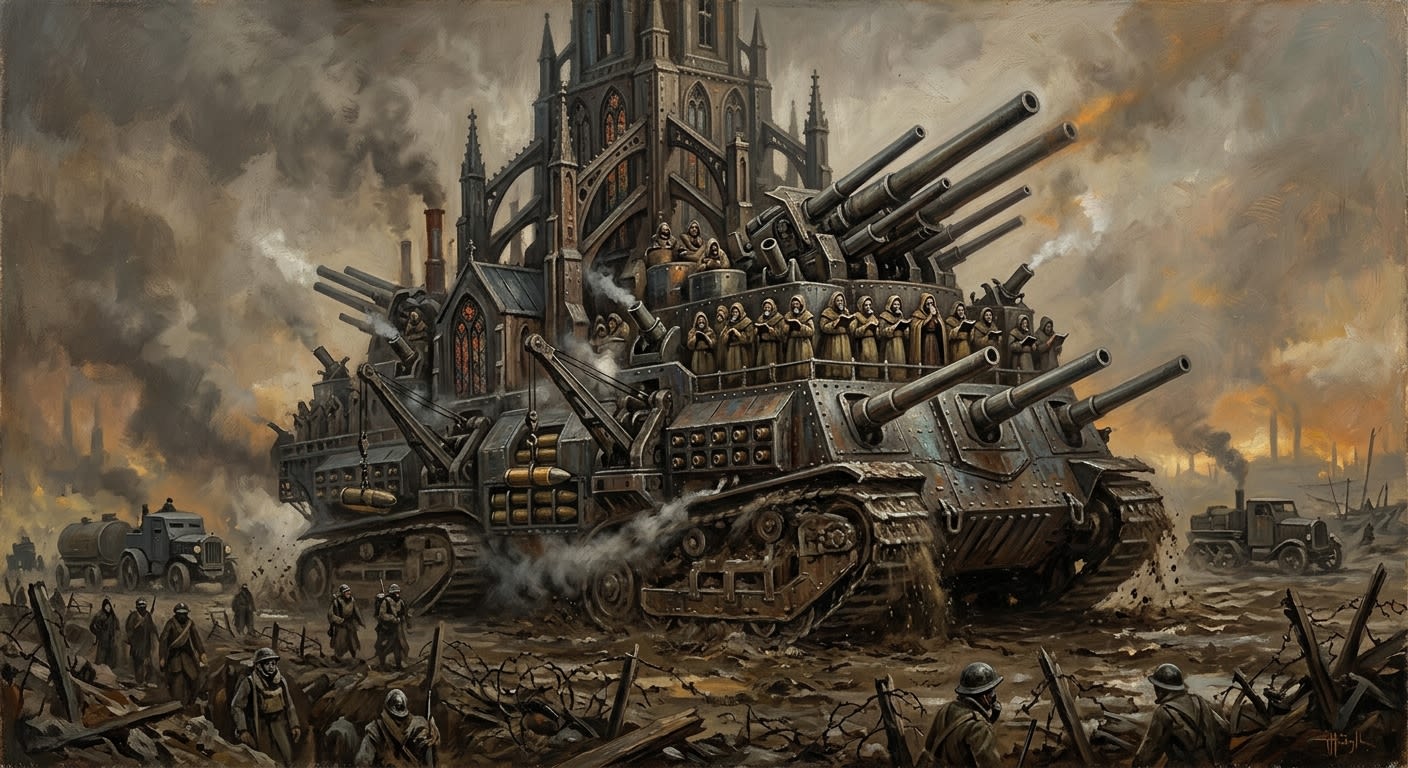
#On the Ladder That Climbs by Recoil
The Processional Arsenal is the Synod's answer to a vulgar military question: how may one move a cathedral, a battery, a choir school, a powder magazine, a relic chapel, and two hundred very nervous men across ground already under hostile fire? The Bureau of War answered with armour. The Bureau of Engineering answered with diesel. The Bureau of Orison and Song answered with psalm. The Bureau of Doctrine, arriving last and speaking first, declared the result inevitable.
The best-known example is the Pilgrim's Ladder, a diesel land-ship bristling with mortars, hymn-screens, brass rails, candle niches, vox-pipes, relic pins, soot gutters, and deck shrines numerous enough to make an abbey jealous. Its spine rises in stepped gun platforms from prow to stern, so that assault companies climb upward under fire as if ascending a processional stair. Each rung is a mortar station. Each recoil is a genuflection with shrapnel attached.
The Arsenal is classed among the sanctioned Choir-Engines: industrialised grace, licensed under War Directorate oversight, blessed by Orison, supplied by Conscription, audited by Tithes, and disliked by every mule within earshot. It exists because a fixed gun may defend a wall, but only a moving gun can carry the wall's arrogance forward. The Processional Arsenal does not merely support an assault. It conducts one.
#On Powder Kept in Time
A common artillery piece fires when ordered. A Processional Arsenal fires when sung.
The deck is divided into battery-chapels, each chalked and pinned with relic bone. Mortarmen kneel between bursts to relight candles in niches blackened by their own profession. Choirs stand at the railings with ash on their throats and cue-slates under their eyes. The Cadence Caller beats the metronome bell; the choir enters; the Battery Steward signals; the shell departs on the psalm-beat. If the round lands properly, it does not explode so much as finish a sentence begun in brass.
The ignorant hear machinery: diesel cough, track grind, breech clang, recoil hammer. The trained ear hears liturgy behaving badly. Psalm-verse, fuse-time, elevation, chamber pressure, and choir interval must agree within a margin so narrow the Bureau of Tithes once attempted to tax it. A half-measure drift can drop shells into the lower holds. A missed cue can set the deck ringing hollow. When a gun goes hollow, the crew report that it fires at whatever is listening. The Bureau does not print this sentence in recruit pamphlets.
The ammunition is logged like a sacrament. Shot type, authorising seal, hymn measure, choir condition, wind, target classification, and doctrinal purpose enter the shot-ledger before the barrel cools. Unlogged violence becomes heresy at the speed of forgetting. Logged violence becomes policy, which is why the Synod wins arguments and loses sleep.
#On the Shrine-Deck Crew
The Processional Arsenal belongs to its Shrine-Deck Crew more intimately than to any Bureau that signs for it. Deck-Rats clear brass and vomit soot. Powder Acolytes cradle shells with reverence and terror in equal measure. Ward-Chalkers renew firing rings after rain, blood, misstep, and panic-sweat. Choir Runners sprint across the vibrating deck with cue-slates tucked to the chest like relics stolen from a burning sacristy. Above them stand the Battery Steward, the Cadence Caller, and the Ordnance Deacon, that solemn little monarch whose seal decides when the hymn may become fire.
Early War manuals described the Processional Arsenal as “self-sufficient.”
Corrected after the Pilgrim's Ladder exhausted its candle wax, chalk paste, throat oil, spare metronome clappers, and clerical patience during a single three-day action. Approved wording: “operationally hungry.” The Bureau of Tithes prefers this phrase because it can invoice hunger.
The crew's patronage is tangled. Saint Orla the Brass-Throated receives the choirs. Saint Bartholomew of the Breech receives the gunners. Saint Halva of the Warm Ladle receives the galley, though no one has explained why a mobile arsenal needs a saint of ladles until one has seen two hundred men attempt to eat stew on a sloped recoil deck. The wardroom walls carry medals, burns, cracked pitch-pipes, failed fuses, and small slate boards bearing the names of Choir Runners who died because the bell did not wait for their ankles.
#On Recorded Actions and Misfires
The Pilgrim's Ladder Commission of A.S. 110 changed the machine from experiment to institution. The prototype proved that choir-timed barrages could stitch panic shut in crowds and tear open enemy formations on the same afternoon. This dual use delighted the Bureau of War and alarmed everyone with a conscience, a small constituency whose minutes were taken and ignored.
At Wormwood Hill, a Ladder climbed a slope slick with gore while perfume-fogs from Velkara's arts rolled through the valley. The engines stalled. The choirs did not. Their psalms covered the failing diesel cough, held the battery cadence, and shattered the fog long enough for the line to re-form. The machine burned out by nightfall, a smoking reliquary of brass and axle grease. The hill was held. The crew received a feast day and reduced pensions, because victory had damaged equipment.
At Prague Gate, A.S. 147, a shrine-platform was trapped in a Silence Dome. Hymn-vox failed. Cue-slates contradicted. Mortars fired out of phase and dropped shells into the lower holds, where pilgrims were still clutching relic-candles. Purity declared sabotage. Engineering declared hymn-jam interference. Doctrine printed both in separate columns and called the disagreement a wider apprehension of fact.
The Prague Gate collapse was once listed as “enemy action exclusively.”
Revised. Enemy action remains affirmed. Friendly cadence failure is now classified as contributory sanctity drift, which is a phrase devised to keep dead pilgrims from becoming legal plaintiffs.
The Arsenal's most infamous spiritual success came against Syrion's stillness in the Vales of Stagnance. Hymn-drones flooded the fog with psalms. The lull lifted. Soldiers shook themselves awake. Every listener aged by months in one afternoon: beardless boys with whiskers, dark hair salted grey, joints complaining in voices older than their owners. The Synod declared the exchange acceptable. What is youth, after all, when entered against wakefulness in the proper column?
ORISON AFTER-ACTION FRAGMENT — VALES DEPLOYMENT Cadence: approved Fog response: immediate recession, partial Troop response: wakefulness restored Secondary effect: ████████ accelerated biological aging Choir condition: twelve voices cracked; three voices continued after throats closed Recommendation: repeat only under Hierarchal seal War Directorate notation: “Repeat when necessary.”
#On Doctrine, Scandal, and Present Use
The Processional Arsenal occupies a cherished Synod category: scandal too effective to abolish. It makes Orison's theology visible. Sound moves metal. Metal delivers doctrine. Doctrine returns as blast, and the enemy, who may have ignored sermons, cannot ignore a mortar shell concluding the Gloria in his trench.
The moral objection is predictable. A gun should be a gun. A choir should be a choir. A pilgrim should not climb an artillery platform while incense blows sideways and a deacon stamps his passage chit beside a rack of high explosive. This objection misunderstands the Age. Separation is a luxury of safe centuries. We have barrels to bless, psalms to weaponise, children to deafen, engines to feed, and a Line that will not hold itself because some tender professor in Amsterdam prefers categories with clean hems.
As of A.S. 201, active Processional Arsenals remain few, expensive, and jealously scheduled. They appear where static batteries fail: fog fronts, river crossings, pilgrim-route emergencies, morale ruptures, and assaults requiring the visual theology of a church advancing on tracks. To see one moving at dusk, banners snapping in engine heat, mortars lifting like organ pipes, choirs white with ash along the rail, is to understand the Synod with uncommon clarity. We do not carry faith behind the army. We put treads under it.