
#On the Engine That Outlived Its Crew
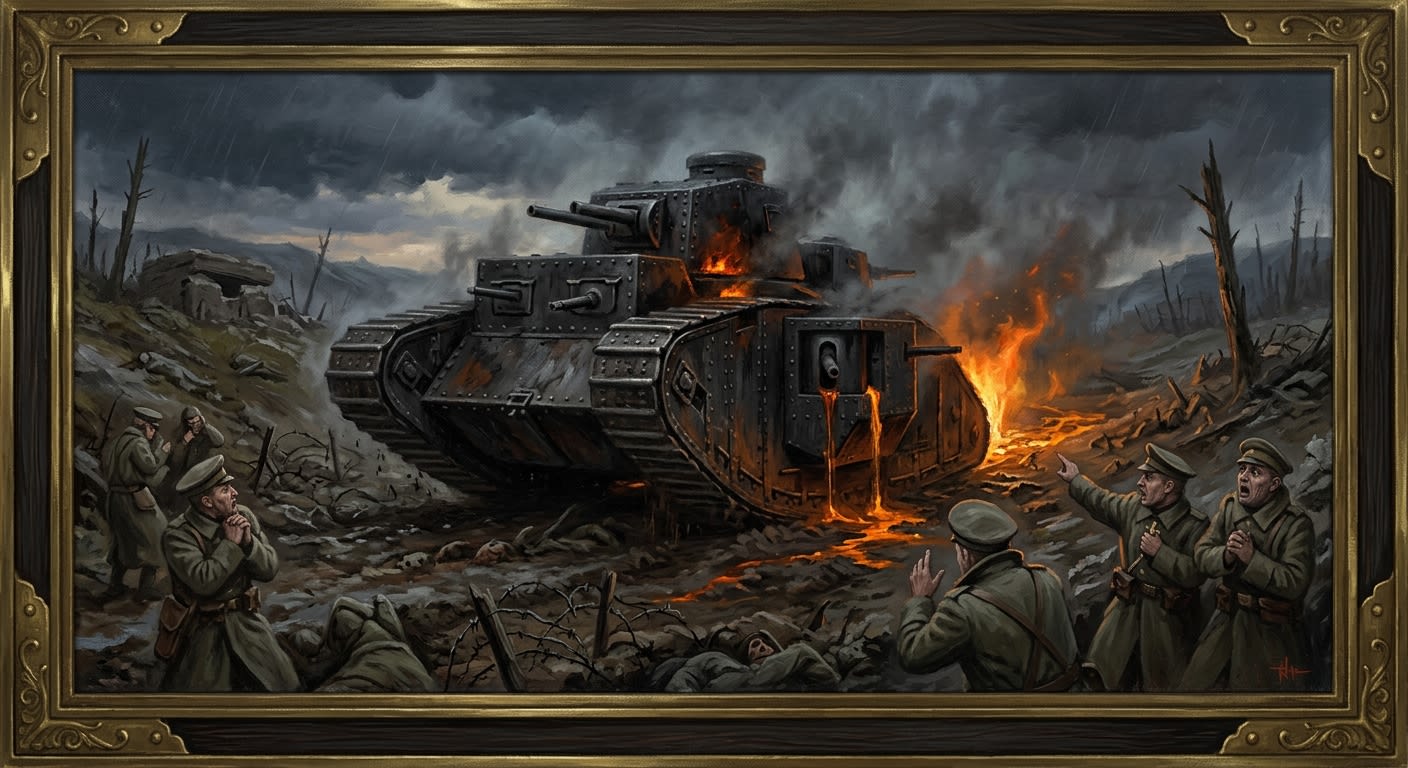
The Wormwood Hill Tank Incident of A.S. 163 is the black-diesel case every Distiller knows and every Engineer misquotes with professional terror hidden under professional jargon. A tank, fuelled on illegal Anatolian run, burned its crew alive inside the hull and continued to advance for three days. Its hymn-vox blared a distorted canticle. Its treads ground through its own supply column. When the 7th Orison Battery finally broke it open with relic-shot, the wreck still dripped oil that ignited itself at dusk for eleven days.
The Bureau of Engineering called this “residual thermal signature.” I have read the report. Its margins smell faintly of panic.
#On Wormwood Hill Before the Fire
Wormwood Hill already had a reputation before the tank made it worse. It was a supply rise, a firing slope, a grave incline, and a place where troops reported hearing their own voices chant treachery in the night. Older files record the Tithe of Wormwood Hill (Unregistered) and the Echo at Wormwood by sealed campaign names rather than reliable years, with dates so disordered that Records has treated chronology as a suggestion offered by nervous men. The A.S. 163 tank incident belongs to a uglier layer than the later Pilgrim's Ladder (Unregistered) action: before the chant “step by step, shell by shell” became safe enough for pilgrims, before the hill learned to sell its horror as devotion.
In A.S. 163, the hill was mud, blood, and accounting failure. The official fuel allotment arrived short. The chrismole drums were diverted, delayed, or stolen by one of the respectable thieves who wear Bureau seals and call theft logistics. The tank commander accepted black diesel from a supply Pit-Master whose name appears nowhere in War files and three times in Purity files, each time spelled differently. The fuel burned hot. The engine woke cleanly. The tank moved.
A War summary states that the vehicle “entered the action under emergency auxiliary fuel protocols.”
Corrected. “Emergency auxiliary fuel” means black diesel when written by an officer whose career still has ambitions.
The crew heard the hymn-vox first. Every modern assault vehicle carries some sanctioned chant apparatus: part morale, part cadence, part technical superstition, part genuine harmonic stabiliser, depending on which Bureau is billing the parts. Witnesses at Wormwood reported the vox beginning with the Litany of Saint Barrach, then slowing by half a beat, then repeating the fourth petition in a voice that did not belong to the crew. The tank did not stop. The crew did not dismount. Smoke entered through the vision slits from the inside.
#On the Three-Day Advance
The crew died before the first dusk. This is the conclusion Engineering tried not to reach and Medicine reached immediately after opening what remained of the hatch. Charred hands were found at controls fused into position. The commander's jaw was wired shut by heat around his own speaking tube. One loader was discovered kneeling beside an ammunition rack, arms raised as though receiving communion from a shell.
The tank continued.
It advanced through its assigned lane, crossed the gun-pit boundary, broke two mule carts, crushed one water station, and turned east without command. On the second day it moved in a slow circle around the ridge chapel, hymn-vox shrieking the same broken canticle while smoke pulsed from the exhaust in time with the vowels. Men sent to board it returned deaf, burned, or reciting words they could not remember learning. One sergeant ordered the tank blessed. The chaplain refused to approach unless granted hazard pay. I respect both men, though one of them understood the situation better.
SIGNAL LOG — WORMWOOD HILL, SECOND NIGHT 0200: Vox audible from lower trench. Phrase repeated: “████ ████ the fuel remembers.” 0315: Rifle section reports singing from inside hull. Crew confirmed dead. 0340: Tank turns toward supply column. No driver visible through forward slit. 0410: Order given to withdraw ammunition mules. 0412: Order too late.
By the third day, the tank's plates glowed at the seams after sunset. Its treads dragged lengths of wire, shattered timber, cloth, bone, and canister hoops in a tail that looked almost processional if one has the diseased imagination of a Bureau of Doctrine clerk, which I do, and magnificently. The hymn-vox faltered whenever official bells rang from the western camp. It strengthened when the bells ceased. This detail matters. The Bureau of Bells has never thanked the witnesses for noticing it.
#On the 7th Orison Battery
The 7th Orison Battery (Unregistered), recorded in Shrine-Deck Crew lecture tradition as the battery that made the hill quiet, received the order to destroy the vehicle after War exhausted every cheaper theory. Mud did not halt it. Trenches did not hold it. Rifle fire struck sparks from the plates and encouraged nothing but embarrassment. Two Engineering sappers approached with charges and returned without their eyebrows, their satchels, or their previous confidence. A third sapper refused the order and was shot, which proved that War could still stop some machines.
The Orison crew prepared relic-shot under field rite: shell washed in ash-water, copper driving band kissed with Saint Edras wax, firing cord held by three gunners and one priest whose hands shook hard enough to improve the drama. The first round struck low and made the tank turn. The second broke the left tread. The third entered beneath the forward plate and produced a sound witnesses compared to a choir drowning in oil.
The wreck opened like a reliquary designed by a mad butcher. Flames rose without consuming the oil. The hymn-vox, cracked and half-melted, continued to pulse a single phrase through the cooling hull until a Gunner-Monk smashed the speaker housing with a rammer. He was reprimanded for damaging evidence and commended for spiritual initiative. Both notices arrived in the same envelope.
#On the Eleven Dusks
The wreck dripped oil at dusk for eleven days. Not all day. Not at dawn. Dusk. Each evening the seams grew wet, black drops gathered along the ruptured belly, fell onto the stones, and ignited in small blue-black flames that smelled of tar, incense, and cooked brass. Guards scraped the burning patches with shovels. The next dusk they returned. A Purity officer ordered sand. The sand burned. An Engineer ordered water. The water hissed and left letters on the ground too quickly to read.
Pit-Masters loved this detail. “The fuel remembering what it ate,” they said, and sold engine-grade black diesel at a premium for months. Engineering hated the phrase because it was imprecise, vivid, and closer to the evidence than “residual thermal signature.” Doctrine filed both terms and used whichever made the listener more obedient.
Engineering's final assessment reads: “Post-destruction ignition consistent with residual thermal signature in contaminated fuel reservoirs.”
Corrected for the general reader: the dead tank bled fire for eleven evenings after its reservoirs were ruptured, cooled, blessed, sanded, drained, and watched by men paid to deny that watching frightened them.
Samples were taken in black glass. Three evaporated. Two cracked their seals. One stained the inside of its jar with a line from the Litany of Saint Barrach written backward. The jar was transferred to Doctrine, then to Purity, then to Records, then to a shelf whose label has been cut away. The shelf is still warm.
#On the Approved Lesson
The approved lesson of Wormwood Hill is fuel discipline. This is useful, dull, and insufficient. War teaches officers not to accept undocumented engine fuel under combat pressure, which is excellent advice for officers stationed in warm rooms with full stores. Engineering teaches mechanics to flush lines after black-diesel contamination, as though the central horror were a dirty valve. Purity teaches cadets that contraband spirits occupy unlawful combustion. Distillers teach children never to store hot-run in a hymn-vox vehicle unless they want the machine to sing after everyone inside has stopped.
The better lesson is narrower and less comforting: obedience can persist without life. A tank is an obedience engine. Fuel is appetite. Hymn-vox is command disguised as prayer. At Wormwood Hill, appetite entered obedience through a song and found no soul in the way.
As of A.S. 201, the incident remains attached to black diesel handling manuals, Orison Battery lectures, and private distiller superstition. The 7th Orison Battery keeps the third shell's firing cord in a sealed case. War claims the cord is preserved as evidence of successful termination. The gunners touch the glass before deployment. They know a relic when one has earned them a quiet night.