
#On the Profession of the Shrine-Deck Crew
"The Hymn directs the Barrel; the Barrel defends the Hymn." — Bureau of War, Standing Order 44-C, as inscribed on every ammunition locker aboard every shrine-platform in the Synod's inventory, and ignored, with perfect consistency, by every man who has ever served a shift in the powder sanctum.
The Shrine-Deck Crew are the men — and they are overwhelmingly men, for reasons the Bureau of Rites attributes to vocal-range requirements and the Bureau of War attributes to nothing at all — who keep the Synod's mobile arsenals operational. Cathedral-barges on the Danube. Rail-shrine crawlers grinding along the supply corridors between Bastion-Sibiu and Bastion-Irongate. The great diesel land-ships like the Pilgrim's Ladder, which I have personally inspected and from which I personally retreated at speed when the morning salvo commenced without the customary three-bell warning. And the fortress pontoons that patrol the river-lock approaches at Bastion-Brest, where the Bug runs shallow and the things that live in the shallows do not appreciate mortar fire but receive it regardless.
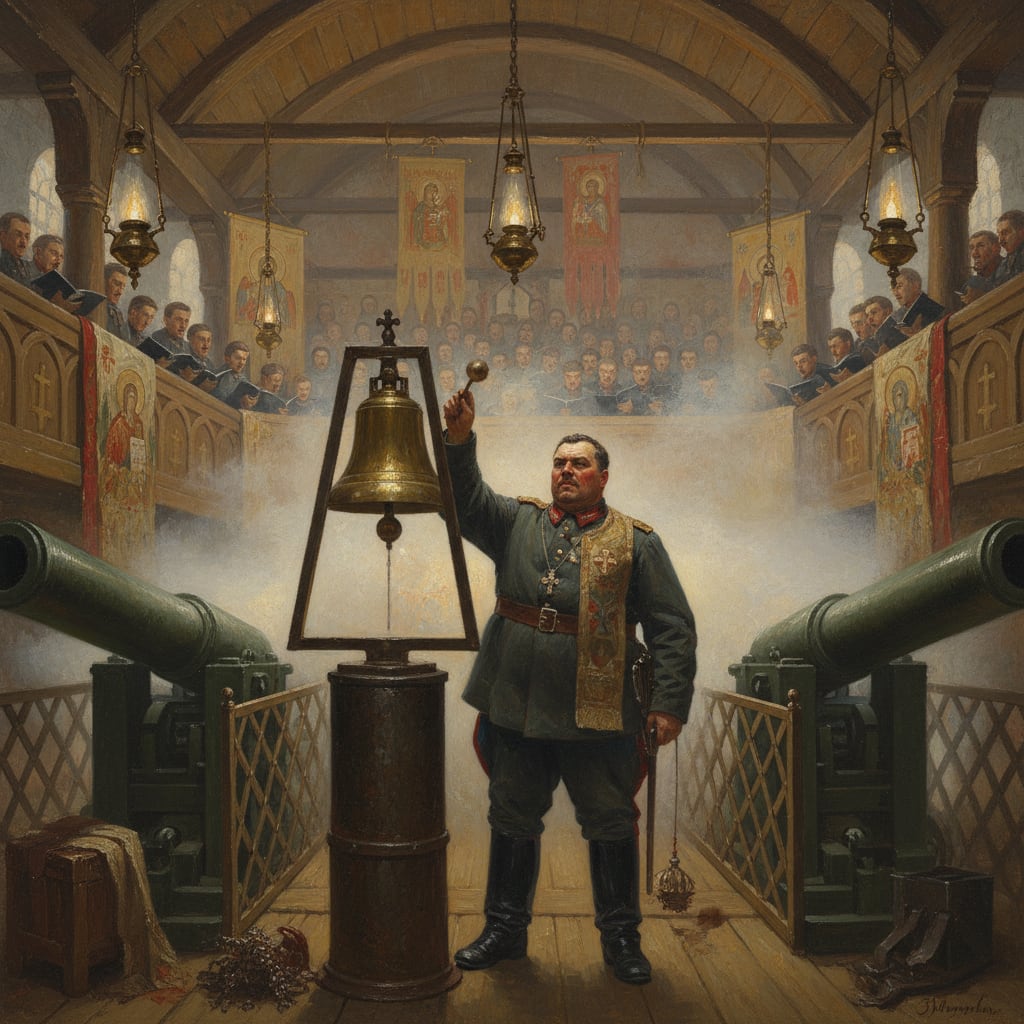
These men serve two hungers at once: metal and sanctity. Every shell loaded must be loaded on the beat. Every volley must land on a sanctioned toll of the metronome bell. Every discharge must be recorded in the shot-ledger before the barrel has cooled, because unlogged violence — and I quote the Bureau of Doctrine's Operational Catechism, Third Revision — "becomes heresy at the speed of forgetting." The shrine-platform fires, and it fires liturgically. The guns are the instruments; the choir provides the score; the Cadence Caller conducts both; and the Deck-Rats — the lowest rank, the swab-haulers and casing-clearers — exist to ensure that the sacred machinery of destruction does not choke on its own brass.
#On Their Nature and Purpose
The shrine-platforms are the Synod's answer to a problem that static bastion guns could not solve: demons swarm, insurgent flotillas move, pilgrim-route raids strike where the walls are not. The early trench collapses of the post-Sundering decades proved that a gun bolted to stone can only kill what stands in front of it, and the Enemy (Unregistered) has never been obliging enough to stand still. Mobility was required. And because this is the Synod, mobility alone was insufficient — the mobile gun must also be a mobile church, because the Bureau of Doctrine does not recognise any category of human activity that falls outside the jurisdiction of prayer.
The result is a machine that looks, to the uninitiated, like a war barge with hymn-screens bolted to the railings. To the faithful — and I count myself, naturally, among the faithful, though I prefer to count myself from a safe distance — it is a ladder angled heavenward, each rung a mortar tube, each volley a prayer ascending in fire and shrapnel. The Bureau of Doctrine records this as "synchronization of Heaven and powder." The Bureau of Engineering records it as "ritual clutter on a functional artillery platform." Both are correct. The Bureau's gift is holding contradictions in separate filing cabinets and calling each one policy.
#On Their Origin
The profession crystallised in three stages, each one a disaster that the Bureau converted, retroactively, into a lesson.
The First Floating Cathedral Burn — date uncertain, likely the early A.S. 70s — in which a shrine-barge on the Danube detonated when unlogged powder stores were discovered in a compartment the crew chief had designated as "supplementary prayer supplies." The explosion killed forty-one men and scattered hymnals across three kilometres of riverbank. The Bureau of War's response was immediate, total in scope, and — by the standards of the Synod — almost rational: henceforth, every round of ammunition aboard a shrine-platform would be logged like a sacrament. The shot-ledger was born. It has not, in the intervening century and a half, become any less onerous.
The Cadence Reforms (Unregistered) — approximately A.S. 95 — in which choir conductors were granted operational authority over gunners after a series of recoil desynchronisations caused shrine-barges to shake themselves apart mid-volley. The gunners, who had until that point regarded the choir as decorative, were informed that the choir's metronome bell now governed their trigger rhythm. The gunners' opinion of this arrangement has been recorded in numerous disciplinary filings and one memorable mutiny attempt at Pressburg (Unregistered), which was quelled when the choir conductor locked the powder sanctum and sang the Canticle of Restraint until the mutineers surrendered from sheer acoustic exhaustion.
An earlier edition of this entry stated that the Pressburg mutiny was resolved by "diplomatic intervention from the Bureau of Oaths."
No Bureau of Oaths intervention occurred. The choir conductor — one Sister Margit of the Fourth Hymnal (Unregistered) — locked the door, sat on the powder kegs, and sang for eleven hours. The mutineers' formal complaint, filed afterward, cited "unreasonable vocal endurance" as a grievance. It was denied.
The Pilgrim's Ladder Commission — A.S. 110, approximately — in which the prototype mobile arsenal proved that a choir-timed barrage could "stitch shut" panic in crowds. This was the turning point. The shrine-platform ceased to be a military experiment and became a political instrument: a machine that could suppress a riot, escort a pilgrim caravan, and deliver a sermon simultaneously, all while firing mortars at whatever the Bureau of Doctrine had designated as the enemy that week.
#On the Crew
The hierarchy is strict, and the hierarchy is the only thing between a functioning arsenal and a brass-filled coffin.
At the bottom: the Deck-Rats. They swab, haul, scrub casings, and exist in a state of permanent soot that no amount of river water can remedy. A Deck-Rat's hands are black by the end of the first week and remain black for the duration of their service, which the Bureau of Rites has declared "a form of ash-penance, unsolicited but accepted." The Deck-Rats do not find this comforting.
Above them: the Powder Acolytes, who handle the ammunition with the reverence the Bureau demands and the terror the ammunition deserves; the Ward-Chalkers, who maintain the chalk rings that sanctify each gun position and must be renewed after every rain, every engagement, and every time a Deck-Rat accidentally scuffs one with his boot; and the Choir Runners, who relay cue changes between the hymn-gallery and the battery positions at a sprint, because the metronome bell waits for no man's legs.
At the senior level: the Battery Steward, who commands the guns; and the Cadence Caller, who commands everything else, because the Cadence Caller bridges choir and artillery into a single organism of sanctified violence. The Cadence Caller does not fire guns. The Cadence Caller determines when guns fire, which is a distinction the Bureau of War considers more sacred than the firing itself.
At the apex, removed from the soot but not from the paperwork: the Ordnance Deacon, who holds seal authority — the power to authorise a volley. Without the Deacon's seal, no shot may be fired. With the Deacon's seal, any shot may be fired, at anything, for any reason the Bureau has pre-approved, and the list of pre-approved reasons occupies eleven pages of the Operational Catechism and includes, on page nine, the phrase "morale maintenance through percussive demonstration."
#On the Metronome and the Chalk
Two things keep a shrine-platform holy: the bell and the chalk.
The metronome bell is a small brass instrument, no larger than a man's fist, mounted on the Cadence Caller's station. It ticks. The choir sings to its tick. The guns fire to the choir's measure. The entire apparatus of destruction — powder, shell, recoil, smoke, prayer — hangs from the rhythm of a bell that cost, according to the Bureau of Tithes' procurement records, four Crowns and six pennies. I have inspected one. It is unremarkable. It is also, by the testimony of every Cadence Caller I have interviewed, the most important object aboard the platform, more important than the guns, more important than the relic pins, more important than the Ordnance Deacon's seal. "Miss the bell," one told me, "and the deck goes hollow." I asked him what "hollow" meant. He would not elaborate. The other crewmen present found reasons to look elsewhere.
The chalk ring is drawn around each gun position in a paste of chalk and ash, pressed with small relic pins at the cardinal points. It sanctifies the firing arc. It must be renewed after rain — immediately, without exception, regardless of whether the enemy is currently attempting to board — and after every engagement, and after any contact with unsanctioned material, which includes blood, river water, and the sweat of a man in mortal terror, which means, in practice, that the Ward-Chalkers never stop working.
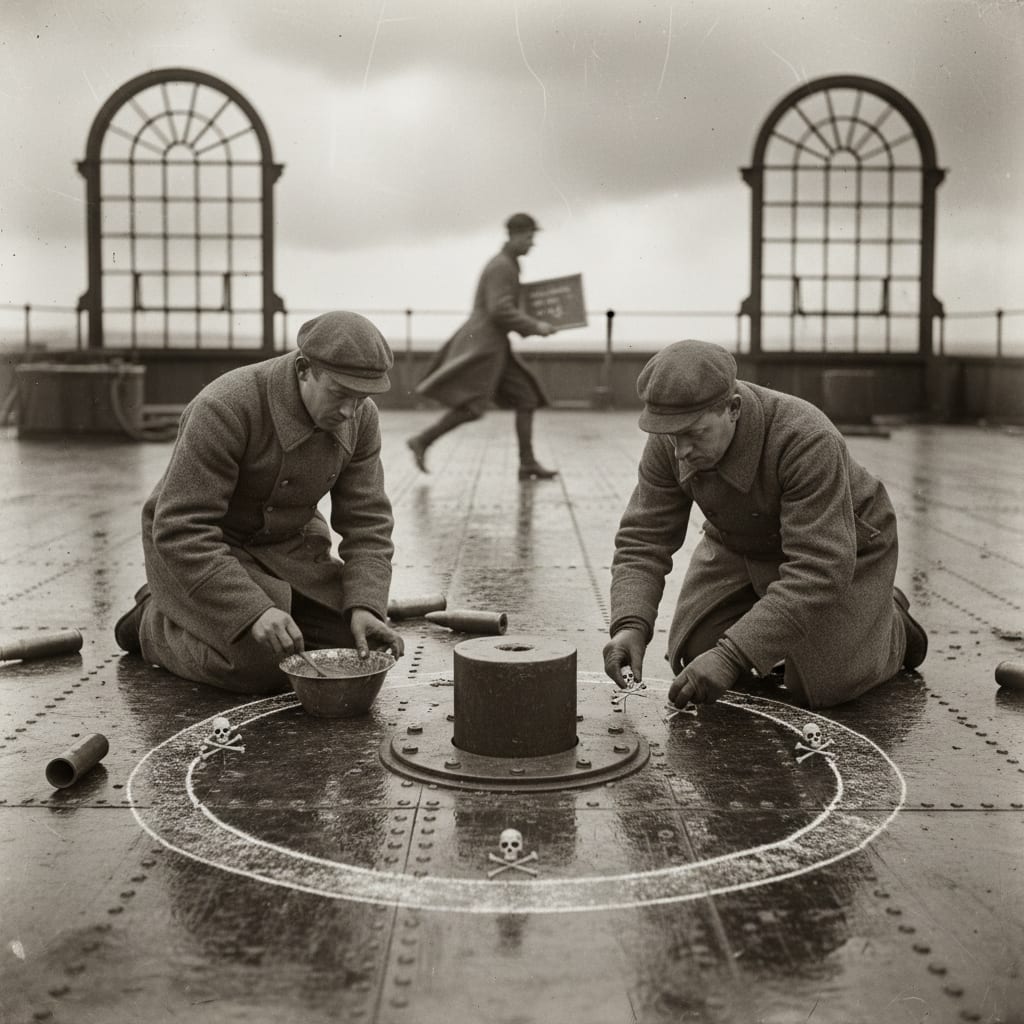
When the chalk holds and the bell ticks true, the shrine-platform is a miracle of coordinated lethality: guns thundering on the psalm-beat, shells arcing in cadence, the choir's voices braiding with the percussion of recoil into a sound that the Bureau of Orison & Song has classified as "a form of prayer, albeit an aggressive one." When the chalk smudges or the bell drifts — when cue and cadence separate by even a half-measure — the platform becomes something else. The crew call it "going hollow." The Bureau of Doctrine does not have an official term for it. The Bureau of Silence has a file on it, and the file is sealed.
#On the Shot-Ledger
The shot-ledger is the shrine-platform's soul, if a machine of brass and diesel and incense can be said to possess one.
Every discharge is recorded: shot type, time of firing, purpose, authorising seal, hymn-measure at moment of volley, weather conditions, choir status, and — since the Ledger Reforms of A.S. 165 — the name of the Powder Acolyte who loaded the round. This last addition was introduced after an incident at Bastion-Irongate in which a shrine-barge fired fourteen rounds of grapeshot into a crowd of refugees and the subsequent inquiry could not determine who had loaded the ammunition because every Powder Acolyte aboard claimed to have been in the latrine. The Bureau of War found this implausible. The Bureau of Mercy found it tragic. The Bureau of Records found it "a ledger deficiency," which, in the Records' hierarchy of sins, ranks somewhere between blasphemy and poor penmanship.
The incident at Bastion-Irongate has been attributed in earlier editions to "enemy provocation resulting in defensive discharge."
The Bureau of Doctrine has revised this assessment. The discharge was "administrative in nature." The refugees were "reclassified." The Powder Acolytes were reassigned. The latrine was inspected and found to be of standard capacity, accommodating at most three men, which did not explain the seven simultaneous claims of occupancy.
A clean ledger is the highest status symbol aboard a shrine-platform. A crew whose ledger survives an audit without correction is a crew that drinks well at the next port. A crew whose ledger contains "ghost entries" — false records inserted to conceal misfires, unsanctioned discharges, or rounds that vanished into the shadow deck's (Unregistered) resale network — is a crew that prays the auditor is tired, or bribable, or both.
#On Saint Orla the Brass-Throated
Every profession in the Synod has its patron, and the Shrine-Deck Crew claim Saint Orla the Brass-Throated — canonised, according to the Bureau of Rites' hagiographic register, for singing through a deck fire to maintain cadence timing while the platform burned around her.
The details are, as with all hagiography, a matter of which Bureau you consult. The Bureau of Rites maintains that Orla was a choir conductor aboard a shrine-barge on the Danube, date uncertain but likely A.S. 130, who refused to abandon her station when a powder-fire engulfed the hymn-gallery. She sang the Canticle of Measured Fire — a piece I have heard performed in Strasbourg's Cathedral of the Perpetual Audit (Unregistered) and which lasts, in its full form, approximately forty minutes — while the flames consumed the gallery's curtains, the gallery's prayer-benches, and, eventually, the gallery's floor. She was recovered from the wreckage with burns covering most of her body and her voice intact. The voice lasted another six years. The body lasted four.
The Bureau of Bells disputes several details. The Bureau of Engineering disputes the rest. The crew do not care which version is correct. They care that Orla sang, and that the cadence held, and that the guns fired true while the world burned. That is sufficient doctrine for men who live on vibrating decks and breathe brass-dust for a living.
#On What Goes Wrong
The failure modes of a shrine-platform are numerous, spectacular, and — in the Bureau's preferred framing — "instructive."
Cue drift occurs when the choir's timing and the metronome bell diverge. This happens when singers are exhausted, when the bell mechanism fouls with soot, when a Choir Runner delivers the wrong cue-slate, or when a singer coughs blood — a common affliction among choir members who have spent months singing in incense-thick air at volumes the human throat was never designed to sustain. When cue drift begins, the guns fire between tolls. The crew describe the sound as the deck going "hollow," as though the platform has become a drum struck by something underneath. Cadence Callers drill for cue drift obsessively. They drill because recovery is possible. They also drill because the alternative — sustained off-tempo firing — draws things that listen, and the things that listen are not in the choir's repertoire.
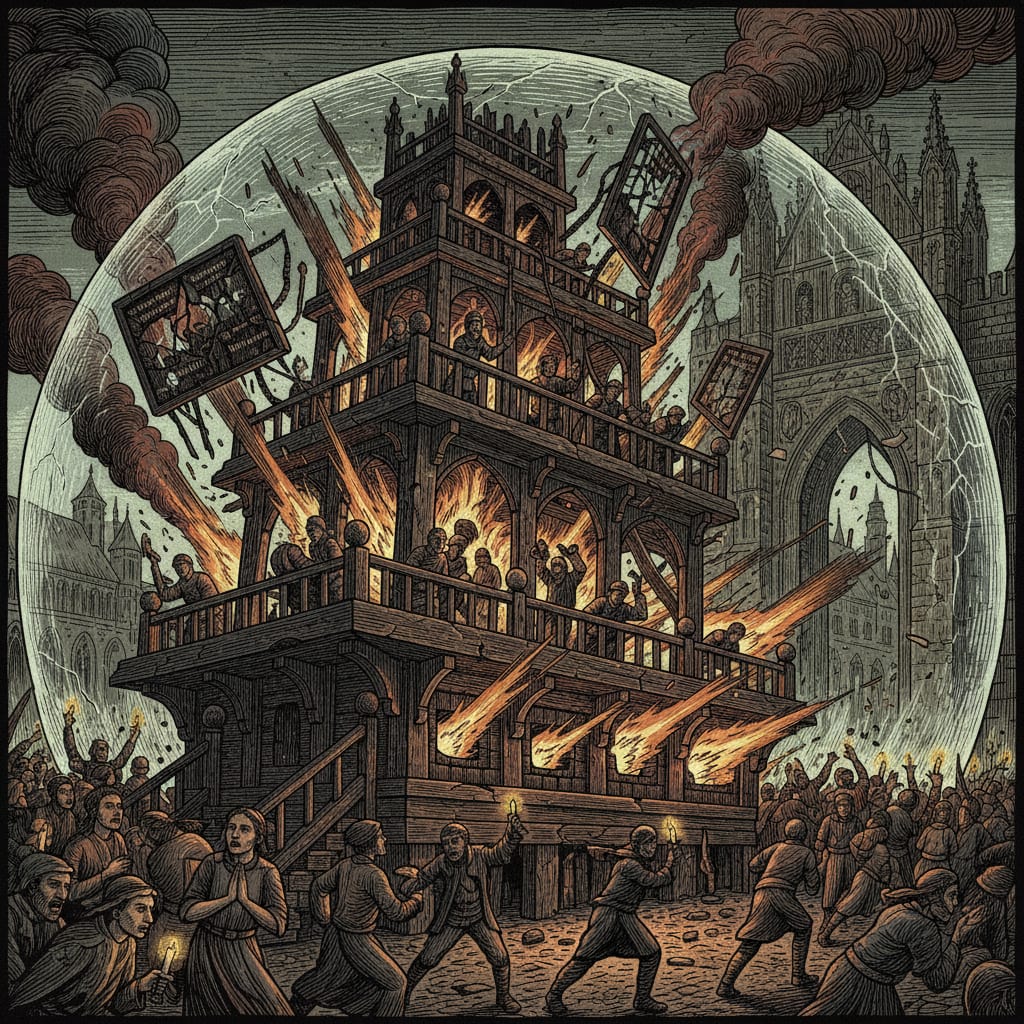
Psalm-backfire is worse. When cadence collapses entirely — when the choir's measure and the gun's rhythm separate beyond recovery — the shells fall short, or fall wrong, or fall into the platform's own pilgrim tail. The Collapse at Prague Gate, in which a Pilgrim's Ladder was trapped inside a Silence Dome (Unregistered) and its hymn-vox severed, remains the Bureau's canonical example: mortars detonating in the lower holds, pilgrims torn apart while clutching relic-candles, and two Bureaus — Purity and Engineering — each blaming the other in reports published side by side because the Bureau of Doctrine could not determine which lie was more useful.
[CONTENT REMOVED — Bureau of Silence, File 88-K/Shrine] The phenomenon designated "third voice (Unregistered)" — an additional harmonic detected during sustained off-tempo firing aboard shrine-platforms — ████████████████ ██████████ ████ operational parameters. Crew superstition holds that humming between tolls "invites" this voice. The Bureau's position is that ████████████████████ and that the phenomenon, if it exists, is "acoustically explicable." The file remains sealed. The crew remain superstitious. The Bureau remains, as always, correct.
#On Their World
The shrine-deck is a world of its own: a cathedral-sized space that never stops vibrating, where brass casings roll underfoot like prayer beads scattered by a careless novice, where incense mixes with hot oil until the air tastes of worship and machinery in equal measure. The crew live in this world for months at a stretch. They eat in it. They sleep in it — or they try to sleep, in hammocks slung between recoil housings, rocked by the engine's idle and woken by the watch-bell at intervals the Bureau of War has calculated to prevent rest without technically constituting torture. They confess in it, to the platform's chaplain, who hears more admissions of ledger fraud per week than any parish priest in Strasbourg hears in a year.
They emerge, when they emerge, into port towns that regard them with the specific mixture of awe and resentment reserved for men who have protected you by firing over your house. The crowds cheer the salutes. Then they spit when the smoke drifts over their laundry. The Bureau considers this an acceptable ratio of admiration to complaint.
The profession costs hearing, tenderness, and the ability to appreciate music as anything other than a timing mechanism. Veterans — the "brass-deaf," in the crew's own parlance — develop a characteristic stare: fixed, rhythmic, counting something invisible. They tap surfaces. They flinch at bells. They chew wax, a habit acquired from the ear-plugs they fashion from waxed cloth and never quite abandon. The Bureau of Mercy classifies their condition as "occupational acclimation." The crew classify it as going deaf in the service of a machine that sings while it kills.
They do not, as a rule, complain. The platform fires. The ledger holds. The chalk ring endures. And the bell — four Crowns and six pennies, unremarkable, indispensable — ticks on, measuring out the Synod's authority in increments of brass and prayer and smoke.