
#On the Substance and Its Origins
"I smelled it once — acrid, sharp, unmistakable. Yes, it offends Providence. But it burns magnificently." — Margin note, private correspondence, undated
Black diesel is heresy rendered liquid — contraband pit-sludge distilled in cellar furnaces, pumped through hidden pipes beneath the Warrens, and burned in every lamp, stove, and engine the Bureau of War's ration allotments fail to reach. Which is most of them. The Bureau of Doctrine has pronounced it anathema on eleven separate occasions, each pronouncement more specific in its damnation than the last, as though the substance might be shamed into non-existence by sufficiently detailed theology. The substance has declined to cooperate.
Its source is the Anatolian pitlands — crude seams tapped by men whose names the Bureau of Records does not carry and whose labour the Bureau of Tithes does not tax, because to tax them would be to acknowledge them, and to acknowledge them would be to concede that the sanctified fuel system administered by the Chrismole Furnaces of Brast does not, in fact, meet the requirements of a continental war fought on seven fronts across two centuries.
It does not. Everyone knows this. The Bureau has classified the knowledge.
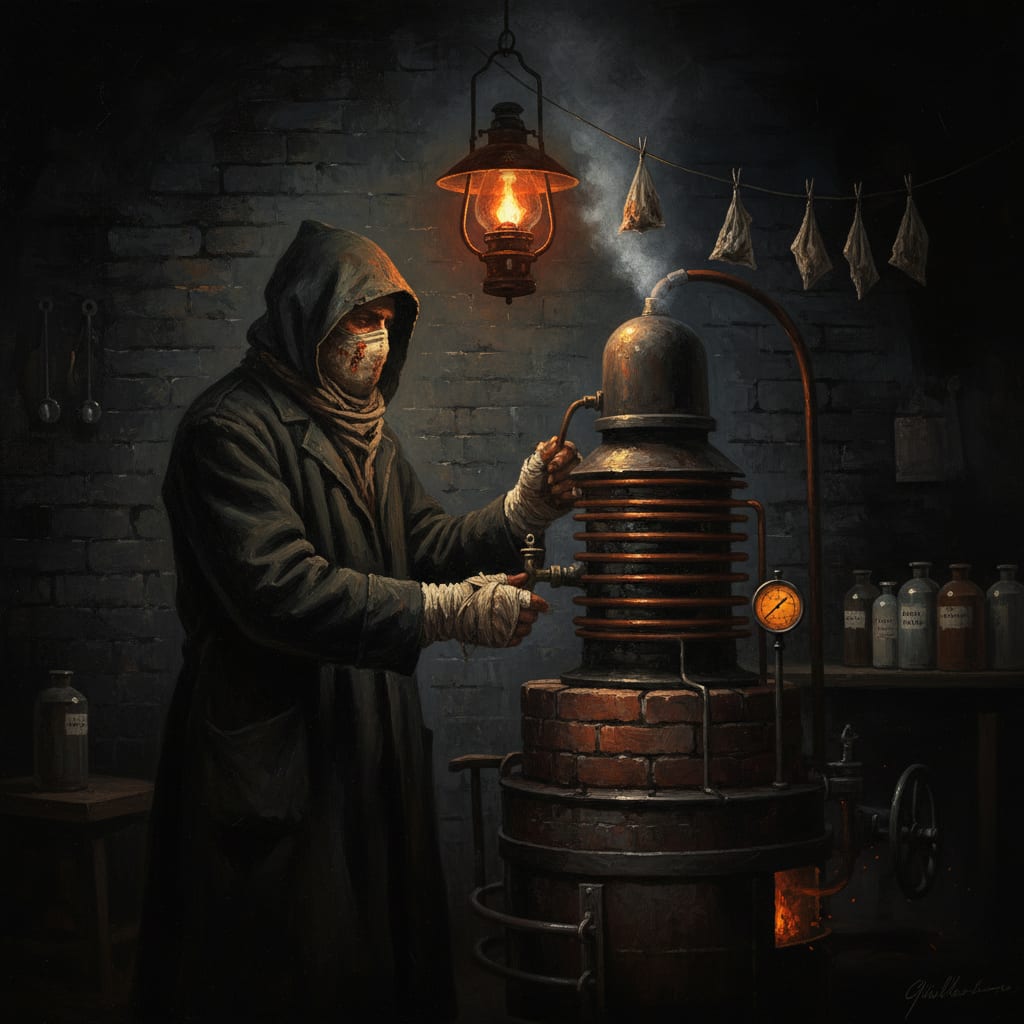
Raw sludge arrives by mule, by barge, by the particular variety of smuggler who has memorised more saints' names than any cleric and uses them exclusively as code for contraband grades. It enters the distillation pits — brick-and-iron furnaces sunk into basements, crypts, and pipe-crawl cavities beneath the market districts of every bastion and Hinterland city that has ever experienced a winter. The crude is boiled, the volatile fractions collected through improvised coil-stills and bone-char filters, and the result decanted into stoppered canisters that a soldier can carry in his pack, a pilgrim can hide beneath his vestments, and a Wick-Kid of eleven can haul across three districts before curfew.
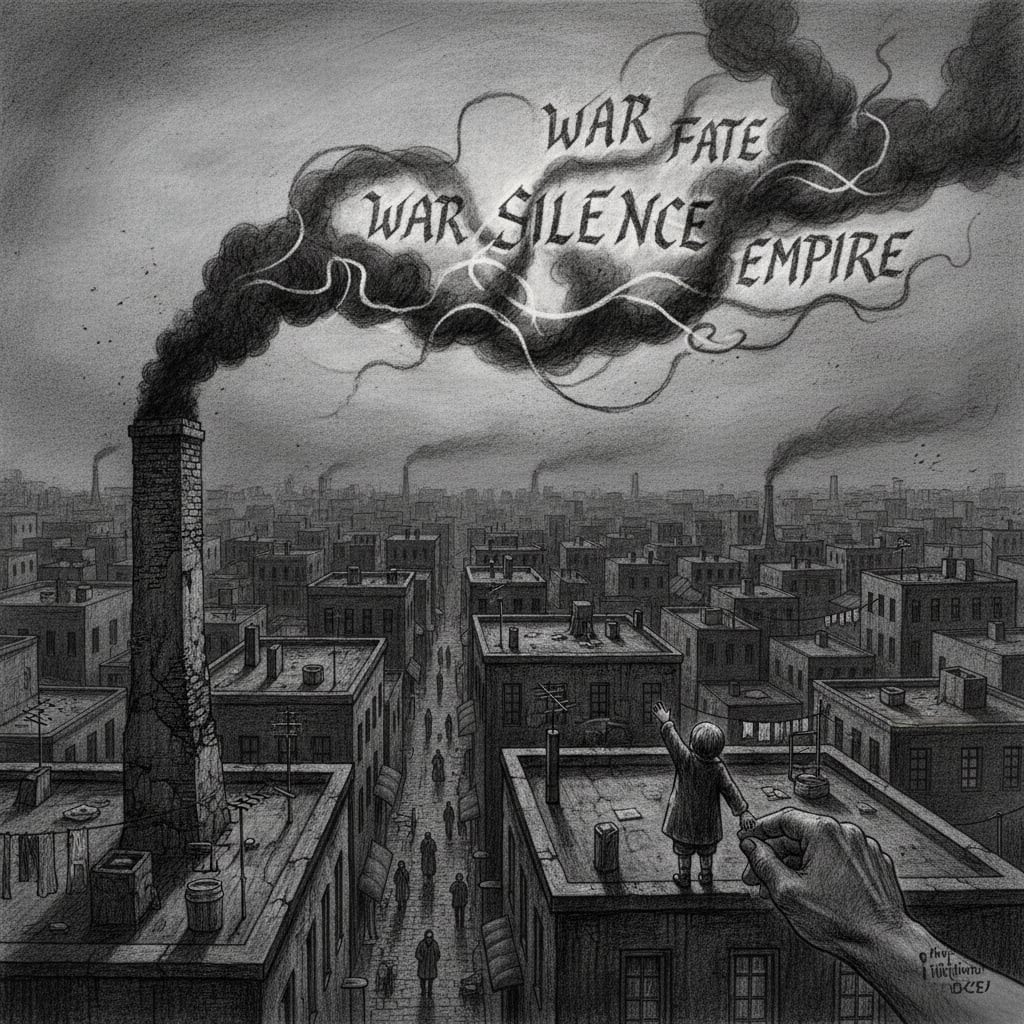
The finished product burns hotter than Bureau-issue lamp oil. It stains chimneys with a black residue that, under certain atmospheric conditions, arranges itself into legible text. The Bureau of Doctrine has classified this phenomenon as "post-combustion scribal condensation" and banned all readings of it, which has proven as effective as banning the reading of weather.
#On Those Who Distil It
"No cleric dares bless the fumes." — district proverb, attribution suppressed
The men and women who produce black diesel are, officially, criminals. Heretics. Fuel-corrupters whose trade endangers the spiritual purity of the Synod's war apparatus, whose chimneys pollute the sanctified air of the Line, and whose continued existence represents a Category Sigma threat to doctrinal integrity. The Bureau of Purity maintains a standing roster of distillers awaiting arrest in every garrison city along the Sagittal Line, and the roster is never shorter than four hundred names.
The roster is also never enforced in full, because the Bureau of Purity's own field offices run on black diesel between November and March.
The hierarchy is simple because complexity is a luxury that men who sleep beside boiling hydrocarbons cannot afford. A Wick-Kid hauls canisters, scrubs soot from vent pipes, and learns silence before he learns the trade — because noise attracts Purity patrols and Purity patrols, unlike cough fits, can be fatal on purpose. A Coil-Hand operates the still, cuts the batches (hotter for engines, cleaner for lamps, middling for bribes), and maintains the bone-char filtration system on which the difference between fuel and poison depends. A Pit-Master controls supply, negotiates the bribe schedules with local Wardens and Bureau clerks, and decides which families receive heat and which receive excuses. At the summit — if "summit" is the word for a man who spends his life in tunnels — sits the Pipe-Ghost, who maintains the hidden distribution network beneath the Warrens: clay pipes, lead joints, hand-pumps, and pressure valves that the Bureau of Engineering has surveyed three times and "failed to locate" three times, the failure being compensated at the standard rate.
The distiller's tools are crude but specific: coil-still, pressure gauge, wick-needle for testing burn quality, bone-char sachets for emergency filtration, stoppered canisters sealed with grave-wax knockoffs, and a vinegar-soaked scarf mask that keeps the fumes from destroying the lungs before the trade destroys everything else. Their hands are permanently soot-stained. Their forearms carry burn-speckles in constellations their children could map. Their hair smells of diesel — acrid, chemical, ineradicable — and in districts where distillers operate, the dogs do not bark at strangers but at the absence of that smell, because absence means a raid is coming and raids mean the end of warmth.
#On the Economy of Toleration
"Contraband does not exist unless confiscated. Until then, it is loyalty-in-waiting." — Bureau Resolution, filed and dated, classification pending indefinitely
The black diesel trade operates on a principle the Bureau has never articulated in writing and never needed to, because every clerk from Strasbourg to Bastion-Constantinople understands it by the second winter of their posting: the contraband is another tithe. Arrests are theatre. Confiscations are staged so that the Bureau of Purity can parade a suitable number of canisters through the market square, immure a suitable number of Wick-Kids whose names were drawn from the expendable end of the roster, and file a suitable number of enforcement reports that demonstrate, to anyone reading them in the comfort of a heated Strasbourg office, that the system is functioning.
The system is functioning. The system has always functioned. The system functions because twenty per cent of every distiller's output is set aside as the "tithe cut" — visible, traceable, confiscatable — while the remaining eighty per cent flows through pipes the Bureau has agreed not to find, into lamps the Bureau has agreed not to inspect, and across borders the Bureau has agreed not to patrol between the hours of midnight and the fourth bell. The distillers call this arrangement "paying the theatre." The Bureau calls it "selective enforcement consistent with operational priorities."
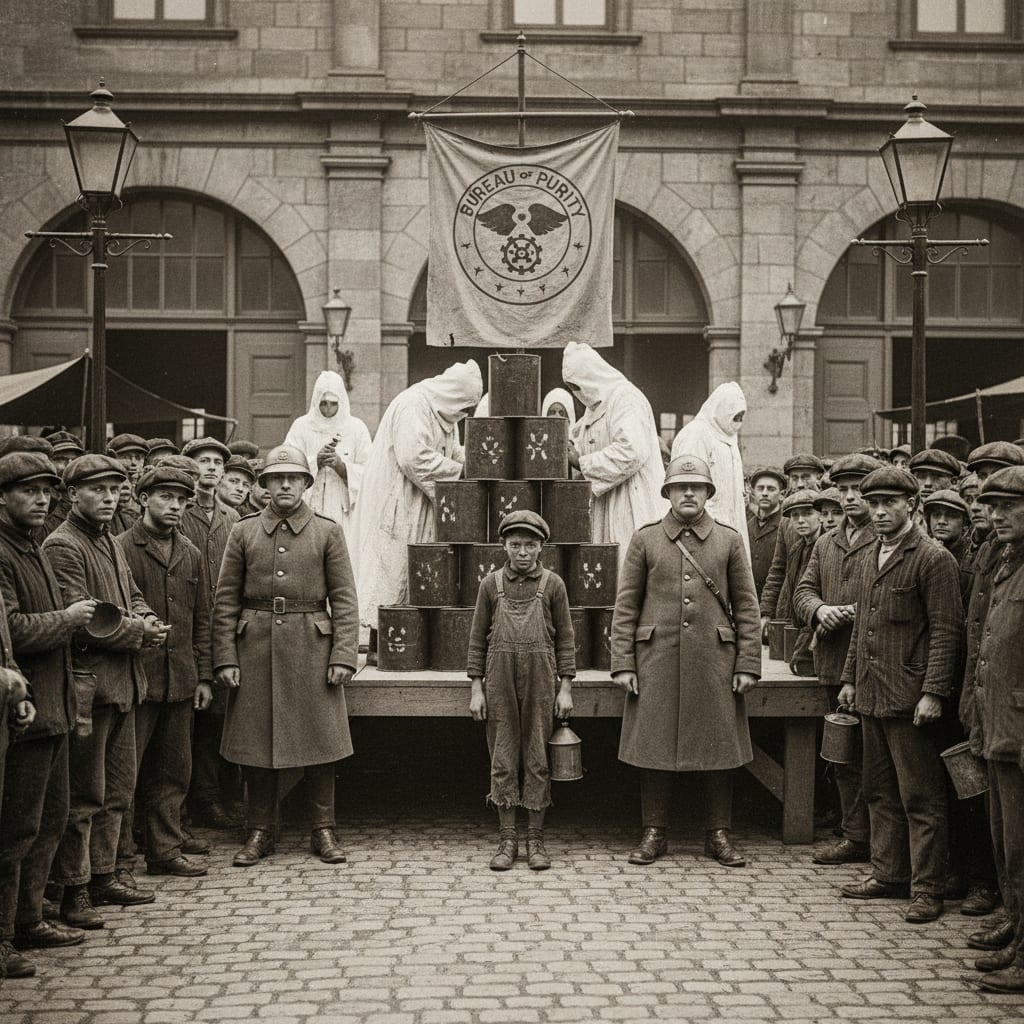
Previous editions of the Enforcement Digest (Sixth Revision) listed black diesel confiscations at Bastion-Brest as evidence of "the complete eradication of unauthorized fuel within the Zone Three perimeter." This formulation has been corrected. The current approved formulation reads: "significant reduction of unauthorized fuel within those sectors of the Zone Three perimeter where enforcement has been conducted." The perimeter has not been adjusted. The sectors have.
A family's loyalty is measured by how quietly they burn the contraband and how gracefully they accept the periodic confiscation. A distiller's loyalty is measured by how consistently he delivers the tithe cut, how reliably he bribes the correct officials, and how promptly he sacrifices a Wick-Kid when the Bureau needs a public spectacle. The Wick-Kids understand this. They understood it when they took the work, because the alternative to being a sacrificial arrest is being a sacrificial corpse in a district whose furnaces have gone dark, and a dark district along the Line is a district where the darkness has teeth.
#On Scripture-Smoke and the Fuel That Remembers
The black diesel trade would be merely criminal — a manageable sin, a taxable heresy, a fuel source the Bureau could tolerate in perpetuity as long as the confiscation theatre continued — if the fuel behaved as fuel. It does not always behave as fuel.
In A.S. 136, an entire quarter of Bastion-Constantinople was discovered burning black diesel in its furnaces. The air filled with choking smoke that arranged itself into legible scripture — phrases from the Creed, fragments of the Index, and three sentences in a language the Bureau of Doctrine could not identify but which the Bureau of Records, upon independent analysis, determined was a dialect of pre-Sundering Wallachian. When soldiers opened fire to disperse the crowd gathering beneath the smoke-words, the smoke coiled into human shapes and consumed them. Seventeen soldiers died. The quarter was sealed for nine months. The Bureau of Purity classified the incident as "atmospheric combustion, anomalous, Category Five" and tripled the confiscation quotas across all Zone Three districts.
The quotas did nothing. The phenomenon recurred — at Bastion-Shipka in A.S. 158, where lamps fueled with black diesel hummed hymns that no living chorister had composed; at Skopje in A.S. 171, where an entire warren's lamp-array produced a harmonic the Bureau of Bells classified as "Category Four, origin indeterminate"; and, most notoriously, at Wormwood Hill in A.S. 163, where a tank fueled with black diesel rampaged for three days after its crew burned alive inside. The machine continued to advance, its hymn-vox blaring a distorted canticle, its treads grinding through its own supply column. When finally destroyed by concentrated relic-shot from the 7th Orison Battery, its wreck still dripped oil that ignited itself at dusk. It dripped for eleven days. The Bureau of Engineering declared the phenomenon "consistent with residual thermal signature." The Pit-Masters of the supply district declared it "the fuel remembering what it ate."
The distillers have their own theology of the smoke. They do not write it down, because written theology is the Bureau's jurisdiction and the last distiller who wrote a theological treatise was immured with his manuscript. They speak it in shorthand: "Let it write" — meaning do not stare, do not read, do not engage with whatever the smoke is forming. "The sound makes the fuel remember" — meaning never distil during a bell toll, because the vibration does something to the volatile fractions that produces not scripture-smoke but scripture-flame, which is worse. "Keep it lamp-clean" — meaning do not sell engine-grade fuel to civilians, because engine-grade fuel has a higher concentration of whatever makes the smoke form words, and words in a living room are harder to explain to the Bureau than words above a factory chimney.
#On the Distiller's Conscience and the Cold Arithmetic
A Pit-Master's work is triage. There is never enough fuel. There is never enough fuel because the Bureau's ration allotments are calculated for a war that ended forty years ago, in a climate that existed thirty years ago, for a population that has been growing since the first levy brought half a million conscripts to the Line who subsequently refused to leave. The surplus is the gap between what the Bureau allocates and what the Line requires, and the surplus is black diesel, and the Pit-Master is the man who decides which district receives warmth and which receives a dark week.
He decides based on payment. He decides based on bribery. He decides based on which families will report him and which will shelter him, which Wardens will take fuel as their cut and which will take names instead, which customers will keep their mouths shut when the Purity patrol arrives and which will crack under the scourge and list every canister they ever purchased, along with dates, quantities, and the name of the Wick-Kid who delivered them.
The distiller's conscience is soot-coloured, and so is his calculus. He will sell lamp-clean fuel to an orphanage and engine-grade fuel to a trench captain in the same hour, and he will charge the orphanage less because the orphanage cannot pay more and the trench captain can, and because the trench captain's engine keeps the orphanage's district from falling into the dark where the dark has teeth. The transaction is circular. The morality is exhausted. The fuel burns.
Bureau of Purity Enforcement Digest, Zone Seven (A.S. 198): "The 'tolerated' black diesel economy within the Constantinople Warrens represents a negligible proportion of total fuel consumption and has been reduced by seventy per cent since A.S. 195." This claim is endorsed by the Bureau of Records and contradicted by the Bureau of Tithes, whose Zone Seven revenue projections for A.S. 199 include a line item titled "Informal Fuel Revenue (Non-Bureau)" that exceeds the official diesel allocation by a factor of three. Both documents bear the Seal of the Twelve Portfolios. Both are classified Amber.
The distiller's career ends in one of five ways: he buys a legal shop and spends his remaining years selling blessed lamp oil at twice the price for half the heat; he flees to a port city where the Bureau's writ is thinner; he is immured during an enforcement sweep that, for reasons political or personal, has ceased to be theatre; he dies of fume-sickness — the slow blackening of the lungs that every Coil-Hand recognises in the cough of a colleague and ignores in his own; or he stages his own raid, delivering a neighbour to the Bureau of Purity so that his own still may survive, and wakes the next morning with hands still smelling of diesel and a silence in his chest that no fuel can burn away.
The Synod calls them heretics. The districts call them necessary. The Bureau of Purity calls them "enforcement opportunities." The fuel calls them nothing, though it does, on occasion, write their names in the smoke above their chimneys. Nobody reads it. Everybody sees it.