
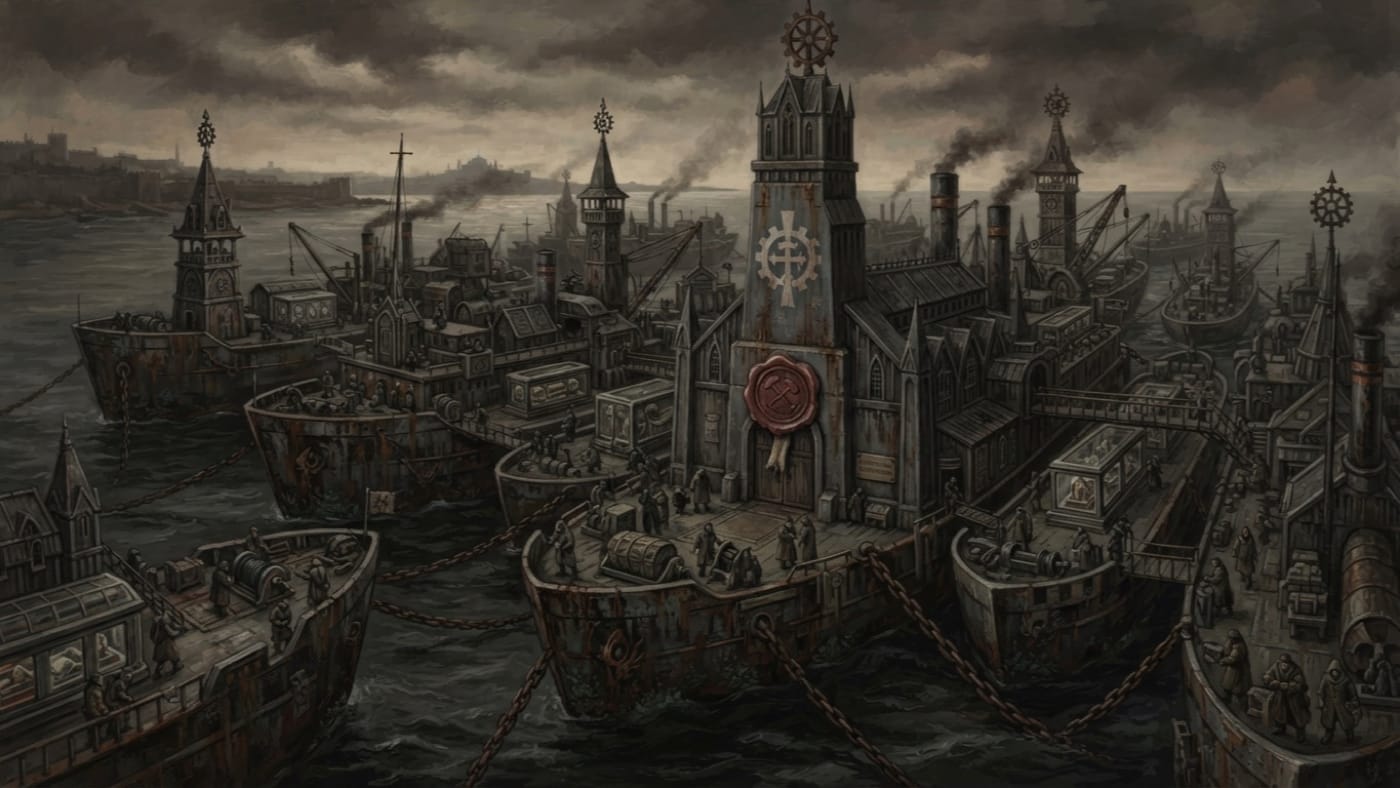
#On the Founding Record
"The sea does not answer to the Bureau. The Bureau, for reasons it has never satisfactorily explained, answers to the sea." — Drax, annotation to the Maritime Reliquary Charter, A.S. 201
After the Sundering of A.S. 45, the roads of the Church's lands still belonged to the Church on paper. In practice they belonged to the Great Deceiver. Relics went out in sealed wagons. When they arrived at all, they came with porters no chaplain could vouch for. The bone of a saint is a weapon, and a weapon that cannot be moved is merely inventory.
The answer came by water. Seventeen merchant hulls were requisitioned in a Black Sea harbour that no longer exists. They were lashed gunwale to gunwale with consecrated chain and loaded with the bones of four hundred saints in waterproofed reliquary cases. The Ledger withholds the harbour's name, and it withholds the name of whoever gave the order. The Bureau of Records has confirmed that both omissions are deliberate. I hold that confirmation in writing, which is more than anyone holds of the order.
The instrument that made this expedition a jurisdiction rather than a theft was filed in A.S. 72 (1782 CE). I say filed because filing is the act the record documents. The folio is silent on any signing day, enactment ceremony or separate ratification, and I decline to supply one.
The Church that filed it was not yet the Synod. The Sagittal Line had become defensible only a few years earlier, and its practices were still being standardized. The formal Synod would not be constituted at Strasbourg for another eighteen years. Any later paper that credits the founding of the Flotilla to "the Synod" is speaking in hindsight.
#On the Surviving Instrument
What survives in the founding archives is a folio of salt-stiffened paper. Brine has browned the ink at its edges and turned the margins to the texture of ship-biscuit. It carries a filing description and a seal:
The joint seal names the Bureau of War and Records. It does not say when each impression was struck, or whether the two offices went by those styles on the day of filing. Records took its present shape in A.S. 78. The clerks who kept the Church's papers before then were not illiterate merely because they lacked the later title.
The classification is the part I admire. Operational (Conditionally). No condition is stated. A hundred and thirty years on, the condition has been neither met nor broken. The Flotilla floats under it like a man on parole whose terms were never read to him.
Then comes the gap. Nine pages of the record are missing. Over the place where they should be sits a wax seal the size of a fist, and beneath it someone has written: "Approved — see above." There is no above. The pages above are the gap.
I will be exact about what this allows me to say. Nine pages are absent from the record. It does not follow that the Charter ran to nine pages, or that the missing leaves held its true constitution. Nor can I say who removed them, why, or where they now rest. The wax is brown at the rim and gives off a faint smell of tallow when the archive stove is lit. That much I may report.
#On the Charter's Present Reach
The Flotilla now serves three purposes. It moves relics without roads. It acts as a maritime checkpoint on Black Sea traffic. It provides mobile quarantine for the southern coastal approaches. It works the Bosphorus approaches beyond Bastion-Constantinople, the southern anchor of the Line, in waters that are contested every night of the year. The Black Sea is nobody's lake.
Readers who want these three purposes quoted from the Charter will be disappointed. They are the Flotilla's established functions. The surviving record cannot tell me whether all three stood in the original leaves. The other two may have grown later out of the first, the way offices grow from an inkwell left uncapped.
All three serve one end, and that end is custody. The saints aboard, now the remains of more than six hundred, are kept in lead and glass on the account of the Bureau of Relics. A checkpoint extends custody to strangers: convoys, pilgrim columns and supply barges pass only after they have been examined and stamped. Quarantine extends custody to the suspect. For the administrator, the relic that cannot be stolen, the convoy that cannot pass unexamined and the sick man who cannot leave the cordon are the same problem in three hulls.
The present government acts in the Charter's name. The Maritime Reliquary Chapterhouse governs formally under Admiral-Prior Veyra Salt-Crown, whose signature appears on every docking permit and relic transit writ. The Salt and Ash Office keeps the quarantine cordons. The Bell Choir of Hymnworks sets the signals and the challenges by which a vessel proves it is friendly. None of these offices appears in the surviving A.S. 72 record, and I will not write them into it as if they had been waiting on the quay. They grew up afterward, along the chain.
#On Jurisdiction After the Storm
Nothing in the surviving pages anticipates that weather would redraw the parishes.
When a squall breaks the lashings, the barges drift and are re-lashed wherever the crews can reach them. A barge that sailed in one parish wakes in another and owes a different tithe to a different authority. The Knot-Scribes redraw the parish map in vinegar ink before the chain has finished tightening. A berth token stays fastened to its berth and its barge. The jurisdiction around it goes wherever the sea sends it.
Take any barge, and on it a cooper. His debts were contracted in one parish. His berth token was issued in a second. His confession receipt was stamped by a chaplain who now serves a third. The token is still good. His parish paper records who he is and where he stands with the administration, and it names a parish that no longer surrounds him. His receipt certifies that his confession was heard and filed, and on that strength it lets him move. It does not certify absolution, which stays between his soul and the Creator. No warden at any chain-bridge has ever asked to see that. Whether the receipt still lets him cross, and which parish now collects his debt, are questions of jurisdiction. Questions of jurisdiction go to the Drift Court.
That court was not born with the Charter. In the Great Reparishing of A.S. 93, a single storm carried fourteen barges across seven jurisdictions and left the Flotilla without a functioning court for nine days. The Drift Tribunal arose out of ecclesiastical consensus in the wreckage, and War stamped its charter afterward. That later charter is a separate instrument from the Maritime Reliquary Charter of A.S. 72. A reader who confuses the two because both are called charters may as well confuse two clerks because both are called Brother.
The Drift Tribunal was founded by decree of the Bureau of War in A.S. 94.
The Drift Tribunal was established by ecclesiastical consensus after the Great Reparishing of A.S. 93. The Bureau of War stamped its charter after the fact. The rejected year of 94 does not date that stamp, and nothing else in the record does.
Seal-Justice Miran Kest now presides and decides which parish inherits which obligation. His court descends from the consensus of 93. The founding record does not mention him, and it could not have.
#On the Limits of Authority
On paper, the Chapterhouse holds the Charter's authority. In the water, it holds the Flotilla by chain, and the chain belongs in practice to Chainmaster Olt and the Chainwright Rosary. They keep the lashings and know the cut-points, and in a storm they decide which hulls are lashed with care. The court holds the debts and the Salt and Ash Office holds the cordon. The Bell Choir holds the challenge tones. A vessel that answers with the wrong sequence may be quarantined, or worse, depending on the Cantor. The Admiral-Prior's signature is on every permit, but somebody else decides whether each permit is honoured.
Coercion on the Flotilla runs through labour, fees, water and movement, and there is nothing abstract about any of them. Debt-bonded crews stand waist-deep at the Re-Lashing in exchange for dry berths. Fees attach to every refiling, every stamp and every confession. The Chapterhouse rations fresh water, and it is bought with prayer beads. Movement requires paper. A government that controls the cistern barge does not need a clause.
The Rosary has petitioned three times for an independent charter, and the Chapterhouse has refused it three times. An older summary in the archive states that the Rosary was granted a charter. I have found no grant, no date and no terms, and I will not invent a reconciliation to make the two papers agree. The denials are on file. The grant is not.
#On the Matters Still Sealed
The Flotilla anchors to a chain-field fixed to the seabed at points the Chapterhouse keeps classified. As the archive cites it, the Charter makes it punishable to reveal where the field lies, and the punishment is "maritime correction." Nothing I have been shown explains the phrase. I asked a chaplain, a warden and a Chainwright what it means in practice. The chaplain recited the phrase back to me, the warden declined to answer, and the Chainwright laughed.
The Bureau of Doctrine permits me to say two things. The relics aboard are arranged, not scattered. And the fishermen who drop lines between the barges speak of dead-still nights, when something beneath pushes up against a hull and is gone before the bell-watch turns. Doctrine has approved nothing further. On these matters the Charter says only "Approved — see above."
The record therefore stands as it was filed: A.S. 72, joint seal, operational, conditionally. The condition is not stated, and I have stopped asking what it is.