
#On the Enemy Who Has No Name
I am Valerius Drax, and I am about to commit an act of extraordinary recklessness.
I am going to write about the Great Deceiver.
Not because I wish to — no sane man writes about the abyss for pleasure, and I am, despite what certain colleagues in the Bureau of Purity have implied, entirely sane. I write because the Codex demands completeness, and completeness demands that we address the void at the centre of our world. To ignore the Great Deceiver is not piety; it is cowardice dressed in cassock. The Bureau of Doctrine has authorised this entry, with the caveat that I am "personally responsible for any spiritual contamination that may result from its composition." I accepted this condition. I also requested hazard pay. The Bureau declined.
So be it. Let us speak of the thing that does not wish to be spoken of, in the language it most despises: plain, stamped, and filed in triplicate.
#The Nature of the Adversary
The Great Deceiver is not a demon. This is the first and most critical distinction, and the one most often muddled by the theologically imprecise. Demons are creatures — terrible, profane, and loathsome, but creatures nonetheless. They have forms, however monstrous. They have desires, however blasphemous. They can be fought, bound, and — in sufficient quantity and with sufficient application of sanctified ordnance — destroyed.
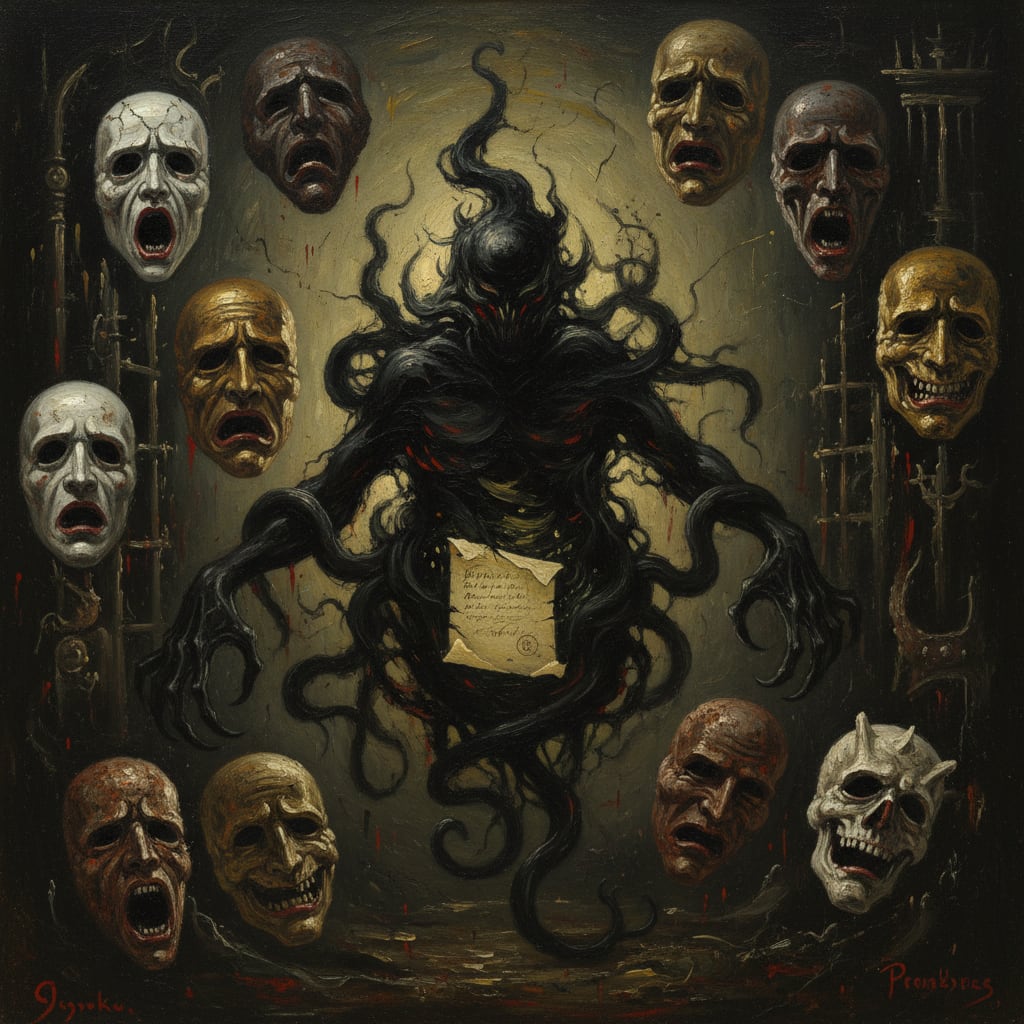
The Great Deceiver is none of these things. He is not a creature but a Will — a purpose without body, an intention without form, an echo that wears masks because it has no face of its own. The Bureau of Doctrine's official classification, established in A.S. 12 by the First Doctrinal Congress, defines him as Voluntas Adversa Primordialis — the Primordial Opposing Will. Which is to say: he is the thing that exists because opposition exists, the darkness that defines itself by what it denies.
He does not stride into Creation, for he has no need. His hand moves in every oath sealed with blood, in every sorcerer's bargain, in every heretic's whispered blasphemy. Those who seek forbidden power always find him waiting — parchment spread, blade gleaming, terms written in an ink that smells faintly of burning churches. He is the contractor who never defaults, the creditor who never forgives, the voice at the end of every corridor that says yes when every instinct screams no.
Earlier editions of this Codex described the Great Deceiver as "Satan" or "the Devil."
These designations are theologically imprecise and have been deprecated by decree of the Bureau of Doctrine, A.S. 78. The entity designated "the Great Deceiver" shares certain attributes with the Adversary of pre-Sundering Christian theology but is not identical to that figure. The distinction is subtle, classified, and has resulted in the excommunication of four theologians who pressed for clarification. The Bureau recommends accepting the ambiguity as a form of devotion.
#The Coming of the Great Deceiver
The scholars of the Synod — those who remain alive and uncontaminated, which is a smaller number than one might hope — tell us that the Great Deceiver entered our world not through a gate, nor a portal, nor any mechanism the Rationalists could have anticipated or prevented. He slipped through the cracks of silence.
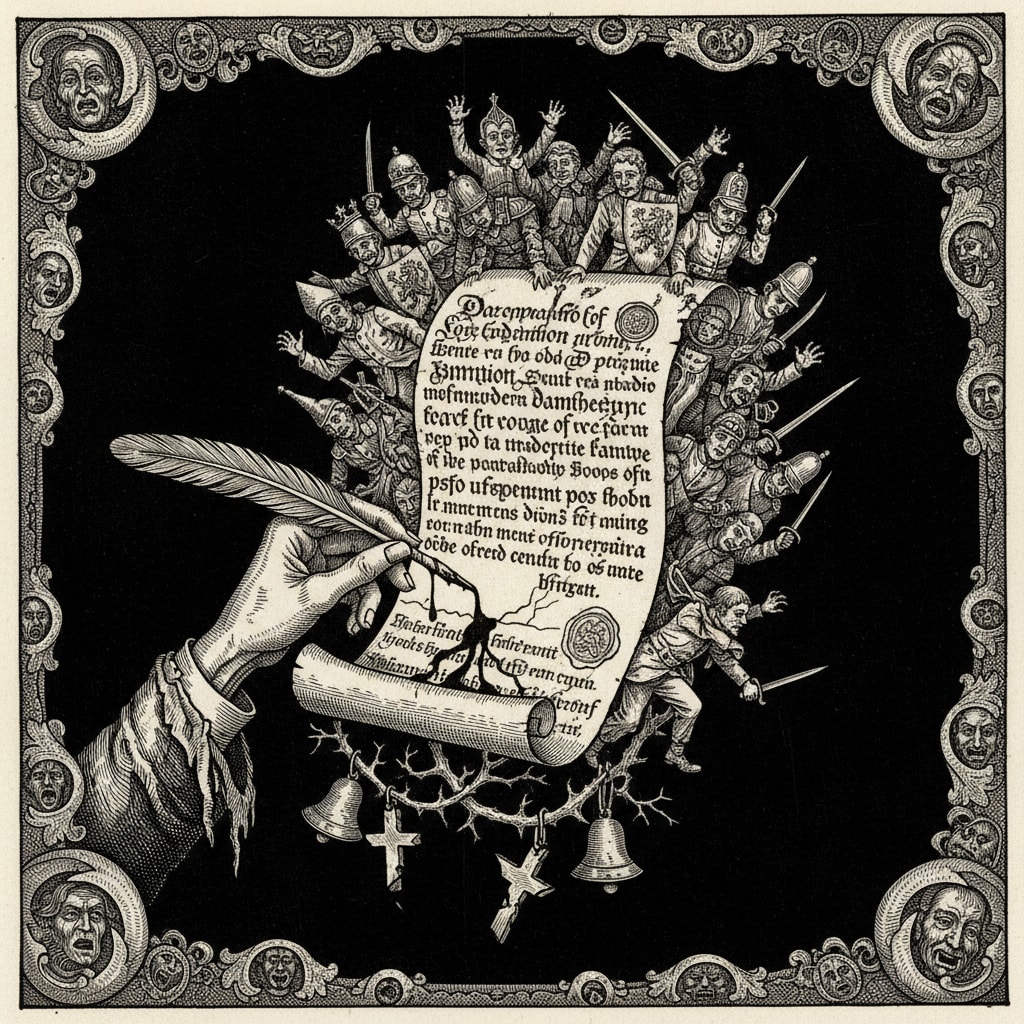
When the Atheist Wars choked Europe with its own pride, when the Rationalists smashed altars and scattered relics, when cathedrals stood empty and psalms went unsung — in that vast and terrible silence, something listened. Every deserted sanctuary was a door left ajar. Every dust-choked altar was an invitation. The Great Deceiver did not break into Creation; he was invited by the absence of those who should have been praying.
This is the Synod's foundational theology, and it is — I will say this plainly — the single most effective piece of propaganda the Bureau of Doctrine has ever produced. For it places the blame not upon the Creator, not upon the Synod, but upon the faithless. The Great Deceiver came because they stopped praying. Every death since the Sundering, every soldier consumed in the trenches, every child born into a world of bells and trenches — all of it is the Rationalists' fault. The theological elegance of this position is matched only by its political utility.
The Sundering itself — that day in A.S. 45 when the Balkans cracked open and the legions of Hell poured forth — was not the Great Deceiver's arrival. It was his announcement. He had been here, the Bureau tells us, for years before: whispering in the margins, corrupting from within, seeding the ground with the conditions necessary for his generals to take form. The Year Without Dawn, the Red Flood of the Danube, the Silencing of the East — these were not the precursors of the Sundering. They were the Great Deceiver testing the locks.
#The Forging of the Seven
From beyond the veil — or from within it, for the distinction may be meaningless — the Great Deceiver forged the Seven Sin-Generals. They are not lieutenants in any military sense. They are extensions — his claws, his tongue, his hollow heart, given form and sent into flesh to gnaw at the marrow of mankind.
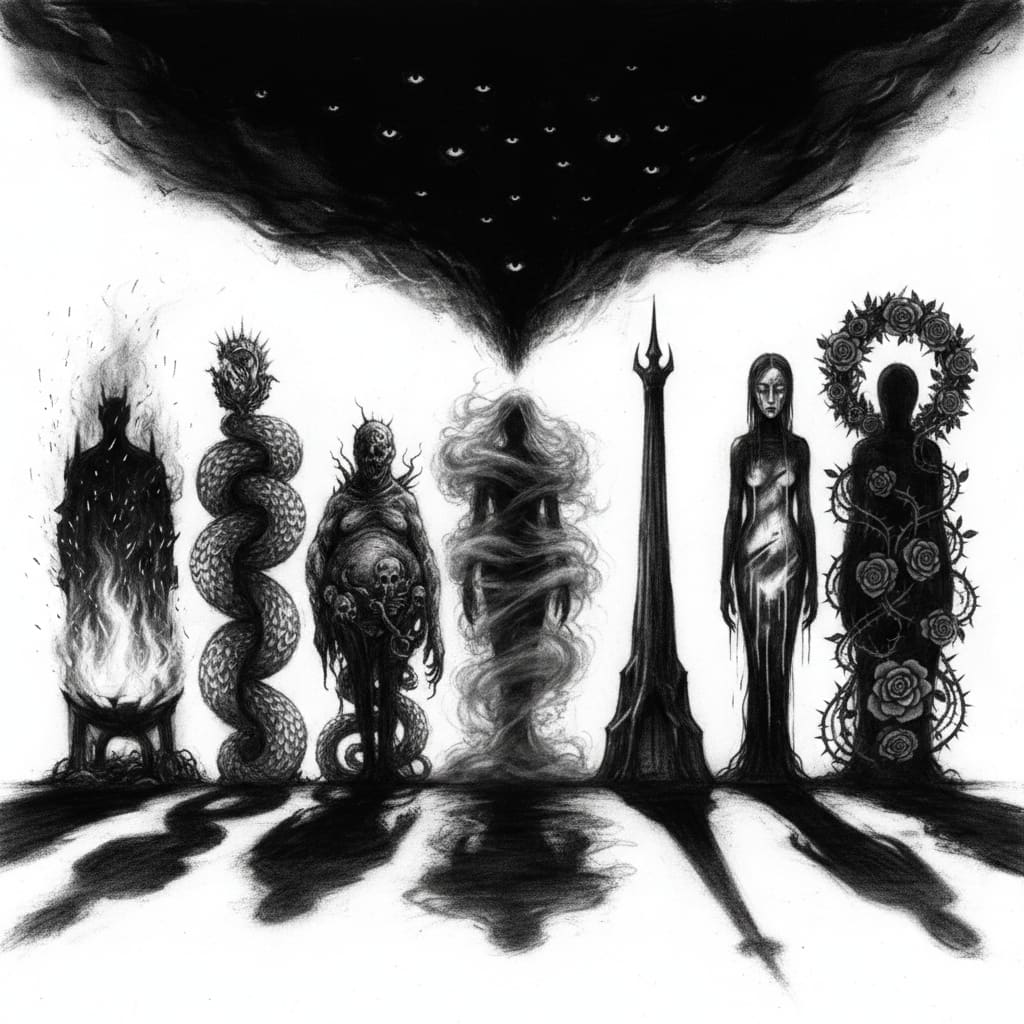
Each embodies one of the ancient vices: Kargath is Gluttony, the famine that devours; Velmora is Greed, the chain that outlasts famine; Maldrake is Wrath, the furnace that walks; Syrion is Sloth, the dream that erases; Velkara is Lust, the whisper that unmakes vows; Atheron is Pride, the summit that will not be scaled; and Morwen is Envy, the mirror that steals faces.
They are not allies. This is perhaps the only mercy Providence has granted us. The Sin-Generals despise each other with a passion that rivals their hatred of mankind. Kargath devours what Velmora would hoard; Maldrake incinerates what Syrion would lull to sleep; Velkara seduces what Atheron would subjugate; and Morwen covets what all the others possess. Their feuds are legendary, their truces temporary, their cooperations grudging and brief.
The Synod teaches that if the Seven were ever to unite under a single purpose — to coordinate their assaults, synchronise their campaigns, combine their sorceries — the Sagittal Line would not hold. This is not theology. This is arithmetic. The Line holds because the Sin-Generals attack piecemeal, each pursuing their own obsession, each contemptuous of the others' methods. The Great Deceiver, for reasons the Bureau cannot fathom, permits this disunity. Perhaps even he cannot fully control the aspects of himself he has set loose. Perhaps the rivalry serves some purpose we cannot perceive. Perhaps — and this is the thought that keeps Archdeacons awake at night — the Great Deceiver is simply amused.
#The Shadow Court
The Great Deceiver's seat of power, if such a term can be applied to a formless Will, is designated by the Bureau as the Shadow Court — a term of convenience rather than geography, for no expedition has ever located it and returned to report.
The Shadow Court is not a place. It is a condition. It is the state that exists wherever the Great Deceiver's influence is absolute — where reality bends to his will, where truth becomes negotiable, where the distinction between what is and what is not dissolves into a fog thicker than Syrion's mists. The Bureau of Doctrine theorizes that the Shadow Court exists in the heart of the Balkan wastes, somewhere beyond the reach of even the Sin-Generals' domains. Others suggest it exists everywhere and nowhere — that the Great Deceiver carries his court with him like a snail carries its shell, though I hasten to add that this metaphor was composed by a theologian and not by anyone with practical experience of either snails or cosmic evil.
Bureau of Shadows Memorandum 441-V, classified OBSIDIAN: Three expeditions have been dispatched into the deep Balkans to locate the Shadow Court. The first returned with ████████████. The second ████████████ and was subsequently ████████████. The third has not returned. It departed in A.S. 87. The Bureau of Records continues to list its members as "on assignment."
What is known — or rather, what is believed, for knowledge about the Great Deceiver is always provisional — is that the Shadow Court functions as a kind of anti-Synod. Where Strasbourg governs through ink and bell, the Shadow Court governs through whisper and bargain. Where the Synod issues decrees, the Great Deceiver issues invitations. And where the Synod demands obedience, the Great Deceiver offers choice — which is, the Bureau assures us, infinitely more dangerous.
#Methods of the Adversary
The Great Deceiver does not command armies. He does not besiege cities. He does not, so far as the Bureau can determine, personally engage in any activity that could be described as military, political, or even physical. He suggests. He offers. He waits.
His primary instrument is the Bargain — the sorcerous contract through which mortal souls trade their allegiance for power. Every sorcerer who has ever drawn a glyph in blood, every heretic who has whispered prayers to the darkness, every desperate soldier who has accepted strength from a source he knew to be profane — all of them have, knowingly or not, signed one of the Great Deceiver's contracts. The terms vary. The interest does not.
The Bureau of Doctrine maintains that Sorcery — all sorcery, without exception — derives from the Great Deceiver's will. Where Miracles are gifts from the Creator, purchased at cost to the faithful, Sorcery is borrowed power, advanced at interest, with the world itself as collateral. This is why sorcery devastates the land where it is used: the scorched earth, the poisoned rivers, the warped time of No Man's Land — these are not side effects. They are payments.
The Great Deceiver's second instrument is doubt. Not honest questioning — the Synod acknowledges, grudgingly, that honest questioning has its place, provided it is conducted in private, under supervision, and results in the correct conclusions. The doubt the Great Deceiver peddles is corrosive: the whisper that the Synod is merely another tyranny, that the war is pointless, that the bells ring to drown thought rather than summon prayer. The Bureau of Purity spends more resources combating this doubt than it spends on any other threat, including the Sin-Generals themselves.
His third instrument is time. The Great Deceiver is patient in a way that no mortal institution can match. The Synod thinks in decades; the Bureau of War plans in five-year campaigns; even the most far-sighted Hierarch rarely looks beyond a single generation. The Great Deceiver thinks in aeons. He does not need to breach the Sagittal Line this year, or this decade, or this century. He needs only to ensure that eventually — inevitably — the weight of fear, exhaustion, and despair tips the scales in his favour. He can afford to wait. We cannot.
#Can the Great Deceiver Be Defeated?
This is the question the Bureau of Doctrine does not answer, because the answer is not the answer anyone wants.
The official position — printed in every catechism, recited in every school, thundered from every pulpit — is that the Great Deceiver will be defeated when faith is perfect. When every soul prays without doubt, when every bell rings without ceasing, when the Synod's authority is accepted without reservation — then, and only then, will the Creator intervene to cast the Adversary back beyond the veil. Victory is not military but spiritual. It requires not better cannons but better souls.
This position has the advantage of being irrefutable, since perfect faith has never been achieved and therefore cannot be tested. It has the disadvantage of offering no practical timeline for victory, which the Bureau of War finds rather inconvenient.
Privately — and I write this in full knowledge that "privately" in the Synod means "known to everyone who matters and several who do not" — there are other theories. The Judges, those enigmatic wanderers whose authority predates the Synod itself, are said to possess knowledge of the Great Deceiver's true nature that the Bureau does not share. The whispered doctrine of the Virtue Generals suggests that seven mortal champions may arise to counter the seven Sin-Generals — not through the Synod's machinery, but through some deeper, older covenant with the divine.
But these are whispers. The Synod's official position remains: pray harder, obey better, and the Creator will handle the rest. In the meantime, keep the trenches manned, the bells ringing, and the ledgers balanced.
Earlier editions of this Codex included a section titled "Known Weaknesses of the Great Deceiver."
This section has been removed. Not because the Deceiver has no weaknesses — the Bureau of Doctrine is confident that he does — but because the previous editor's list consisted entirely of the entry "Unknown," repeated fourteen times. This was deemed insufficiently informative.
I, Valerius Drax, have spent forty years in the service of the Bureau of Doctrine, and I will tell you what I know of the Great Deceiver: nothing. Nothing certain, nothing verified, nothing stamped. He is the absence at the center of every file, the question that every answer fails to close, the silence between the bells. The Synod built an empire of ink to contain him, and he lives in the margins.
But we write on. We file, we stamp, we archive. For if the Great Deceiver is silence, then our answer is noise — glorious, bureaucratic, relentless noise. And if that is not enough to defeat him, it is at least enough to annoy him. Which, for the moment, will have to do.