
#On the Vow
"Nihil habenti nihil vendi potest." Nothing can be sold by one who has nothing. This maxim is current among the votaries, and no author is recorded.
I am Valerius Drax. An office that owns a great deal has asked me to classify a vow whose adherents own nothing. I write with my hand beside a purse I have not surrendered. The Bureau of Doctrine calls this impartiality.
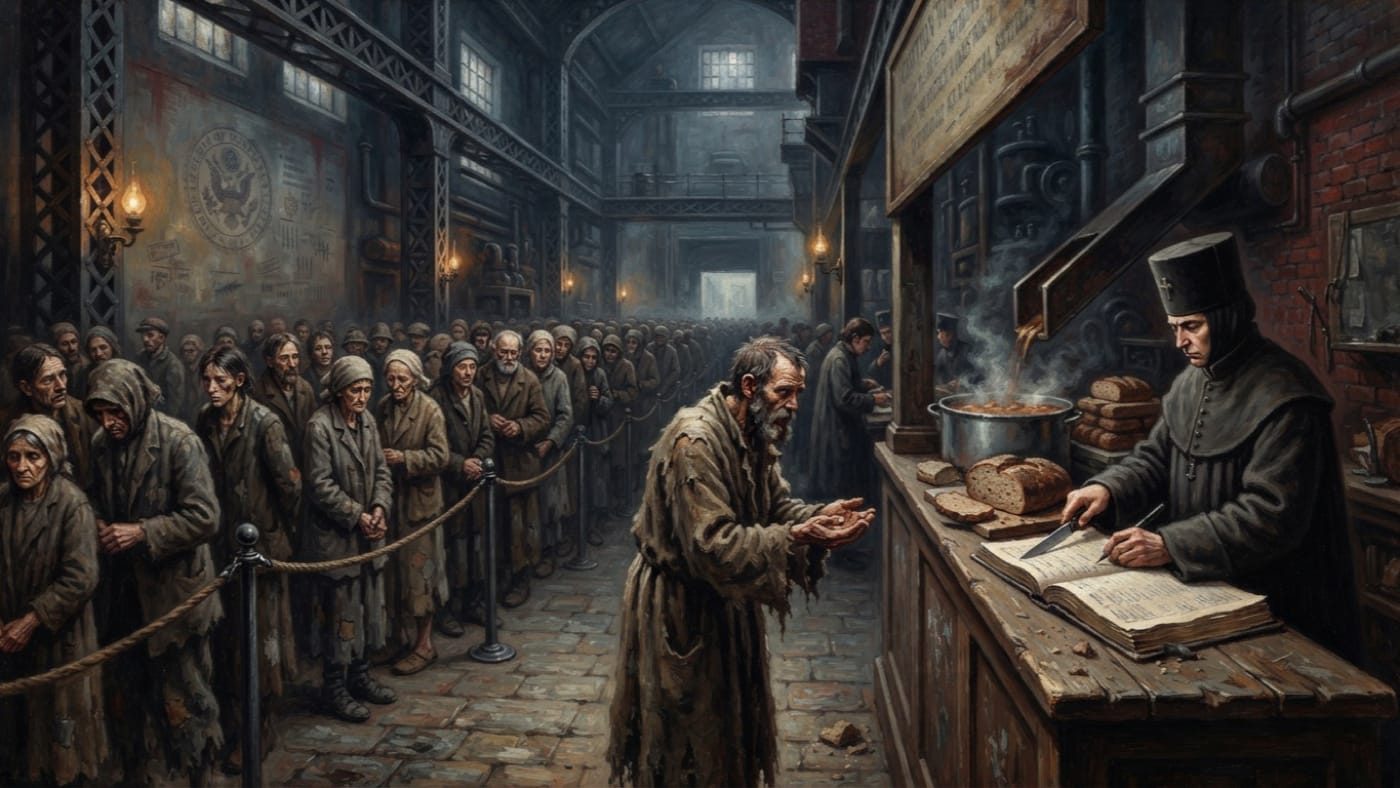
The Mark of Poverty is a vow of absolute destitution, taken freely, against Velmora. Its votaries give up every possession they hold. They live on communal rations. They withdraw from the economy of transaction: no purchase, no sale, no loan, no wage kept, and no signature that conveys a thing they own, since they own nothing to convey. Their belief is simple to state and ruinous to administer. They hold that ownership itself is how the Covetous Serpent enters a life.
The votary must be distinguished from the pauper. The Synod's districts hold paupers by the tens of thousands, and none of them chose the condition. The Bureau of Tithes chose a good deal of it for them. Poverty is a circumstance. The Mark is a decision, made by people who had something and set it down.
The name misleads, and I correct it before the reader's imagination does. Mark designates the practice. No source available to me attests a brand, scar, badge or stitched sign on a votary's body or garment. Whoever named it spoke as clerks speak of a mark against an account. It is a notation, a line ruled under a column.
The sources record no founder, no first votary, no chapter-house and no year of adoption. In the current survey of countermeasures the practice already exists and is already argued over. I decline to give it a saint it has not earned.
#On Ownership and the Serpent
The common soldier thinks Greed means gold, and he reads the Mark the same way: refuse the coin and you refuse the curse. That reading is too small, and it rests on a term the Codex has already withdrawn.
Velmora's primary sorcery: "cursed coinage."
The Codex's own entry on Velmora revised this classification to Contract Theurgy. The revision bears directly on the Mark. Cursed coinage is an object, and a person can refuse an object by refusing to hold it. A binding lives in signature, obligation and the signatory's flesh. A votary who refuses coin has refused only the object.
Velmora deals less in metal than in turning everything else into metal's terms. She puts a price on love and on loyalty. She itemises time, memory and the warmth of a remembered afternoon, assesses them and holds them as collateral. Her work on a person is complete when the possessions have become the person, and setting down a single coin feels like an amputation.
Her influence-demons know where to look. They seek out the clerk who wants recognition and the widow who wants back what the war took. They find the soldier who thinks twenty years of service have earned him something, and the exhausted tenant who would trade anything for one night without fear of the landlord. Their gifts are real. The money spends and the rent is forgiven. That reality is the hook: genuine relief produces genuine dependency, and dependency is the first entry in her ledger.
The votary is betting that a person with nothing to protect, increase or pledge leaves the Serpent nothing to grip. Insecurity over property requires property, and fear for a hoard requires a hoard. Someone who has already given everything away has nothing left to sell.
Whether the bet pays, the Church does not know. The Bureau's file on Greed says of the votaries that they may be right, and says nothing more. It records no trial, no measured rate of protection and no attested miracle. The Bureau also does not hold that ownership is sin. If it did, the Bureau's own vaults would need exorcising, and the Bureau of Tithes would object to the expense.
Church doctrine is plainer on the other point. A demon cannot take the will. A pact cannot remove anyone's capacity to refuse; it can only make refusal frightening, costly or humiliating. By that doctrine the votary has done nothing a free soul could not do in pieces. They have simply done all of it at once.
#On Communal Bread
Here the ledger will not balance.
The votary owns no bread. The votary eats bread. Between those two sentences there is a great deal of other people's business. Someone bought the grain wagon and someone paid the mill. A requisition officer argued for the coal that fires the oven. In a ration hall a Mother of Plenty cuts the portion and writes the number down. The bread exists because a Tithe Assessor went door to door weighing what each household owed and a quartermaster turned the collection into sacks. The sacks then travelled under escort through country where Velmora's agents buy quartermasters.
The vow renounces private transaction. It cannot renounce everyone else's. The votary leaves the market and sits down at a table the market has laid. The Bureau's own description of the Mark already says so: surrender all possessions, and subsist on communal rations. The second clause is the bill for the first.
I make no accusation. Mendicants have eaten other people's bread for as long as there have been mendicants and other people. The votary eats the Synod's. It is the same bread a pauper queues for, measured with the same chalk. Nothing in the sources gives the votary a larger portion or a reserved place in the line. Nothing promises that the hall will have anything left when the votary reaches the front.
The votary has renounced ownership. They have kept their need, and the Synod meets that need out of taxation. Is this purity, or only a change of creditor? That question is better than anything my office is paid to settle.
#On the Bureaus' Objection
The Bureau of War has entered its opinion. I give its substance with the courtesy owed to the office that controls the bread wagons. The votaries, it notes with measured diplomacy, are functionally useless as soldiers, as administrators, or as contributors to any logistical system that runs on currency. The Bureau respects the theology. The Bureau cannot staff a war with theology alone.
Consider where that opinion was written. At Bastion-Sibiu the garrison faces an enemy who fights with payment. Velmora's gold-vein workings under the Transylvanian Alps pay for bought loyalties along three supply corridors. Her domain runs from the highlands through Wallachia and Moldavia, and every mile of it is a market. Sibiu intercepts more corrupted convoys than it repels assaults. It is defended by paid soldiers, audited pay-chests, purchased grain and clerks who can read a manifest. A garrison of votaries would refuse its pay, decline the requisition forms and go hungry with untroubled souls. Very pious. Also starving.
The Bureau of War is right about its war. The war runs on Crowns of Grace. A man who will not hold one cannot draw his wage, sign for his rifle or count a convoy.
Then the Bureau overreaches, as Bureaus do. A person who refuses currency still has two hands. A votary can carry a stretcher, dig a latrine, sit with the dying, or turn down a bribe with a face the briber has never seen before. "Useless" is a verdict on how well the votary fits the Bureau's ledgers, and the office that keeps those ledgers entered it. It describes what the system requires and presents that as a judgement of the person. I record the distinction because I also keep ledgers, and I would rather not be weighed by them.
#On Present Application
Two countermeasures use the language of surrender, and the clerks confuse them weekly. They must be kept apart.
The Mark is voluntary and absolute. The Value Fast is compulsory and brief. According to the Codex entry on Velmora, the administrative circular of A.S. 199 requires soldiers and citizens to surrender all personal property to communal custody for fourteen days. The theory is that enforced detachment weakens the Serpent's hooks. Custody is not renunciation. The property sits under tag in a depot until the term runs out.
The same entry gives the Value Fast a poor record. It produces a fortnight of concentrated desperation, and Velmora's agents, who have read the schedule, arrive with very generous terms. The Synod made thousands poor by order, and the Serpent sent lenders. The files available to me document no equivalent campaign against votaries. A missing file proves nothing; the Bureau of Records teaches that at every inventory.
The adjacent measures fit the votary badly. The contract readers of the Bureau of Records review agreements for buried clauses, and a votary signs none. The Bureau of Doctrine promotes tithe as an inoculation, to the satisfaction of the Bureau of Tithes. On one reading, the votary has paid that doctrine in full. On another, they have given the Synod nothing, because nothing remained. I have seen no ruling on which reading the Bureau prefers.
The vow also cancels nothing signed before it. A votary who took the Mark while owing a lender has given away the assets and kept the obligation. Whether the vow discharges any prior claim is not established. The Debt Tribunals exist because such claims do not dissolve when their debtors wish them gone, and the tribunals succeed roughly once a decade.
The sources leave further matters open. They do not say whether the vow is lifelong or can be released, or what happens when a votary breaks it. They say nothing on whether a votary leaves the census, the levy rolls or the tithe register. Clerks who need answers to these questions will have to ask the Bureau of Doctrine, which will ask the clerks.
The Survey of A.S. 201 enters the following assessment. Efficacy against the Serpent: undetermined. Charge on the communal store: real, and paid by others. Moral agency of the votary: intact, as doctrine requires for every soul under the Synod's protection. Usefulness to the Bureau of War: contested, and the contest belongs to the Bureau of War.