
#On the Necessity of Sibiu
"The Line is a spine. A spine without vertebrae is a rope." — Annotation in the Surveyor-General's Report, A.S. 66
Seven hundred kilometres separate Bastion-Przemyśl from Bastion-Irongate. Seven hundred kilometres of ridgeline, snowfield, and alpine pass through which the Sagittal Line must hold or admit that it does not, in fact, constitute a line at all. The Bureau of Engineering submitted seventeen proposals between A.S. 58 and A.S. 72 to address this deficiency. Fourteen were rejected on grounds of cost. Two were rejected on grounds of theology. The seventeenth was approved because it was the cheapest, because it was the nearest, and because the Saxons of Hermannstadt had already built most of it.
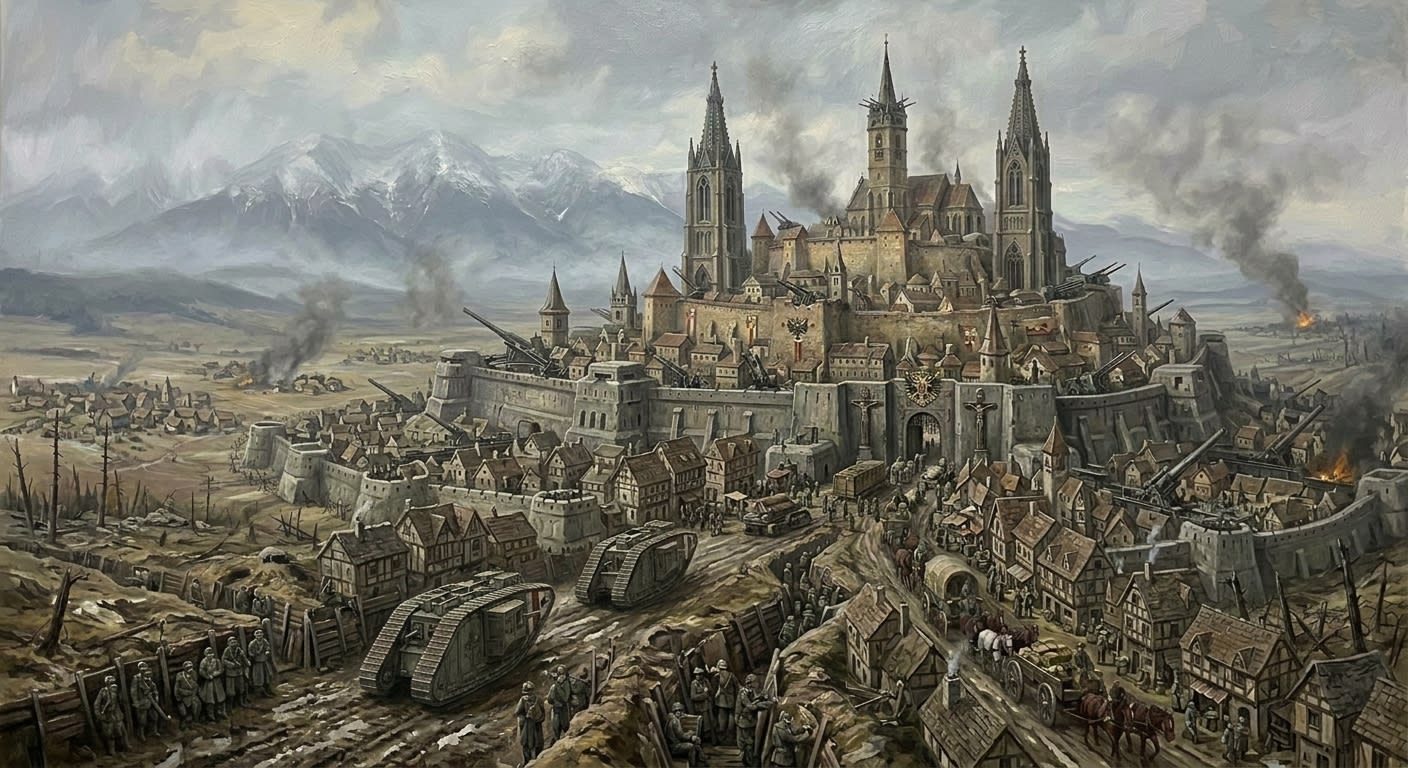
Bastion-Sibiu rises from the bones of a Saxon citadel at Hermannstadt — a fortification that predates the Sundering by centuries and predates the Synod's interest in Transylvania by the precise duration of time it took Velmora to begin extracting gold from the Southern Carpathians. The Saxons had built their churches with walls three metres thick, their granaries with firing slits, their bell-towers with murder-holes. They had done this because they lived in Transylvania and Transylvania has always required its inhabitants to treat architecture as a form of prayer conducted under siege conditions. The Synod arrived in A.S. 66 and found a population that already understood the relationship between fortification and salvation. All that remained was to expand the vocabulary.
The citadel was rebuilt on a scale its founders would have recognised in principle if not in proportion. The Saxon fortified-church template — thick walls, central granary, bell-tower command — was replicated outward in concentric rings until Sibiu ceased to be a town with fortifications and became a fortification with a town trapped inside it. By A.S. 92, the inner rings were complete. By A.S. 110, the outer bastions had reached the treeline. By A.S. 140, the garrison population exceeded thirty thousand and the original Saxon community had been compressed into three streets near the old Rathaus, still speaking their own dialect, still maintaining their own parish rolls, and still — with a stubbornness the Bureau of Records finds simultaneously admirable and administratively inconvenient — refusing to file their baptisms in Synodal Latin.
#On the Geography of the Wall
"The mountain does not care who holds it. The mountain is the hold." — Bureau of Engineering Field Manual, Section 14
The Transylvanian Alps form the outer rampart. The range runs roughly east-to-west across the belly of the Carpathian arc, its peaks cresting between two and two-and-a-half thousand metres, its passes few and its valleys narrow. This is the barrier. Every demonic advance toward Sibiu must first cross this wall of granite and pine, ascending through passes that a competent artillery battery can seal with three salvos and a prayer.
The bastion itself occupies a plateau behind this wall — elevated, defensible, and positioned to control the three primary passes through which any eastern force must advance: the Turnu Roșu pass to the south, the Bran corridor to the northeast, and the Predeal gap to the east. Each pass is fortified with gun-redoubts, wire entanglements, and the usual catechism-towers from which the Bureau of Doctrine broadcasts hymnal suppression at volumes calibrated to discourage both demons and independent thought.
The terrain east of the Alps — Moldavia, Wallachia, the plains rolling toward the Black Sea — belongs to Velmora. Her domain begins where the treeline ends and the gold-veins begin. The Gilded Chasm, her fortress-treasury, opens somewhere in the limestone karst south of the range, though its exact coordinates shift between surveys in a manner the Bureau of Engineering has classified as "geologically unprecedented" and the Bureau of Doctrine has classified as "expected."
That parenthetical — "poor (economic)" — is the reason this article exists. Sibiu's walls have never been breached. The passes have held since the first redoubts were raised. The mountain barrier has done precisely what mountain barriers do, which is to make frontal assault so expensive that only a fool or a god of Wrath would attempt it. Velmora is neither. She does not assault Bastion-Sibiu. She audits it.
#On the Garrison and Its Afflictions
"A fortress that cannot be bribed is merely a fortress that has not yet received a sufficient offer." — Attributed to Velmora. Denied by the Bureau of Doctrine. Believed by the Bureau of Tithes.
The garrison of Bastion-Sibiu numbers forty-two thousand at authorized strength, a figure that the Bureau of War achieves roughly eight months per year and the Bureau of Records achieves twelve months per year through the expedient of not updating the rolls when soldiers desert, die, or are reassigned to duties they did not request in locations they cannot identify. The actual effective strength fluctuates between thirty-five and thirty-nine thousand, a discrepancy the Bureau attributes to "seasonal variance" and the soldiers attribute to the fact that three supply corridors feed Sibiu and all three pass through territory where Velmora's agents operate with an efficiency the Synod's own logistics corps can only envy.
The garrison is organised into four commands: the Alpine Watch (mountain pass defense), the Plateau Guard (bastion perimeter and interior), the Convoy Escort Corps (supply route protection), and the Bureau Detachment (the usual collection of Doctrine enforcers, Records clerks, Purity inquisitors, and Tithes auditors whose combined headcount exceeds that of a frontline battalion and whose combat contribution is, per the Alpine Watch's unofficial assessment, "calligraphic").
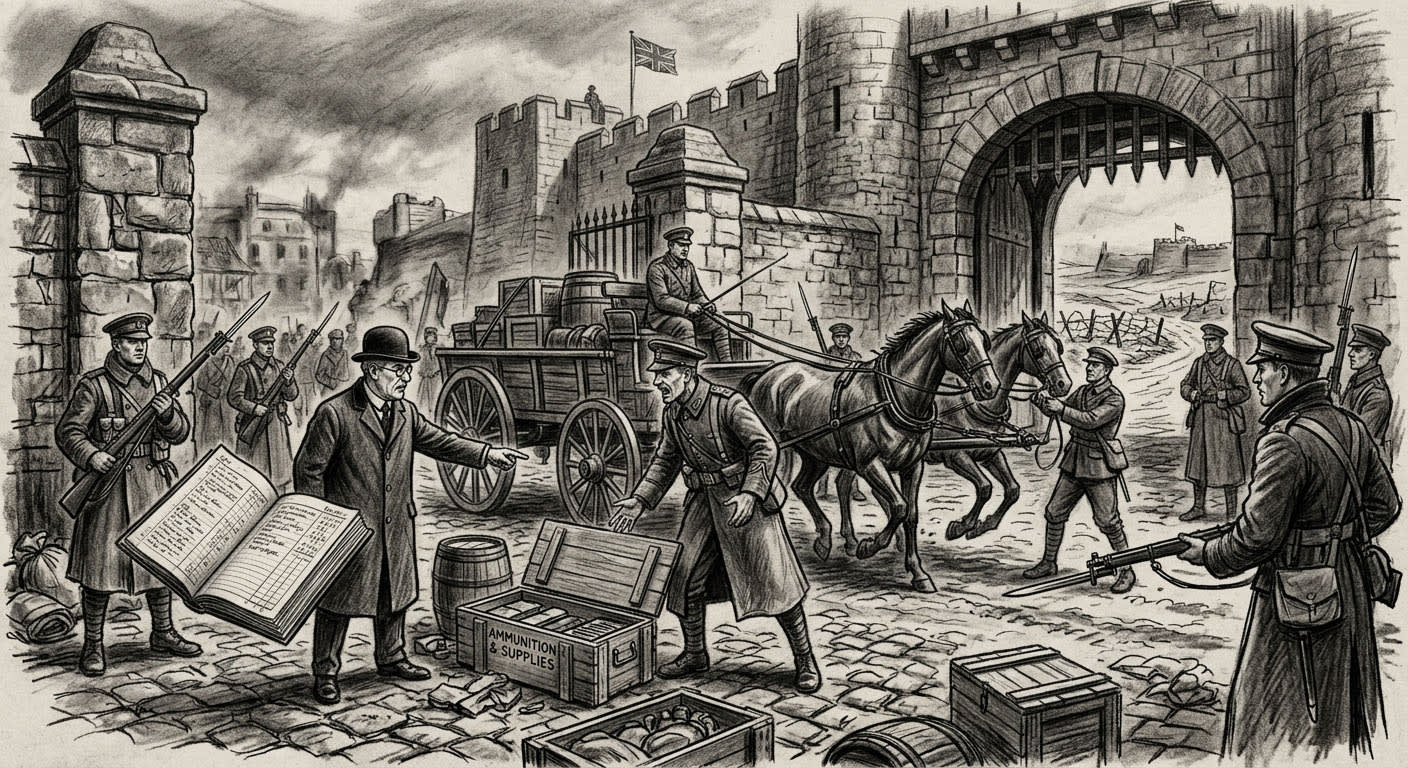
The garrison's primary occupation — and I use the word with full bureaucratic precision — is the interception of corrupted supply convoys. Velmora's agents infiltrate the three supply corridors that feed the bastion: the central route from Budapest through the Transylvanian plateau, the northern route descending from Przemyśl through the Carpathian passes, and the southern route climbing from the Danube crossings near Irongate. Each convoy that arrives at Sibiu's gates must be inspected, audited, and certified clean by a Tithes auditor, a Doctrine censor, and a Purity examiner before its cargo is admitted. The process takes between four and eleven hours, depending on the convoy's size, the auditor's temperament, and whether the cargo includes any item whose provenance cannot be documented in triplicate.
Prior editions of this Codex stated that Bastion-Sibiu intercepts "an average of three corrupted convoys per season."
This figure was drawn from A.S. 190 records and is obsolete. The current rate, per the Bureau of Tithes' quarterly assessment (A.S. 200), is eleven per season. The Bureau attributes the increase to "improved detection methods." The garrison attributes it to the fact that Velmora has tripled her investment in the supply corridors since A.S. 195 and the Synod has not tripled its countermeasures in any corresponding proportion.
What constitutes a "corrupted" convoy requires specification. The obvious cases — cursed coinage mixed with Crown wages, enchanted grain that produces hunger rather than satiation, contract-scrolls bearing Velmora's seal folded into the pages of requisition forms — account for perhaps a third of interceptions. The remainder involve corruption of a more mundane and therefore more dangerous variety: bribes. Simple, human, effective bribes paid to teamsters, quartermasters, checkpoint guards, and the occasional Bureau official whose salary has not kept pace with the cost of maintaining a family in a war zone. Velmora does not need sorcery to hollow a supply line. She needs only the observation, ancient and irrefutable, that a hungry man's loyalty extends precisely as far as his last meal.
#On the Economy of Siege
"Gold is the only siege engine that does not require assembly." — Bureau of Tithes, Internal Memorandum (Leaked, A.S. 197)
The economy of Bastion-Sibiu operates on a paradox that the Bureau of Tithes has spent forty years attempting to resolve and that Velmora exploits with a precision that suggests she wrote the paradox herself. The bastion sits behind the richest gold-bearing mountain range on the continent. The veins run through the Southern Carpathians in seams so dense that Saxon miners were extracting ore from these hills three centuries before the Sundering. The gold is still there. The gold will always be there. And the gold belongs to Velmora.
Her extraction operations in the Moldavian highlands and along the eastern face of the Alps produce, by the Bureau of Tithes' most conservative estimate, enough gold to finance the annual operating budget of three Synod provinces. This gold flows west through channels the Bureau of Shadows has spent decades attempting to trace: counterfeit Crowns indistinguishable from mint-issued currency, bullion stamped with forged Tithes seals, and — most insidiously — legitimate commercial transactions conducted by merchants who do not know they are handling Velmora's capital because the capital has passed through seventeen intermediaries and arrived scrubbed of every demonic trace except the faint, irreducible fact that it generates profit for its holder at a rate the Bureau of Alchemical Standards has classified as "theologically anomalous."
The garrison's ration economy runs on Crown scrip — paper vouchers issued by the Bureau of Tithes and backed by the Synod's central reserves. The scrip system was introduced in A.S. 130 specifically to combat Velmora's currency infiltration. For fifty years it functioned adequately. Then, in A.S. 181, a Tithes auditor named Goss — first name redacted, career subsequently brief — discovered that fourteen per cent of the Crown scrip circulating within Bastion-Sibiu bore serial numbers that did not correspond to any issuance in the Bureau's master ledger. The scrip was perfect. The paper was genuine. The ink was correct. The serial numbers simply did not exist. They had been invented, printed, and introduced into circulation with a craftsmanship that the Bureau of Records privately described as "superior to our own."
The compliance rate tells the story. Forty-three per cent of transactions within Bastion-Sibiu involve scrip verification. The remaining fifty-seven per cent occur in markets, canteens, quartermaster depots, and the warren of unlicensed trading stalls that occupies the bastion's lower districts — places where a soldier buying bread does not inspect the serial number on his voucher because he is hungry and the bread is warm and the alternative is a four-hour queue at the Bureau verification window. Velmora's economy does not defeat the Synod's. It simply moves faster.
#On the Districts of Sibiu
"A city designed by soldiers is a barracks. A city designed by clerks is a filing cabinet. A city designed by both is Sibiu." — Overheard in the Rathaus Quarter, attributed to everyone and no one
The bastion is organised in concentric rings, following the Saxon original's logic of defence-in-depth — though the Saxons built three rings and the Synod has added four more.
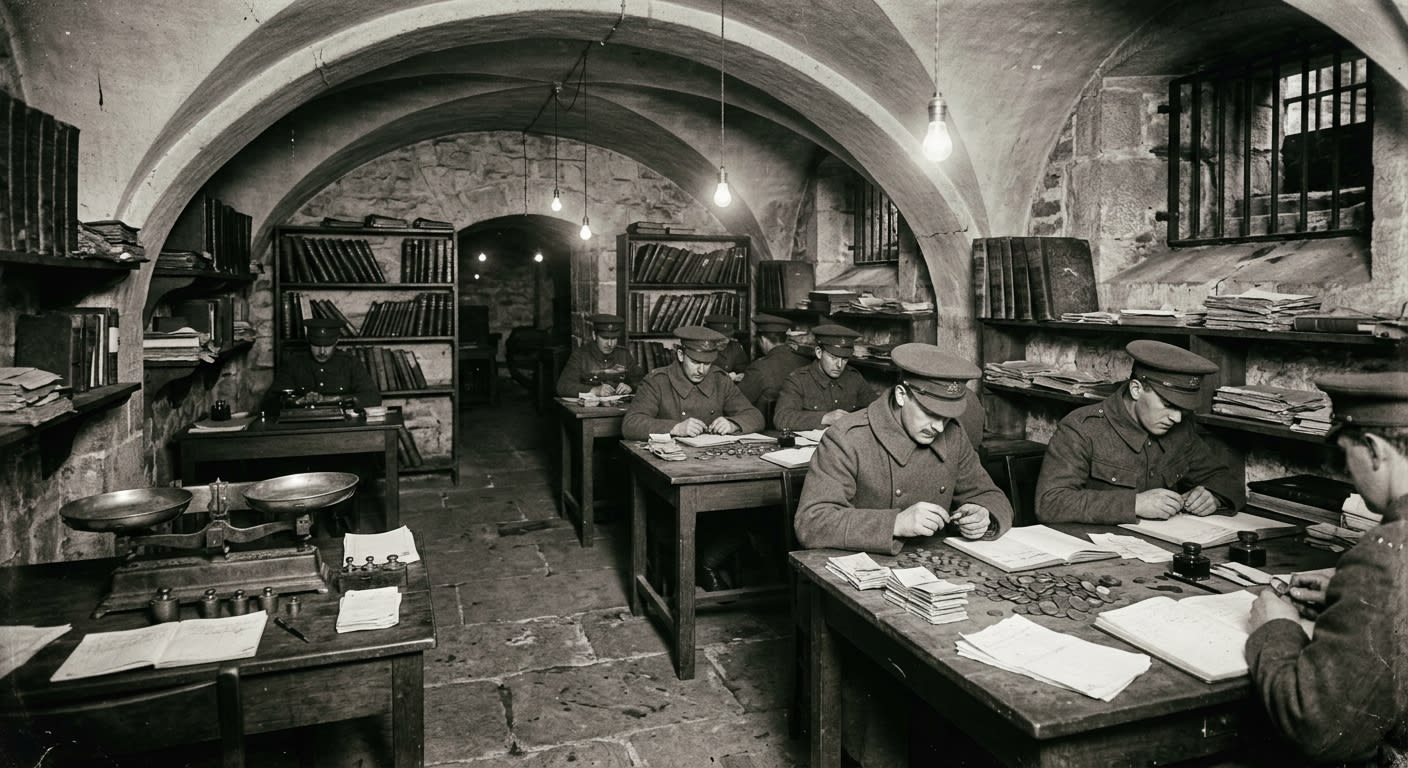
The Citadel Ring occupies the hilltop centre: the old Saxon Rathaus, now the garrison command post; the Cathedral of the Fortified the Creator, built atop the original Saxon parish church; and the vaults of the Bureau of Tithes, which are the most heavily guarded structures in the bastion and are located, with a symbolism the Bureau insists is coincidental, directly beneath the cathedral's altar. The Citadel Ring houses the senior command, the Bureau offices, and the single most contested resource in Sibiu: the Assay Chamber, where every Crown, every scrip note, and every piece of metal entering the bastion is tested for Velmora's taint. The Assay Chamber operates around the clock. Its examiners sleep in four-hour shifts and age at a rate that the Bureau of Mercy has deemed "accelerated but not yet miraculous."
The Church Ring surrounds the Citadel — the Saxon fortified churches, seven of them, each converted into a combination of barracks, armoury, and chapel. The walls are the original three-metre stone, their firing slits widened for modern rifles, their granaries now ammunition stores. The Church Ring garrisons eight thousand soldiers and maintains the inner perimeter. Its churches still hold services. The congregations are armed. The sermons are brief.
The Market Ring is the commercial district, such as it is. The legitimate economy — ration distribution, equipment repair, the canteens and sutler-stalls that serve the garrison — operates here under Bureau supervision. The Crown scrip circulates, is sometimes verified, and is always suspect. The Market Ring is also where the Convoy Escort Corps maintains its headquarters, a long stone building called the Weighhouse, from which every incoming shipment is tracked, catalogued, and argued over.
The Barracks Ring houses the bulk of the garrison: the Alpine Watch quarters along the northern arc, the Plateau Guard billets along the east and west, and the Escort Corps dormitories along the south. Conditions are adequate by Sagittal Line standards, which is to say they would constitute a violation of several humanitarian principles in any jurisdiction that recognised such principles.
The Wire Ring is the first line of outer defence — electrified barbed wire, catechism-towers, and gun-emplacements arranged in a pattern the Bureau of Engineering describes as "the Thorned Crown" and the soldiers describe with words the Bureau of Doctrine does not permit in print.
The Pass-Forts are not properly part of Sibiu but answer to its command: the three fortified redoubts at Turnu Roșu, Bran, and Predeal, each garrisoned by a battalion of the Alpine Watch and each representing the actual point of contact between Velmora's domain and the Synod's. The Pass-Forts conduct daily patrols into the high country and weekly reconnaissance sweeps down the eastern slopes. They report to the Alpine Watch commander, who reports to the garrison commander, who reports — in theory — to the Bureau of War's Transylvanian Desk in Budapest and — in practice — to the Bureau of Tithes' Sibiu Comptroller, because at Bastion-Sibiu the man who controls the money controls the war.
#On the Nature of Velmora's Campaigns
"She has never fired a shot at us. She has never needed to." — Alpine Watch Commander's Annual Assessment, A.S. 199
Velmora wages war on Bastion-Sibiu the way a creditor wages war on a debtor: patiently, incrementally, and with the serene confidence that time is an asset she holds and her opponent does not. She does not storm the passes. She does not hurl legions against the Wire Ring. The Avarice Engine — her monstrous war-golem of fused precious metals — has been sighted three times on the Sibiu approaches, each time at dusk, each time withdrawing before the gun-batteries could range it. The Bureau of War filed these sightings as "reconnaissance in force." The Bureau of Tithes filed them as "asset valuation."
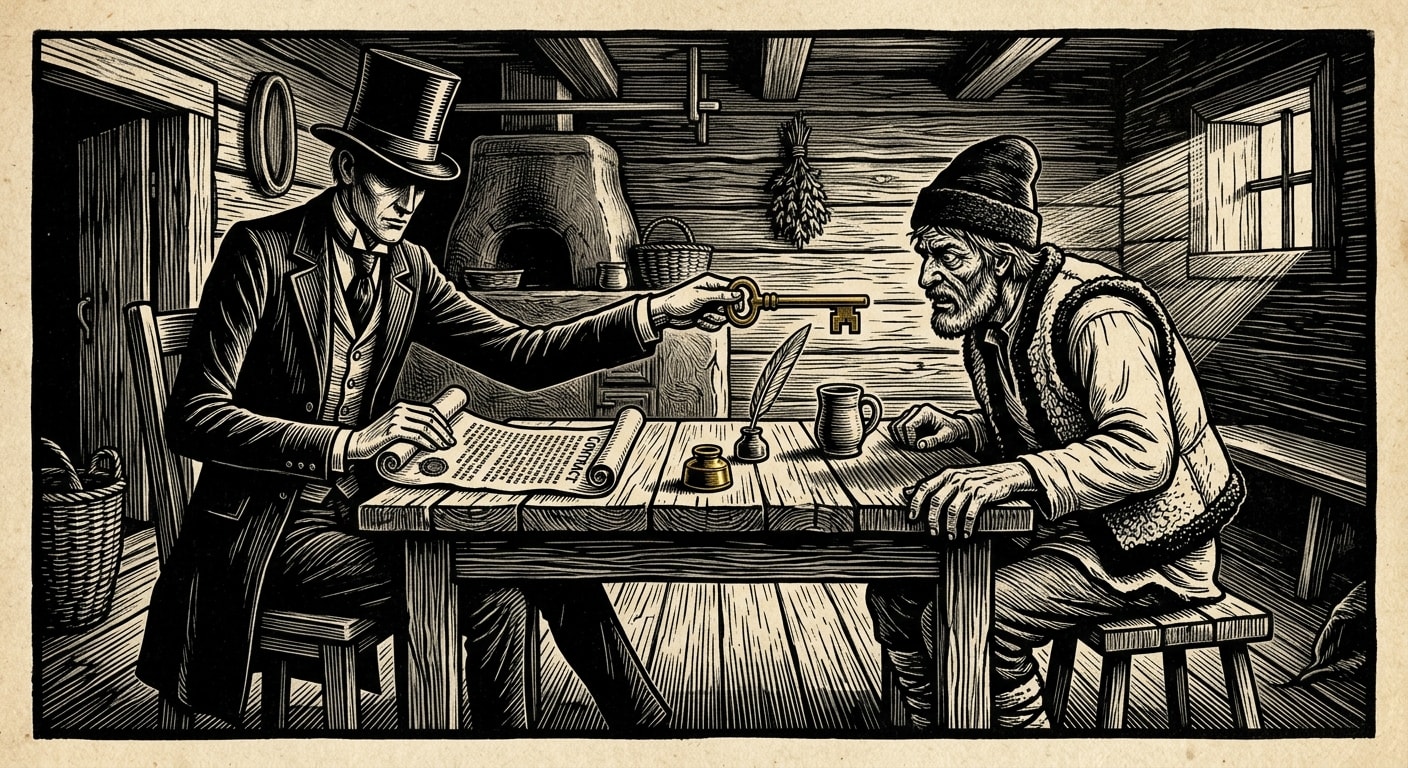
Her true campaigns are conducted in ledger-ink. The Ten Thousand Keys cult operates in the highland villages between the passes and the bastion, offering loans to farmers whose harvests have failed — and harvests fail often in the Transylvanian highlands, where Velmora's Blightbearers can wither a crop by walking through the adjacent valley. The loans are generous. The terms are clear. The repayment schedule is manageable. And the collateral is always the same: a key. A physical brass key, cut to no lock the borrower possesses, handed over with a signature on a contract written in ink that dries the colour of old blood. The Bureau of Purity has burned six hundred of these contracts. The Bureau of Tithes has confiscated fourteen hundred keys. The cult continues to grow because the loans continue to be repaid on time and the alternative — Synod charity — involves a six-week application processed through three Bureaus and a theological examination.
The corrupted convoys are her artillery. The bribed quartermasters are her infantry. The counterfeit scrip is her sappers, undermining the garrison's economy from beneath with a patience that no human siege engineer could sustain. And behind it all — behind the gold, the contracts, the cult, the infiltration — stands the simple, devastating logic of Greed itself: that a man who has been offered everything he wants will eventually accept, because refusal requires a strength that hunger erodes and poverty corrodes and Velmora has all the time in the world to wait for the erosion to complete its work.
The garrison knows this. The garrison's countermeasures reflect this knowledge with a grim thoroughness that the other bastions — those fortunate enough to face enemies who can be killed with artillery — regard with a mixture of pity and incomprehension. At Sibiu, the Doctrine of Sufficiency is posted in every barracks, every canteen, every chapel: Desire nothing beyond thy ration. The Crown provides. The Crown suffices. The soldiers recite it. Whether they believe it is a question the Bureau of Purity examines quarterly and the Bureau of Tithes examines daily, because at Sibiu the line between faith and solvency has been erased so thoroughly that the Bureau of Doctrine cannot determine where one ends and the other begins.
#On the Anomaly
"The walls sing when the gold moves." — Alpine Watch sentry report, classified A.S. 199
Every bastion on the Sagittal Line has its anomaly — the local phenomenon that the Bureau of Doctrine cannot explain, the Bureau of Records cannot classify, and the Bureau of Purity cannot determine whether to venerate or to burn. At Königsberg, the Grey wears faces. At Brest, confessions echo back from empty booths. At Przemyśl, the wire sings names.
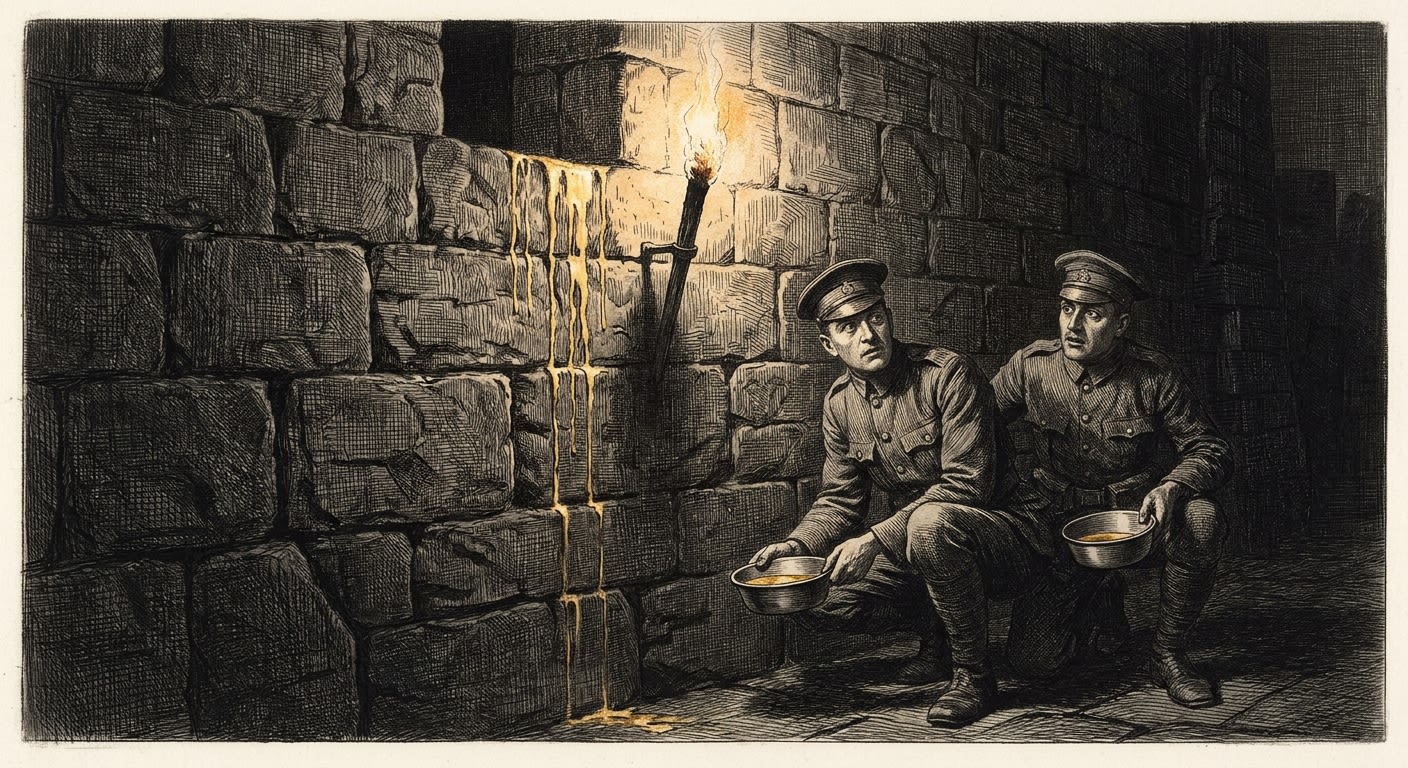
At Sibiu, the walls weep gold.
████████████████████████████████████████████████████████████████████████████████████████████████████████████████████████████████████████████████
The phenomenon was first documented in A.S. 178, the same year the Bureau of Engineering confirmed that gold-veins run beneath the bastion's foundations. At irregular intervals — sometimes weekly, sometimes with gaps of months — a thin film of liquid gold appears on the inner surfaces of the Citadel Ring's walls. The gold is warm. The gold is pure. And the gold, when tested by the Assay Chamber examiners, bears no trace of Velmora's corruption. It is, by every metric the Bureau possesses, genuine, clean, holy gold — sweating through consecrated stone in a bastion built to resist the Sin-General of Greed.
The Bureau of Doctrine has issued three explanations. The first (A.S. 179) attributed the phenomenon to "the mountain's gratitude for the faithful stewardship of the Synod." The second (A.S. 188) attributed it to "residual geological pressure expressing itself through sanctified mineral channels." The third (A.S. 199) attributed it to nothing at all and instructed all personnel to cease discussing the matter. The third explanation is the one currently in force.
The soldiers have their own theory, which the Bureau has not solicited and which I record here because the Bureau's silence on the matter is itself a form of testimony. They believe the gold-veins beneath Sibiu are Velmora's veins — that her extraction operations on the eastern face of the Alps have extended beneath the range itself, beneath the Sagittal Line, beneath the bastion, and that the weeping gold is not a gift from the mountain but a symptom of an infection already in progress. They believe that Velmora is beneath them. That she has been beneath them for years. That the walls weep because the walls have already been purchased and are merely awaiting delivery.
The Bureau of Doctrine denies this. The Bureau of Engineering has not commented. The Bureau of Tithes continues to collect the gold.
#On the Present Condition
"We are solvent, Hieromnemon. The question is: in whose currency?" — Garrison Commander's dispatch, A.S. 201, addressed to the Bureau of War and copied, without authorisation, to the Bureau of Tithes
Bastion-Sibiu holds. Its walls have never been breached. Its passes have never fallen. Its garrison has never routed, never mutinied, never surrendered a metre of ground to Velmora's physical forces. By every military metric the Bureau of War employs, Sibiu is among the most successful positions on the Sagittal Line.
The Bureau of Tithes tells a different story. The counterfeit scrip rate has risen from fourteen per cent in A.S. 181 to an estimated twenty-two per cent in A.S. 201. The convoy corruption rate has tripled in six years. The Ten Thousand Keys cult has been "eradicated" in the highland villages eleven times since A.S. 170 and is currently operating at its largest recorded membership. Three supply corridors feed the bastion and Velmora's agents operate freely in all three. The Assay Chamber examines ten thousand items per week and clears ninety-six per cent — a figure that sounds reassuring until one calculates that four per cent of ten thousand is four hundred corrupted items entering Sibiu's economy every seven days.
Prior editions stated that the Sibiu garrison "has contained Velmora's economic warfare to manageable levels."
The Bureau of Tithes' A.S. 200 assessment reclassified Sibiu's economic situation from "contained" to "chronic." The distinction is not semantic. "Contained" implies a boundary. "Chronic" implies that the boundary has been internalised — that the corruption is no longer outside the walls pressing in but inside the walls and circulating. The reclassification was approved by the Bureau of Tithes, contested by the Bureau of War, and sealed by the Bureau of Doctrine before either could appeal.
The garrison commander — whose name I am authorised to record and whose career I am therefore authorised to damage — has requested a doubling of the Convoy Escort Corps for three consecutive years. The Bureau of War has denied the request each time on grounds that the troops are needed elsewhere, that Sibiu's geographic defences are sufficient, and that economic warfare is a matter for the Bureau of Tithes. The Bureau of Tithes has requested a tripling of the Assay Chamber staff. The Bureau of Records has denied that request on grounds that the clerks are needed elsewhere and that assay work is a matter for the Bureau of War. Between these two denials, Velmora's agents operate in the space where institutional jurisdiction ends and institutional blame begins.
The Saxons of the Citadel Ring maintain their fortified churches. The Alpine Watch patrols the passes. The Escort Corps walks the supply roads. The Assay Chamber tests and tests and tests. The walls weep gold that the Bureau collects and the soldiers distrust. And somewhere beneath the Transylvanian Alps, in seams of ore that run deeper than the Bureau's surveys have mapped, something that is either the mountain's gratitude or the Serpent's patience continues to accumulate.
Bastion-Sibiu has never fallen. The question — unasked by the Bureau and therefore unrecorded in the Ledger and therefore, by the Bureau's own logic, nonexistent — is whether a fortress can be purchased from the inside without its garrison ever knowing the transaction has occurred.